B. Life Systems · BiodiversityStrong Communities: Biodiversity and Resilience
B2.4 A1.5 A3.1About 45 minutes
Learning goals- I can explain what resilience means for a community of living things.
- I can describe how many species and many connections help a community recover from a disturbance.
- I can explain how a variety of communities in a region helps each one recover.
Words to know
resilience
The ability of a community or ecosystem to resist harm and recover after a disturbance.
disturbance
An event that harms or changes a community, such as a fire, flood, drought, storm or disease.
food web
All the connected food chains in a community.
monoculture
A large area planted with just one species, like a field of only one crop.
recolonize
To move back into an area and live there again after a disturbance.
Bend, don't break
A spider web with many strands can lose one strand and still hold. A web with only three strands falls apart if one snaps.
Communities of living things are similar. Ice storms, droughts, fires, floods and diseases happen. Some communities bounce back quickly. Others fall apart. Scientists call the ability to bounce back resilience, and biodiversity is one of the biggest reasons a community is resilient.
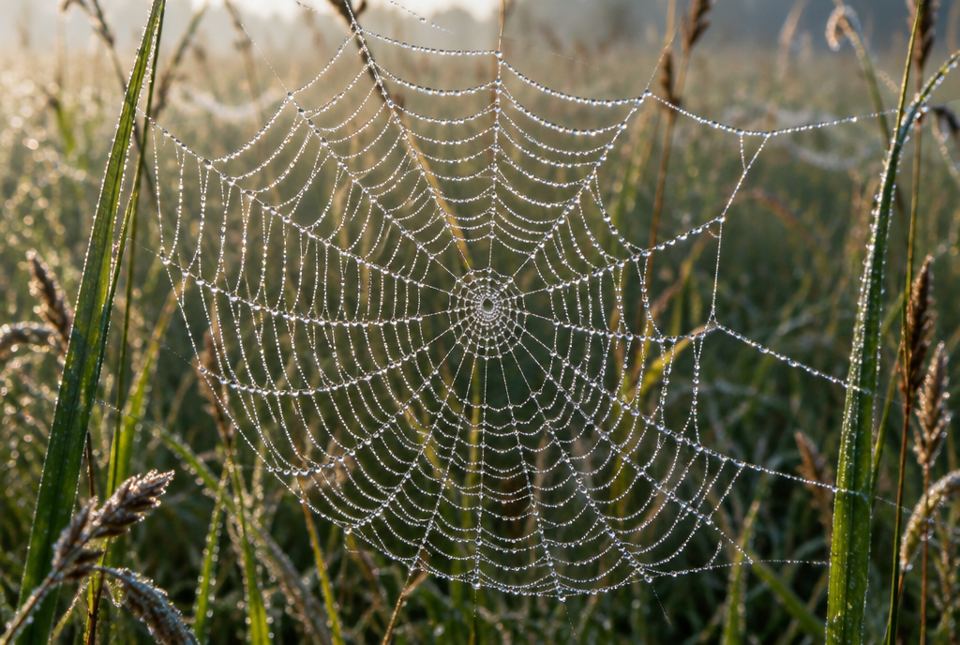 A web with many strands can lose one and still hold. A community with many species can bounce back in the same way. AI-generated image
Remember from Grade 4
In Grade 4 you built food chains and food webs, and you learned that removing one species can affect many others in a community. Now you will see why more variety makes a community stronger.
Diversity within a community
A community with many species usually has many connections: many things to eat, many ways to get jobs done.
- Back-up foods: if a predator eats several kinds of prey, losing one prey species does not starve it. It switches to another.
- Back-up workers: if bees, flies, moths and beetles all pollinate flowers, losing one pollinator still leaves others to do the job.
- Different strengths: in a mixed forest, some tree species may die from a disease, but others are not affected. The forest stays a forest.
- Different timing: some plants grow well in wet years, others in dry years, so the community always has some plants doing well.
Worked exampleLet's test which forest is more resilient
The emerald ash borer is a beetle that kills ash trees. Forest A is a planted stand of only ash trees. Forest B is a mixed forest of sugar maple, red oak, basswood, white pine and some ash. The beetle reaches both forests. Predict what happens to each.
- Forest A: every tree is an ash, so the beetle can kill nearly every tree. The shade disappears, the forest floor dries out, and animals that needed the trees must leave. The community collapses.
- Forest B: only the ash trees are harmed. Maples, oaks, basswood and pines are not affected by this beetle.
- In Forest B, gaps where ash trees die let sunlight in. Young trees of other species grow up to fill them.
- Animals in Forest B still have shade, nuts, seeds and nesting spots from the other trees.
Forest B is more resilient. Its variety of species means one disease can't destroy the whole community.
The emerald ash borer only attacks ash trees. In Forest A every tree is an ash, so the forest is lost. In mixed Forest B the other trees survive and fill the gaps.Just for funWhy did the mixed forest stay calm when the ash borer showed up?
It never puts all its acorns in one basket!
What scientists found in grasslands
In a long study in Minnesota, scientists compared grassland plots with different numbers of plant species. During a severe drought, plots with more species generally held up better and recovered faster than plots with only a few species. Different species handled the drought in different ways, so some always survived.
Diversity among communities
Resilience also depends on having many different communities in a region, linked together.
- After a forest fire, seeds blow in and animals move back from nearby unburned forests, meadows and wetlands. This is called recolonizing. Some trees even depend on fire: the jack pine has cones that often open to release their seeds after the heat of a fire.
- Wetlands next to forests and farms soak up water during floods and release it slowly in dry times, which helps the communities around them.
- Many animals use more than one community. A moose may feed on water plants in a wetland in summer and shelter in a conifer forest in winter.
When communities are cut off from each other (by roads, cities or large fields), plants and animals have a harder time moving back after a disturbance.
Careers connection
Foresters plan which trees to plant after harvesting or after a pest outbreak. Planting a mix of species, instead of just one, is one way they help forests stay resilient. Ecologists study how communities recover after fires and floods.
Hands-on activityFood web resilience model
You need: 10 sticky notes or paper squares, a ball of string or yarn, scissors (with a grown-up), tape, a large table or floor space.
- Simple web: write Sun, grass, rabbit, fox on four notes. Tape them in a column and connect who-eats-what with string (grass to rabbit, rabbit to fox). Tape the Sun to the grass.
- Disturbance: a disease wipes out the rabbits. Remove the rabbit note and its strings. Does the fox still have a food source? Record your answer.
- Connected web: now use 10 notes: Sun, grass, clover, berry bush, rabbit, mouse, grasshopper, robin, garter snake, fox. Connect each eater to everything it eats (for example: fox eats rabbit, mouse, robin and berries; snake eats mouse and grasshopper; robin eats grasshopper and berries).
- Remove the rabbit again. Count how many animals still have at least one food source.
- Try removing other species. Which removal causes the most damage? Why?
- Write two sentences explaining how the connected web shows resilience.
Safety: a grown-up should help with scissors.
What to look for: the child notices that in the connected web almost every animal still has food after one species is removed, and connects this to the word resilience.
Your turn
1What does resilience mean for a community?
Its ability to resist harm and recover after a disturbance.
2Name three kinds of disturbance.
For example: fire, flood, drought, ice storm, disease, an invasive species.
3Why does a predator that eats many kinds of prey survive the loss of one prey species better?
It can switch to its other foods.
4In the forest example, why did the mixed forest survive the emerald ash borer?
The beetle only kills ash trees. The other species (maple, oak, basswood, pine) survived and kept the forest going.
5What did scientists find about grassland plots during a drought?
Plots with more plant species generally held up better and recovered faster.
6How do nearby communities help a burned forest recover?
Seeds and animals move back in (recolonize) from the unburned communities around it.
A large area planted with just one species.
More practice: warm-up
1Is a lawn of one grass species high or low in diversity?
2Which is more resilient, a simple food web or a connected one?
3Name a tree whose cones often open after a fire.
4What do wetlands do during floods?
They soak up extra water.
5Give one job that many different species can share in a community.
For example pollinating flowers or decomposing dead things.
More practice: on your own
1Explain how having bees, flies, moths and beetles as pollinators makes a meadow more resilient.
If one pollinator group declines, the others still pollinate the flowers, so plants can still make seeds and fruit.
2A highway is built between a forest and a wetland. How might this affect resilience?
Animals and seeds have a harder time moving between the communities. After a disturbance, fewer can move back in, so recovery is slower. Some animals also need both places.
3Why might a mixed forest stay healthier through both wet and dry years?
Different species do well in different conditions. In wet years some grow well, in dry years others do, so the forest always has healthy plants.
4Use the diagram: in the connected web, which of the two plants at the bottom (grass or clover) could disappear with less effect on the animals? Explain.
Clover. Only the mouse and the insect eat clover, and both of them also eat grass, so every animal still has food. (Losing grass would be worse: the rabbit eats only grass in this diagram. Losing the berry would also have little effect, because the fox has other foods.)
5A forester must replant an area after logging. Give one advantage of planting several species instead of one.
If a pest or disease attacks one species, the others survive, so the new forest is more resilient. Several species also give more food and shelter for wildlife.
Challenge
1A farm grows only one crop over a huge area. Use the idea of resilience to explain one risk, and suggest one way farmers can increase diversity.
Risk: a pest, disease or drought that harms that one crop can damage the whole farm at once. Ways to add diversity: grow several crops or rotate crops, plant hedgerows or strips of wildflowers for pollinators and insects that eat pests, keep wetlands or woodlots on the farm.
2A student says, "A community with more species will never be harmed by a disturbance." Is this correct? Explain.
No. A diverse community can still be harmed (for example, by a huge fire). Diversity makes it more likely to resist and recover, but it is not a guarantee.
3Explain how biodiversity among communities (different communities in a region) adds resilience that a single diverse community can't give on its own.
If a disturbance hits one whole community (like a fire burning a forest), even its diversity may be lost. Nearby different communities that were not affected act as a source of seeds and animals to recolonize. Animals that use several habitats also have somewhere else to go.
Quiz
1. A resilient community is one that...
2. Which forest is most likely to survive a disease that kills only one tree species?
3. A fox eats mice, rabbits, birds and berries. If the rabbits disappear, the fox will most likely...
4. How do nearby communities help a burned area recover?
5. Which is an example of a monoculture?
6. Grassland plots with more plant species during a drought generally...
Big idea: biodiversity within a community (many species and connections) and among communities (many different, linked communities) makes living systems more resilient: better able to resist and recover from disturbances.
How to help at home:
- Build the food web model together. Remove different species and talk about what happens.
- On a walk, compare a mowed lawn or a one-crop field with a hedgerow, ravine or woodlot. Which would bounce back faster from a disease or drought?
- Talk about "not putting all your eggs in one basket". It is the same idea.
Safety: help with scissors.
Common difficulties:
- Thinking diversity means a community can never be harmed. Diversity improves the odds; it is not a guarantee.
- Forgetting the role of different communities nearby in helping an area recover.