B. Life Systems · BiodiversitySorting Life: Kingdoms and the Classification System
B2.1 A1.5 A3.3About 50 minutes
Learning goals- I can explain why scientists classify living things.
- I can name the levels of the classification system from kingdom to species.
- I can describe the main characteristics of the kingdoms of living things.
- I can read and write a scientific name correctly.
Words to know
classify
To sort things into groups based on shared characteristics.
characteristic
A feature or trait that helps describe or identify something.
taxonomy
The science of naming and classifying living things.
kingdom
A large group of living things in the classification system, such as animals or plants.
genus
A small group of closely related species. The first word of a scientific name. Plural: genera.
scientific name
A two-part name for a species, made of its genus and species words, such as Acer saccharum (sugar maple).
nucleus
The control centre inside many kinds of cells. Bacteria and archaea do not have one.
Imagine a library with no order
Picture a library where the books are piled in random heaps. Finding a book about turtles would take days! Libraries sort books into sections, then shelves, then by author.
Living things are even harder to keep track of. Scientists have named a huge number of species, and they keep finding more. To make sense of them, scientists classify them: they sort organisms into groups using their characteristics.
Remember from earlier grades
In Grade 2 you compared animals by body coverings and body parts. In Grade 4 you sorted animals as herbivores, carnivores and omnivores. Those are useful ways to sort. In Grade 6 you learn the system scientists use around the world.
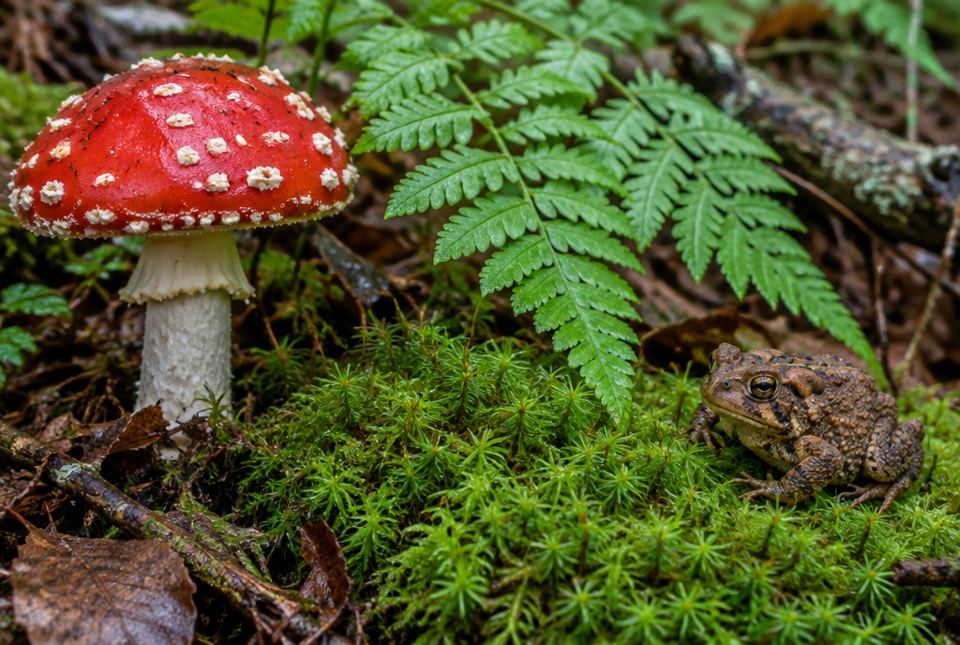 Four living things from three kingdoms: the mushroom is a fungus, the fern and moss are plants, and the toad is an animal. (Never touch or eat wild mushrooms.) AI-generated image
The levels of classification
Scientists sort living things into levels. Each level is a group inside a bigger group, like boxes inside boxes:
kingdom → phylum → class → order → family → genus → species
- The kingdom is the biggest, broadest group. Its members share only a few characteristics.
- As you go down, each group is smaller and its members are more alike.
- A species is the smallest group: one kind of organism.
A silly sentence can help you remember the order: King Philip Came Over For Good Spaghetti.
Many scientists today also use an even bigger level above kingdom, called a domain.
Scientific names
A species can have many common names. The bird called a loon in English is called huard in French, and other languages have their own names. To avoid confusion, every species also has one scientific name that scientists everywhere use.
In the 1700s, the Swedish scientist Carl Linnaeus made popular the system of giving each species a two-part name:
- The first word is the genus. It starts with a capital letter.
- The second word is the species word. It is all lowercase.
- The whole name is written in italics (or underlined when you write by hand).
Examples: Acer saccharum (sugar maple), Acer rubrum (red maple), Canis lupus (grey wolf), Canis latrans (coyote), Homo sapiens (humans).
Notice that the sugar maple and red maple share the genus Acer. Species in the same genus are close relatives.
People had knowledge systems for naming and grouping living things long before Linnaeus. Indigenous languages in Canada, such as Anishinaabemowin and Inuktitut, have their own names for plants and animals, often connected to how each one lives, what it is used for and how it relates to other beings.
The kingdoms of life
Scientists have changed the classification system many times as they learned more, and they still debate it. A system often used in schools has six kingdoms. The table shows their main characteristics.
| Kingdom | Cells | How it gets food | Examples |
|---|
| Animals | many cells; no cell walls | eats other organisms; most can move around | wolf, robin, frog, earthworm, ant |
| Plants | many cells; cell walls | makes its own food by photosynthesis | sugar maple, moss, fern, white pine, corn |
| Fungi | most have many cells (yeast has one); cell walls | absorbs food from living or dead things | mushrooms, moulds, yeast |
| Protists | most have one cell; cells have a nucleus | some make food (algae), some eat other organisms | amoeba, paramecium, many algae |
| Bacteria | one cell; no nucleus | many ways | bacteria in soil, yogurt and your gut |
| Archaea | one cell; no nucleus | many ways | some live in hot springs and very salty water |
Is a virus alive?
Viruses are not placed in any kingdom. They are not made of cells, and they can only make copies of themselves inside the cells of a living thing. Scientists still discuss whether to call them living.
Worked exampleLet's find the closest relatives
Use the classification of four Ontario mammals to decide which two are most closely related.
- Grey wolf: Carnivora (order), Canidae (family), Canis lupus
- Coyote: Carnivora, Canidae, Canis latrans
- Red fox: Carnivora, Canidae, Vulpes vulpes
- American black bear: Carnivora, Ursidae, Ursus americanus
- All four share the order Carnivora, so they are all related.
- Wolf, coyote and fox share the family Canidae (the dog family). The bear is in a different family, Ursidae (the bear family).
- Wolf and coyote also share the genus Canis. The fox is in a different genus, Vulpes.
- The lower the level two organisms share, the more closely related they are.
The grey wolf and the coyote are most closely related. They share every level down to genus (Canis).
The four mammals from the example. All share the order Carnivora, but only the grey wolf and the coyote share every level down to the genus Canis.Just for funFunny but true: the scientific name of the western lowland gorilla is Gorilla gorilla gorilla. Scientists don't always need to be creative!
Hands-on activityClassify a drawer
You need: 15 to 20 small household objects (for example: buttons, keys, pens, coins, spoons, hair clips, erasers, bottle caps), a large sheet of paper, sticky notes.
- Put all objects together. This is your "kingdom".
- Split them into two or three big groups using one characteristic (for example: metal or not metal).
- Split each group again using a new characteristic (for example: used for writing or not). Keep going until each object is alone.
- Draw your system as a branching chart on the paper with sticky-note labels.
- Give one object a two-part "scientific name" using your top group and its own name, written the right way, like Metallicus keyus.
- Ask someone else to use your chart to find where a new object belongs.
Safety: buttons, coins, bottle caps and other small objects are choking hazards for little brothers and sisters, so keep them out of reach.
What to look for: each split uses one clear, observable characteristic; every object ends up in exactly one place; the two-part name has a capital first word and a lowercase second word.
Your turn
1List the seven classification levels from kingdom to species.
kingdom, phylum, class, order, family, genus, species
2Which level contains the most different kinds of organisms: family or kingdom?
Kingdom. It is the biggest, broadest group.
3Write the scientific name for the sugar maple correctly.
Acer saccharum (genus capitalized, species lowercase, in italics or underlined).
4What does the first word of a scientific name tell you?
5Name the kingdom: a mushroom.
6Name the kingdom: a one-celled organism whose cell has a nucleus, which swims through pond water using tiny hairs.
Protists (this describes a paramecium).
7Why do scientists use scientific names instead of common names?
Common names change from language to language and place to place. A scientific name is the same everywhere, so scientists know exactly which species is meant.
More practice: warm-up
1Finish the memory sentence: King Philip Came Over For Good...
2Which kingdom makes its own food by photosynthesis?
Plants (some protists, such as algae, do too).
3Who made the two-part naming system popular in the 1700s?
4Is homo sapiens written correctly? Fix it.
No. It should be Homo sapiens (capital H).
5Name the kingdom: an earthworm.
More practice: on your own
1Acer rubrum and Acer saccharinum are both trees. What can you tell about them from their names alone?
They are in the **same genus (Acer), so they are close relatives** (both are maples: red maple and silver maple).
2How are fungi different from plants? Give two differences.
Fungi cannot make their own food; they absorb food from living or dead things. Plants make food by photosynthesis. (Also: fungi cell walls are made of a different material, and fungi have no leaves, stems or roots.)
3A lion is Panthera leo and a tiger is Panthera tigris. A house cat is Felis catus. Which two are most closely related? Why?
The lion and tiger. They share the genus Panthera. The house cat is in a different genus (all three are in the cat family, Felidae).
4What do bacteria and archaea have in common? How are they different from protists?
Bacteria and archaea are single cells with no nucleus. Protists are mostly single-celled too, but their cells have a nucleus.
5Why do the members of a kingdom share fewer characteristics than the members of a genus?
A kingdom is a huge group with many very different organisms, so only a few traits are shared. A genus is a small group of close relatives, so they share many traits.
Challenge
1A student says: "The bat flies like a bird, so it should be classified with birds." Explain why scientists classify bats as mammals instead.
Scientists classify using many characteristics, not one. Bats have hair, give birth to live young and feed their young milk, like other mammals. Birds have feathers and lay hard-shelled eggs. Flying is only one trait, and it evolved separately in bats and birds.
2Snowshoe hare: Lagomorpha (order), Leporidae (family), Lepus americanus. Eastern cottontail: Lagomorpha, Leporidae, Sylvilagus floridanus. Beaver: Rodentia (order), Castoridae (family), Castor canadensis. Which two are more closely related? Which level do they first differ at?
The snowshoe hare and eastern cottontail are more closely related. They share the order and family, and first differ at the genus level (Lepus vs Sylvilagus). The beaver is in a different order.
3Why might two textbooks show different numbers of kingdoms? Is one of them "wrong"?
Classification is a human-made system that scientists update as they learn more (for example from studying cells and DNA). Different books may use older or newer systems. Neither is simply wrong; each is a model. A good scientist checks which system a source uses and how up to date it is.
Quiz
1. Which list is in the correct order from biggest group to smallest?
2. Which scientific name is written correctly?
3. Organisms in the same genus are...
4. A mould growing on old bread belongs to which kingdom?
5. Which characteristic do bacteria have?
6. The grey wolf (Canis lupus) is most closely related to...
Big idea: scientists classify living things into levels (kingdom, phylum, class, order, family, genus, species) using shared characteristics, and give each species a two-part scientific name.
How to help at home:
- Do the "classify a drawer" activity. It shows that classification means choosing clear characteristics and splitting into smaller and smaller groups.
- Look for scientific names on plant tags at a garden centre. Point out the capital genus and lowercase species, and spot plants that share a genus.
- Practise the memory sentence (King Philip Came Over For Good Spaghetti) or make up your own.
Common difficulties:
- Thinking fungi are plants. Fungi cannot make their own food.
- Capitalizing both words of a scientific name. Only the genus is capitalized.
- Expecting one "correct" number of kingdoms. Books differ; the six-kingdom system is common in schools, and many scientists also group life into three domains.