Strand A: Foundations of Language and Mathematics · Numbers and CountingHow Many? The Last Number Tells Us
A6.8 A6.2 A5About 20 minutes
Learning goals- I know the last number I say tells how many there are.
- I can count things in any order and still get the same number.
- I know that moving things around does not change how many.
Words to know
how many
The number of things in a group. We find it by counting.
last number
The number you say when you touch the last thing. It tells how many.
same
Not changed. 5 is still 5.
Let's count toy cars
Grown-up: read aloud.
Let's count the cars. Touch each one and say a number.
🚗🚗🚗🚗🚗
1, 2, 3, 4, 5.Now, how many cars are there?
We don't need to count again! The last number we said was 5. So there are 5 cars.
The last number you say tells how many are in the whole group.
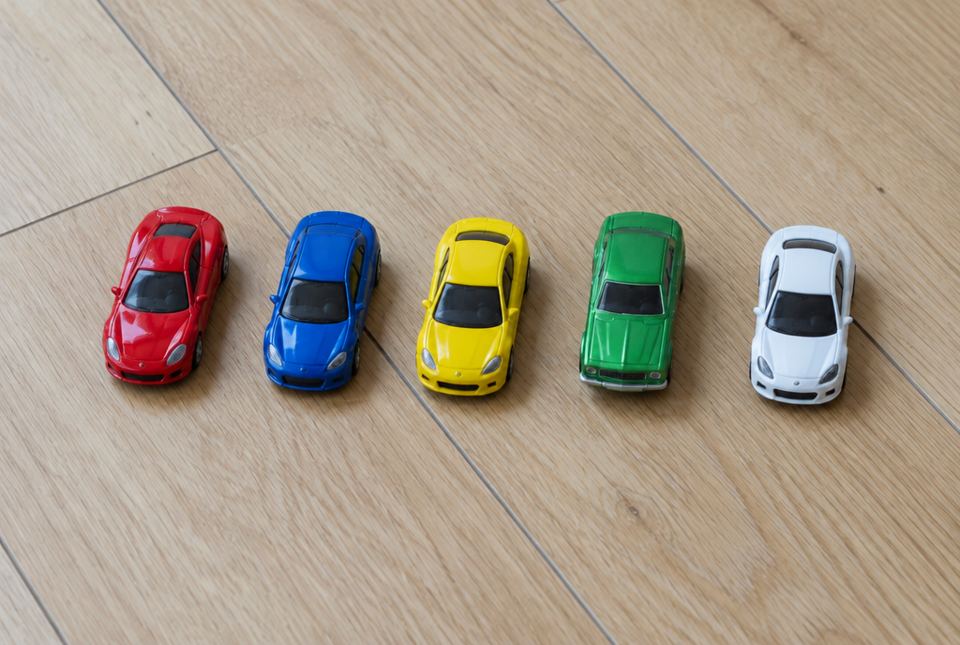 Count the cars: 1, 2, 3, 4, 5. The last number you say, 5, tells how many cars there are. AI-generated image
Worked exampleLet's count bears, then say how many
Count the bears. Then answer: How many bears?
- Touch and count: 1, 2, 3, 4.
- The last number we said was 4.
- So we say: "There are 4 bears."
4 bears. The last number tells how many.
🐻🐻🐻🐻
Start anywhere!
We can count a group from left to right, or from right to left, or start in the middle. As long as we touch each thing one time, we get the same number.
Worked exampleCount the frogs two ways
Count the frogs starting at the left. Then count them again starting at the right.
- Left to right: 1, 2, 3, 4, 5, 6.
- Now right to left: 1, 2, 3, 4, 5, 6.
- Both times the last number was 6.
6 frogs both ways. The order we count in does not change how many.
🐸🐸🐸🐸🐸🐸
Count from either end. You get 6 each time.Spread out or close together?
If we spread things out, or push them close, the number does not change. Nothing was added. Nothing was taken away.
Grown-up tip
After your child counts, ask "How many?" If they count again from 1, that's okay. Say: "Remember the last number you said? That's how many!"
Just for funHow do cows count their friends?
With a cow-culator! 🐄
Hands-on activityCount, shuffle, and guess
You need: 5 to 10 small toys or blocks, and a tea towel.
- Count the toys. Say "There are __."
- The grown-up spreads them out or moves them into a circle. Ask: "How many now?" Guess first, then check by counting.
- Count them again, but start at a different toy. Is it the same number?
- Hide-and-count: count the toys, then cover them with the towel. "How many are under the towel?" (You know without looking!)
Math talk: "Did the number change? Why not?"
Your turn
1Count the cars. How many?
🚗🚗🚗🚗🚗
5. The last number you say is 5, so there are 5 cars.
2Count the cookies starting at the right side. How many?
🍪🍪🍪🍪🍪🍪🍪
7. Starting on the other side still gives 7.
3Sam counted: "1, 2, 3, 4." How many things does Sam have?
4. The last number Sam said was 4.
4Grown-up: put 6 blocks in a line. Let your child count. Then spread them far apart. How many blocks now?
6. Spreading them out does not change how many. Look for your child saying 6 without recounting, or recounting and getting 6.
5Count the ducks. Then tell me: how many ducks?
🦆🦆🦆
Look for your child counting out 3 spoons and stopping at 3, not grabbing a handful.
More practice: warm-up
3Count the trees from the right. How many?
🌲🌲🌲
4Mia counted: "1, 2, 3, 4, 5." How many does Mia have?
5. The last number tells how many.
5Hold up 2 fingers. How many fingers?
More practice: on your own
8 tulips. The last number said is 8.
2Count the buses from the right. Then count from the left. Do you get the same number?
🚌🚌🚌🚌🚌🚌
Yes. 6 both ways. The order we count in doesn't change how many.
3Grown-up: put out 5 toys and let your child count them. Then move them into a circle. How many now?
5. Moving them into a circle doesn't add or take away any.
4Leo counted 9 crayons. Then he dropped them in the box. How many crayons are in the box?
9. Nothing was added or taken out, so it is still 9.
Look for counting out exactly 7 and stopping. Ask "How many did you bring?" They should say 7.
Challenge
1Ben counted 8 marbles in a line. Then he pushed them into a pile. Does he need to count again to know how many?
No. It is still 8. Pushing them into a pile doesn't change how many.
2Mia counted these bees from the left and got 9. Leo will count from the right. What number will Leo get?
🐝🐝🐝🐝🐝🐝🐝🐝🐝
9. Counting from the other side still gives 9.
3Grown-up: count out 10 blocks together. Then split them into two piles. How many blocks are there in all?
10. We didn't add or take away any blocks, so there are still 10 altogether.
Quiz
1. Ava counts: "1, 2, 3, 4, 5, 6." How many things does she have?
2. Count these from the left, then from the right.
🐸🐸🐸🐸
What happens?
3. There are 5 buttons close together. Now they are spread out. How many now?
Big idea: This lesson covers three counting ideas:
- Cardinality: the last number said tells how many.
- Order irrelevance: you can count objects in any order and get the same total.
- Conservation: moving or spreading objects doesn't change how many.
Common difficulties:
- Recounting when asked "How many?" This means the child doesn't yet see that the count gives the answer. Model it: "1, 2, 3, 4. Four! There are four."
- Thinking a spread-out row has more. Very common at 4 and 5. Don't just tell them. Let them count both ways and see that the number is the same.
- Grabbing a handful when asked for 5. Practise "Give me 4" type requests. They are harder than "How many?"
How to help: Ask "How many?" after every count, and "Give me __" during chores ("Bring 3 apples"). Play guess-then-check games with hidden or spread-out toys.