B. Life Systems · CellsFrom Cells to Organisms: Organs and Organ Systems
B2.6 A1.2 A1.5About 50 minutes
Learning goals- I can describe the levels of organization: cells, tissues, organs, organ systems and organisms.
- I can explain how different tissues work together in an organ.
- I can describe organs and systems in both animals and plants.
- I can explain how organ systems depend on each other to meet the needs of every cell.
Words to know
organ
A structure made of different tissues working together to do a job, such as the heart, stomach, skin or a leaf.
organ system
A group of organs that work together to carry out a major function, such as the digestive system.
levels of organization
The order from smallest to largest: cell, tissue, organ, organ system, organism.
root system
The underground part of a plant: roots that anchor it, absorb water and minerals, and often store food.
shoot system
The above-ground part of a plant: stems, leaves, and flowers and fruits when present.
Building a body
Think of hockey. Each player is like a cell. Players with the same role, such as the defence pairs, are like a tissue. A whole team, with forwards, defence and goalies, is like an organ. All the teams in a league are like an organ system, and the whole sport is like the organism. Each level is built from the level below it, and each level can do things the level below can't do alone.
Organs: different tissues working together
An organ is made of several kinds of tissue. For example, the heart has:
- cardiac muscle tissue that contracts to pump blood,
- nervous tissue that carries signals controlling the heartbeat,
- connective tissue that holds it together (and the blood inside it),
- epithelial tissue lining its chambers and covering it.
The stomach has muscle tissue that churns food, epithelial tissue lining it that releases digestive juices, connective tissue and nervous tissue. The skin is the body's largest organ.
Plants have organs too. The main plant organs are roots, stems and leaves, plus flowers, fruits and seeds for reproduction. A leaf has dermal tissue (with guard cells) on the outside, ground tissue full of chloroplasts inside, and veins of xylem and phloem.
Organ systems
In Grade 5 you studied human organ systems in detail: respiratory, circulatory, digestive, excretory, nervous and musculoskeletal. Here is how they all serve the cells:
| Organ system | Main organs | What it does for every cell |
|---|
| Digestive | Mouth, esophagus, stomach, intestines, liver | Breaks food into small particles that can enter the blood and then the cells |
| Respiratory | Nose, trachea, lungs | Brings in oxygen and removes carbon dioxide |
| Circulatory | Heart, blood vessels, blood | Carries oxygen and nutrients to cells and wastes away |
| Excretory (urinary) | Kidneys, bladder | Filters wastes from the blood |
| Nervous | Brain, spinal cord, nerves | Controls and coordinates; carries signals |
| Musculoskeletal | Bones, muscles, joints | Supports, protects and moves the body |
Plants have two main systems:
- The root system anchors the plant, absorbs water and minerals, and often stores food (carrots, beets).
- The shoot system (stems, leaves, flowers) makes food by photosynthesis, transports materials and carries out reproduction.
Xylem and phloem run continuously through both systems, connecting every part, a bit like your blood vessels.
Systems depend on each other
No system works alone. Every cell needs oxygen and food and must get rid of wastes, so the digestive, respiratory, circulatory and excretory systems work together, and the nervous system coordinates them. In a plant, the roots need sugar made by the leaves, and the leaves need water brought up by the roots.
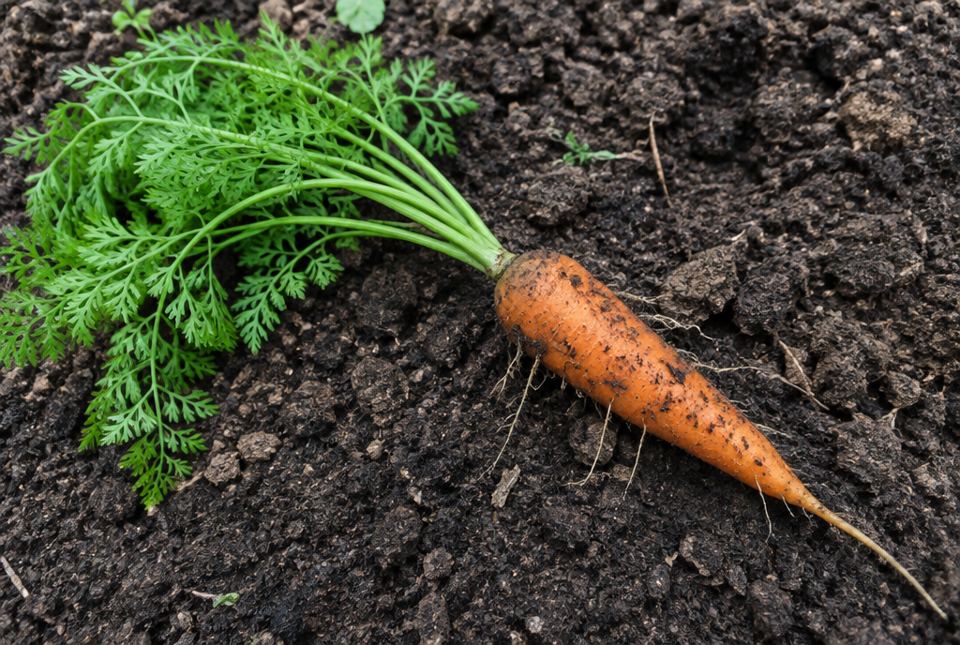 This carrot shows both plant systems: the orange root belongs to the root system and stores food, and the leafy stems belong to the shoot system, which makes food. AI-generated image
Worked exampleLet's trace oxygen from the air to a mitochondrion
Trace the path of an oxygen particle from the air to a mitochondrion inside a muscle cell in your leg. Name each level of organization or system it passes through.
- Respiratory system: air enters the nose, travels down the trachea and into the lungs (organs) to tiny air sacs.
- Oxygen diffuses through thin epithelial tissue of the air sacs into the blood.
- Circulatory system: red blood cells carry the oxygen; the heart (organ) pumps the blood to the leg.
- In the leg muscle (an organ), oxygen diffuses out of tiny blood vessels into a muscle cell.
- Inside the cell, it moves through the cytoplasm into a mitochondrion, where it is used in cellular respiration.
Air → respiratory system (lungs) → circulatory system (blood, heart) → muscle tissue → muscle cell → mitochondrion. Two systems and diffusion work together.
The oxygen path from the example. Two organ systems hand the oxygen along, and diffusion moves it into the blood and then into the cell.Worked exampleLet's classify by level
Sort these into cell, tissue, organ, organ system or organism: a maple leaf, xylem, a guard cell, a white-tailed deer, the shoot system.
- Guard cell: a single specialized cell.
- Xylem: a tissue (many similar cells forming tubes).
- Maple leaf: an organ (made of dermal, ground and vascular tissues).
- Shoot system: an organ system (stems, leaves, flowers).
- White-tailed deer: an organism.
cell: guard cell; tissue: xylem; organ: maple leaf; organ system: shoot system; organism: white-tailed deer.
Just for funA leaf, a chloroplast and a guard cell try to get into the Organ Club. Only the leaf gets in: it's made of several tissues. The chloroplast is just an organelle, and the guard cell is a single cell, but at least it's great at opening and closing doors.
Hands-on activityWatch a plant's transport tissue at work
You need: 2 fresh celery stalks with leaves, 2 clear glasses, water, food colouring (blue or red works best), a knife (adult), a magnifying glass if you have one, a ruler.
- Ask an adult to trim the bottom of each celery stalk with a fresh cut.
- Fill each glass with about 100 mL of water and add 10 to 15 drops of food colouring. Stir.
- Put one stalk in each glass. Keep one glass in a warm, bright spot and one in a cool, shady spot (this is your one changed variable).
- Predict which will show colour in its leaves first, and why.
- Check after 1 hour, 3 hours and the next day. Measure how far up the colour has travelled by looking at the outside or by having an adult cut a slice at different heights.
- Look at a cut cross-section with a magnifying glass. The coloured dots are bundles of xylem.
- Draw the cross-section and label the xylem bundles. Write how this shows the root/shoot systems working together.
Safety: an adult does all cutting. Food colouring stains.
What to look for: coloured dots arranged near the outside of the cross-section; the warm, bright stalk usually moves colour up faster, because more water evaporates from its leaves and pulls water up the xylem.
Your turn
1List the levels of organization from smallest to largest.
Cell → tissue → organ → organ system → organism.
A structure made of several kinds of tissue working together to do a job.
3Name the four tissue types in the heart.
Cardiac muscle, nervous, connective and epithelial tissue.
4Name the main organs of a plant.
Roots, stems and leaves (plus flowers, fruits and seeds for reproduction).
5What are the two main systems of a plant?
The root system and the shoot system.
6Which human system carries oxygen to every cell?
7Give one example of two human organ systems working together.
For example: the respiratory system takes in oxygen and the circulatory system carries it to cells; the digestive system breaks down food and the circulatory system delivers nutrients.
More practice: warm-up
1Is the stomach a tissue or an organ?
3What is the largest organ of the human body?
4Which system includes the brain?
5Which plant system includes the leaves?
More practice: on your own
1Explain why the stomach needs both muscle tissue and epithelial tissue.
Muscle tissue contracts to churn and mix food. Epithelial tissue lines the stomach, protecting it and releasing digestive juices.
2Explain how the root and shoot systems depend on each other.
The roots absorb water and minerals that the leaves need for photosynthesis. The leaves make sugar that the root cells need for energy (carried down by phloem).
3A carrot is a root. Which job of the root system does it show especially well?
Storing food. The carrot stores sugar and starch made by the leaves.
4Why can't an organ do its job with only one kind of tissue? Use the heart.
Muscle tissue can pump, but it needs nervous tissue to signal when to contract, connective tissue to hold it together, and epithelial tissue to line it. Each tissue adds something the others can't.
5Trace a nutrient from a sandwich to a muscle cell, naming the systems.
Digestive system breaks the food into small particles, which pass into the blood in the small intestine; the circulatory system carries them to the muscle; they enter the muscle cell through its membrane.
Challenge
1Describe what might happen to the whole body if the kidneys stopped working. Use levels of organization.
Kidneys (organs of the excretory system) filter wastes from blood. If they stopped, wastes would build up in the blood, so every tissue and cell would be surrounded by harmful wastes. Cells would be damaged, other organs and systems would start to fail, and the whole organism would become very sick without treatment (such as dialysis).
2A tree has no heart, but water reaches leaves 30 m up. Using your celery results, suggest what pulls water up the xylem.
Water evaporates from the leaves through open pores (controlled by guard cells). That loss pulls more water up the long xylem tubes from the roots, like sipping through a straw. In the celery test, the stalk in the warm, bright spot (more evaporation) moved colour faster.
3Each level of organization can do things the level below can't. Give an example for tissue → organ and organ → organ system.
Tissue → organ: muscle tissue alone can contract, but only the heart (muscle + nervous + connective + epithelial) can pump blood in a controlled rhythm. Organ → organ system: the heart alone can't deliver blood to cells; with blood vessels and blood, the circulatory system carries oxygen and nutrients to every cell.
Quiz
1. Which list is in order from smallest to largest?
4. Which system carries oxygen and nutrients to every cell?
5. The two main systems of a plant are…
6. Which is an organ system?
Big idea: cells form tissues, tissues form organs, organs form organ systems, and organ systems form an organism. In both animals and plants, systems depend on each other to meet the needs of every cell.
How to help at home:
- Do the celery experiment together (you do the cutting).
- Play "What level is it?" with words like liver, blood, stomach, carrot, xylem, moose.
Common difficulties:
- Confusing organs and tissues. An organ has several tissue types.
- Forgetting plants have organs and systems.
- Remembering that every system ultimately serves the cells.