B. Life Systems · Interactions in the EnvironmentFarming, Fishing and Foraging: Keeping Ecosystems in Balance
B2.8 A1.1 A3.1 A3.3About 55 minutes
Learning goals- I can describe how different approaches to agriculture can affect an ecosystem.
- I can describe how harvesting food from the natural environment (fishing, hunting, gathering) can affect an ecosystem.
- I can identify strategies that maintain or restore balance in ecosystems used for food.
- I can explain what makes a harvest sustainable.
Words to know
agriculture
Growing crops and raising animals for food and other products.
monoculture
Growing one crop over a large area, often year after year.
crop rotation
Growing different crops in a field from year to year, for example corn, then soybeans, then wheat.
cover crop
A crop such as clover or rye planted to cover and protect the soil between main crops.
runoff
Rain or melted snow that flows over the land into streams and lakes, carrying soil, fertilizer and other materials with it.
quota
A limit on how much of a species can be caught or harvested.
sustainable harvest
Taking food from nature at a rate that lets the population replace itself, so there will be enough in the future.
overharvesting
Taking a species faster than it can reproduce, so its population falls.
Where your food comes from
Some of your food grows on farms: wheat for bread, corn, soybeans, apples, milk and eggs. Some of it is harvested from the natural environment: fish from lakes and oceans, maple syrup, wild blueberries, wild rice, game such as moose and deer.
Every way of getting food changes an ecosystem in some way. Food is a need, so the question is not whether to use ecosystems, but how to use them so they stay healthy for the future.
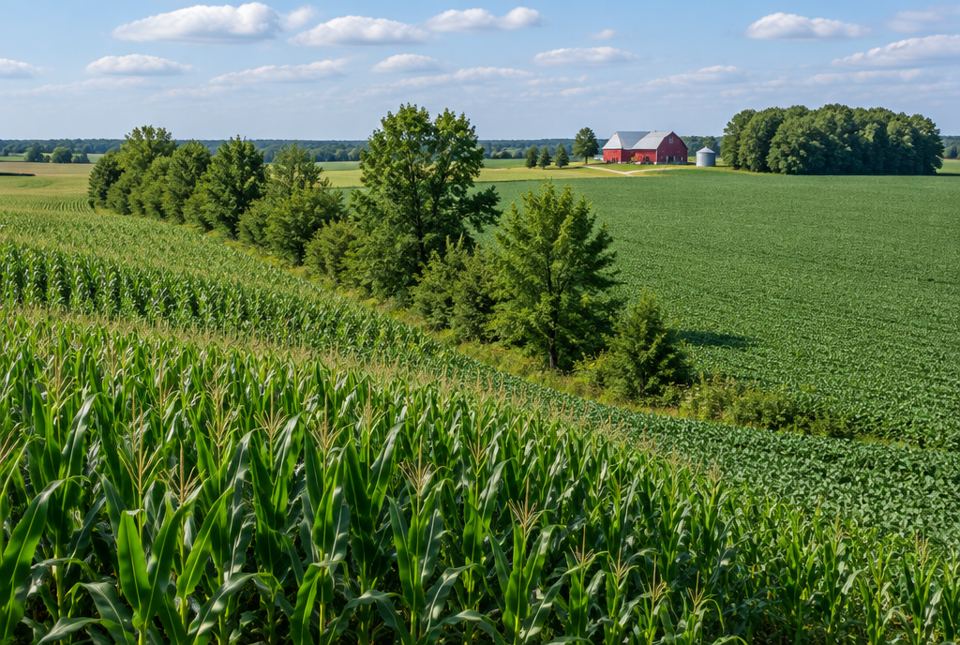 The row of trees between fields, called a hedgerow, gives wildlife shelter and slows soil erosion on farmland. AI-generated image
How farming can affect ecosystems
Turning land into a farm replaces a natural community (forest, prairie or wetland) with crops or pasture. How a farm is run makes a big difference.
Possible negative effects:
- Habitat loss: clearing forests and draining wetlands removes homes for many species. Much of southern Ontario's original forest and wetland was cleared or drained for farms and towns.
- Monocultures: one crop over a huge area gives food and shelter to only a few species, and a pest that likes that crop can spread fast.
- Pesticides: chemicals that kill pests can also harm helpful insects like bees and ladybugs, and some can move into water and food chains.
- Fertilizer runoff: extra nitrogen and phosphorus wash into streams and lakes and feed huge algae blooms. In Lake Erie, phosphorus from farm fields, manure and sewage has caused large blooms, some of them toxic. When the algae die, decomposers use up oxygen in the water.
- Soil erosion: bare fields lose soil to wind and rain.
Approaches that reduce harm:
- Crop rotation and mixed crops break pest cycles and keep soil healthy.
- Cover crops (like clover or rye) protect bare soil over winter and add organic matter; clover also adds nitrogen.
- No-till or low-till farming leaves crop leftovers on the soil, which reduces erosion.
- Buffer strips of trees, shrubs and grasses along streams catch runoff before it reaches the water and give habitat to wildlife.
- Integrated pest management: checking crops for pests and using natural predators, traps or crop rotation first, and pesticides only when really needed.
- Organic farming uses no synthetic pesticides or fertilizers.
- Indigenous agricultural knowledge, such as growing the Three Sisters together (Grade 6), uses relationships between plants to keep soil healthy.
How harvesting from nature can affect ecosystems
Harvesting wild food (fishing, hunting, trapping, gathering berries, nuts, mushrooms, wild rice and maple sap) can be sustainable for a very long time if people take less than the population can replace.
Overharvesting happens when people take a species faster than it can reproduce.
Example: the northern cod. For hundreds of years, huge numbers of Atlantic cod were caught off Newfoundland and Labrador. In the second half of the 1900s, large factory ships with powerful technology caught more and more fish. The cod population collapsed. In 1992, the Government of Canada closed the northern cod fishery. Tens of thousands of people lost their jobs, and many coastal communities were deeply affected. The large commercial fishery stayed closed for more than 30 years. In 2024 the government allowed a limited commercial fishery again, but the cod are still far fewer than before the collapse.
Removing a species also affects its food web: its predators lose food, and its prey can increase.
Strategies for a sustainable harvest
- Quotas and catch limits: only a set amount can be taken.
- Seasons: no fishing or hunting during spawning or breeding times.
- Size limits: release young fish so they can grow and reproduce.
- Licences so governments know how much is taken.
- Protected areas where no harvesting is allowed, so populations can rebuild.
- Monitoring: counting populations every year and changing the rules if numbers fall.
- Respectful harvesting practices from Indigenous knowledge.
Wild rice (manoomin): for Anishinaabe communities in Ontario and the Great Lakes region, manoomin is a sacred food and an important part of culture. Traditional harvesters travel through the rice beds by canoe and use two wooden sticks to gently bend the stalks over the canoe and tap the ripe grains loose. Unripe grains stay on the plant to ripen later, and many grains fall into the water, which reseeds the rice bed for the next year. Many communities also work to protect rice beds from changes in water levels and pollution.
Many Indigenous teachings about harvesting share ideas such as: take only what you need, never take the first or the last, ask permission and give thanks, share what you harvest, and leave enough for the plants and animals to renew themselves.
Restoring balance
When an ecosystem is out of balance, people can help it recover:
- Restoring wetlands by blocking drainage ditches so water returns.
- Planting native trees, shrubs and wildflowers along streams and field edges.
- Reducing phosphorus runoff: Canada and the United States have agreed on targets to cut the phosphorus flowing into Lake Erie.
- Closing a fishery or lowering quotas until fish recover.
- Bringing species back: for example, Atlantic salmon were wiped out from Lake Ontario by the late 1800s, and groups are now working to restore them to some Lake Ontario streams.
Worked exampleLet's evaluate two farms
Farm A grows only corn on every field every year. It sprays insecticide on a schedule, ploughs right up to the stream bank, and leaves the soil bare all winter. Farm B rotates corn, soybeans and wheat, plants a rye cover crop in the fall, keeps a 15 m strip of trees and grasses along the stream, and checks its fields for pests before deciding to spray. Compare their effects on the ecosystem.
- Soil: Farm A's bare winter soil can erode in wind and snowmelt. Farm B's cover crop holds the soil and adds organic matter.
- Water: Farm A's fertilizer and soil can wash straight into the stream. Farm B's buffer strip catches much of the runoff before it reaches the water.
- Biodiversity: Farm A's monoculture and regular spraying support few species and can harm helpful insects. Farm B's rotation, buffer strip and careful spraying support more species, including pollinators and predators of pests.
- Pests: pests that attack corn can build up year after year on Farm A. On Farm B, rotation breaks the pest cycle.
Farm B has a smaller negative effect on the ecosystem. Both farms grow food, but Farm B's approach helps maintain balance in the soil, water and living community.
Farm A's bare field lets soil and fertilizer run straight into the stream. On Farm B, a cover crop holds the soil and the buffer strip of trees and grasses catches runoff before it reaches the water (not to scale).Just for funFarmers who plant cover crops are basically tucking their fields into bed for the winter: a cozy blanket of rye or clover keeps the soil from blowing away. Sweet dreams, field!
Careers connection
Farmers, agronomists (crop and soil scientists), fisheries biologists and conservation officers all work to keep food production and ecosystems in balance. Fisheries biologists count fish and recommend quotas; conservation officers make sure people follow fishing and hunting rules; agronomists help farmers test their soil so they add only the fertilizer they need.
Hands-on activityThe fishing game: sharing a lake
You need: 16 dried beans or paper clips (the fish), a bowl (the lake), 2 to 4 players, paper and pencil.
Rules:
- The lake can hold at most 16 fish (its carrying capacity).
- Each round is one fishing season. Players take turns taking any number of fish (0 or more). Each player needs at least 2 fish per round to feed their family.
- After everyone fishes, the fish left in the lake double (they reproduce), but never above 16.
- Play 6 rounds. Record the fish at the start and end of each round.
- Game 1: don't talk to each other. Each player tries to catch as many fish as possible.
- Game 2: before you start, agree on a quota together.
- Compare the two games. In which game did the fish last longer? Who had food in round 6?
Example: two players each take 4 fish from 16. That leaves 8, which double to 16. This can go on forever. If both take 6, only 4 are left, which double to 8. Next round they can't each take 6 from 8. The lake soon runs out.
Safety: keep beans away from very young children.
What to look for: the child notices that taking half or less of the fish each round keeps the lake full (sustainable), while greedy fishing collapses the population. Ask them to connect this to quotas and the northern cod.
Your turn
1Name two ways farming can harm an ecosystem.
For example: habitat loss, monocultures, pesticides harming helpful insects, fertilizer runoff causing algae blooms, soil erosion.
2How does fertilizer runoff harm a lake?
Extra nitrogen and phosphorus feed algae blooms. When the algae die, decomposers use up oxygen, which can harm fish. Some blooms are also toxic.
3What is crop rotation, and how does it help?
Growing different crops in a field from year to year. It breaks pest cycles and helps keep the soil healthy.
4What is a buffer strip, and why is it useful?
A strip of trees, shrubs and grasses along a stream. It catches runoff (soil, fertilizer) before it reaches the water and gives habitat to wildlife.
5What happened to the northern cod, and what did the government do in 1992?
It was overfished until the population collapsed. In 1992, Canada closed the northern cod fishery.
6Name three strategies that keep fishing sustainable.
For example: quotas, closed seasons during spawning, size limits, licences, protected areas, monitoring populations.
7How does traditional manoomin harvesting help the rice bed renew itself?
Harvesters tap only the ripe grains; unripe grains stay to ripen later, and many grains fall into the water and reseed the bed for next year.
More practice: warm-up
One crop grown over a large area.
A limit on how much can be caught or harvested.
Clover or rye (also oats and others).
4What Great Lake has had large algae blooms caused partly by farm runoff?
5What does overharvesting mean?
Taking a species faster than it can reproduce.
More practice: on your own
1Why can a monoculture make pest problems worse?
A huge area of one crop gives a pest that eats it unlimited food, and there are fewer natural predators living there, so the pest can spread quickly.
2Explain why closed seasons during spawning help fish populations.
Fish can reproduce without being caught, so new young fish replace the ones that are harvested.
3In the fishing game, the lake has 16 fish and 3 players. What is the largest total catch the players can take each round and still have the lake refill to 16?
8 fish in total. 16 − 8 = 8, which doubles to 16. (For example 3, 3 and 2, or close to 2 or 3 each.)
4How can a farmer reduce fertilizer runoff? Give two ways.
For example: test the soil and add only what is needed; don't spread before heavy rain; plant cover crops; keep buffer strips along streams.
5Why did removing so many cod affect more than just the cod?
Cod are part of a food web. Their predators (such as seals and larger fish) lost food, and their prey (smaller fish, shrimp, crabs) could increase. People's jobs and communities were affected too.
Challenge
1A town has a lake where an algae bloom happens every August. Upstream there are farms, a golf course and a sewage treatment plant. Suggest three strategies to restore balance, and explain how each one helps.
Model answer: 1. Buffer strips along streams on farms and the golf course to catch runoff before it reaches the lake. 2. Soil testing and fewer fertilizers (or none before rain) to reduce extra phosphorus and nitrogen. 3. Upgrade the sewage plant to remove more phosphorus. Also: restore wetlands upstream, which filter water. Each strategy cuts the nutrients that feed the algae.
2Compare industrial fishing with large factory ships to a traditional harvest like manoomin. Use the idea of a sustainable harvest.
Factory ships could catch fish faster than they reproduced, leading to the collapse of northern cod (not sustainable). Traditional manoomin harvesting takes only ripe grain, by hand from canoes, and leaves grains to reseed the bed, so the rice renews itself each year (sustainable). The key difference is whether the harvest is smaller than what the population can replace.
3A student says, "To protect ecosystems, we should stop all farming." Is this a good solution? Explain using the idea of balance.
No. People need food, so farming is necessary. A better goal is balance: use approaches like crop rotation, cover crops, buffer strips, careful pest control and protecting some natural areas, so farms produce food while reducing harm to soil, water and biodiversity.
Quiz
1. Which farming practice best protects soil from erosion over winter?
2. Fertilizer runoff into a lake can cause...
3. A sustainable harvest means...
4. What happened to the northern cod fishery in 1992?
5. Which is not a strategy for sustainable fishing?
6. In traditional manoomin harvesting, why are some grains left behind?
7. A buffer strip along a stream helps by...
Big idea: all food comes from ecosystems. Different approaches to farming and to harvesting wild food can harm or protect ecosystems. Strategies like crop rotation, cover crops, buffer strips, quotas, seasons and respectful Indigenous harvesting practices keep ecosystems in balance.
How to help at home:
- Play the fishing game twice (with and without a quota) and talk about why the results differ.
- At the grocery store or farmers' market, look for where foods come from. Some seafood labels show sustainability certifications; talk about what they might mean.
- If you fish, look up Ontario's fishing seasons and size limits together and connect them to this lesson.
Safety: beans are a choking hazard for toddlers.
Common difficulties:
- Thinking all farming is bad. The goal is balance, not stopping food production.
- Not explaining why a strategy works (for example, quotas leave enough fish to reproduce).
- Forgetting that removing one species affects the rest of its food web.