B. Life Systems · Interactions in the EnvironmentWhat Is an Ecosystem? A Network of Interactions
B2.1 A1.1 A1.4 A1.5About 50 minutes
Learning goals- I can explain that an ecosystem is a network of interactions among living organisms and their environment.
- I can put the levels organism, population, community, ecosystem, biome and biosphere in order.
- I can describe several kinds of interactions in an ecosystem near me.
- I can record observations of a local ecosystem safely and share them in a clear diagram.
Words to know
ecosystem
All the living things in an area plus the non-living parts of their environment (sunlight, water, soil, air), and all the ways they interact.
organism
One individual living thing, such as one maple tree or one chickadee.
population
All the members of one species living in the same area at the same time.
community
All the populations of different species living in the same area.
interaction
Any way two parts of an ecosystem affect each other, such as eating, competing, sheltering or changing the soil.
biome
A large region of Earth with a similar climate and similar kinds of plants and animals, such as boreal forest or tundra.
biosphere
All the parts of Earth where life exists: land, water and air together.
A pond in January
In January, a pond in Ontario looks frozen and empty. Snow covers the ice. But under the ice, the pond is busy. Fish swim slowly in the cold water. Frogs and turtles rest in the mud at the bottom. Water plants and tiny algae still use the dim light that gets through clear ice. Bacteria break down the dead leaves that fell in the fall.
Every one of these living things depends on the others, and on the water, the ice, the mud and the oxygen. Take away one part, and the others feel it. A place like this, with all its living and non-living parts working together, is an ecosystem.
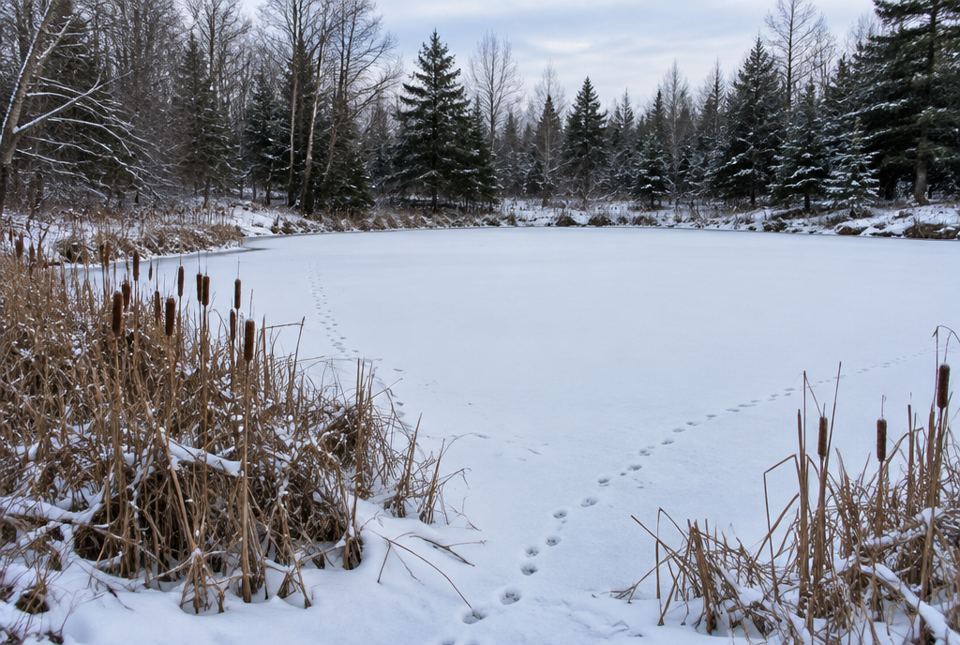 The pond looks empty, but the tracks and the life under the ice show that the ecosystem's interactions keep going all winter. AI-generated image
Remember from earlier grades
In Grade 4 you learned about habitats, communities, food chains and food webs. In Grade 6 you learned about biodiversity and the relationships between species, such as predation, competition and symbiosis.
In Grade 7 you will put all of these ideas together and look at the whole system: how energy flows through it, how materials are recycled, what limits it, how it changes over time, and how people affect it.
What is an ecosystem?
An ecosystem is a network of interactions among living things and their environment.
Think of a network like a spider web or the Internet. Each part is connected to many other parts. A change in one place travels along the connections.
An ecosystem has three things:
- Living things (plants, animals, fungi, bacteria and other microorganisms).
- Non-living things (sunlight, water, air, soil, rocks, temperature).
- Interactions: all the ways these parts affect each other.
The interactions are the most important part. A pile of soil, a jar of water and a frog sitting side by side are not an ecosystem. They become one when the frog drinks and breathes, the plants grow in the soil, and insects feed the frog.
Levels of organization
Scientists study life at different levels, from one living thing up to the whole planet.
- Organism: one living thing, like one white-tailed deer.
- Population: all the deer of one species in the area.
- Community: all the populations together: deer, maples, wolves, chickadees, fungi and more.
- Ecosystem: the community plus the non-living parts, and all their interactions.
- Biome: a large region with a similar climate and similar ecosystems, like the boreal forest.
- Biosphere: every place on Earth where life is found.
Ecosystems come in all sizes
An ecosystem can be tiny or huge. A rotting log on the forest floor is an ecosystem: fungi, beetles, millipedes, moss and salamanders live in and around it, and the log holds moisture. A pond, a city park, a wetland and Lake Superior are ecosystems too.
Ontario has three large natural regions called ecozones:
- the Hudson Bay Lowlands in the far north, with huge wetlands and some tundra along the coast,
- the Ontario Shield, with rocky ground, many lakes and boreal and mixed forests,
- the Mixedwood Plains in the south, with deciduous and mixed forests, farmland and most of Ontario's cities.
Ecosystems also have no hard walls. Water flows from a stream into a lake. Birds migrate from Ontario to South America. Seeds blow in the wind. Ecosystems are connected to each other.
| Kind of interaction | Example in an Ontario forest |
|---|
| Feeding (predator and prey, plant eater and plant) | A red fox eats a meadow vole. The vole eats grass seeds. |
| Competition | Young maple trees compete for sunlight under the tall trees. |
| Symbiosis (living closely together) | Fungi wrap around tree roots, help the tree take in water and minerals, and get sugar from the tree. |
| Living thing affects non-living | Tree roots hold soil in place; fallen leaves add nutrients to the soil. |
| Non-living affects living | Deep snow makes it hard for deer to walk and find food in winter. |
Worked exampleLet's map a schoolyard ecosystem
Amira looked at the edge of her schoolyard in October. She saw: a maple tree, grass, dandelions, an American robin, earthworms, a squirrel, mushrooms, puddles, sunlight and soil. Show how this is a network of interactions.
- Step 1: Sort the parts. Living: maple, grass, dandelions, robin, earthworms, squirrel, mushrooms. Non-living: puddles (water), sunlight, soil, air.
- Step 2: Find feeding links. The robin eats earthworms. The squirrel eats maple seeds. Earthworms eat dead leaves in the soil.
- Step 3: Find links with non-living parts. Sunlight lets the maple, grass and dandelions make food. Rain fills the puddles, and the robin drinks and bathes there. Earthworm tunnels let air and water into the soil.
- Step 4: Find other links. Mushrooms (fungi) break down fallen leaves and return nutrients to the soil. The maple and the grass compete for water and light near the trunk.
- Step 5: Follow one change through the network. If the maple is cut down: less shade, so the grass grows more; no maple seeds, so the squirrel must find other food; fewer fallen leaves, so the earthworms and mushrooms have less to eat.
Every part is linked to several others, so a change to one part (the maple) affects many parts. That is what makes it a network of interactions, an ecosystem.
Amira's schoolyard as an interaction web. Every arrow has a label that says what is happening. Living parts are green; non-living parts are yellow. Follow any arrow and you will find more connections.Arrows tell a story
When scientists draw an interaction web, every arrow should have a label that says what is happening: eats, shades, gives shelter to, adds nutrients to. An arrow without a label is hard to understand. This is part of communicating like a scientist.
Just for funRiddle: What is an ecosystem's favourite social network?
The food web, of course. Everybody is connected, and somebody is always eating.
Hands-on activityInteraction web of a place near you
You need: a notebook, a pencil, a clipboard or hard surface, warm clothes if it is cold, and a grown-up.
- Choose a small area: a corner of a yard, a park, a balcony planter, or a spot by a stream (stay well back from the water). Mark out about 2 m by 2 m.
- Sit quietly for 15 minutes. List every living thing you notice (including signs of living things, like chewed leaves, tracks in snow or spider webs) and every non-living part (sun or shade, water, soil, rocks, wind, temperature).
- On a large page, write each part in a bubble. Draw labelled arrows to show at least 8 interactions.
- Circle one part. Write 2 or 3 sentences: "If this part disappeared, these parts would be affected because..."
- Share your web with someone at home and explain it.
Safety: look, don't touch, any wild animals, mushrooms or unknown plants (some are poisonous). Wash your hands afterwards. A grown-up should come with you near water or roads.
What to look for: at least 8 correct, labelled arrows, a mix of living and non-living parts, and a sensible prediction about what happens if one part is removed.
Your turn
1What three things does every ecosystem have?
Living things, non-living things, and the interactions between them.
2Put these in order from smallest to largest: community, organism, biosphere, population, ecosystem, biome.
Organism, population, community, ecosystem, biome, biosphere.
3What is the difference between a population and a community?
A population is one species in an area. A community is all the species (all the populations) in that area.
4Why is a rotting log called an ecosystem?
It has living things (fungi, beetles, moss, salamanders) and non-living parts (wood, moisture, air), and they interact: fungi break down the wood, beetles eat fungi, the log holds water for salamanders.
5Give one example of a living thing affecting a non-living thing.
For example: tree roots hold soil in place, earthworms loosen soil, beavers raise the water level with a dam.
6Give one example of a non-living thing affecting a living thing.
For example: deep snow makes it hard for deer to find food; cold temperatures make frogs hibernate; sunlight lets plants make food.
7Why do we say ecosystems have "no hard walls"?
Water, air, seeds and animals move between ecosystems, so they are connected to each other.
More practice: warm-up
1Is a single chickadee an organism, a population or a community?
2Is sunlight living or non-living?
3Name the three ecozones of Ontario.
Hudson Bay Lowlands, Ontario Shield and Mixedwood Plains.
All the places on Earth where life exists.
5All the white-tailed deer in Algonquin Park are a ______.
More practice: on your own
1A student lists the parts of a pond: frogs, water, cattails, dragonflies, mud. Is that an ecosystem? What is missing from the list?
It is the start of one, but the interactions are missing. An ecosystem also includes how the parts affect each other, for example dragonflies eat mosquitoes, frogs eat dragonflies, cattails grow in the mud and shelter birds.
2Explain the difference between a community and an ecosystem.
A community is only the living things. An ecosystem is the community plus the non-living parts (water, soil, sunlight, air) and the interactions among all of them.
3Fungi wrap around tree roots and help the tree take in water and minerals. The tree gives the fungi sugar. What kind of interaction is this?
Symbiosis (a close relationship where both partners benefit, which you called mutualism in Grade 6).
4A highway is built through a forest. Name two interactions that could be changed.
For example: animals can no longer move between the two sides to find food or mates; road salt runs into soil and streams and harms plants; noise and cars disturb or kill animals; less forest means less shade, so the forest edge gets hotter and drier.
5Why is it useful to think of an ecosystem as a network instead of a list?
A network shows that each part is connected to many others, so you can predict how a change in one part spreads to other parts. A list does not show those connections.
Challenge
1In winter, snow covers the ground. Small mammals like voles live in tunnels between the snow and the ground, where it stays near 0 °C even when the air is much colder. Describe two interactions in this example and say whether each is living-to-non-living or non-living-to-living.
- Snow (non-living) protects voles (living) by insulating them from the cold: non-living affects living. 2. Voles (living) dig tunnels in the snow (non-living): living affects non-living. (Other good answers: owls and foxes listen for voles under the snow, which is living-to-living.)
2A scientist says, "You cannot understand a wolf by studying only wolves." Use the idea of an ecosystem to explain what she means.
A wolf's life depends on its interactions: the deer and beavers it eats, the plants those animals eat, the snow that affects hunting, other wolves in its pack, diseases and people. To understand the wolf, you must study the network it is part of.
3Draw (or describe) a mini interaction web with at least five labelled arrows for a city park in summer.
Model answer: Sun → grass (gives light energy); grass → rabbit (food); rabbit → hawk (food); oak tree → squirrel (acorns and shelter); earthworms → soil (loosen and add nutrients); rain → pond (fills it); pond → ducks (water, food). Look for five or more arrows, each with a label that says what happens.
Quiz
1. An ecosystem is best described as...
2. Which list is in order from smallest to largest?
3. All the snowshoe hares in one forest are a...
4. Which is a non-living part of an ecosystem?
5. Which shows a living thing changing a non-living part?
6. Which of Ontario's ecozones is in the far north and has huge wetlands?
Big idea: an ecosystem is not just a place or a list of plants and animals. It is a network of interactions among living things and their non-living environment.
How to help at home:
- Go on the observation walk together and help your child label arrows with verbs (eats, shades, shelters, feeds).
- At dinner, play "What if?": What if all the bees disappeared from our garden? What if the pond dried up? Follow the changes through the network.
- Use the levels in everyday talk: "One robin is an organism. All the robins in the neighbourhood are a population."
Safety: stay with your child near water and roads, and remind them not to touch wild animals, mushrooms or unknown plants.
Common difficulties:
- Mixing up population (one species) and community (all species).
- Forgetting the non-living parts and the interactions when defining an ecosystem.
- Drawing arrows without labels.