E. Earth and Space Systems · Heat in the EnvironmentGreenhouse Gases: Where They Come From and How to Cut Them
E2.8 A1.1 A1.5 A3.2About 50 minutes
Learning goals- I can identify natural sources and human sources of greenhouse gases.
- I can explain which human activities add the most greenhouse gases in Canada.
- I can describe ways that people, communities and governments can reduce greenhouse gas emissions.
- I can use math to estimate the carbon dioxide from a car trip.
Words to know
emissions
Gases released into the air, for example from a car's tailpipe or a factory chimney.
fossil fuels
Coal, oil and natural gas, formed over millions of years from the remains of ancient living things.
carbon sink
Something that takes in and stores more carbon dioxide than it releases, such as a forest, a wetland or the ocean.
methane
A strong greenhouse gas. It is the main part of natural gas and is also made when food and plant waste rot without oxygen.
nitrous oxide
A greenhouse gas released mainly when nitrogen fertilizers are used on farm fields.
deforestation
Cutting down forests and not replacing them.
What's in a tailpipe?
On a cold January morning you can see a white cloud coming out of a car's tailpipe. That cloud is mostly tiny water droplets. What you cannot see is the carbon dioxide streaming out with it. Every litre of gasoline a car burns releases about 2.3 kg of carbon dioxide into the air.
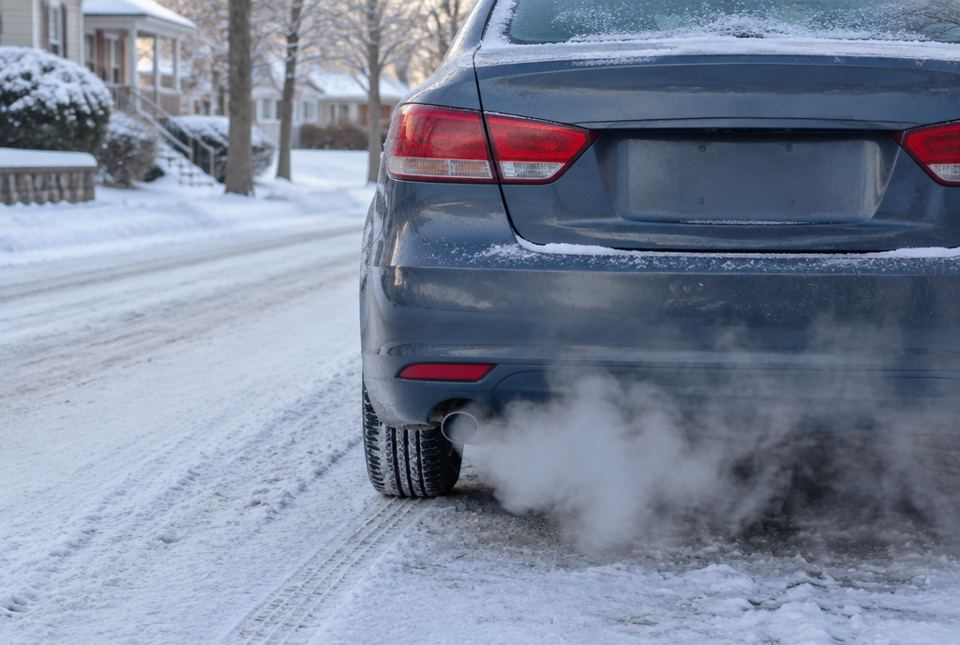 The white cloud you can see is mostly water droplets. The carbon dioxide coming out with it is invisible, but it is a greenhouse gas. AI-generated image
Natural sources
Greenhouse gases have always entered the atmosphere naturally:
- Carbon dioxide: breathing (respiration) by animals and other living things, decomposition of dead plants and animals, volcanoes, forest fires.
- Methane: wetlands and swamps, where plants rot with little oxygen; some animals' digestion.
- Water vapour: evaporation from oceans, lakes and plants.
Nature also removes carbon dioxide. Plants take it in for photosynthesis, and oceans absorb it. Forests, wetlands, peatlands and oceans are carbon sinks. Ontario's Hudson Bay Lowlands hold one of the largest areas of peatland in the world, storing huge amounts of carbon in wet, partly rotted plant material.
For thousands of years, these natural sources and sinks were roughly balanced.
| Greenhouse gas | Main human sources |
|---|
| Carbon dioxide (CO₂) | burning gasoline and diesel in vehicles; burning natural gas or oil to heat buildings; burning fossil fuels in industry and some power plants; making cement; cutting down forests |
| Methane | landfills (food and yard waste rotting without oxygen); cattle and other livestock digesting food; leaks from natural gas and oil wells and pipelines |
| Nitrous oxide | nitrogen fertilizers on farm fields; some industries; burning fuels |
| Fluorinated gases | leaks from old refrigerators, freezers and air conditioners |
Where do Canada's emissions come from?
According to Environment and Climate Change Canada, the two largest sources of greenhouse gas emissions in Canada are the oil and gas industry and transportation (cars, trucks, planes, trains and ships). Heating buildings, heavy industry, farming and waste are other important sources.
Canada's cold climate and long distances matter too: we use a lot of energy to heat homes in winter and to travel and ship goods across a huge country.
How can emissions be reduced?
At home and as individuals:
- Travel smarter: walk, bike, take transit or carpool. Combine errands into one trip. Do not leave a car idling.
- Heat smarter: lower the thermostat a little in winter, especially at night; seal drafts; add insulation (next lesson).
- Waste less food: compost food scraps. In a compost bin with air, food breaks down with much less methane than in a landfill.
- Reduce, reuse, repair, recycle: making new things uses energy.
In communities and governments:
- Electric buses and better transit, safe bike lanes.
- Capturing methane from landfills and burning it to make electricity.
- Electricity from low-emission sources (hydro, nuclear, wind, solar).
- Heat pumps and better building codes for new homes.
- Protecting and restoring forests, wetlands and peatlands, and planting trees.
- Helping farmers use fertilizer more precisely.
No single action solves the problem. Many actions by many people, businesses and governments add up.
Worked exampleLet's calculate: carbon dioxide from a car trip (A3.2)
A family drives 50 km to visit their grandparents and 50 km back. Their car uses 8 L of gasoline per 100 km. About how much CO₂ does the round trip release? (Use 2.3 kg of CO₂ per litre of gasoline.)
- Total distance: 50 km + 50 km = 100 km.
- Gasoline used: 8 L per 100 km × 100 km = 8 L.
- CO₂ released: 8 L × 2.3 kg/L = 18.4 kg.
About 18.4 kg of carbon dioxide, about the mass of a big bag of potatoes, from one round trip.
The car-trip calculation in three steps: find the distance, then the fuel used, then multiply by 2.3 kg of CO₂ per litre.Just for funFunny but true: most of the methane from cattle comes out as burps, not from the other end. Scientists are even testing seaweed snacks that help cows burp less methane.
Hands-on activityGreenhouse gas detective at home (A1.1)
You need: paper, a pencil, and a grown-up to answer questions.
Part 1: Research
- With a grown-up, find out: How is your home heated? (Natural gas, electricity, heat pump, oil, propane, wood?) How do family members usually get to school and work? Where does your food waste go?
- Make a table: Activity, Greenhouse gas, Source.
- Find at least 6 activities in your family's week that release greenhouse gases.
Part 2: Plan
- Choose 3 changes your family could realistically make. For each, write which gas it reduces and why.
- Choose 1 change your community or school could make.
- Communicate (A1.5): make a short poster or a 1-minute talk for your family that explains your plan. Use at least three words from this lesson.
What to look for: sources such as driving, home heating, food waste, and buying new products; realistic changes such as combining trips, composting, lowering the thermostat by 1 °C, or walking to school when it is safe.
Note for families: this is about learning, not blame. Every family's situation is different (distance, budget, health, transit). Focus on ideas that are possible for you.
Your turn
1Name two natural sources of carbon dioxide.
Any two: respiration (breathing), decomposition, volcanoes, forest fires.
2Name two human sources of methane.
Any two: landfills, cattle and other livestock, leaks from natural gas and oil wells and pipelines.
3What is a carbon sink? Give an example.
Something that takes in and stores more carbon dioxide than it releases. Examples: forests, wetlands, peatlands, oceans.
4What are the two largest sources of greenhouse gas emissions in Canada?
The oil and gas industry and transportation.
5Why does composting food scraps produce less methane than sending them to a landfill?
In a compost bin with air (oxygen), food breaks down with much less methane. In a landfill, buried food rots without oxygen, which makes methane.
6Why does cutting down a forest add to greenhouse gases?
The trees no longer absorb CO₂, and if they are burned or left to rot, the carbon stored in them goes into the air.
7Give three ways a family could reduce its emissions.
Any three: walk, bike, take transit or carpool; don't idle the car; lower the thermostat; seal drafts; compost; reduce food waste; reduce, reuse, repair.
More practice: warm-up
1What gas makes up most of natural gas?
2What greenhouse gas comes mainly from farm fertilizers?
3Name the three fossil fuels.
Coal, oil and natural gas.
4About how much CO₂ comes from burning 1 L of gasoline?
5Do plants take in or give off CO₂ during photosynthesis?
More practice: on your own
1A car uses 6 L of gasoline per 100 km. How much CO₂ is released on a 200 km trip?
27.6 kg. 200 km uses 12 L (6 × 2). 12 × 2.3 = 27.6 kg.
2Why do Canadians use a lot of energy for heating compared with people in warmer countries?
Canada has long, cold winters, so homes and buildings must be heated for many months.
3Explain why protecting peatlands in the Hudson Bay Lowlands helps the climate.
Peatlands store huge amounts of carbon. If they are dried out or disturbed, the carbon can be released as greenhouse gases. Protecting them keeps the carbon stored.
4Why is a leaky natural gas pipeline a climate problem, even if no gas is burned?
Natural gas is mostly methane, a strong greenhouse gas. Leaked methane goes straight into the atmosphere.
5A town captures methane from its landfill and burns it to make electricity. Why is this better than letting the methane escape?
Burning methane turns it into CO₂ and water. Methane is a much stronger greenhouse gas than CO₂, so this reduces warming. It also makes useful electricity.
Challenge
1A student bikes 3 km to school instead of being driven, 180 school days a year, both ways. If the car uses 8 L per 100 km, how much CO₂ is saved in a year? (2.3 kg CO₂ per L)
Distance: 3 km × 2 × 180 = 1080 km. Gasoline: 1080 × 8 ÷ 100 = 86.4 L. CO₂: 86.4 × 2.3 = 198.72 kg, about 200 kg of CO₂ a year.
2Water vapour is a greenhouse gas, but scientists focus on cutting CO₂ and methane, not water vapour. Suggest why.
Human activities do not directly control much of the water vapour in the air; its amount depends mostly on temperature (warmer air holds more). CO₂ and methane are added directly by human activities and stay in the air a long time, so cutting them is what we can control. (Warming from CO₂ also adds more water vapour, which adds more warming.)
3Choose one community action from this lesson. Describe one benefit and one challenge of doing it.
Sample: electric buses. Benefit: no tailpipe emissions, cleaner air, quieter streets. Challenge: they cost more to buy and need charging stations, and very cold weather reduces battery range. Look for: a realistic benefit and a realistic challenge.
Quiz
1. Which is a natural source of carbon dioxide?
2. Which human activity releases methane?
3. A forest is a carbon sink because it...
4. Which are the two largest sources of greenhouse gas emissions in Canada?
5. A car burns 10 L of gasoline. About how much CO₂ is released?
6. Which action reduces greenhouse gas emissions?
Big idea (E2.8): greenhouse gases come from natural sources and human sources. In Canada, the oil and gas industry and transportation are the largest sources. People, communities and governments can reduce emissions through transportation, heating, waste and land choices. The home detective task is research (A1.1) and communication (A1.5); the trip calculation connects science and math (A3.2).
How to help: do the detective task together without judgement. Choose one realistic change as a family and track it for a month.
Common difficulties:
- Thinking only cars matter. Heating, food waste, industry and farming all matter.
- Feeling hopeless. Emphasize that many solutions already exist and are growing.
Sources: Environment and Climate Change Canada, National Inventory Report and Greenhouse Gas Emissions indicator (2024 data: oil and gas about 30% and transport about 22% of Canada's emissions, the two largest sectors). The figure of about 2.3 kg of CO₂ per litre of gasoline is a widely used government estimate.