E. Earth and Space Systems · Heat in the EnvironmentHeat, Temperature and Thermal Energy
E2.1 A1.2 A1.4About 45 minutes
Learning goals- I can explain the difference between temperature, thermal energy and heat.
- I can use the particle theory to explain how heating changes the motion of particles in solids, liquids and gases.
- I can explain why heat always moves from a warmer object to a cooler one.
- I can explain why our senses are not a reliable way to measure temperature.
Words to know
temperature
A measure of how hot or cold something is. It tells us the average speed (energy of motion) of its particles. Measured in degrees Celsius (°C).
thermal energy
The total energy of motion of all the particles in a substance. It depends on the temperature AND on how much of the substance there is.
heat
Thermal energy that moves (is transferred) from a warmer object to a cooler one.
thermometer
A tool that measures temperature.
thermal equilibrium
When two objects in contact reach the same temperature, so heat stops flowing between them.
kinetic energy
Energy of motion. The faster a particle moves, the more kinetic energy it has.
Hot chocolate or a hot bath?
After a cold day of tobogganing, you have a mug of hot chocolate at 70 °C and a bathtub of warm water at 38 °C. Which one is hotter? Which one holds more energy?
The answers are different, and that is the key to this lesson. Scientists use three words very carefully: temperature, thermal energy and heat.
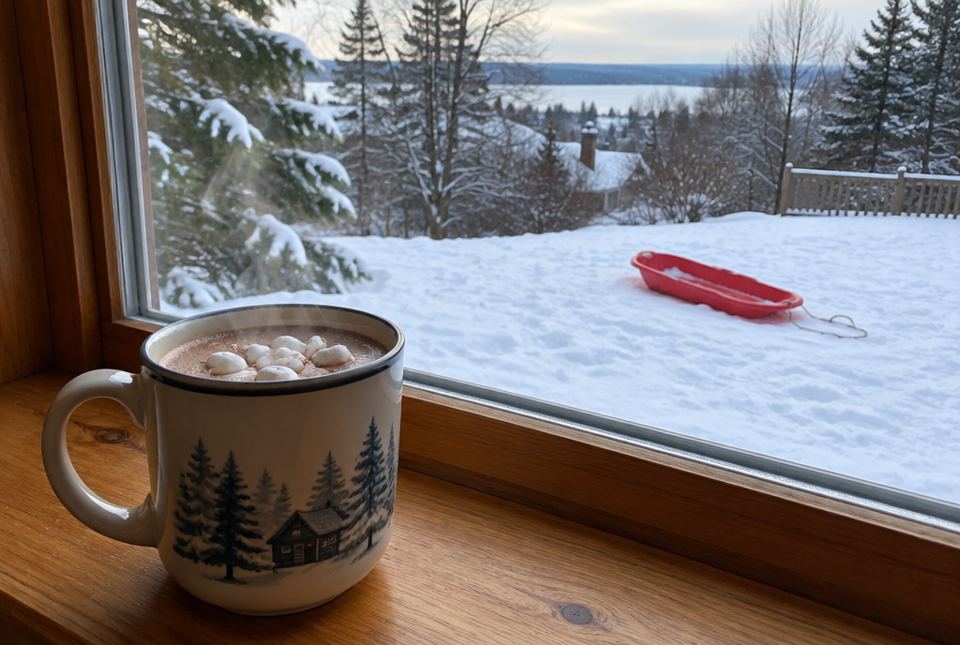 The hot chocolate has a high temperature, but a whole bathtub of warm water holds far more thermal energy because it has many more particles. AI-generated image
Temperature
Temperature tells us how hot or cold something is. Using the particle theory: temperature is a measure of the average speed (the average energy of motion, or kinetic energy) of the particles.
- Higher temperature → particles move faster on average.
- Lower temperature → particles move slower on average.
In Canada we measure temperature in degrees Celsius (°C). Pure water freezes at 0 °C and boils at 100 °C (at sea level). A healthy body is about 37 °C, and a comfortable room is around 20 °C.
Scientists also know of a lowest possible temperature, called absolute zero: about −273 °C. At absolute zero, particles would have the least motion possible. Nothing can be colder.
Thermal energy
Thermal energy is the total energy of motion of all the particles in something. It depends on:
- the temperature (how fast the particles move), and
- the amount of matter (how many particles there are).
The bathtub is cooler than the hot chocolate, but it has far more water particles. So the bathtub holds much more thermal energy.
Heat
Heat is thermal energy on the move. It always flows from a warmer object to a cooler object, never the other way on its own.
- When you hold an ice cube, heat flows from your hand into the ice. Your hand feels cold because it is losing thermal energy. "Cold" does not flow into your hand.
- Heat keeps flowing until both objects are at the same temperature. This is called thermal equilibrium. A cold juice box left on the counter warms up until it reaches room temperature, and then it stops changing.
In everyday speech, people say "heat" to mean many things. In science, heat means energy being transferred because of a temperature difference.
| Word | What it means | Bathtub (38 °C) vs mug (70 °C) |
|---|
| Temperature | Average speed of the particles | The mug has the higher temperature. |
| Thermal energy | Total energy of all the particles | The bathtub has more thermal energy (many more particles). |
| Heat | Thermal energy moving from warmer to cooler | Heat flows from each one into the cooler air of the room. |
Heating solids, liquids and gases
When any state of matter is heated, its particles gain energy and move faster:
- Solid: particles vibrate faster and harder in their places.
- Liquid: particles slide past each other faster and move a bit farther apart.
- Gas: particles zoom around faster and hit the walls of their container harder and more often.
When something cools, the opposite happens: the particles slow down.
Worked exampleLet's compare: an iceberg and a cup of tea
An iceberg is at about −10 °C. A cup of tea is at 80 °C. Which has the higher temperature? Which has more thermal energy? Explain.
- Temperature compares the average speed of particles. Tea at 80 °C is much warmer than ice at −10 °C, so the tea's particles move faster on average.
- Thermal energy is the total energy of all the particles. An iceberg has billions of times more particles than a cup of tea.
- Even though each ice particle is moving more slowly, there are so many of them that their total energy is far larger.
The tea has the higher temperature. The iceberg has far more thermal energy, because it is so much bigger.
Just for funRiddle: What did the hot chocolate say to the bathtub?
"I'm hotter than you... but fine, you've got way more thermal energy."
Worked exampleLet's follow the heat: a cold spoon in hot soup
A metal spoon from a drawer (20 °C) is put in a bowl of soup (60 °C). Which way does heat flow, and when does it stop?
- Heat flows from warmer to cooler: from the soup into the spoon.
- The spoon's particles gain energy and vibrate faster, so the spoon warms up. The soup loses a little energy and cools slightly.
- Heat keeps flowing until the spoon and the soup near it reach the same temperature (thermal equilibrium). Meanwhile, both slowly lose heat to the cooler air.
Heat flows from the soup to the spoon until they reach the same temperature.
Hands-on activityCan you trust your hands? (three-bowl test)
You need: 3 bowls big enough for a hand, warm tap water, room-temperature water, cold water with a few ice cubes, a clock, and a kitchen or outdoor thermometer if you have one. A grown-up fills the warm bowl and checks that it is comfortably warm, not hot.
- Line up the bowls: warm on the left, room temperature in the middle, cold on the right.
- Put your left hand in the warm water and your right hand in the cold water. Count to 60.
- Now put both hands in the middle bowl at the same time.
- Record: how does the middle water feel to each hand?
- If you have a thermometer, measure the temperature of each bowl. Wait until the reading stops changing before you write it down.
What to look for: the middle water feels cool to the hand that was in warm water and warm to the hand that was in cold water. Your skin senses whether heat is flowing in or out, not the actual temperature. That is why scientists use thermometers.
Fair testing (A1.2): keep both hands in for the same time. Repeat once and see if you get the same result.
Safety (A1.4): only a grown-up handles hot water. Never use water from a kettle. If the warm water feels uncomfortable, take your hand out. Wipe up spills right away so no one slips.
Your turn
1What does temperature measure, using the particle theory?
The average speed (average energy of motion) of the particles.
2What two things does the thermal energy of an object depend on?
Its temperature and the amount of matter (number of particles). The kind of substance also matters.
3In science, what is heat?
Thermal energy that moves from a warmer object to a cooler one.
4When you hold a snowball, which way does heat flow?
From your warm hand into the snowball. Your hand feels cold because it is losing thermal energy.
5How do the particles of a gas change when the gas is heated?
They move faster and hit the walls of the container harder and more often.
6What is thermal equilibrium?
When two objects in contact reach the same temperature, so heat stops flowing between them.
7Why is a thermometer better than your hand for measuring temperature?
Your hand only senses whether heat is flowing in or out, and it can be fooled (as in the three-bowl test). A thermometer gives an accurate number.
More practice: warm-up
1At what temperature does pure water freeze?
2At what temperature does pure water boil at sea level?
3What unit do we use for temperature in Canada?
4About what is normal human body temperature?
5Heat flows from ______ to ______.
More practice: on your own
1A swimming pool at 26 °C and a mug of cocoa at 65 °C: which has the higher temperature and which has more thermal energy? Explain.
The cocoa has the higher temperature (its particles move faster on average). The pool has much more thermal energy because it has vastly more particles.
2Explain why your hand feels cold when you touch a frosty car window in January.
Heat flows from your warm hand into the cold glass. Your hand loses thermal energy, and your skin senses that loss as cold.
3A carton of milk from the fridge (4 °C) is left on the counter (21 °C). What happens to its temperature over the next hours, and when does it stop changing?
It warms up because heat flows from the warmer air into the milk. It stops changing when it reaches 21 °C, room temperature (thermal equilibrium).
4Describe how the particles of a solid iron nail change as the nail is heated.
The iron particles vibrate faster and harder in their places. They stay in their places as long as the nail is solid.
5Your friend says, "Close the door, you're letting the cold in!" What would a scientist say is really happening?
Heat is flowing out of the warm house to the cold outdoors. Cold is not a thing that flows; heat flows from warmer to cooler.
Challenge
1Two pots of water are both at 50 °C. Pot A has 1 L and Pot B has 4 L. Do they have the same thermal energy? Which would melt more snow? Explain.
No. They have the same temperature, but Pot B has 4 times as many particles, so it has about 4 times the thermal energy. Pot B would melt more snow, because it has more energy to give.
2Could anything be colder than −273 °C? Explain using particles.
No. At about −273 °C (absolute zero), particles would have the least possible motion. There is no way to slow them down any more, so nothing can be colder.
3A spark from a campfire is about 1000 °C, but it barely hurts if it lands on your sleeve for an instant. A pot of boiling water at 100 °C can cause a serious burn. Use the words temperature and thermal energy to explain.
The spark has a very high temperature but is tiny, so it has very little thermal energy to transfer. The pot of water has a lower temperature but a huge amount of thermal energy, so it can transfer much more heat to your skin. (Never test this! Both can burn.)
Quiz
1. What does temperature measure?
3. A lake at 15 °C and a kettle of water at 95 °C. Which has more thermal energy?
4. When you hold an ice cube, your hand feels cold because...
5. What happens to the particles of a liquid when it is heated?
6. Why is a thermometer better than your hand for measuring temperature?
Big idea (E2.1): temperature (average particle motion), thermal energy (total particle energy) and heat (energy transferred from warmer to cooler) are different. Students often use them as one word. The three-bowl test practises a simple experiment (A1.2) and safety with warm water (A1.4).
How to help: use the words carefully in daily life. When your child says "the cold is getting in", ask "which way is the heat flowing?" Compare a cup of hot tea with a bathtub of warm water: which is hotter, and which has more energy?
Common difficulties:
- Thinking a hotter object always has more thermal energy. Size matters.
- Thinking cold flows. Only heat flows, from warmer to cooler.
- Thinking particles grow when heated. They move faster and farther apart; they do not grow.
Safety: only an adult handles hot water. Use warm tap water, never water from a kettle or stove.