B. People and Environments: Canada's Interactions with the Global Community · Canada's Interactions with the Global CommunityFirst Nations, Métis and Inuit in the Global Community
B3.2 B3.3 B3About 45 minutes
Learning goals- I can describe international organizations through which First Nations, Métis and Inuit take part in global issues.
- I can explain what the UN Declaration on the Rights of Indigenous Peoples is and how Canada's position changed.
- I can describe how Inuit leaders have brought Arctic issues to the world.
- I can explain why Indigenous Peoples work together across borders.
Words to know
Indigenous Peoples
The first peoples of a land and their descendants. In Canada: First Nations, Métis and Inuit. There are Indigenous Peoples all over the world.
circumpolar
Around the North Pole: the Arctic regions of several countries.
permanent participant
An Indigenous Peoples' organization that has a seat at the Arctic Council table alongside the eight Arctic countries.
UNDRIP
The United Nations Declaration on the Rights of Indigenous Peoples, adopted by the UN in 2007.
advocate
A person who speaks up and works for a cause or for other people.
Neighbours across the ice
An Inuk teenager in Iqaluit, Nunavut, and an Inuk teenager in Nuuk, Greenland, live in different countries. Yet they may share a language family, foods like Arctic char, and worries about thinning sea ice.
Inuit live in four countries: Canada, the United States (Alaska), Denmark's Greenland and Russia (Chukotka). Borders drawn by other governments run through their homelands. So Inuit work together across borders, and they speak up in the global community.
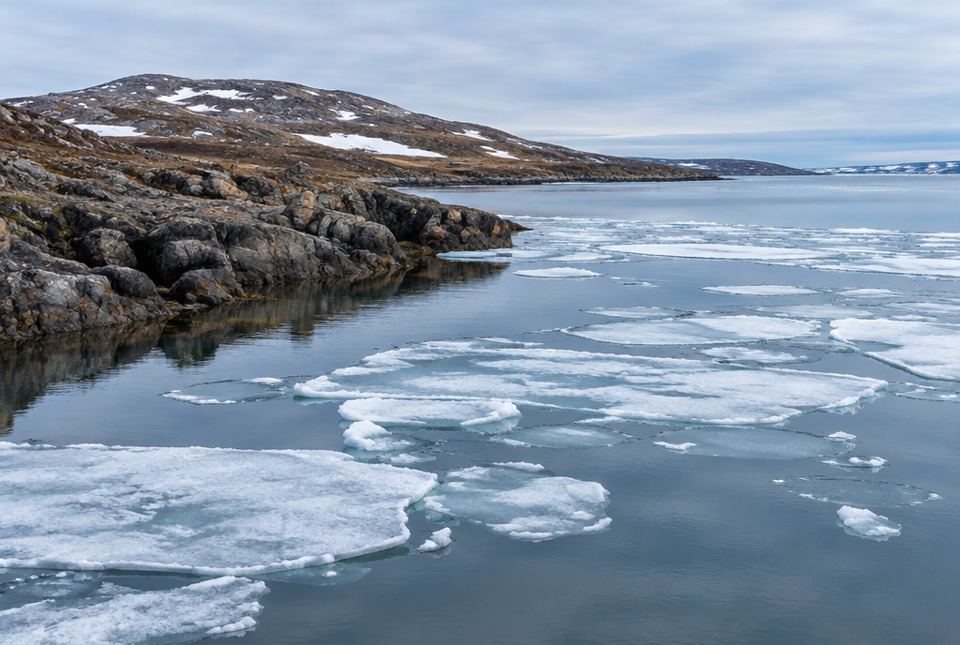 Thinning sea ice is a worry Inuit share across borders, in Canada, Alaska, Greenland and Russia. AI-generated imageSeen from above the North Pole, the four places where Inuit live (Chukotka, Alaska, Canada and Greenland) sit around one ocean. That is why the Inuit Circumpolar Council works across borders.
Remember from Grade 5
In Grade 5 you learned about First Nations, Métis and Inuit governments in Canada today, and about the duty to consult. You also met the UN Declaration on the Rights of Indigenous Peoples (UNDRIP), which talks about free, prior and informed consent.
This lesson looks at how First Nations, Métis and Inuit take part in international organizations and global issues.
The Inuit Circumpolar Council
The Inuit Circumpolar Council (ICC) was founded in 1977. It represents Inuit in Canada, Alaska, Greenland and Chukotka. The ICC:
- speaks for Inuit at the United Nations and other international meetings;
- works on climate change, pollution, wildlife, health and Inuit rights;
- is a permanent participant on the Arctic Council.
| Arctic Council permanent participants with members in Canada | Who they represent |
|---|
| Inuit Circumpolar Council | Inuit in Canada, Alaska, Greenland and Chukotka |
| Arctic Athabaskan Council | Athabaskan (Dene) First Nations in Canada and Alaska |
| Gwich'in Council International | Gwich'in in the Northwest Territories, Yukon and Alaska |
Speaking up for the Arctic
Sheila Watt-Cloutier is an Inuk from Kuujjuaq, in Nunavik (northern Quebec). As international chair of the ICC in the early 2000s, she explained to the world that climate change is a human rights issue: when the ice and snow change, Inuit hunters, families and culture are put at risk. She was nominated for the Nobel Peace Prize in 2007. She tells her story in her book The Right to Be Cold.
Inuit also helped show the world that pollution travels. Chemicals used far away were found in Arctic animals and people, carried north by wind and ocean currents. Inuit advocacy helped support a 2001 global accord, the Stockholm Convention, that bans or limits some of these chemicals.
First Nations on the world stage
- Deskaheh (Levi General), a Cayuga chief from the Six Nations of the Grand River in Ontario, travelled to Geneva, Switzerland, in 1923. He asked the League of Nations (an earlier world organization, before the UN) to recognize the Haudenosaunee as a self-governing nation. He was not given a hearing, but his journey is remembered as an early example of Indigenous Peoples taking their rights to the world.
- Today, the Haudenosaunee Nationals lacrosse teams compete in world championships as their own nation. Lacrosse comes from Haudenosaunee and other First Nations traditions.
- First Nations leaders and youth speak at the UN Permanent Forum on Indigenous Issues, created in 2000, alongside Indigenous Peoples from every continent.
UNDRIP and Canada
The UN Declaration on the Rights of Indigenous Peoples (UNDRIP) was adopted by the UN in 2007. Indigenous Peoples from around the world, including First Nations, Métis and Inuit from Canada, worked for many years to create it.
Canada's position changed over time:
- 2007: Canada was one of four countries that voted against it.
- 2010: Canada endorsed it, with some concerns.
- 2016: Canada announced its full support.
- 2021: Canada passed a federal law to put UNDRIP into practice in Canadian laws.
This shows how an international accord, and the people who push for it, can change a country's laws at home.
Sports and culture cross borders too
The North American Indigenous Games bring together First Nations, Métis and Inuit athletes from Canada and Native American athletes from the United States. The Arctic Winter Games include traditional Inuit and Dene games, with athletes from northern regions of several countries.
Worked exampleLet's figure out why working across borders helps
Why would Inuit in Canada team up with Inuit in Greenland and Alaska to speak about melting sea ice?
- Same problem: Sea ice is melting across the whole Arctic, not just in Canada.
- Same ways of life: Inuit in all four countries hunt, travel and live on the ice, so they are affected in similar ways.
- More knowledge: Each region notices different changes. Sharing knowledge gives a fuller picture.
- A stronger voice: Together they represent Inuit in four countries, so world leaders are more likely to listen.
Because the problem crosses borders, Inuit are stronger together: they share knowledge and speak with one united voice at places like the Arctic Council and the UN.
Just for funTry a map trick: look at a globe from the top instead of the side. Suddenly Canada, Alaska, Greenland and Russia look like neighbours sitting around one round table, the Arctic Ocean! 🌍
Hands-on activityPollution travels: a map model
You need: a sheet of paper, a pencil, and a small amount of flour or cocoa powder, plus a tray. Do this at a table with a grown-up.
- On the paper, draw a simple circle for the Arctic in the middle and write the names of some countries around the edges (for example, Canada, the United States, Russia, countries in Europe and Asia).
- Put the paper on the tray. Sprinkle a small pinch of flour at the edge of the paper near one country. This is "pollution" from a factory or farm far away.
- Gently blow across the paper toward the Arctic, like wind. (Blow away from everyone's faces.)
- Where did the flour end up? Did it stay at the border?
- Talk about it: Why couldn't Inuit solve this problem only by changing what happens in the Arctic?
What to look for: your child explains that wind (and ocean currents) carry pollution across borders, so countries far away must also act. Clean up with a damp cloth.
Your turn
1In which four countries or regions do Inuit live?
Canada, the United States (Alaska), Greenland (part of the Kingdom of Denmark) and Russia (Chukotka).
2What is the Inuit Circumpolar Council?
An organization founded in 1977 that represents Inuit across Canada, Alaska, Greenland and Chukotka and speaks for them internationally.
3What is a permanent participant on the Arctic Council?
An Indigenous Peoples' organization with a seat at the Council table alongside the eight Arctic countries.
4Name one Arctic Council permanent participant that includes First Nations in Canada.
Arctic Athabaskan Council or Gwich'in Council International.
5Why did Sheila Watt-Cloutier say climate change is a human rights issue?
Because changes to ice and snow threaten Inuit ways of life: hunting, travel, food, health and culture.
6What did Deskaheh do in 1923?
He travelled to Geneva to ask the League of Nations to recognize the Haudenosaunee as a self-governing nation.
More practice: warm-up
1What does circumpolar mean?
2What does UNDRIP stand for?
The United Nations Declaration on the Rights of Indigenous Peoples.
3In what year did the UN adopt UNDRIP?
4Which sport comes from Haudenosaunee and other First Nations traditions?
5Name a sports event for First Nations, Métis and Inuit athletes.
The North American Indigenous Games (or the Arctic Winter Games).
More practice: on your own
1Put Canada's positions on UNDRIP in order: full support, voted against, law passed, endorsed.
Voted against (2007) → endorsed (2010) → full support (2016) → law passed (2021).
2How did pollution from far away end up in the Arctic? Why did that matter for Inuit?
Wind and ocean currents carried chemicals north. They built up in animals Inuit hunt and eat, so they affected Inuit health, even though Inuit did not use those chemicals.
3How is the Haudenosaunee Nationals team competing at world championships an example of a First Nation in the global community?
The team represents the Haudenosaunee as their own nation internationally, sharing a sport that comes from their culture.
4Why might the Arctic Council be more effective with Indigenous permanent participants at the table?
Indigenous Peoples have lived in the Arctic for thousands of years and have deep knowledge of the land, ice and animals. They are also the people most affected by Arctic decisions.
5Why do Indigenous Peoples from many countries meet at the UN Permanent Forum on Indigenous Issues?
They face similar issues (land, rights, language, environment) and can share ideas and speak together to governments around the world.
Challenge
1Explain how UNDRIP shows that an international accord can change things inside a country.
UNDRIP was created at the UN. Over time, Canada moved from voting against it to passing a law in 2021 to bring Canadian laws in line with it. An international agreement led to new laws at home.
2Deskaheh was not given a hearing in 1923. Why might his journey still be considered important?
It was an early example of a First Nation taking its rights to an international organization. It inspired later Indigenous advocates, and Indigenous Peoples now have a place at the UN (like the Permanent Forum). Sometimes actions matter for the future, even if they do not succeed right away.
3A government plans a new shipping route through Arctic waters. Using this lesson, explain why Inuit organizations would want a say.
Ships affect sea ice, marine animals and hunting areas that Inuit depend on, and the waters are part of Inuit homelands. Through groups like the ICC and the Arctic Council, Inuit can share their knowledge and protect their rights, which UNDRIP recognizes.
Quiz
1. The Inuit Circumpolar Council represents Inuit in...
4. Deskaheh, a Cayuga chief, went to Geneva in 1923 to...
5. Why did Inuit leaders say climate change is a human rights issue?
6. A permanent participant on the Arctic Council is...
Big idea: First Nations, Métis and Inuit are active in the global community: through the Inuit Circumpolar Council and other Arctic Council permanent participants, at the UN, in international sport, and through decades of work that produced UNDRIP. Canada's position on UNDRIP changed from opposing it (2007) to passing a law to implement it (2021).
How to help at home:
- Look up the Inuit Circumpolar Council or the Arctic Council websites together and find one current project.
- If you can, borrow The Right to Be Cold by Sheila Watt-Cloutier from the library (it is written for adults, so read parts together).
- Speak about First Nations, Métis and Inuit in the present tense, as living peoples and nations with their own governments and organizations.
Common difficulties:
- Thinking Indigenous issues are only local. Indigenous Peoples live on every continent and work together internationally.
- Grouping all Indigenous Peoples together. First Nations, Métis and Inuit are distinct peoples, and there are many different First Nations.
- For the activity, use only a small pinch of flour or cocoa and wipe up afterwards.