C. Matter and Energy · Light and SoundHot Light and Cool Light: Light Sources and Heat
C2.7 C2.1 A1.2 A3.3About 35 minutes
Learning goals- I can sort light sources into those that give off a lot of heat and those that give off little heat.
- I can explain why LED bulbs save energy compared with old-style light bulbs.
- I can describe how the Inuit qulliq gives both light and heat.
- I can do a fair test to compare the heat from two light sources.
Words to know
heat
A form of energy that makes things warmer.
incandescent bulb
An old-style light bulb with a thin wire inside that glows because it is very hot. Most of its energy comes out as heat.
LED
A kind of light that gives off light with very little heat. LED bulbs use less energy.
energy efficient
Uses less energy to do the same job.
qulliq
A traditional Inuit lamp, carved from stone, that burns oil and gives both light and heat.
Warm on your face
Stand by a sunny window in winter and close your eyes. You can feel the sunshine warming your face. Now hold your hand near a phone flashlight (without touching it). It is bright, but it hardly feels warm at all. Some light sources give off light and heat, and some give off light with very little heat.
Two kinds of light sources
Light sources that give off light AND a lot of heat:
- the Sun
- fire: a campfire, a candle flame, a fireplace
- old-style (incandescent) light bulbs: a thin wire inside gets so hot that it glows
- a stove element or toaster wires when they glow
- lightning (extremely hot!)
Light sources that give off light but very little heat:
- LED bulbs and flashlights
- fireflies (their light is sometimes called "cold light")
- glow sticks
- phone and tablet screens (they get only a little warm)
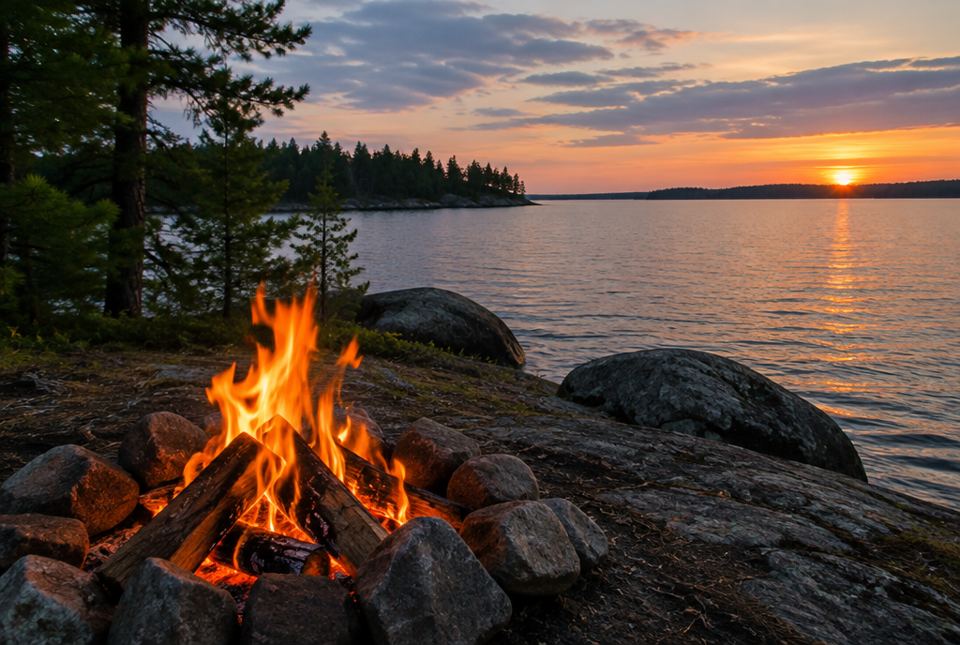 A campfire gives off both light and a lot of heat, just like the Sun setting behind it. AI-generated image
| Light and a lot of heat | Light with little heat |
|---|
| Sun | LED bulb |
| candle flame | firefly |
| campfire | glow stick |
| old-style (incandescent) bulb | LED flashlight |
| glowing toaster wires | phone screen |
Why LED bulbs save energy
An old-style incandescent bulb works by making a thin wire very hot. Most of the electrical energy it uses comes out as heat, not light. That heat is wasted if you only want light.
An LED bulb gives off light with very little heat. It uses much less electricity to make the same amount of light, and it lasts much longer. That is why many homes, schools and street lights in Ontario now use LEDs. Using less electricity saves money and is better for the environment. We say LEDs are more energy efficient.
The qulliq: light and heat together
For Inuit, a light source that also gives heat has long been very important in the cold Arctic. The qulliq (say KOOD-lik; sometimes spelled kudlik) is a traditional Inuit lamp carved from soapstone. It burns oil from seals or whales, with a wick made of moss or arctic cotton.
The qulliq gave Inuit families light during the long, dark Arctic winters and heat to warm the home. It was also used to melt snow and ice for drinking water, to cook, and to dry clothing. Caring for the qulliq flame is a special skill traditionally passed down by Inuit women.
Today, the qulliq is still lit at many important Inuit gatherings and celebrations, as a symbol of Inuit culture, knowledge and community.
Worked exampleLet's read a heat test
Nadia wanted to know: Which light source gives off more heat: sunlight or an LED desk lamp? She put one ice cube on a plate in a sunny window, one ice cube on a plate 10 cm under an LED desk lamp, and one ice cube on a plate in a shady corner of the same room. All the ice cubes came from the same tray. She checked every 5 minutes.
- in the sunny window: melted in 20 minutes
- under the LED lamp: melted in 40 minutes
- in the shady corner: melted in 45 minutes
- What changed? Only the light source (sunlight, LED lamp, or no direct light).
- What stayed the same? Same size ice cubes, same kind of plates, same room, same checking times. It was a fair test.
- Why the shady plate? It is the control. It shows how fast ice melts just from the warm air in the room.
- Compare to the control: the LED cube melted only 45 − 40 = 5 minutes faster than the shady cube. The sunny cube melted 45 − 20 = 25 minutes faster.
- So sunlight added a lot of heat. The LED lamp added very little.
The Sun gives off light and a lot of heat. The LED lamp gives off light with very little heat.
Nadia's results as a bar graph. The shorter the bar, the faster the ice melted. Sunlight melted the ice 25 minutes faster than the shade; the LED lamp only 5 minutes faster.Hands-on activityHot light or cool light?
You need: 3 ice cubes the same size from the same tray, 3 small plates the same kind, a sunny window, a lamp with an LED bulb (check the package or ask a grown-up), a clock or timer, paper and a pencil.
- Question: Does sunlight or an LED lamp give off more heat?
- Predict: which ice cube will melt first?
- Set up Nadia's test: one plate in the sunny window, one 10 cm under the LED lamp, one in a shady spot in the same room (the control).
- Check every 5 minutes and record what you see in a table.
- Conclude: which light source gave off the most heat? Was your prediction right?
- Extra: list every light source in your home in a T-chart: light and a lot of heat or light with little heat. Ask a grown-up which bulbs are LED.
What to look for: the cube in the sunny window melts much faster than the one under the LED lamp, and the LED cube melts only a little faster than the control. (On a cloudy day, results will be closer; try again on a sunny day.)
Safety: never touch a light bulb, especially an old-style bulb or a halogen lamp: they get hot enough to burn. Stay away from flames, stoves and toasters; they are for grown-ups only. Ice cubes are for melting, not for sucking on during the test. Wipe up the water when you are done.
Just for funWhat did the LED bulb say to the old-style bulb?
"Chill out! You're wasting all your energy getting hot!"
Your turn
1Name two light sources that give off light and a lot of heat.
Any two of: the Sun, a campfire, a candle flame, an old-style light bulb, glowing toaster wires, lightning.
2Name two light sources that give off light with very little heat.
Any two of: an LED bulb or flashlight, a firefly, a glow stick, a phone screen.
3In an old-style light bulb, where does most of the energy go?
Most of it comes out as heat, not light.
4Why do LED bulbs save energy?
They make light with very little heat, so they use much less electricity for the same amount of light.
A traditional Inuit lamp carved from soapstone. It burns seal or whale oil and gives light and heat.
6Name two jobs the qulliq did in an Inuit home.
Any two of: gave light, gave heat, melted snow and ice for water, cooked food, dried clothes.
More practice: warm-up
1A lot of heat or little heat: a candle flame?
2A lot of heat or little heat: a glow stick?
3A lot of heat or little heat: the Sun?
4A lot of heat or little heat: a firefly?
5Is it safe to touch a light bulb that has been on?
No. Some bulbs get hot enough to burn you.
More practice: on your own
1In Nadia's test, why did she put one ice cube in a shady corner?
It was the control. It showed how fast ice melts from the room's air alone, so she could compare the other two to it.
2The sunny cube melted in 20 minutes and the shady cube in 45 minutes. How much faster did the sunny cube melt?
25 minutes faster. 45 − 20 = 25.
3Why was the qulliq especially important in the Arctic?
The Arctic has long, dark, very cold winters. The qulliq gave both light and heat, and helped make water from snow and ice.
4A family replaces all their old-style bulbs with LEDs. Name two good results.
They use less electricity, so they save money; the bulbs last longer; they waste less energy as heat, which is better for the environment. (Any two.)
5Why might a firefly's light be called "cold light"?
It gives off light with almost no heat.
Challenge
1In a hot summer, why might a store owner prefer LED lights to old-style bulbs, besides saving electricity on the lights?
Old-style bulbs give off a lot of heat, which makes the store hotter. Then the air conditioner must work harder and use even more energy. LEDs give off little heat.
2Ben says, "Bright light is always hot light." Give an example that shows he is wrong.
A bright LED flashlight or a bright phone screen gives off a lot of light but very little heat. (A firefly or glow stick also works.)
3Nadia did her test on a cloudy day and all three cubes melted at about the same time. What should she do? Why?
Repeat the test on a sunny day. On a cloudy day, very little sunlight reached the window, so she wasn't really testing sunlight. Repeating a test helps make results trustworthy.
Quiz
1. Which light source gives off light and a lot of heat?
2. Which light source gives off light with very little heat?
3. Most of the energy used by an old-style (incandescent) bulb comes out as...
4. The qulliq is a traditional Inuit...
5. Why are LED bulbs called energy efficient?
6. In a fair test, the plate kept in the shade with no lamp is called the...
Big idea: Ontario Grade 4 expectation C2.7 asks children to distinguish between sources of light that emit both light and heat and those that emit light but little heat. The ice-cube test is a fair test with a control (A1.2). The qulliq is an example of an Inuit technology (A3.3); present it as part of living Inuit culture, not only the past.
How to help: Read the packages of the light bulbs in your home together and find the ones marked LED. Talk about your electricity bill and how LED bulbs help.
Common difficulties:
- Thinking all light sources are hot. LEDs, fireflies and glow sticks show they are not.
- Not understanding why heat from a bulb is "wasted". If you only want light, the heat is energy you paid for but didn't need.
- Forgetting the control. Ask "How would we know the lamp did anything, if we didn't have a plate with no lamp?"
Safety: children should never touch bulbs, especially old-style or halogen bulbs, or go near flames, stoves or toasters. You place the ice cube under the lamp. Ice cubes should not be sucked on during the experiment.