C. Matter and Energy · Light and SoundLight Bounces and Soaks In: Reflection and Absorption
C2.3 C2.6 A1.3 A1.4 A3.3About 40 minutes
Learning goals- I can explain that light reflects (bounces) off surfaces.
- I can explain why smooth, shiny surfaces like mirrors make clear images.
- I can explain that some materials absorb light energy and warm up.
- I can explain how Inuit snow goggles protect eyes from bright reflected light.
- I can use the design process to build a periscope, and use mirrors safely.
Words to know
reflection
When light bounces off a surface.
mirror
A very smooth, shiny surface that reflects light so well that it makes a clear image.
image
The picture you see in a mirror.
absorb
To soak up. Dark materials absorb a lot of light energy and warm up.
glare
Very bright light reflected off something like snow, ice or water. It can hurt your eyes.
periscope
A tube with two mirrors that lets you see over walls or around corners.
prototype
A first model of a design, built to test.
Snow day squint
After a big snowfall, the Sun comes out. Everything is so bright that you have to squint! The snow is not making light. It is reflecting a lot of sunlight into your eyes. And why does a black jacket feel warm in the sunshine, while a white jacket stays cooler? In this lesson you will find out what happens when light hits something.
Three things light can do
When light hits an object, it can:
- Reflect: bounce off it.
- Be absorbed: soak into it.
- Pass through it (if it is transparent or translucent), sometimes bending as it goes. You will learn about bending in the next lesson.
Often more than one of these happens at the same time.
Reflection
All objects we see reflect some light. But surfaces reflect in different ways.
- Smooth, shiny surfaces like a mirror, a still lake, a shiny spoon or a window at night reflect light in a neat, even way. They make a clear image. You can see yourself!
- Rough or dull surfaces like paper, cloth, wood or snow scatter the light in many directions. You can see the object, but you cannot see your image in it.
When light hits a mirror, it bounces off at the same angle it came in, like a ball bouncing off a wall. That is why you can aim reflected light.
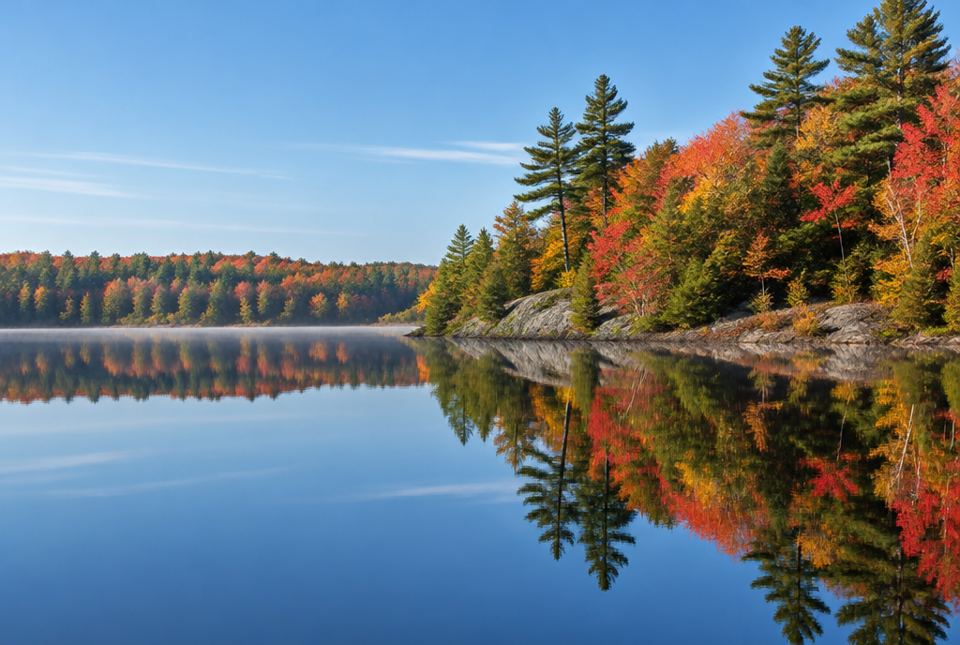 The smooth, still water reflects light evenly, so it makes a clear upside-down image of the trees. AI-generated imageLight hits the mirror and bounces off at the same angle it came in.A smooth surface sends all the rays back in neat parallel lines, so you see an image. A rough surface scatters them in many directions, so you see the paper but not yourself.
Mirror writing
A mirror flips things left to right. That is why the word AMBULANCE is often printed backwards on the front of an ambulance. When drivers ahead look in their rear-view mirror, the word appears the right way around, so they can read it and move over.
Absorption
When light is absorbed, its energy soaks into the material. Absorbed light energy usually turns into heat, so the material warms up.
- Dark colours, especially black, absorb most of the light that hits them. They warm up quickly in the Sun.
- White and light colours reflect most of the light. They stay cooler.
That is why a black car gets very hot on a sunny summer day, and why many people wear light-coloured clothes in hot weather. Dark rubber mats on sunny steps can help snow and ice melt a bit faster.
Too much reflected light: Inuit snow goggles
Fresh snow reflects a great deal of sunlight. In the Arctic in spring, there is snow and ice everywhere and the Sun shines for many hours a day. All that glare can hurt the eyes and even cause snow blindness, a painful sunburn of the eyes.
Inuit have long solved this problem with snow goggles. They are carved from materials like wood, bone or antler, and they have narrow slits to look through. The slits let in only a little light, so the wearer can see without being blinded by the glare. This clever technology is still made and admired today, and it works on the same idea as modern sunglasses: block extra light to protect the eyes.
Worked exampleLet's read an absorption test
Leo wanted to know: Does a dark colour warm up more in the Sun than a light colour? He filled two identical cups with the same amount of cold water. He wrapped one cup in black paper and one in white paper. He set both cups side by side in a sunny window for one hour and measured the temperature.
- start: both cups 15 °C
- after 1 hour: black cup 26 °C, white cup 21 °C
- What did Leo change? Only the colour of the paper (black or white).
- What stayed the same? The same cups, the same amount of water, the same starting temperature, the same window, the same time. It was a fair test.
- How much did each warm up? Black: 26 − 15 = 11 degrees. White: 21 − 15 = 6 degrees.
- Compare: the black cup warmed up 11 − 6 = 5 degrees more.
Yes. The black paper absorbed more light energy, so its water warmed up more. The white paper reflected more light.
Just for funWhy was the mirror so good at science class?
It always took time to reflect!
Engineering with mirrors: the periscope
A periscope uses two mirrors to let you see over a wall or around a corner. Light from the object hits the top mirror and reflects down the tube. Then it hits the bottom mirror and reflects into your eye. Submarines use periscopes to see above the water.
Engineers use a design process: ask (what is the problem?), plan, build a prototype, test, improve, and share.
Hands-on activityDesign challenge: build a periscope
Problem: Design a tool that lets you see over the back of a couch without standing up.
You need: a clean, empty milk or juice carton (1 or 2 litres), two small flat mirrors (plastic safety mirrors are best; small compact mirrors also work), tape, a pencil, a ruler. A grown-up will need scissors or a craft knife.
- Ask: What should success look like? (You can see something clearly over the couch.)
- Plan: draw your design. A grown-up cuts a square window near the top of one side and a square window near the bottom of the opposite side.
- Build: tape one mirror inside the top, facing down at a slant (about halfway between flat and straight up). Tape the other mirror inside the bottom, facing up at the same slant, so the two mirrors face each other.
- Test: look into the bottom window. Can you see over the couch? Is the image clear?
- Improve: if you see only the inside of the carton, adjust the angle of one mirror and test again.
- Share: draw the path of the light through your periscope with arrows.
What to look for: when both mirrors are at the same slant and facing each other, your child sees objects above the top window. Their arrow drawing should show light going in the top window, bouncing down off the top mirror, then bouncing off the bottom mirror into the eye.
Safety: a grown-up does all cutting. Use plastic mirrors if you can; glass mirrors can break and have sharp edges. Never use a mirror or periscope to look at the Sun or to bounce sunlight into anyone's eyes, and never play with laser pointers.
Your turn
1What does it mean when light reflects?
It bounces off a surface.
2Why can you see yourself in a mirror but not in a sheet of paper?
A mirror is smooth and shiny, so it reflects light evenly and makes a clear image. Paper is rough, so it scatters light in many directions.
3Which warms up more in the Sun: a black T-shirt or a white T-shirt?
The black T-shirt. Dark colours absorb more light energy.
4What happens to light energy that is absorbed?
It soaks in and usually turns into heat, so the material warms up.
5Why do Inuit snow goggles have narrow slits?
To let in only a little light, so the bright glare reflected off the snow and ice does not hurt the eyes.
6How many mirrors does a simple periscope use?
7Name two safety rules for using mirrors.
For example: never reflect sunlight into anyone's eyes; never look at the Sun with a mirror; let a grown-up handle glass mirrors and cutting.
More practice: warm-up
1Reflect or absorb: light bouncing off a mirror?
2Name something smooth and shiny that you can see your image in.
For example: a mirror, a shiny spoon, a still lake, a window at night.
3Do white things reflect or absorb most light?
Very bright reflected light, for example off snow, ice or water.
5In the design process, what do you do after you test?
Improve your design (then test again).
More practice: on your own
1In Leo's test, the black cup warmed up 11 degrees and the white cup warmed up 6 degrees. How many more degrees did the black cup warm up?
2Why is AMBULANCE written backwards on the front of an ambulance?
A mirror flips words left to right. When drivers ahead look in their rear-view mirror, the backwards word looks the right way around, so they can read it.
3You want a tent that stays cool on a hot summer day. Should it be dark or light in colour? Explain.
Light-coloured. Light colours reflect most of the sunlight, so less light energy is absorbed and turned into heat.
4Snow is white and rough, not shiny. Why can it still cause glare?
Snow reflects a lot of light. It scatters the light in many directions, so bright light comes at your eyes from everywhere.
5Your periscope shows only the dark inside of the carton. What should you check and change?
Check the angle of the mirrors. Both should be on a slant and face each other. Adjust one, then test again.
Challenge
1Light hits a mirror at a slant from the left. Which way does it bounce: back the way it came, or off to the right at the same slant? Explain.
Off to the right at the same slant. Light bounces off a mirror at the same angle it came in, like a ball bouncing off a wall.
2Explain how Inuit snow goggles and modern sunglasses use the same science idea.
Both reduce the amount of light reaching the eyes. The goggles do it with narrow slits; sunglasses do it with dark lenses that absorb some light. Both protect the eyes from glare.
3Plan a fair test: does a dark mat help snow melt faster than a white mat? Say what you change, what you keep the same, and what you measure.
Change: only the mat colour (one dark, one white). Keep the same: same size mats, same amount of snow on each, same sunny spot, same time. Measure: how long until the snow melts, or how much snow is left after one hour.
Quiz
1. When light bounces off a surface, it is...
2. Which surface makes the clearest image?
3. Which colour absorbs the most light and warms up the most in the Sun?
4. What usually happens to absorbed light energy?
5. Inuit snow goggles protect the eyes by...
6. Which is a safe way to use a mirror?
Big idea: Ontario Grade 4 expectation C2.3 includes that light can be reflected and absorbed, and C2.6 asks how different materials interact with light. Smooth shiny surfaces make clear images; dark materials absorb more light and warm up. The periscope uses the engineering design process (A1.3) and safe handling of materials (A1.4). Inuit snow goggles are an example of a technology from a First Nations, Métis or Inuit community (A3.3).
How to help: Look for reflections together: a spoon (the inside flips you upside down!), a window at night, a puddle. On a sunny day, touch a dark car door and a light one (carefully; dark surfaces can get very hot in summer).
Common difficulties:
- Thinking only mirrors reflect light. Everything we see reflects some light; mirrors just do it evenly.
- Thinking black things "attract" heat. They absorb light energy, which becomes heat.
- Mirror angles: a Grade 4 student only needs to know that light bounces off at the same angle it hits.
Safety: do all cutting yourself, use plastic mirrors if possible, and never allow mirrors to be used to aim sunlight. Keep laser pointers away from children.