A. Creating Canada, 1850–1890 · Creating Canada, 1850–1890From Sea to Sea: British Columbia, PEI and the Black Pioneers of Victoria
A3 A2 A1About 50 minutes
Learning goals- I can explain why British Columbia (1871) and Prince Edward Island (1873) joined Canada, and why Newfoundland did not.
- I can describe the contributions of the Black pioneers who settled in Victoria in 1858, including Mifflin Gibbs, and the obstacles they faced.
- I can explain how the joining of these provinces affected Indigenous peoples.
- I can describe how Canada's map changed between 1867 and 1880.
Words to know
terms of union
The conditions a colony negotiated before joining Canada.
gold rush
A rush of people to a place where gold has been found. The Fraser River gold rush began in 1858.
absentee landlord
A landowner who lives far away and collects rent from the people farming the land.
Yale Convention
A meeting at Yale, British Columbia, in 1868 that called for BC to join Canada and set out terms.
militia
A group of citizen volunteers trained to defend their community.
Douglas Treaties
Fourteen agreements made between 1850 and 1854 between Governor James Douglas and First Nations on Vancouver Island.
Let's start with a question
Canada's motto is A mari usque ad mare: "From sea to sea." In 1867 Canada reached only one sea, the Atlantic. How did it reach the Pacific? And who was already living on the Pacific coast when it did?
The answer includes First Nations, gold miners, Chinese newcomers, and a group of Black pioneers who chose British territory over the United States.
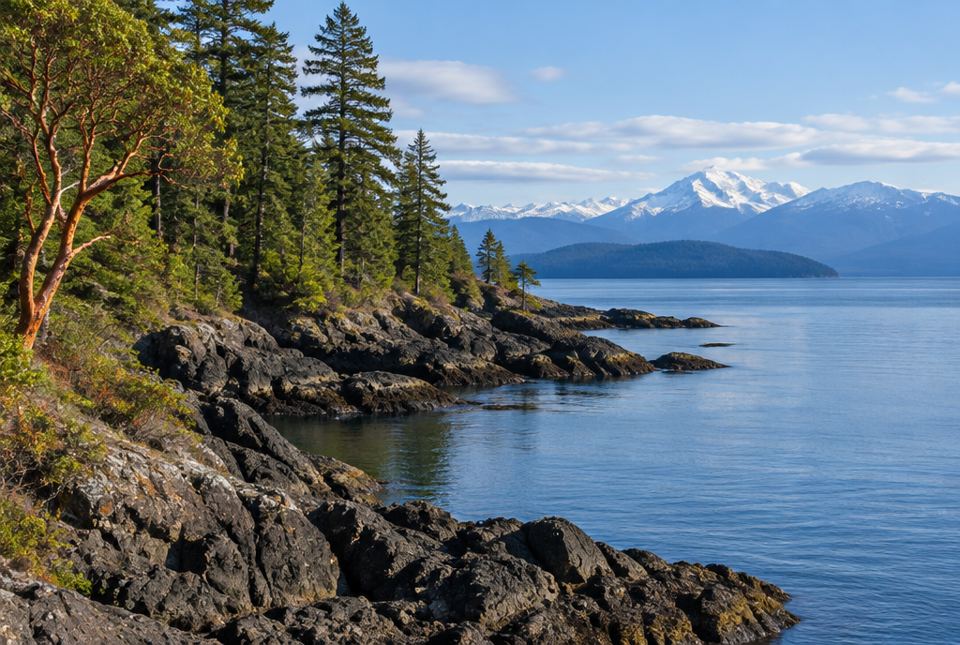 The Pacific coast of Vancouver Island, where Victoria grew. Reaching this coast was what 'from sea to sea' meant, and it was already home to First Nations long before the colony or Confederation. AI-generated image
Black pioneers in Victoria, 1858
In the 1850s, California had a large Black community, but California laws denied Black people political rights, such as voting, and limited their rights in court. In 1858, the Black community of San Francisco decided to look for a new home.
- Governor James Douglas of the colony of Vancouver Island welcomed them. The Fraser River gold rush was bringing thousands of American miners north, and Douglas wanted settlers loyal to Britain to balance them. (Douglas himself was born in British Guiana, in South America, to a Scottish father and a mother described in records as a free woman of colour.)
- Several hundred Black people moved to Victoria and nearby areas in 1858. Some later farmed on Salt Spring Island.
- Mifflin Wistar Gibbs, a businessman from Philadelphia who had lived in San Francisco, opened a store in Victoria that sold supplies to miners, competing with the Hudson's Bay Company. He wrote that British Columbia offered protection and "equality of political privileges".
- In 1866, Gibbs was elected to Victoria City Council, the first Black person elected to public office in what is now British Columbia.
- In 1868, Gibbs was a delegate at the Yale Convention, which set out the terms for BC to join Canada. A Black pioneer helped bring British Columbia into Confederation.
Obstacles in Victoria
The Black pioneers found more rights than in California, but not equality.
- In 1860, the best seats (the dress circle) in a Victoria theatre were reserved for white customers. In 1861, white men threw flour on Gibbs and a Black business partner at a theatre performance; the men were acquitted because witnesses would not testify.
- Some saloons refused to serve Black customers, and Black men were refused as volunteer firefighters in 1859.
- Black men formed their own militia, the Victoria Pioneer Rifle Company (sometimes called the African Rifles), sworn in in 1861. They built their own drill hall. But in 1864, organizers of a parade to welcome a new governor refused to let the company march.
Many of the pioneers, including Gibbs (in 1870), returned to the United States after the Civil War ended slavery there. Others stayed, and their descendants are part of BC today. Parks Canada recognized Gibbs as a Person of National Historic Significance in 2017.
British Columbia joins, 1871
- Vancouver Island and the mainland colony of British Columbia united in 1866. The united colony was in debt after the gold rush.
- Some colonists wanted to join the United States; others wanted to stay a British colony. Many, like Gibbs and Amor De Cosmos, pushed to join Canada.
- The terms: Canada would take over BC's debt, and would start a railway to connect BC to the rest of Canada within two years and finish it within ten years.
- BC joined Canada on July 20, 1871.
First Nations perspective: On Vancouver Island, Douglas had made 14 treaties (1850–1854), but almost all of the rest of British Columbia was never covered by treaties. First Nations were not part of the negotiations. As settlers and miners arrived, many First Nations lost access to land and resources without agreement. Many land claims in BC are still being negotiated today.
Prince Edward Island joins, 1873
- PEI said no in 1867. Islanders feared being a tiny voice in a big country.
- But PEI faced two big problems: a costly railway that put the colony deeply in debt, and the land question: most of the island's land had been owned by absentee landlords in Britain since the 1760s, and many farmers paid rent on land they could never own.
- Canada offered to take over the railway debt and to lend $800,000 to buy out the absentee landlords.
- PEI joined Canada on July 1, 1873.
The rest of the map
- 1870: Rupert's Land and the North-Western Territory became Canada's North-West Territories (Manitoba was created the same day).
- 1880: Britain transferred its claims to the Arctic islands to Canada. Inuit were not consulted and, in this period, most Inuit communities had little contact with the Canadian government.
- Newfoundland stayed out. In an 1869 election, anti-Confederates won a big victory. Newfoundland did not join Canada until 1949.
| Province | Joined | Main reasons | Who was not consulted |
|---|
| Manitoba | 1870 | Métis negotiated terms after the Red River Resistance | Many First Nations of the region |
| British Columbia | July 20, 1871 | Debt; promise of a railway | First Nations (most land never under treaty) |
| Prince Edward Island | July 1, 1873 | Railway debt; buying out absentee landlords | The Mi'kmaq of the Island |
| Newfoundland | Stayed out (joined 1949) | Anti-Confederates won the 1869 election | n/a |
Worked exampleModelled example: Why did Black pioneers support BC joining Canada?
Use cause and perspective to explain why Mifflin Gibbs worked for Confederation in 1868.
- What had he experienced? In California, Black people were denied political rights. In British territory he could vote and be elected.
- What were the options for BC? Stay a British colony, join the US, or join Canada.
- How did each option look from his perspective? Joining the US in 1868 was risky: slavery had just ended, and racist laws were common. Staying a debt-ridden colony was unstable. Joining Canada, another British country, would keep British law and protect the rights he had gained.
- Evidence: He was elected to Victoria City Council (1866) and was a delegate at the Yale Convention (1868).
Gibbs's support makes sense from the perspective of a Black man who had gained rights under British law. It shows that Black British Columbians were active builders of Confederation, not just observers.
Joined vs created
Ontario, Quebec, Nova Scotia and New Brunswick created Canada in 1867. Manitoba (1870), British Columbia (1871) and PEI (1873) joined it. Alberta and Saskatchewan came later, in 1905, which you'll study in the unit Canada, 1890–1914.
Just for funPEI joined Canada in 1873, but it didn't get a bridge to the mainland until 1997: the 12.9-km Confederation Bridge. That's a 124-year wait for a shortcut. 🌉
Hands-on activityA growing-country timeline strip
You need: a long strip of paper (tape two sheets together), a ruler and coloured pencils.
- Draw a line and mark 1865 at one end and 1885 at the other. Make each year 1 cm apart (20 cm total).
- Mark and label: 1867 Confederation, 1870 Manitoba and the North-West Territories, 1871 BC, 1873 PEI, 1880 Arctic islands.
- Below the line, add events from Black and Indigenous history in the same years: 1866 Gibbs elected in Victoria, 1868 Yale Convention, 1869 Red River Resistance begins.
- Ask a grown-up: what does putting both rows together show that one row alone would not?
Look for: correct spacing, and the idea that the "growing country" story and the stories of Black and Indigenous peoples happened at the same time and are connected.
Your turn
1Why did many Black Californians move to Victoria in 1858?
California laws denied them political rights, and Governor Douglas welcomed them to Vancouver Island.
A Black businessman who settled in Victoria in 1858, was elected to Victoria City Council in 1866, and was a delegate at the Yale Convention (1868).
3Name one obstacle Black pioneers faced in Victoria.
Any one: segregated theatre seating; being attacked with flour at a theatre; saloons refusing service; being refused as firefighters; their militia barred from a parade in 1864.
4What did Canada promise British Columbia in 1871?
To take over its debt and to build a railway linking BC with the rest of Canada (start in 2 years, finish in 10).
5When did BC and PEI join Canada?
BC: July 20, 1871. PEI: July 1, 1873.
6What was PEI's "land question"?
Most land was owned by absentee landlords in Britain, and farmers paid rent on land they could not own.
7When did Newfoundland join Canada?
More practice: warm-up
1What is Canada's motto in English?
2Which gold rush began in 1858?
The Fraser River gold rush.
3What was the name of the Black militia in Victoria?
The Victoria Pioneer Rifle Company.
4How much did Canada lend PEI to buy out the landlords?
5What did Britain transfer to Canada in 1880?
Its claims to the Arctic islands.
More practice: on your own
1Why did Governor Douglas welcome Black settlers in 1858?
He wanted settlers loyal to Britain to balance the many American miners arriving in the gold rush.
2Why is Gibbs's role at the Yale Convention significant?
It shows a Black pioneer directly helping to bring British Columbia into Canada. Black people were part of building Confederation.
3Why did the railway promise matter so much to British Columbians?
BC was far from the rest of Canada, with the Rockies in between. Without a railway, joining Canada would bring little trade or connection.
4Explain how BC's joining Canada affected First Nations differently from settlers.
Settlers gained a railway promise and debt relief. Most First Nations were not consulted, most of their lands were never under treaty, and settlement took their land and resources without agreement.
5Why did many Black pioneers, including Gibbs, return to the US after 1865?
The US Civil War ended slavery there, opening new opportunities, and they still faced racism in Victoria.
Challenge
1Compare the Black pioneers' experience in Victoria with Black communities in Canada West in the 1850s. Give one similarity and one difference.
Similarity: both found more rights under British law (voting, being elected: Abraham Shadd in 1859, Gibbs in 1866) but faced racism (segregated schools in Canada West; segregated theatres and exclusion in Victoria). Difference: many in Canada West were freedom seekers escaping slavery, while most Victoria pioneers were free people leaving California's unequal laws.
2PEI joined in 1873 after refusing in 1867. Using cause and consequence, explain what changed.
PEI's railway debt grew too large, and Islanders still wanted to solve the land question. Canada's offer to take over the debt and lend $800,000 to buy out landlords made joining worth it. Changed circumstances changed the decision.
3Was Canada's expansion between 1867 and 1880 the result of agreement? Give a balanced answer.
Partly: Manitoba, BC and PEI negotiated terms through their leaders and legislatures. But the Indigenous peoples of the West, BC and the Arctic were mostly not consulted, and Nova Scotians and others had no direct vote. So it was agreement among colonial governments, not among all peoples.
Quiz
1. Why did Black pioneers move from California to Victoria in 1858?
2. What office did Mifflin Gibbs win in 1866?
3. What did Canada promise BC to convince it to join?
4. When did PEI join Canada?
5. Which colony stayed out of Canada until 1949?
6. Which statement about First Nations in BC is accurate?
7. What happened to the Victoria Pioneer Rifle Company in 1864?
Big idea: Students describe significant developments in Canada's expansion (A3), with attention to the contributions of Black pioneers and the obstacles they faced, as the 2026 curriculum emphasizes; they compare perspectives (A2) and think about change over time (A1).
How to help: Look at a map of BC together and find Victoria, Salt Spring Island and Yale. Ask: why would a railway matter so much to people this far away?
Sensitive points: Racism in Victoria is described factually. If your child asks about James Douglas's ancestry: he was born in British Guiana to a Scottish father and a mother described in records as a free woman of colour, with roots in the Caribbean.
Common difficulties: Thinking BC joined in 1867; forgetting the railway promise; thinking all of BC is under historic treaties.