B. Drama / D. Visual Arts · Drama and Visual ArtsVisual Arts: Sculpture, Installations, Culture and Identity
D1.4 D2.1 D2.4 D3.1 D3.2About 50 minutes
Learning goals- I can tell the difference between open-form and closed-form sculpture, and describe what an installation is.
- I can create textures with a variety of tools, materials and techniques.
- I can describe how art forms and styles reflect the beliefs and traditions of different cultures and civilizations.
- I can explain the functions of visual and media arts today and in the past, and how art shapes personal and cultural identity.
- I can identify my strengths, interests and areas for improvement as a creator, interpreter and viewer of art.
Words to know
sculpture
A three-dimensional art work that has height, width and depth.
closed form
A sculpture that is compact and solid, with few or no openings, so the eye stays on its surface.
open form
A sculpture with openings and parts that reach out, so space flows through and around it.
installation
An art work that fills or transforms a whole space, often one viewers walk into or around. It may use objects, light, sound or video.
actual texture
How a surface really feels when you touch it.
implied texture
Texture that is drawn or painted so it looks rough, smooth or furry, even though the surface is flat.
identity
Who you are: the things that make you, or your community, unique.
civilization
A large, organized society with cities, government and shared culture, such as ancient Greece.
Remember from Grade 6
You studied how art forms and styles reflect the beliefs and traditions of communities (ancient Egyptian tomb painting, Métis floral beadwork, the Woodland style of Norval Morrisseau, the Group of Seven, Inuit prints from Kinngait), and the functions of art in your community and in Canada. You also made relief prints with textures.
In Grade 7 you will explore sculpture and installations, create textured landscapes, and look at how art connects to identity, yours and your community's.
Walk under a giant spider
Outside the National Gallery of Canada in Ottawa stands Maman (1999), a sculpture of a gigantic spider by the artist Louise Bourgeois. Its long, thin legs arch high above the ground, and visitors walk right underneath. Maman means "Mom" in French: Bourgeois made it as a tribute to her mother, who repaired tapestries, and connected the spider's weaving to her mother's careful, protective work.
You can't experience Maman from one side, like a painting. You walk around and under it, and the space between its legs becomes part of the art work.
Closed form and open form
- Closed form: compact and solid, with few or no openings. Your eye travels around its surface and mass. A smooth river stone is like a natural closed form. Many stone carvings by Inuit artists are compact, rounded closed forms.
- Open form: has holes, gaps and parts that reach out, so space flows through it. Wire sculptures, Maman's arching legs and hanging mobiles (the American artist Alexander Calder is famous for mobiles that move in the air) are open forms.
Installations
An installation transforms a whole space. Viewers often walk into it, around it or even take part in it. Installations may use everyday objects, light, sound, video or natural materials, and many are temporary.
In 1991, the Anishinaabe artist Rebecca Belmore, a member of Lac Seul First Nation in northwestern Ontario, created Ayum-ee-aawach Oomama-mowan: Speaking to Their Mother, a huge wooden megaphone. She brought it to different places across Canada and invited people to speak through it directly to the land. The art work wasn't only the object: it was the people, their voices and the land together.
Texture
- Actual texture is what you feel when you touch a surface: rough bark, smooth stone.
- Implied texture is drawn or painted to look rough or smooth on a flat surface.
For a textured landscape, try different tools and materials: dab with a sponge for leaves, drag a comb or an old card through wet paint for grass or water, spatter with an old toothbrush for snow, press crumpled foil for rocks, mix a little sand into paint for a beach, or make rubbings of bark and leaves with a crayon.
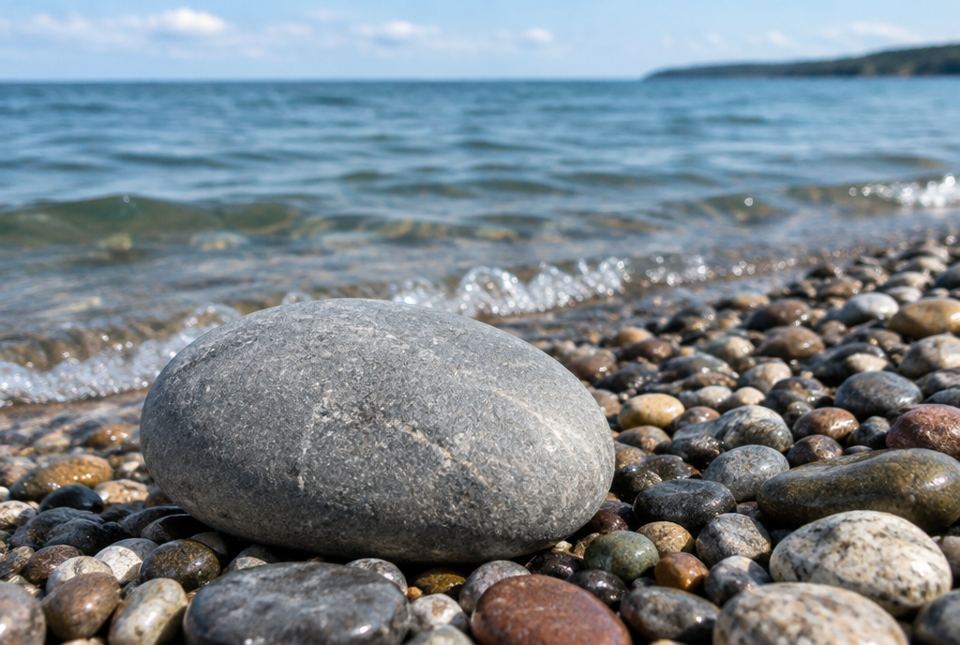 A smooth stone is a good example of closed form: compact and solid, so your eye travels around its surface and mass. AI-generated imageFour tools for implied texture in a textured landscape: sponge dabs for leaves, a comb dragged through paint for grass or water, toothbrush spatter for snow, and crumpled foil prints for rocks.
Art reflects beliefs and traditions
Art forms and styles grow out of what a culture believes and values. Here are a few, from long ago and today.
| Culture or civilization | Art form and style | Beliefs, values or traditions it reflects |
|---|
| Ancient Greece (about 2,500 years ago) | marble and bronze sculptures of gods, athletes and heroes, with carefully balanced, idealized proportions (many were originally painted in bright colours) | beauty, balance and human excellence; honouring the gods |
| Haida Nation (Haida Gwaii, British Columbia), past and present | formline design with flowing lines, ovoids and U-shapes; carved poles, masks, canoes, prints and jewellery showing crest figures such as Raven and Eagle | family crests, histories and relationships with the land and sea; Haida artists such as Robert Davidson continue this work today |
| Inuit (Inuit Nunangat, the Inuit homeland in the North), present day | carving in stone, bone and antler; printmaking and drawing | life on the land and sea, family, stories and community, shown by Inuit artists in their own styles |
| Asante and Ewe peoples (Ghana) | kente cloth, woven in narrow strips and sewn together; colours and patterns have names and meanings | history, status and celebration; worn on important occasions |
Art and identity, today and in the past
Art has always done important jobs (functions): honouring gods and spirits, recording history, showing who has power, teaching, decorating everyday objects, and remembering people. Today it also sells products, shares news, protests injustice and helps people heal.
Art also shapes identity:
- Personal identity: the clothes you choose, how you decorate your room or your binder, the profile picture or avatar you design, the photos you take. All of these show who you are.
- Cultural identity: Bill Reid, a Haida artist, created The Spirit of Haida Gwaii, a large bronze canoe crowded with figures from Haida stories, such as Raven, Bear and Eagle. One version, The Jade Canoe, greets travellers at Vancouver International Airport, sharing Haida culture with the world. Many graduates of African descent in North America wear kente stoles at graduation to celebrate their heritage. The Métis flag, a white infinity symbol on a blue (or red) background, is a symbol of Métis identity.
- National identity: coins, stamps, flags and monuments help a country tell a story about itself. Asking whose stories are shown, and whose are missing, is part of thinking critically about art.
Worked exampleExample: Interpreting an installation
Imagine an installation in a library atrium: hundreds of paper birds hang from the ceiling at different heights. Each bird has a word written by a community member about what home means to them, in many languages. Soft recorded sounds of wind and voices play.
- First reaction: "I feel peaceful but also a bit sad."
- Describe: paper birds (an open arrangement that viewers walk under), handwritten words in many languages, sound of wind and voices.
- Analyse: the birds are repeated (unity), hung at different heights (variety); sound turns the space into an experience.
- Interpret: the theme is home and migration: birds travel, and so do people who move to new countries. The many languages show the community's diversity.
- Function and identity: the installation helps people see that the community is made of many identities and stories, and invites them to add their own.
An installation is interpreted by looking at the space, objects, sound and viewer experience, and by asking what it says about identity and community.
Just for funFunny but true: Maman, the giant bronze spider outside the National Gallery of Canada, is more than 9 metres tall. It may be the only spider in Canada that people happily line up to walk under.
Worked exampleExample: Reflecting as creator, interpreter and viewer
At the end of the unit, a student looks back at their portfolio.
- Creator, strength: "My two-point perspective corner store really looks 3-D, and my blue-violet shadows made it feel like winter."
- Creator, area for improvement: "My logo had too many details. I need to simplify earlier and test it small."
- Interpreter, strength: "I can explain how lines and colour create mood, using design words."
- Interpreter, area for improvement: "I should ask more about culture and context before I decide what a symbol means."
- Viewer, interest: "I want to see Maman in Ottawa and learn more about Haida formline design from Haida artists."
- Goal: "Next, I'll build a small open-form sculpture from wire and paper."
A strong reflection gives specific strengths, areas for improvement and interests in all three roles, and sets a goal.
Learning about cultures with respect
- Name the Nation, people or place: Haida, Inuit, Anishinaabe, Asante and Ewe, ancient Greece.
- Talk about Indigenous art as living: First Nations, Métis and Inuit artists are creating new work today.
- Learn from artists, communities, galleries and museums, and from books by Indigenous authors.
- Be inspired by ideas such as texture, form or symbolism, but don't copy crests, sacred designs or another culture's symbols into your own work.
Hands-on activitySculpture, texture and identity
You need: aluminum foil, pipe cleaners or soft craft wire, modelling clay or salt dough, a sponge, an old comb or card, an old toothbrush, paint, paper, a crayon, and (optional) a shoebox and a flashlight.
- Closed and open forms: squeeze a ball of clay or foil into a compact, smooth closed form (an animal or a stone shape). Then bend pipe cleaners or wire into an open form with loops and gaps (ask a grown-up to cut wire; the ends can be sharp). Shine a flashlight on each. How are the shadows different?
- Textured landscape: paint a landscape (a forest, a rocky shore, a snowy field) using at least four texture techniques: sponge, comb, toothbrush spatter, crumpled foil, sand in paint, crayon rubbings.
- Mini installation: turn a shoebox into a tiny room installation about identity: "What home means to me." Use objects, paper, light (a flashlight, never a candle) and words.
- Identity sculpture: make a small sculpture (open or closed) with three symbols that show something about you.
- Culture connection: choose one art form from the table. With a grown-up, look at examples on a gallery or museum website. Write how it reflects the beliefs or traditions of its culture.
- Reflect: write one strength, one area for improvement and one interest as a creator, an interpreter and a viewer, and set a goal.
Your turn
1What is the difference between open form and closed form sculpture?
Closed form is compact and solid, with few or no openings. Open form has openings and parts reaching out, so space flows through it.
An art work that fills or transforms a whole space, often one viewers walk into or around, sometimes with light, sound or video.
3Name three tools or materials you could use to create texture in a landscape painting.
Any three: sponge, comb or old card, old toothbrush (spatter), crumpled foil, sand in paint, crayon rubbings, a palette knife.
4Who made Maman, when, and where can you see it in Canada?
Louise Bourgeois, 1999, outside the National Gallery of Canada in Ottawa.
5Describe Rebecca Belmore's Speaking to Their Mother.
A huge wooden megaphone (1991) that Belmore, an Anishinaabe artist, took to places across Canada, inviting people to speak to the land through it.
6Name one way art shapes personal identity.
Any one: the clothes you choose, how you decorate your room or binder, your profile picture or avatar, the photos you take.
7What values does ancient Greek sculpture reflect?
Beauty, balance and human excellence, and honouring the gods.
More practice: warm-up
1A smooth, rounded stone carving with no holes is ___ form.
2Is texture you feel with your hand actual or implied?
3What does Maman mean in English?
4Which artist is famous for hanging mobiles?
5Where does kente cloth come from?
Ghana (woven by Asante and Ewe weavers).
More practice: on your own
1Why is Maman an open-form sculpture?
Its long, thin legs arch above the ground with lots of space between them, and people can walk underneath. Space flows through it.
2How does The Spirit of Haida Gwaii connect to cultural identity?
It shows figures from Haida stories (such as Raven, Bear and Eagle) in a canoe, a key part of Haida life and travel. Placed at a busy airport (The Jade Canoe), it shares Haida culture and identity with people from around the world.
3Give two functions art had in the past and two it has today.
Past: any two, such as honouring gods and spirits, recording history, showing who had power, decorating everyday objects, remembering people. Today: any two, such as advertising, sharing news, protest, healing, decorating spaces, expressing identity.
4Why do many Haida, Inuit and other Indigenous art forms need to be described in the present tense?
Because they are living traditions: Indigenous artists such as Haida artist Robert Davidson and Inuit carvers and printmakers are creating new work today.
5Describe a textured landscape of a rocky Lake Superior shore. Which techniques would you use where?
Example: crumpled foil pressed in grey paint for the rocks; sponge dabs for the pine needles; comb dragged through blue paint for the waves; toothbrush spatter for spray. Look for techniques matched to surfaces.
Challenge
1Compare how art connects to identity in two different cultures from the lesson.
Example: Haida formline art shows family crests and histories, connecting people to their lineage, land and sea; Bill Reid's canoe shares that identity publicly. Kente cloth's named colours and patterns connect wearers to Asante and Ewe history and celebration, and kente stoles at graduations celebrate African heritage today. Both use art to show belonging and pride; they differ in materials (carving and bronze versus woven cloth) and in how they are used.
2Plan an installation about an issue in your community. Describe the space, materials, viewer experience and message.
Example: in a school hallway, hang hundreds of clear plastic bottles collected in one week, lit from above with a blue light, so walking through feels like being underwater. A recording of lake waves plays. Message: how much plastic one school uses, and its effect on our lakes. Look for space, materials, experience and a clear message.
3A national monument shows only one group's history. Using critical thinking, what questions would you ask about its function and identity?
Whose story does it tell, and whose is missing? Who paid for it and chose the design? When was it made, and how have views changed? How do different communities, such as First Nations, Métis and Inuit communities, feel about it today? Could new art add missing perspectives?
Quiz
1. A sculpture with openings that let space flow through it is ___.
2. An art work that transforms a whole space, often with objects, light or sound, is a(n) ___.
3. Texture painted to look rough on a flat surface is ___.
4. Maman (1999) by Louise Bourgeois stands outside ___.
5. Ancient Greek sculpture often showed ___.
6. Which statement about Haida art is accurate?
7. Designing your own profile picture or avatar connects most to ___.
Big idea: For Grade 7, the curriculum's focus includes open-form versus closed-form sculpture and installations (space), and textures created with a variety of tools, materials and techniques (e.g., textured landscapes). Students use a variety of materials, tools and techniques to solve design challenges (D1.4), interpret art works (D2.1), identify their strengths, interests and areas for improvement (D2.4), describe how visual art forms and styles reflect the beliefs and traditions of a variety of cultures and civilizations (D3.1), and understand the function of visual and media arts today and in the past and their influence on personal and cultural identity (D3.2).
How to help:
- Visit public sculpture in your town and walk all the way around it: "Open or closed form? What does the space around it do?"
- Explore gallery and museum websites together, such as the National Gallery of Canada, the Art Gallery of Ontario and the Bill Reid Gallery of Northwest Coast Art in Vancouver.
- Talk about identity: "What would you put in an art work about who you are?"
Safety: a grown-up should help bend and cut wire (ends can be sharp); use a flashlight or battery light, never a candle, in a shoebox installation; supervise scissors.
Common difficulties:
- Thinking sculpture must be carved stone. Show wire, paper, found objects and installations.
- Describing other cultures' art as "strange." Ask, "What might this mean to the people who make it?"
- Talking about Indigenous art only in the past. Point to living artists and communities.