B. Drama / D. Visual Arts · Drama and Visual ArtsVisual Arts: Expressive Lines, Converging Lines and Visual Rhythm
D1.3 D2.1 D2.2About 45 minutes
Learning goals- I can choose lines for expressive purposes, to communicate a feeling or idea.
- I can use diagonal and converging lines to create depth of space.
- I can repeat lines to create visual rhythm.
- I can plan lines for a specific audience and purpose.
- I can explain how lines communicate meaning in my own and others' art works.
Words to know
expressive line
A line chosen to show a feeling or idea, through its direction, thickness, shape and how it was made.
diagonal line
A slanted line. Diagonals often suggest movement, energy or instability.
converging lines
Lines that come closer together as they go into the distance and seem to meet at one point.
depth
The illusion that a flat picture goes back into space, with near and far parts.
visual rhythm
A feeling of movement or beat created by repeating lines, shapes or colours, like a beat in music.
purpose
What an art work is for: to inform, persuade, celebrate, calm, remember and so on.
audience
The people an art work is made for.
Remember from Grade 6
You used leading lines to guide the viewer's eye to a focal point, and lines to show force and movement (speed lines, wavy and wiggly lines). You also tried contour drawing of tricky objects like crumpled paper.
In Grade 7 you will use lines expressively to communicate feelings and ideas, use diagonal and converging lines to create depth, and repeat lines to make visual rhythm.
A line has a personality
Draw a line while you feel calm. Now draw one while you imagine you are furious. They look completely different, don't they?
Lines can whisper or shout. A line's direction, thickness, speed, shape and texture all communicate feelings, even before you draw anything recognizable. Artists choose lines on purpose, depending on their message and their audience.
Lines for expressive purposes
Here is a guide (but artists can break the rules on purpose):
- Horizontal lines: calm, resting, peaceful (a lake at sunset).
- Vertical lines: strong, tall, proud, still (tall pines, skyscrapers).
- Diagonal lines: movement, energy, action, danger (a skier racing downhill, a falling tree).
- Jagged, zigzag lines: anger, fear, excitement, electricity.
- Curving, flowing lines: gentle, graceful, relaxed (a river, a scarf in the wind).
- Thick, heavy lines: bold, strong, loud. Thin, light lines: delicate, quiet, fragile.
- Broken or sketchy lines: uncertain, nervous, fast.
Famous examples: in The Starry Night (1889), Vincent van Gogh painted the night sky with swirling, curving lines that make it feel alive and restless. In The Scream (1893), Edvard Munch used wavy lines in the sky and landscape that seem to echo the figure's feelings of panic.
Diagonal and converging lines create depth
Stand on a long straight sidewalk or look down a hallway. The edges seem to come together in the distance. Lines that do this are converging lines. When you draw them, a flat page suddenly seems to go back into space.
In a picture, many converging lines are diagonals: the edges of a road, the rails of a train track, a row of fence posts, the tops and bottoms of a row of houses. Things also get smaller and closer together as they go back.
A famous example is The Avenue at Middelharnis (1689) by the Dutch painter Meindert Hobbema: a straight road lined with tall, thin trees leads straight back into the countryside. The road's edges and the rows of trees converge, pulling your eye deep into the painting.
Repetition creates visual rhythm
In music, a beat repeats. In art, repeating lines creates visual rhythm: the furrows of a ploughed field, rows of waves, stripes on a sweater, the bars of a fence. Rhythm can be:
- Regular: the same line repeated evenly (a picket fence).
- Alternating: two kinds of lines take turns (thick, thin, thick, thin).
- Flowing: repeated curves (waves on a lake).
- Progressive: lines that change step by step (getting closer together or thinner).
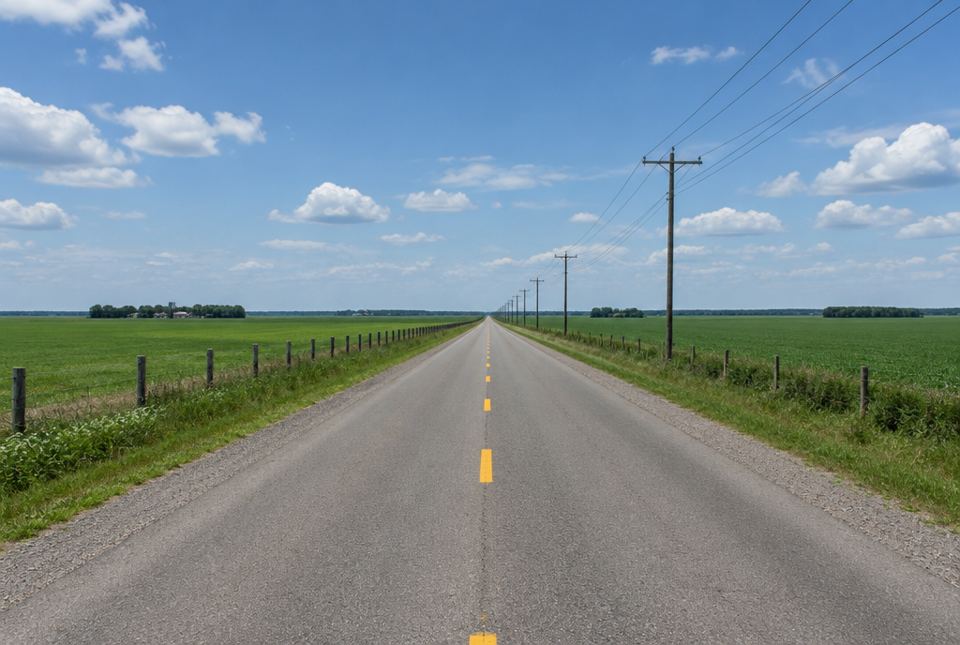 The road edges, fence and power lines are parallel, but they seem to converge at one point on the horizon. Artists use this to create depth. AI-generated imageFour kinds of visual rhythm made with repeated lines: regular (the same every time), alternating (thick, thin, thick...), flowing (repeated curves) and progressive (lines getting closer step by step).
Worked exampleExample: One snowstorm, two purposes
Let's draw a snowstorm for two different audiences and purposes, choosing lines on purpose.
- Purpose 1: a poster warning drivers to stay home during a blizzard. Audience: adults who drive.
- Lines: sharp diagonal slashes for blowing snow, jagged lines for wind, thick heavy outlines on a car sliding sideways. They feel dangerous and urgent.
- Purpose 2: a calm picture for a children's bedtime story about the first snowfall. Audience: young children.
- Lines: soft, curving lines for falling flakes, long horizontal lines for snowy hills, thin delicate lines for the trees. They feel peaceful and quiet.
- Same subject, different message: the lines change the whole feeling.
Choosing expressive lines for a specific audience and purpose lets the same subject communicate completely different ideas.
Just for funA line walks into art class. The teacher says, "You seem a little tense today."
"Sorry," says the line. "I'm feeling a bit zigzag."
Worked exampleExample: Analysing lines in *The Starry Night*
Let's explain how Vincent van Gogh used lines in The Starry Night (1889).
- Describe: a night sky full of swirling, curving brushstrokes; stars and a crescent moon surrounded by circular strokes; a tall dark cypress tree in the foreground with flame-like lines curving upward; a small village below with calmer, straighter lines.
- Analyse: the swirls are repeated across the sky, creating a strong visual rhythm, like wind or waves. The cypress tree's upward lines lead our eye from the ground to the sky.
- Interpret: the sky feels alive, restless and full of energy, while the village feels quiet and still. The contrast between them is part of the meaning.
- Explain with design words: "Van Gogh used expressive curving lines and repetition to create rhythm and movement, so the night sky feels more powerful than the sleeping village."
Describing, analysing and interpreting the lines lets you explain how the art work communicates feeling, not just whether you like it.
Hands-on activityLine studio
You need: paper, a pencil, a black marker or pen, a ruler, and music to listen to.
- Line feelings: divide a page into six boxes. Label them calm, angry, joyful, nervous, sad, proud. Fill each box with lines only (no pictures) that express that feeling. Ask someone to guess the feelings.
- Music lines: play two very different songs. Draw lines to each one for 30 seconds. Compare the two drawings.
- Converging lines: look down a hallway, a long sidewalk or a row of fence posts (from a window or outside, with a grown-up). Draw it. Lightly mark where the lines seem to meet. Make objects smaller and closer together as they go back.
- Visual rhythm: draw a ploughed field, a lake with waves, or a row of birch trees using repeated lines. Try regular, alternating and progressive rhythm.
- Final piece: choose an audience and purpose (for example, a poster for a winter carnival, or a calm picture for a hospital waiting room). Make a drawing where your lines are chosen on purpose.
- Explain: write three sentences about the lines you used and why.
Your turn
1What feeling do diagonal lines often create?
Movement, energy, action or danger/instability.
2What are converging lines?
Lines that come closer together as they go into the distance and seem to meet at a point.
3How do converging lines help a drawing?
They create the illusion of depth, making a flat picture seem to go back into space.
4What is visual rhythm, and how do you create it?
A feeling of movement or beat in an art work, created by repeating lines (or shapes or colours).
5Which kind of line would you choose for a peaceful lake at sunset? Why?
Horizontal (and gentle curving) lines, because they feel calm and resting.
6Name one way Van Gogh used line in The Starry Night.
Any one: swirling, curving lines in the sky; circular strokes around the stars and moon; flame-like upward lines in the cypress tree; repetition that creates rhythm.
7Name the four kinds of rhythm in the lesson.
Regular, alternating, flowing, progressive.
More practice: warm-up
1What feeling do vertical lines often give?
Strong, tall, proud, still.
2Name one real-life example of converging lines.
Any one: railway tracks, the edges of a road, a hallway, a row of fence posts, a long sidewalk.
3Thick, heavy lines usually feel ___; thin, light lines usually feel ___.
Bold/strong/loud; delicate/quiet/fragile.
4Who painted The Scream, and in what year?
5Is a picket fence an example of regular or progressive rhythm?
Regular rhythm (the same line repeated evenly).
More practice: on your own
1Plan the lines for a poster about a school fun run for students. Explain your choices.
Example: diagonal lines for running figures and streamers to show speed and energy; repeated lines in the track for rhythm; bold thick outlines so it's easy to see from down the hallway. Look for line types linked to the purpose and audience.
2In The Avenue at Middelharnis, how does Hobbema create depth?
The road's edges and the rows of tall trees are converging lines that lead toward one point in the distance, and the trees get smaller as they go back. This pulls our eye deep into the painting.
3Describe a progressive rhythm you could draw.
Example: lines that start far apart at the bottom of the page and get closer and closer together toward the top, like the rungs of a ladder going away. Or lines that get thinner step by step.
4An artist draws a calm subject (a sleeping cat) with jagged lines. What might they be communicating?
A feeling of unease, tension or danger, maybe a dream, a storm outside, or the artist's own anxiety. The expressive lines contrast with the calm subject on purpose, which makes the viewer look again.
5Explain how the lines in Munch's The Scream connect to its feeling.
The wavy lines in the sky and landscape seem to ripple around the figure, as if the whole world is shaking with the figure's panic. The lines express emotion more than they describe a real place.
Challenge
1Design a drawing about the issue of a forest being cut down, using expressive, converging and rhythmic lines. Describe your plan.
Example: converging lines of a new logging road cut deep into the forest (depth, leading toward the destruction); repeated vertical lines of standing trees on one side (strong rhythm) that turn into jagged broken stumps on the other side (anger and loss); a few diagonal lines of falling trees (danger). Look for all three kinds, each tied to meaning.
2Why might two viewers interpret the same expressive lines differently?
People bring their own experiences, feelings and cultures. Swirling lines might feel joyful to one person and dizzy or anxious to another. A strong interpretation explains evidence from the art work and admits other readings.
3You draw a hallway with converging lines, but it still looks flat. Name two things to check and fix.
Any two: make sure the lines actually meet at one point; make objects (doors, lockers) get smaller as they go back; make spaces between repeated items get closer together; add overlapping (near things in front of far things); keep near details sharper and far ones simpler.
Quiz
1. Which kind of line most often suggests movement and energy?
2. Lines that come closer together in the distance are called ___.
3. Repeating lines to create a beat or pattern makes ___.
4. Which lines would best express anger?
5. The Starry Night (1889) was painted by ___.
6. Choosing lines that suit a hospital waiting room is thinking about ___.
Big idea: For Grade 7, the curriculum's focus for line is lines for expressive purposes and diagonal and converging lines to create depth of space. Students use elements of design to communicate ideas for a specific audience and purpose (D1.3), interpret feelings and themes in art works (D2.1) and explain how elements create meaning (D2.2). Repetition of lines for visual rhythm connects to the principles of design.
How to help:
- On a walk, look for converging lines: roads, rail trails, rows of trees, hydro wires.
- Look up The Starry Night or The Scream on a gallery website and ask, "How do the lines make you feel? Why?"
- Play music and draw lines together.
Safety: if you go outside to sketch roads or rail lines, stay on the sidewalk or path with a grown-up; never stand on train tracks.
Common difficulties:
- Lines that don't meet. Use a ruler and mark the meeting point first.
- "It's just a line." Ask, "Is it fast or slow? Heavy or light? What feeling does that give?"
- Describing without interpreting. After "I see swirls," ask, "And what does that make the sky feel like?"