D. Structures and Mechanisms · Form and FunctionWhy Structures Fail
D2.5 A1.1 A1.5 A3.3About 45 minutes
Learning goals- I can describe factors that can cause a structure to fail, such as design errors, poor materials, poor construction, overloading, weak foundations, natural forces and aging.
- I can describe the ways structures fail, such as buckling, cracking, bending, twisting, shearing and tipping.
- I can research a real structural failure and explain its causes.
Words to know
structural failure
When a structure, or part of it, can no longer do its job safely: it bends, cracks, breaks, tips or collapses.
buckle
To bend sideways suddenly when squeezed too hard.
fatigue
Weakening of a material caused by a load that is put on and taken off many, many times.
corrosion
Slow damage to a material by chemical reactions, like steel rusting.
overload
A load bigger than the structure was designed to carry.
foundation
The part of a structure that connects it to the ground and spreads its load into the ground.
Hook: the paper clip test
Bend a paper clip back and forth in the same spot. Once, twice, ten times... Snap! You never used much force, but the metal still broke.
That is one way structures can fail. Today you will learn the many factors that can cause failure, so you can design structures that don't fail.
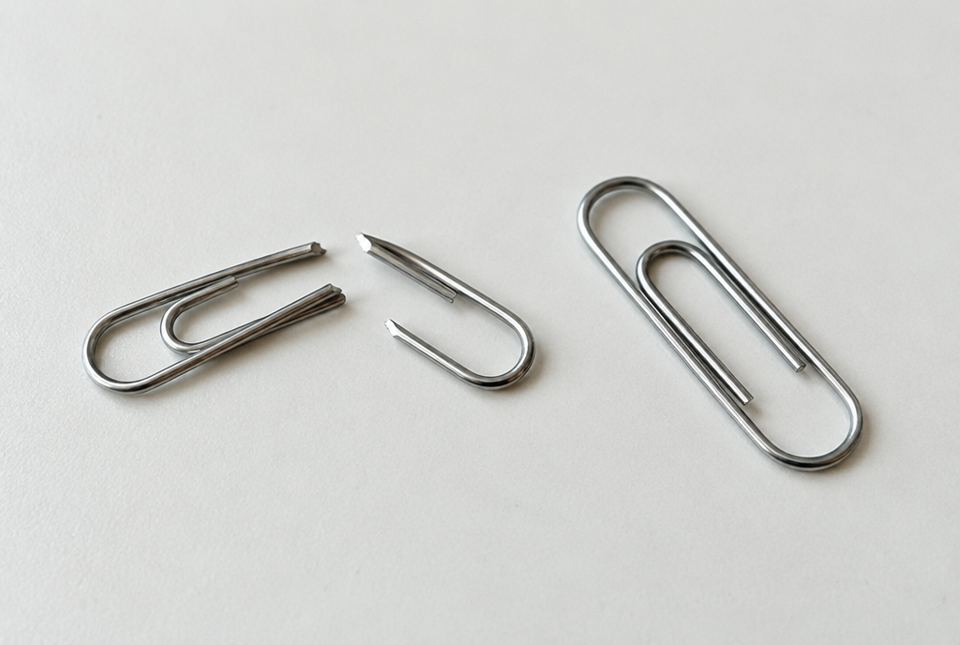 The broken clip failed from metal fatigue: small forces repeated many times in the same spot, not one big force. AI-generated image
Remember from Grade 5
In Grade 5 you learned what too much compression, tension, torsion and shear can do (crush, buckle, snap, twist, cut) and how natural forces like earthquakes, wind, snow and floods damage structures. In Grade 7 you will look at all the factors behind failures, including human ones.
Factors that can cause a structure to fail
- Design errors: the designers underestimated the loads, made a calculation mistake, or chose a weak form (for example, a tall frame with no bracing).
- Poor or wrong materials: a material that is too weak, the wrong type for the job, or has hidden flaws.
- Poor construction: parts missing or badly joined, bolts not tightened, concrete mixed wrong, plans not followed.
- Overloading: more load than it was designed for, like too many people on a deck or too much snow on a roof.
- Foundation problems: soft, wet or shifting ground; soil washed away by floods (erosion); thawing permafrost in the North.
- Natural forces: strong wind, earthquakes, floods, ice storms, heavy snow.
- Aging and poor maintenance: steel corrodes (rusts), wood rots, water freezes and thaws in cracks, and repeated loads cause fatigue. If nobody inspects and repairs the damage, it grows.
Often a failure has more than one cause.
| How it fails | What happens | Main force involved |
|---|
| buckling | a long, thin part bends sideways suddenly | compression |
| cracking or snapping | a part breaks apart | often tension |
| bending or sagging | a beam bends too much | compression and tension |
| twisting | a part twists out of shape | torsion |
| shearing | a bolt or part is cut where two pieces slide past each other | shear |
| tipping over | the CG line moves outside the base | gravity and sideways forces |
| sinking or sliding | the ground under the foundation moves | weak ground, water |
Real failures and lessons learned
The Quebec Bridge (1907): during construction over the St. Lawrence River near Quebec City, the bridge collapsed in 1907, killing about 75 workers. Thirty-three of them were Mohawk ironworkers from Kahnawà:ke, a community whose ironworkers are still known today for building bridges and skyscrapers. An investigation found that the bridge was much heavier than the designers had calculated, and steel parts that were being squeezed buckled. The bridge was redesigned with much stronger parts. A second accident happened in 1916, when the centre section fell while it was being lifted into place, killing 13 workers. Trains began crossing the finished bridge in 1917, and it still carries cars and trains today.
The Tacoma Narrows Bridge (1940), in Washington State, U.S.A.: this suspension bridge had a thin, flexible deck. About four months after it opened, a steady wind made the deck twist back and forth more and more until it tore apart. No people died. Engineers learned to test bridge designs for wind, and to make decks stiffer and shaped so wind flows past smoothly.
Engineers study every failure so the same mistake is not made again.
Worked exampleLet's find the causes of a failure
A wooden backyard deck collapsed during a summer party. Investigators found: 30 people were on the deck, it was built for about 15; it was attached to the house with nails instead of the bolts in the plans; and some of the support posts had rotted at the bottom. List the factors.
- 30 people on a deck built for 15: overloading.
- Nails instead of bolts: poor construction (plans not followed).
- Rotted posts: aging and poor maintenance (the wood was not inspected or replaced).
- Any one of these weakens the deck. Together, they caused the collapse.
Overloading, poor construction and poor maintenance together caused the failure.
Worked exampleLet's match the failure to the force
A tall, thin steel column in a model holding up a heavy load bends sideways suddenly in the middle. What kind of failure is it, and what could fix it?
- The column is being squeezed by the load: compression.
- Bending sideways suddenly under compression is buckling.
- Fixes: make the column thicker, shorter, or brace it in the middle; or use a stronger shape, like a tube.
It is buckling from compression. A thicker or braced column would resist it.
Hands-on activityFailure lab and research mini-project
Part 1: Fatigue (lab). You need: 3 identical paper clips and safety glasses (or sunglasses). Unbend each clip into a straight piece. Bend one back and forth in the same spot at a big angle (about 90°) and count the bends until it snaps. Do the second with small bends (about 30°). Compare. (Keep the third clip as a spare to repeat a test.) Wear eye protection; the broken ends can be sharp, so throw them out right away.
Part 2: Research (with a grown-up). Choose one structural failure to research using at least two reliable sources (for example, a government, university, museum or encyclopedia website). Possible topics: the Quebec Bridge (1907 or 1916), the Tacoma Narrows Bridge (1940), or a roof collapse caused by snow.
Answer: (1) What was the structure, and where? (2) What happened? (3) What factors caused the failure? (4) What did engineers learn or change? Write a one-page report or make a short presentation. List your sources.
What to look for: Part 1: the clip with big bends breaks after fewer bends: that's fatigue. Part 2: the report names at least two factors from the lesson and a lesson learned, and lists the sources.
Just for funWhy did the paper clip finally give up?
It was tired of being bent out of shape over and over again. (That's metal fatigue!)
Your turn
1Name four factors that can cause a structure to fail.
Any four: design errors, poor or wrong materials, poor construction, overloading, foundation problems, natural forces, aging and poor maintenance.
Weakening of a material from a load being put on and taken off many times.
Putting more load on a structure than it was designed to carry.
4What kind of failure happens when a long, thin column is squeezed too hard?
5What caused the Quebec Bridge to collapse in 1907?
It was much heavier than the designers calculated, and parts in compression buckled.
6What happened to the Tacoma Narrows Bridge?
A steady wind made its thin, flexible deck twist back and forth more and more until it tore apart.
7Why can rust lead to failure?
Rust (corrosion) eats away steel, so the part becomes thinner and weaker over time.
More practice: warm-up
1Wood that stays wet for years can...
2Too many people on a balcony is an example of...
3A bolt cut across where two plates slide past each other fails by...
4A tall bookshelf falls forward. What kind of failure is this?
Tipping over (a stability failure).
5True or false: a failure can have more than one cause.
More practice: on your own
1Why can water freezing in a small crack in concrete make the crack bigger?
Water expands when it freezes, pushing the crack apart. After many freeze-thaw cycles in a Canadian winter, the crack grows.
2How can thawing permafrost cause buildings in the North to fail?
Frozen ground is firm. When it thaws, it becomes soft and can sink unevenly, so foundations shift and walls crack.
3A crane tips over while lifting a load that is heavier than its limit. Name the factor and the type of failure.
Factor: overloading. Failure: tipping over, because the CG moved outside the base.
4Why is it important for engineers to study failures?
So they can find the causes and change designs, rules and methods so the same mistake doesn't happen again.
5In the paper clip lab, why did the big bends break the clip faster?
Bigger bends put a bigger strain on the metal each time, so fatigue damage builds up faster.
Challenge
1A flat-roofed store collapses after a winter with record snowfall followed by freezing rain. The roof was built to code 40 years ago and had a leak that was never fixed. Identify at least three possible factors and explain each.
- Natural forces / overloading: record snow plus heavy wet ice made a load bigger than designed. 2. Aging and poor maintenance: the leak let water reach the roof structure, causing rot or corrosion, so the parts became weaker. 3. Design: a flat roof doesn't shed snow, and codes from 40 years ago may have required less strength than today.
2Explain how the Quebec Bridge disaster shows that design errors can be deadly even when workers build exactly what is on the plans.
The workers followed the plans, but the plans themselves were wrong: the bridge's weight was underestimated, so the compression parts were too weak and buckled. A failure can start at the design stage, which is why designs must be checked carefully.
3A student's spaghetti bridge snaps at the bottom in the middle. Which force caused it? Suggest a fix.
The bottom of a beam loaded in the middle is in tension, and the spaghetti there was stretched until it snapped. Fix: add more strands along the bottom, or use triangles (a truss) to share the load, or put supports closer together.
Quiz
1. Which is an example of overloading?
2. A long, thin column that bends sideways suddenly when squeezed has...
4. What was a main cause of the 1907 Quebec Bridge collapse?
5. What made the Tacoma Narrows Bridge fail?
6. Which is a maintenance problem?
Big idea (D2.5): Structures fail because of design errors, poor or wrong materials, poor construction, overloading, foundation problems, natural forces, and aging with poor maintenance, often several at once. The research part practises the scientific research process (A1.1).
How to help: Help your child find two reliable sources for the research task (government, university, museum or encyclopedia sites). Ask: "What were the causes? What did engineers change afterward?" The Quebec Bridge disaster also connects to the Mohawk ironworkers of Kahnawà:ke, whose community is still known for ironwork (A3.3).
Common difficulties:
- Naming only one cause. Real failures usually have several.
- Treating failure stories as scary. Emphasize that studying failures is how engineers make structures safer.
- Safety: eye protection for the paper clip lab, and discard broken ends right away.