B. Canada, 1800–1850: Conflict and Challenges · Canada, 1800–1850: Conflict and ChallengesThe Métis Nation and Life at Red River
B1 B3 B2About 45 minutes
Learning goals- I can describe the culture and way of life of the Métis at Red River before 1850.
- I can explain how the buffalo hunt, the Red River cart and river lots shaped Métis life.
- I can explain the significance of the Sayer trial of 1849.
- I can compare Métis life at Red River with life in Canada today.
Words to know
Métis
A distinct Indigenous nation that grew from the families of First Nations women and European fur traders, with its own language, culture and homeland.
Michif
The language of the Métis Nation, which blends Cree and French. It is still spoken today.
Red River cart
A two-wheeled cart made of wood and rawhide, pulled by an ox or horse, used to carry goods across the prairies.
river lot
A long, narrow strip of farmland that starts at a river, so every family has water and a landing.
monopoly
When one company has the only legal right to sell or trade something.
free trade
Trading without one company controlling who may buy and sell.
Let's start with a sound
Imagine hearing a long, loud squeal across the prairie, growing louder for hours before you see anything. Then a line of hundreds of wooden carts rolls into view.
That was the sound of the Red River carts, and it was a sound of the Métis Nation on the move.
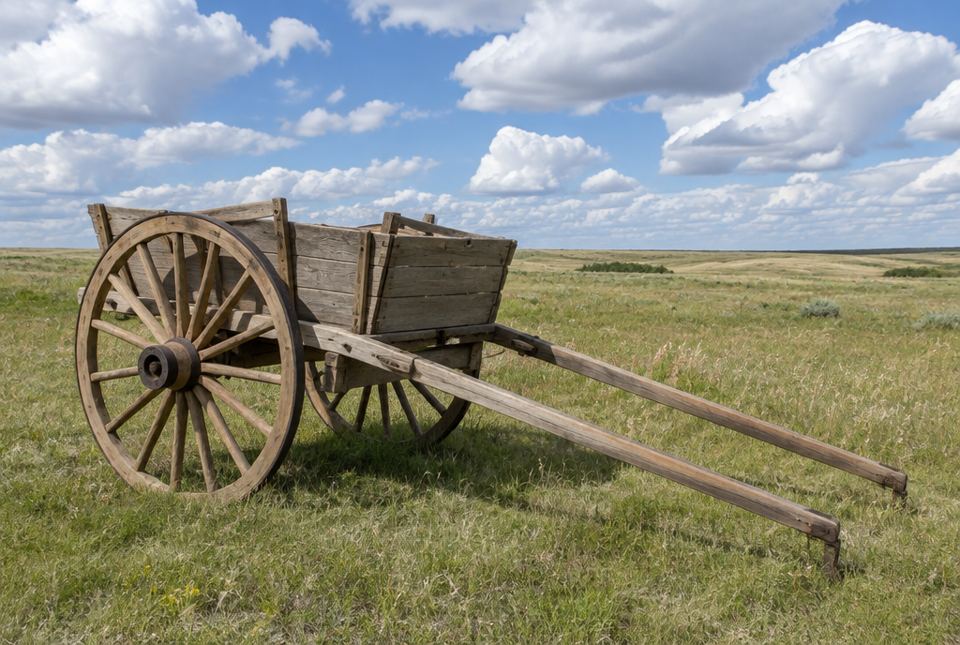 A replica Red River cart. Built of wood and pulled by an ox or horse, carts like this could be repaired on the prairie, and long lines of them squealed as they moved. AI-generated image
Who are the Métis?
In the fur trade country, many First Nations women (often Cree or Anishinaabe) married European fur traders (often French-Canadian or Scottish). Over generations, their children and grandchildren did not simply see themselves as "half" of anything. They became a new and distinct people: the Métis Nation.
By the early 1800s, Métis people had their own:
- Language: Michif, which blends Cree and French. Many Métis also spoke French, English, Cree or Anishinaabemowin.
- Culture: fiddle music and the Red River jig, the woven sash, and beautiful flower beadwork.
- Economy: buffalo hunting, pemmican, freighting with carts and boats, farming and trading.
- Sense of nationhood, shown at Seven Oaks in 1816 and in their own flag with an infinity symbol.
Today the Métis are a living nation with governments such as the Métis Nation of Ontario and the Manitoba Métis Federation.
Life at Red River
After 1821, Red River grew into the main community of the Northwest. It included French-speaking Métis, English-speaking Métis (often of Scottish or English fathers), Selkirk settlers, retired fur traders, and First Nations neighbours.
- River lots: Farms were long and narrow, running back from the river. Every family had river access for water and travel. This pattern came from the French system in Lower Canada.
- The buffalo hunt: Twice a year, large Métis brigades travelled out onto the plains. The hunt was organized like a government: hunters chose a leader and captains and followed rules of the hunt, for example no one could charge the herd early and scare it away. Meat and hides became pemmican, food and trade goods.
- Red River carts: Made only of wood and rawhide, so they could be fixed on the trail. Their wheels could be taken off so the cart could float across rivers. With no grease (it would collect dust), the wooden axles squealed.
- Faith and community: Catholic and Protestant churches, schools run by missionaries, and big gatherings with music and dancing.
The Sayer trial, 1849
The Hudson's Bay Company claimed a monopoly: only the HBC could legally trade furs in Rupert's Land. Many Métis traded furs with American traders anyway. They said they had the right to trade freely on their own land.
In 1849, the HBC put a Métis trader, Pierre-Guillaume Sayer, on trial for illegal fur trading. On the day of the trial, a large group of armed Métis gathered outside the courthouse at Red River. Sayer was found guilty, but he was given no punishment. As the Métis left, they shouted "Le commerce est libre!": "Trade is free!"
After the Sayer trial, the HBC could no longer really enforce its monopoly. The Métis had shown again that they could act together to defend their rights.
| Métis life at Red River, about 1840 | Life in Canada today |
|---|
| Food | Bison, pemmican, fish, garden crops, bannock | Grocery stores, farms, and for many Métis families, hunting and fishing too |
| Travel | Red River carts, canoes and York boats, on foot or horseback | Cars, buses, planes, trucks |
| Language | Michif, French, English, Cree and others | English and French most common; Michif is being revived |
| Government | Rules of the buffalo hunt; HBC's Council of Assiniboia | Métis governments; city, provincial and federal governments |
| Music and celebration | Fiddle, Red River jig | Fiddle and jigging still celebrated, plus many other kinds of music |
Worked exampleModelled example: Continuity and change
Is the Métis sash an example of continuity or change from the 1800s to today?
- What was it then? A long, colourful woven sash worn around the waist by voyageurs and Métis men. It was useful as a belt, tumpline (carrying strap), rope or even a bandage.
- What is it now? A symbol of Métis pride and identity, worn at celebrations, and given as an honour.
- What stayed the same? The sash itself and its link to Métis identity: continuity.
- What changed? It is now mostly symbolic rather than an everyday tool: change.
Both. The sash shows continuity (still worn, still Métis) and change (from a work tool to a symbol of pride). Many things in history show both.
Hands-on activityBuild a model Red River cart
You need: a small cardboard box (like a tissue or cereal box cut down), 2 large round lids or cardboard circles for wheels, a pencil or wooden skewer for the axle, string or yarn, and glue or tape. A grown-up should do any cutting or poking holes with sharp tools.
- Make the cart box, then attach the axle under it so the wheels can turn.
- Use only cardboard, wood (pencil/skewer) and string, no metal, just like the real carts used only wood and rawhide.
- Add two long cardboard shafts in front where an ox or horse would be hitched.
- Load it with small objects and roll it across the floor. Does it squeak?
- Explain to a grown-up: why was it smart to build a cart without metal parts on the prairies?
Model answer: if something broke far from any town, you could fix it with wood and rawhide found or carried along the trail.
Your turn
The language of the Métis Nation, a blend of Cree and French.
2Name two parts of Métis culture.
Any two: Michif language, fiddle music, the Red River jig, the sash, flower beadwork, the infinity flag, the buffalo hunt.
3Why were Red River carts made only of wood and rawhide?
So they could be repaired on the trail with materials at hand.
A long, narrow farm that starts at the river, so every family has water and river access.
5Describe one rule of the buffalo hunt and why it mattered.
No one could charge the herd early, because that would scare the bison away and ruin the hunt for everyone.
6What happened at the Sayer trial in 1849?
Pierre-Guillaume Sayer was tried for illegal fur trading. With armed Métis outside, he was found guilty but not punished. The HBC monopoly could no longer be enforced.
7What does "Le commerce est libre!" mean?
More practice: warm-up
1What symbol is on the Métis flag?
2Name one musical instrument important in Métis culture.
3What animal was at the centre of the Métis hunt?
4Which company claimed a trade monopoly in Rupert's Land?
The Hudson's Bay Company.
5Name one Métis government today.
The Métis Nation of Ontario or the Manitoba Métis Federation (others exist too).
More practice: on your own
1Why is it wrong to describe the Métis as simply "half First Nations, half European"?
Because the Métis became a distinct nation with its own language, culture, homeland and government. They are a people in their own right, not a mixture of two others.
2How was the buffalo hunt "organized like a government"?
Hunters chose a leader and captains, made rules that everyone had to follow, and enforced them. This was Métis self-government in action.
3Why did the river lot system make sense at Red River?
Rivers were the main roads and water supply. Long narrow lots let every family reach the river, and houses could be close to neighbours.
4Why was the Sayer trial a turning point?
It showed the HBC could not enforce its monopoly against the united Métis, opening the way to free trade, and it was another example of the Métis acting together as a nation.
5Name one thing that has continued from Métis life in the 1840s to today and one thing that has changed.
Continuity: fiddle music, jigging, the sash, Michif, Métis identity. Change: cars instead of carts, no large bison hunts, modern Métis governments. Any accurate pair.
Challenge
1Using Seven Oaks (1816) and the Sayer trial (1849), explain how the Métis defended their rights before 1850.
In both events, Métis people acted together to defend their economy and rights on their own land: at Seven Oaks against the Pemmican Proclamation, and in 1849 against the HBC's monopoly. Both times the Métis showed they were a nation that others had to take seriously.
2Why might the HBC and the Métis describe the Sayer trial differently?
The HBC would see it as Métis breaking the law and threatening the court. The Métis saw it as standing up for free trade and their rights. Each saw the law from its own interests.
3Explain why Red River in 1840 is a good example of a community where different peoples met. Give at least three groups and one way they depended on each other.
French- and English-speaking Métis, Selkirk settlers, retired fur traders and First Nations neighbours lived there. Example: settlers depended on Métis hunters for pemmican and food, and on First Nations knowledge in hard winters; the HBC depended on Métis freighters to move goods.
Quiz
2. Why did Red River carts squeal?
3. What shape were river lots?
4. What was the result of the Sayer trial (1849)?
5. Which is an example of continuity in Métis culture?
6. How did the Métis organize the buffalo hunt?
Big idea: Students analyse the lives of the Métis at Red River (B1), describe the significance of events such as the Sayer trial (B3), and see events from the Métis perspective (B2).
Respectful language: Describe the Métis as a nation and a living people today, not as "half-breeds" (a slur in older books) or as a mix. If you are Métis or know Métis community members, invite them to share; many Métis Nation of Ontario regions run cultural events.
How to help: Build the cart together (you handle any cutting). Listen to Métis fiddle music online and talk about how culture is passed down.
Common difficulties: Thinking the Métis disappeared after 1885 or live only in the West. Métis communities live across Ontario too, for example around Sault Ste. Marie.