B. Natural Resources Around the World: Use and Sustainability · Natural Resources Around the World: Use and SustainabilityResource Use in Regions Around the World
B1.2 B1About 50 minutes
Learning goals- I can describe how resources are extracted or harvested and used in some specific regions of the world.
- I can judge whether a resource practice is sustainable, using clear questions.
- I can explain how poverty, demand and government rules can affect resource use.
Words to know
region
An area with shared characteristics, such as a rainforest or a fishing area.
sustainable
Able to continue for a very long time without using up resources or harming the environment, so future generations can meet their needs too.
deforestation
Clearing forests and not replacing them, often to use the land for something else, like farming.
overfishing
Catching fish faster than the population can reproduce and replace them.
moratorium
An official stop or pause on an activity, like fishing for a certain species.
regulation
An official rule, usually made by a government, that controls how something is done.
Hook: two forests, two stories
In one country, forests are cut and the land is turned into cattle pasture. In another, forests are cut and new trees are planted by law. Both countries harvest wood. Only one is likely to have the same amount of forest in 100 years. In this lesson you'll look at real regions and ask: Is this sustainable?
How to judge if a practice is sustainable
Ask these questions:
- Is the resource being used faster than it is replaced?
- Is the environment (land, water, air, wildlife) being seriously harmed?
- Are local people, including Indigenous communities, benefiting and having a say?
- Can this continue for future generations?
Case 1: Forests in the Amazon and in Sweden
The Amazon (South America, mostly in Brazil) is the world's largest tropical rainforest. Large areas have been cleared, mainly to create cattle pasture, and also for crops like soybeans, logging, mining and roads. Once roads are built, more people move in and clear more land. Rainforest soils are often poor, so cleared land can lose its fertility, and farmers may clear more forest. Indigenous peoples who live in the Amazon have often been at the front of efforts to protect it.
Sweden has a large forestry industry too. Its law requires forest owners to make sure new forest grows back after a harvest, by planting or natural regrowth. Sweden's forests are mostly managed for timber, so some scientists point out that managed forests have fewer old trees and less variety of wildlife than natural forests.
Comparison: cutting a forest and turning it into pasture (deforestation) is not sustainable. Cutting and regrowing a forest can be much more sustainable, though it may still change habitat.
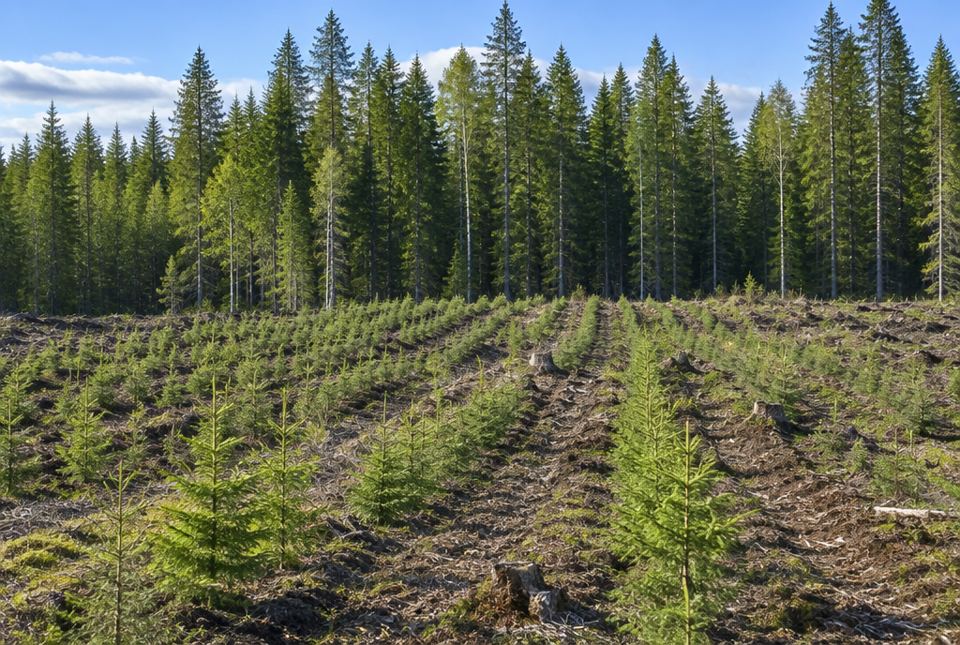 In Sweden, harvested land must be replanted. Notice the old stumps between the rows of seedlings: this is one way to make forestry more sustainable. AI-generated imageTwo ways to use a forest. Turning forest into pasture means the forest is gone; harvesting and regrowing keeps a forest on the land.
Case 2: Fishing off Newfoundland and off West Africa
The Grand Banks (Canada): For hundreds of years people fished the huge cod stocks here. After the 1950s, large factory trawlers from many countries caught enormous amounts. The northern cod population collapsed, and in 1992 the Government of Canada announced a moratorium, stopping commercial fishing of northern cod. Many thousands of people in Newfoundland and Labrador lost their jobs, and many coastal communities shrank. The moratorium lasted more than 30 years. In 2024 the federal government ended it and allowed a larger commercial catch again, though scientists and fishers still debate how fully the stock has recovered.
West Africa: Many people in coastal countries such as Senegal depend on fish for food and jobs. Large industrial fishing boats from other parts of the world also fish these waters, some legally under agreements and some illegally. Many local small-boat fishers report that they must travel farther to catch fewer fish. Weak enforcement and poverty make the problem hard to solve.
Case 3: Coal and electricity in China
China has huge coal deposits, and coal has been its largest source of electricity. Burning coal helped China's economy grow very fast, but it caused serious smog in many cities and large greenhouse gas emissions. In the 2010s China took strong steps to cut air pollution, and it has become the world's largest producer of solar and wind power. It is still a major user of coal, so this case shows a country in transition.
The link between poverty and resource use
When people are very poor, they may have few choices. A family may clear forest to grow food, cut trees for cooking fuel, or catch every fish they can, because they need to eat today. That's why many sustainability programs also try to give people other ways to earn a living, like sustainable farming, ecotourism or fair prices for their products. Poverty is not the only cause: large companies and wealthy countries' demand for products like beef, soy, wood and fish also drive resource use.
Worked exampleLet's judge sustainability: Amazon cattle pasture
Use the four sustainability questions to judge clearing Amazon rainforest for cattle pasture.
- 1. Faster than replaced? Yes. A rainforest takes a very long time to regrow, and pasture land is kept clear, so the forest isn't replaced.
- 2. Environment harmed? Yes: loss of habitat for many species, more carbon dioxide released when trees are burned or rot, and soil can wear out.
- 3. Local people benefit and have a say? Some ranchers and companies profit, but many Indigenous and forest communities lose the forest they rely on and often have little say.
- 4. Can it continue for future generations? No. The forest and its benefits are lost.
Clearing rainforest for cattle pasture is not sustainable: it uses the forest faster than it's replaced, harms the environment and many local people, and can't continue for future generations.
Just for funQ: Why did the young tree go to the sustainability meeting?
A: It wanted to make sure there would be future branches of the family!
Hands-on activitySustainability scorecard
You need: paper and a pencil.
- Draw a table with the three case studies as rows: Amazon/Sweden forests, Grand Banks/West Africa fishing, China's electricity.
- Make four columns, one for each sustainability question.
- Score each answer: ✔ (good for sustainability), ✘ (bad), or ? (mixed/unsure). Write a few words to explain each mark.
- Write one sentence for each case: Which change would make it more sustainable?
Model answer example: Grand Banks before 1992: ✘ used faster than replaced; ✘ ecosystem harmed; ✘/? local people benefited at first, then lost jobs; ✘ could not continue. Change: set catch limits based on science much earlier.
Your turn
1What is the main reason large areas of the Amazon rainforest have been cleared?
To create cattle pasture (also crops like soybeans, logging, mining and roads).
2What does Sweden's forestry law require after a harvest?
That new forest grows back, by planting or natural regrowth.
3What happened to the northern cod in 1992?
The population had collapsed, and the Government of Canada announced a moratorium, stopping commercial fishing of northern cod.
4Give one reason fishing off West Africa may be unsustainable.
Large industrial boats, some fishing illegally, catch huge amounts; local fishers must go farther to catch fewer fish; enforcement is weak.
5Give one problem caused by burning coal in China.
Serious smog (air pollution) in cities, or large greenhouse gas emissions.
6How can poverty lead to unsustainable resource use?
Very poor people have few choices, so they may clear forest, cut trees for fuel or overfish to meet their needs today.
7What does sustainable mean?
Able to continue for a very long time without using up resources or seriously harming the environment, so future generations can meet their needs.
More practice: warm-up
1In which country is most of the Amazon rainforest?
An official stop or pause on an activity.
3What species of fish collapsed on the Grand Banks?
4What fuel has been China's largest source of electricity?
5Is cutting a forest and turning it into pasture called deforestation or reforestation?
More practice: on your own
1Why is cutting trees in Sweden usually more sustainable than clearing the Amazon for pasture?
In Sweden the forest is regrown after cutting, so the resource is replaced. In the Amazon, cleared land is kept as pasture, so the forest is lost.
2Why might a moratorium be hard on a community even if it helps the fish?
Many people lose their jobs and income, businesses close, and families may have to move away. The benefit (fish recovery) comes slowly.
3Why are wealthy countries also part of the Amazon story, even though they are far away?
They buy products like beef, soy and wood that come from cleared land. Their demand helps make clearing profitable.
4What makes it hard to stop illegal fishing off West Africa?
The ocean is huge and hard to patrol; some countries have few patrol boats and little money for enforcement; illegal boats may hide what they catch.
5Why is China described as a country "in transition"?
It still uses a lot of coal, but it has built more solar and wind power than any other country, so it is shifting toward cleaner sources.
Challenge
1Use the four sustainability questions to judge Grand Banks cod fishing in the 1980s.
- Used faster than replaced: yes, catches were far greater than the cod could replace. 2. Environment harmed: yes, the cod population (a key part of the ecosystem) collapsed. 3. People: fishers earned money at first, but in the end many thousands lost their jobs. 4. Future generations: no, the fishery had to close for decades. Not sustainable.
2A sustainability program pays families near a rainforest to protect it and helps them sell nuts and fruit from the standing forest. Why might this work better than just banning tree-cutting?
It gives families a way to earn a living from the forest standing, so they don't need to clear it. A ban alone, without other income, might be broken by people who need to feed their families, and it is hard to enforce.
3Choose one case from this lesson. Explain how physical features (from Lesson 1) and human choices together shaped what happened.
Example, Grand Banks: the shallow continental shelf made it one of the richest fishing grounds (physical feature). Human choices (large factory trawlers, high catch limits, ignoring warnings) led to overfishing and collapse. Both nature and people shaped the outcome.
Quiz
1. What is the main reason large parts of the Amazon rainforest have been cleared?
2. What did the Government of Canada announce in 1992 for northern cod?
3. Which practice is most sustainable?
4. Which question is not one of the sustainability questions in this lesson?
5. Why can poverty lead to unsustainable resource use?
6. Which statement about China is accurate?
How to help: Use the four sustainability questions with anything in the news about forests, fishing or energy. Ask your child to find both a benefit and a cost.
Sensitive points: The cod collapse deeply affected families in Newfoundland and Labrador; some children may have relatives with these experiences. Avoid blaming people in poorer countries; the lesson stresses that demand from wealthy countries also matters.
Common difficulties:
- Calling any tree-cutting "deforestation." Deforestation means the forest is not replaced.
- Giving opinions without reasons. Ask "Which question does that answer? What's your evidence?"
- The 2024 reopening of the northern cod fishery is recent; scientists and fishers still debate it, so there is no single "right" view on whether it was the correct decision.