A. Dance / C. Music · Music and DanceMusic: Ensembles, Timbre and Performing with Expression
C1.1 C1.4 C1.2 C2.2 C2.3About 40 minutes
Learning goals- I can identify the instruments and timbres of an Orff ensemble, a choir, a drum line, a marching band, a guitar and electronic sounds.
- I can sing or play music in two parts, holding my own part.
- I can perform with dynamics from pp to ff and with slurs.
- I can use tools of musicianship, including good recorder technique, and reflect on my growth as a performer.
Words to know
timbre
The special sound quality of a voice or instrument, also called tone colour.
ensemble
A group of musicians performing together.
Orff ensemble
A classroom ensemble of xylophones, metallophones, glockenspiels, recorders, and pitched and non-pitched percussion.
pianissimo (pp)
Very soft.
fortissimo (ff)
Very loud.
slur
A curved line over or under different notes: play or sing them smoothly, without a break.
two-part music
Music where two groups sing or play different parts at the same time.
balance
Making sure no part is too loud for the others, so every part can be heard.
Remember from earlier grades
In Grade 5 you listened closely to brass instruments and steel bands, sang rounds in parts, and used dynamics from p to f, with articulation like staccato and accents.
In Grade 6 you'll widen your dynamics to pp and ff, add slurs, explore more ensemble sounds, and hold your own part in two-part music.
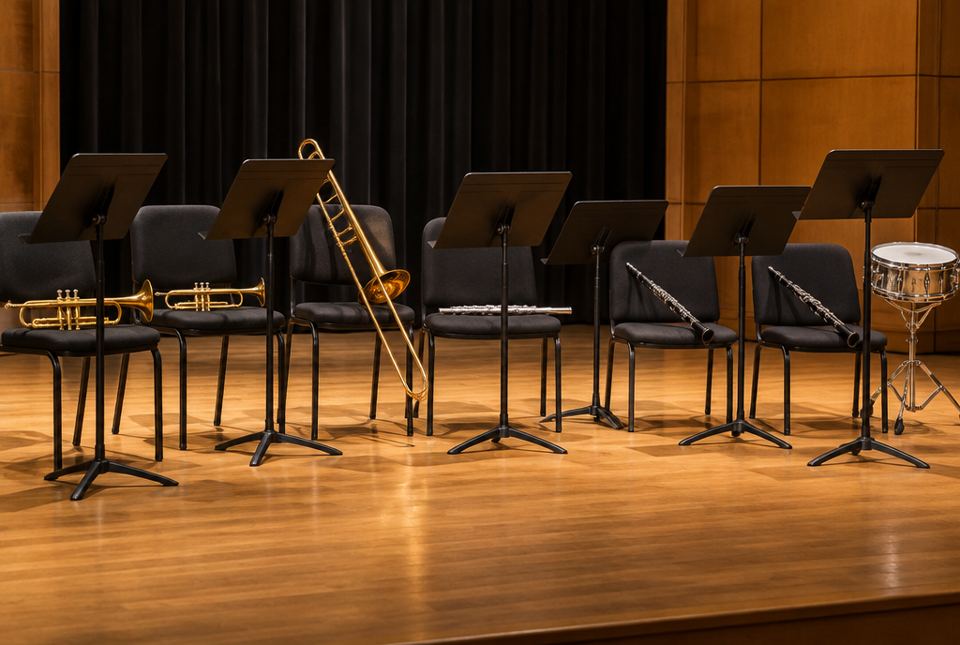 Brass, woodwind and percussion instruments each have their own timbre. Together they make the sound of a concert band. AI-generated image
| Ensemble or sound | What it includes | Timbre words |
|---|
| Orff ensemble | xylophones (wooden bars), metallophones (metal bars, deep ringing), glockenspiels (small metal bars, high and sparkly), recorders, drums, woodblocks, tambourines | wooden, ringing, bright, crisp |
| Choir | voices in sections: soprano (high), alto (lower), tenor (high men's voices), bass (low) | blended, warm, rich |
| Drum line | snare drums, tenor drums (several drums played by one player), bass drums of different sizes, cymbals | crisp, booming, powerful |
| Marching band | brass (trumpets, trombones, tubas...), woodwinds (flutes, clarinets, saxophones), and a drum line, all playing while marching | bold, bright, loud |
| Guitar | acoustic guitar (hollow wooden body) or electric guitar (needs an amplifier) | acoustic: warm, twangy; electric: can be clean or distorted |
| Electronic sounds | synthesizers, drum machines and computer sounds, made or changed with electronics | can imitate other instruments or make brand-new sounds: buzzy, smooth, glittery, pulsing |
Dynamics: from pp to ff
Now you have six dynamic levels. Remember: p = piano (soft), f = forte (loud), m = mezzo (medium). pp (pianissimo) is very soft, and ff (fortissimo) is very loud.
Very soft doesn't mean weak! Singing pp still needs good breath support so the sound stays steady and in tune.
Slurs
A slur is a curved line connecting different notes. Play or sing them smoothly, with no break in between. On the recorder, tongue ("too") only the first note of the slur, then keep the air flowing as your fingers change. (A curved line joining two notes of the same pitch is a tie: hold them as one long note.)
Two-part music
In two-part music, two groups perform different parts at the same time. The parts might be:
- a melody and a harmony part (often a 3rd or 6th apart),
- a melody and a descant (a higher, decorative part),
- a melody and a bass line or chord roots (like the I, IV, V roots you learned).
Holding your part takes skill: know it well alone first, then listen to the other part while you sing yours. Keep the balance, so neither part covers the other.
Tools of musicianship: recorder
If you play the soprano recorder, here are some new notes. (0 = left thumb on the back hole; 1 2 3 = left-hand fingers; 4 5 6 7 = right-hand fingers.)
- Low E: 0 1 2 3 4 5
- Low D: 0 1 2 3 4 5 6
- High C: 0 2 (thumb and left middle finger)
- High D: 2 only (no thumb)
For low notes, blow very gently and cover the holes completely with the pads of your fingers. For high notes, use a little more air.
For every performer: stand or sit tall, breathe low and deep, watch the conductor, start and stop together, and listen to the whole group.
Worked exampleExample: Let's plan an expressive performance
You'll perform the first line of a calm lullaby in two parts: part 1 sings the melody; part 2 sings the chord roots. How do you use the elements to create a peaceful effect?
- Tempo: adagio, steady.
- Dynamics: start pp, grow to mp in the middle of the phrase, and return to pp at the end.
- Articulation: add slurs over each phrase so it sounds smooth, like rocking.
- Balance: the roots (part 2) are slightly softer so the melody stands out.
- Musicianship: breathe together at the end of each phrase; watch the leader for the start and for a ritardando at the end.
A peaceful effect comes from adagio, soft dynamics (pp–mp), slurs, good balance and breathing together.
Worked exampleExample: Let's reflect as a performer
After recording yourself singing a two-part song with your dad, write a reflection.
- Listen to the recording all the way through.
- Strength: I held my part even when Dad's part went in a different direction, and my pp at the end was steady.
- Area for improvement: My ff in the chorus sounded shouty and went sharp (too high).
- Next step: I'll practise the chorus with deeper breaths and a tall posture, and use a keyboard app to check my pitch.
A useful reflection names a specific strength, a specific area for improvement and a practice plan.
Just for funFunny but true: the piano's full name is pianoforte, Italian for "soft-loud", because it can play both p and f. So its real name is basically Mr. Soft-Loud.
Hands-on activityLiving-room ensemble
You need: at least one other person; your voice and any instruments you have (recorder, keyboard app, pots, a wooden spoon, a sealed container with dry rice inside as a shaker); a phone to record (with permission).
- Choose a song you both know. Person 1 sings the melody. Person 2 sings or plays the roots of the chords (use I, IV, V from the chords lesson), or the same melody a 3rd lower if you can.
- Perform it three times: all mf; then from pp growing to ff; then with slurs and a ritardando at the end.
- Make a mini Orff-style layer: add a steady beat on the pot and a shaker pattern.
- Record your best version. Listen: is the balance good? Can you hear both parts?
- Write a reflection: one strength, one area for improvement, one next step.
Your turn
The special sound quality of a voice or instrument (tone colour).
2Name three instruments in an Orff ensemble.
Any three: xylophone, metallophone, glockenspiel, recorder, drums, woodblock, tambourine (pitched and non-pitched percussion).
pp = pianissimo, very soft. ff = fortissimo, very loud.
4What does a slur tell you?
Play or sing the notes smoothly, without a break.
5Name the four sections of a choir from highest to lowest.
Soprano, alto, tenor, bass.
6What is balance in an ensemble?
No part is too loud for the others, so every part can be heard.
7Sing a phrase starting pp and growing to ff.
Look for a gradual increase (no sudden jump), steady pitch at pp, and a full but not shouted ff.
More practice: warm-up
1Which dynamic is louder: mf or ff?
2Which ensemble plays music while marching?
A marching band (with its drum line).
3What kind of sounds does a synthesizer make?
4Does a xylophone have wooden or metal bars?
A group of musicians performing together.
More practice: on your own
1How is a slur different from a tie?
A slur connects different notes to be played smoothly. A tie connects two notes of the same pitch to be held as one longer note.
2Describe the timbre of a drum line compared with an Orff ensemble.
A drum line is crisp, booming and powerful, all unpitched drums and cymbals. An Orff ensemble has wooden and metallic, ringing, pitched bars plus recorders and lighter percussion, so it is gentler and melodic.
3Your two-part song sounds messy: you keep switching to the other part. Give two strategies.
Any two: learn your part alone first until it's solid; cover one ear lightly to hear yourself; start with a slower tempo; practise with a recording of the other part; stand next to someone singing your part.
4Recorder fingering: which note is 0 1 2 3 4 5 6? Which is 2 only?
0 1 2 3 4 5 6 = low D. 2 only = high D.
5Why should you still use strong breath support when singing pp?
So the sound stays steady and in tune. Soft singing without support can go flat (too low) or sound breathy.
Challenge
1Choose an ensemble from the table and explain which would best suit (a) a Canada Day parade, (b) a quiet holiday concert in a small hall, (c) a video game soundtrack. Give reasons using timbre and dynamics.
Example: (a) Marching band: bold, loud brass and drums, can move with the parade and be heard outdoors. (b) Choir: blended, warm voices, can sing pp to mf in a small space. (c) Electronic sounds: synthesizers can make new, imaginative sounds and loop easily for gameplay. Other choices are fine with good reasons.
2Plan a performance of a two-part song for your class. Include tempo, at least three dynamic markings, one slur, and two musicianship reminders for the singers.
Look for a complete plan, e.g.: tempo andante; verse 1 mp, verse 2 mf, final chorus ff then a last line pp; slurs over the long phrase at the end of each verse; reminders: breathe at the commas together and watch the conductor for the cut-off; also balance between parts.
3Write a full performer's reflection on your last musical performance (in class, at home or in a group), using at least three music words.
Look for: a specific strength, a specific area for improvement, a next step the student can practise, and at least three music words (e.g., dynamics, balance, pitch, tempo, slur, breath support).
Quiz
2. Which instrument belongs in an Orff ensemble?
3. A curved line over different notes is a ___.
4. The lowest section of a choir is the ___.
5. A drum line includes ___.
6. Balance in an ensemble means ___.
7. On the soprano recorder, 0 2 (thumb and left middle finger) plays ___.
Big idea: Students sing and play unison and two-part music (C1.1), use tools and techniques of musicianship (C1.4), apply the elements (Grade 6: pp, ff, slurs; timbres of electronic sounds, the Orff ensemble, drum line, choir, guitar and marching band) for an effect (C1.2), identify and describe them (C2.2), and reflect on their growth as performers and interpreters (C2.3).
How to help at home:
- Sing in two parts together: one person sings a song's melody, the other sings the chord roots or a harmony. It's harder than it sounds, so celebrate success!
- Watch performances of a choir, a drum line and a marching band online and compare their timbres.
- If your child plays recorder, short daily practice (5 to 10 minutes) with gentle air is best for low notes.
Common difficulties:
- ff turns into shouting. Keep it full and supported, not strained.
- Low recorder notes squeak. Blow very gently and check that every hole is fully covered.
- Slipping into the other part. Practise each part alone first, then together slowly.