E. Earth and Space Systems · SpaceEarth and the Sun: Days, Years and Seasons
E2.5 A1.2 A3.3About 45 minutes
Learning goals- I can explain how Earth's rotation causes day and night and makes the Sun seem to move across the sky.
- I can explain how Earth's revolution around the Sun makes a year.
- I can explain how Earth's tilt causes the seasons.
- I can describe how the Ojibwe people use the changing night sky to mark the seasons.
Words to know
rotation
Spinning around an axis. Earth rotates once about every 24 hours.
axis
An imaginary line through the North and South Poles that Earth spins around.
revolution
Travelling all the way around another object in an orbit. Earth makes one revolution around the Sun each year.
tilt
The lean of Earth's axis, about 23.4°. The axis always points the same way in space.
hemisphere
Half of Earth. Canada is in the Northern Hemisphere.
solstice
The day with the most daylight (around June 21 in Canada) or the least daylight (around December 21).
Remember from Grade 1
In Grade 1 you learned that day and night happen because Earth spins, and that the seasons repeat in a cycle. Now you will find out exactly why these things happen, using the positions and motions of Earth and the Sun.
Does the Sun really move across the sky?
Every morning, the Sun seems to rise in the east, travel across the sky, and set in the west. For thousands of years, many people believed the Sun moved around Earth.
But it is Earth that is moving. We are spinning, like riders on a merry-go-round who see the playground slide past.
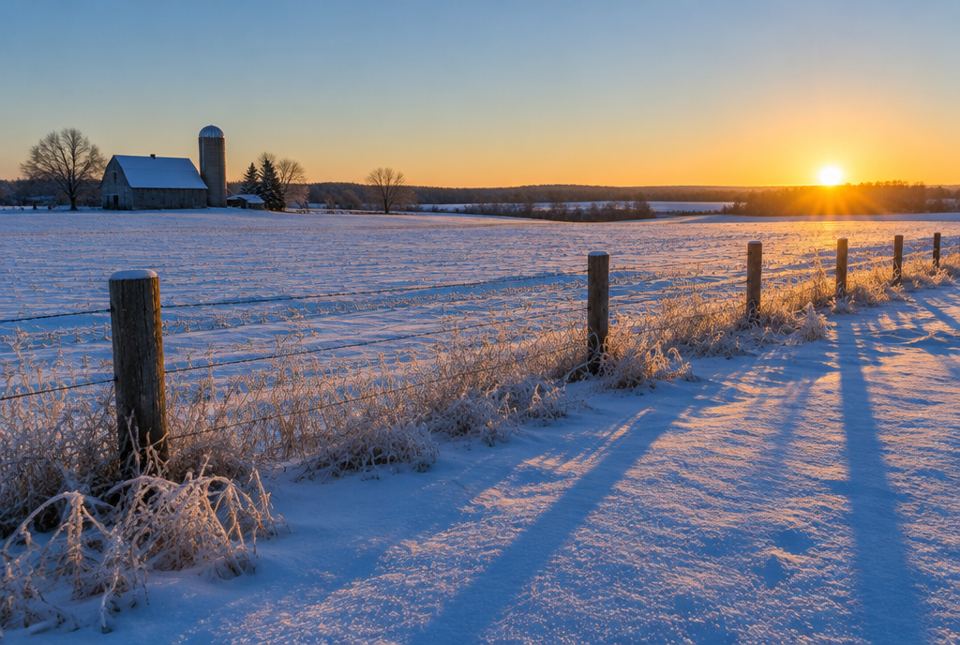 The Sun seems to rise in the east because Earth is spinning toward it. Notice how low the winter Sun is: that makes long shadows. AI-generated image
Motion 1: Rotation → day and night
Earth rotates (spins) on its axis once about every 24 hours.
- The half of Earth facing the Sun has day. The half facing away has night.
- Earth spins from west to east. That is why the Sun, Moon and stars all seem to rise in the east and set in the west.
- Because Earth is a spinning ball, it is a different time in different places. Canada is so wide that it has six time zones. When it is noon in Ontario, it is still morning in British Columbia.
Motion 2: Revolution → one year
While it spins, Earth also revolves (travels) around the Sun in an orbit. One full trip takes about 365¼ days: one year.
The extra quarter day adds up. Every four years, we add one extra day, February 29, in a leap year.
As Earth travels around the Sun, the night side of Earth faces different directions in space at different times of year. So we see different stars in winter and in summer.
The tilt → seasons
Earth's axis is tilted about 23.4°, and it always leans in the same direction in space as Earth goes around the Sun.
- Around June, the Northern Hemisphere (where Canada is) is tilted toward the Sun. Sunlight hits us more directly, the Sun climbs higher in the sky, and the days are longer. It is summer.
- Around December, the Northern Hemisphere is tilted away from the Sun. Sunlight hits at a low slant and spreads out, and the days are short. It is winter.
- In spring and fall, neither hemisphere is tilted toward the Sun.
When it is winter in Canada, it is summer in the Southern Hemisphere, in places like Australia and Argentina!
Important: seasons are not caused by Earth being closer to or farther from the Sun. In fact, Earth is closest to the Sun in early January, during our winter.
Reading the seasons in the stars: Ojibwe sky knowledge
Because Earth revolves around the Sun, different star patterns are overhead in different seasons. The Ojibwe people, an Anishinaabe nation with many communities in Ontario today, have their own constellations and use them to mark the seasons. A few are shown on the Ojibwe Sky Star Map, made by astronomer Annette S. Lee with artists William Wilson and Carl Gawboy:
- Biboonkeonini, the Wintermaker, made of stars that include Orion. He is seen overhead during the winter months.
- Mishi Bizhiw, Curly Tail, the Great Panther, made of stars that include Leo. He rises in late winter and is overhead in spring. When he was overhead, people knew that the ice would be thawing and that it was time to move from winter camp to the sugar bush camp to make maple syrup.
- Ojiig, the Fisher, made of the stars of the Big Dipper. It circles the North Star all year long.
This knowledge comes from careful observation of the sky over many generations, and it is still taught today.
Worked exampleLet's explain Toronto's long summer days
In Toronto, the Sun is in the sky for much longer on June 21 than on December 21. Explain why, using what you know about Earth's motion.
- What stays the same? Earth rotates once every 24 hours all year.
- What changes? Earth's position in its orbit around the Sun (its revolution).
- In June: the Northern Hemisphere is tilted toward the Sun. As Earth spins, Toronto spends more of each 24 hours on the sunny side.
- In December: the Northern Hemisphere is tilted away. Toronto spends less of each 24 hours on the sunny side, and the Sun stays low in the sky.
Long June days happen because Earth's tilt points the Northern Hemisphere toward the Sun at that point in Earth's revolution. In December it points away, so days are short.
Just for funPeople born on February 29 are sometimes called leaplings. A leapling who turns 12 has had only 3 real birthdays on February 29! In other years, most celebrate on February 28 or March 1.
Hands-on activityShadow stick and flashlight seasons
You need: a straight stick or pencil, a lump of modelling clay or a paper cup filled with sand, a sheet of paper or sidewalk chalk, a ruler; also a flashlight, an orange or a ball, and a marker.
Part A: Shadow stick (on a sunny day)
- Stand the stick upright in the clay on paper (or on pavement) in a sunny spot. Mark its base.
- Every hour from morning to afternoon, mark the tip of the shadow and write the time. Measure the length.
- Never look up at the Sun while you do this. Look only at the shadow on the ground.
Part B: Flashlight seasons (indoors)
- Draw a line around the middle of the orange for the equator. Mark Ontario above it.
- In a dark room, shine the flashlight straight at Ontario from 30 cm away, then tilt the orange so the light hits Ontario at a slant. Compare the size and brightness of the spot of light.
Investigate (A1.2): when was the shadow shortest? Which spot of light was smaller and brighter?
What to look for: the shadow is shortest around midday, when the Sun is highest, and it moves from the west side to the east side of the stick as the Sun seems to move from east to west. Direct light makes a small, bright spot (more energy in each part, like summer). Slanted light makes a big, dim spot (energy spread out, like winter). If you repeat Part A in winter, midday shadows will be much longer.
Safety: never look directly at the Sun, not even through sunglasses or binoculars. Wear sunscreen and a hat outdoors.
Your turn
1What causes day and night?
Earth's rotation (spinning on its axis). The side facing the Sun has day; the side facing away has night.
2How long does one rotation of Earth take?
The time it takes Earth to revolve once around the Sun: about 365¼ days.
4Why does the Sun seem to rise in the east?
Earth spins from west to east, so the Sun comes into view on the eastern side of the sky.
Earth's tilted axis. As Earth revolves, each hemisphere takes turns being tilted toward the Sun (summer) and away (winter).
6When it is summer in Canada, what season is it in Australia?
Winter. The Southern Hemisphere is tilted away from the Sun then.
7Name one Ojibwe constellation and the season it is linked to.
Example: Biboonkeonini, the Wintermaker: overhead in winter. Or Mishi Bizhiw (Curly Tail): overhead in spring, when the ice thaws.
More practice: warm-up
1Rotation or revolution? Earth spinning on its axis.
2Rotation or revolution? Earth travelling around the Sun.
3Which takes longer: one rotation or one revolution?
One revolution (a year) takes much longer than one rotation (a day).
4In which direction does the Sun set?
5What extra day is added in a leap year?
More practice: on your own
1Why do we add a leap day every four years?
A year is about 365¼ days. Four quarter days add up to 1 whole day, so we add February 29 to keep the calendar matched to Earth's orbit.
2Noor's shadow-stick results: 9 a.m. 60 cm, 11 a.m. 35 cm, 1 p.m. 30 cm, 3 p.m. 50 cm. When was the Sun highest? How do you know?
Around 1 p.m. (between noon and 1 p.m.). The shortest shadow means the Sun was highest in the sky.
3Why are winter days colder even though the Sun is shining?
In winter, sunlight comes in at a low slant, so its energy is spread out over a larger area, and the days are shorter, so there is less time to warm up.
4Explain why we see different stars in January than in July.
Earth revolves around the Sun. In January our night side faces one direction in space; in July it faces the opposite direction, so we see different stars.
5Ottawa and Vancouver: when the Sun is setting in Ottawa, is it still daytime in Vancouver? Explain.
Yes. Vancouver is farther west. Earth spins west to east, so places farther west see the Sun set later (3 hours later on the clock).
Challenge
1A classmate says, "It's summer because Earth is closer to the Sun." Give two pieces of evidence that this is wrong.
- When it is summer in Canada, it is winter in Australia, but both are about the same distance from the Sun. 2) Earth is actually closest to the Sun in early January, during our winter. The tilt causes seasons.
2What would happen to the seasons if Earth's axis were not tilted at all? Explain.
There would be almost no seasons. Each place would get the same angle of sunlight and about the same length of day all year round, so the temperature would not change much from month to month.
3How is the Ojibwe use of Mishi Bizhiw to know when to move to sugar bush camp an example of science?
It is based on careful observation of a pattern (which stars are overhead at which time of year), tested and passed on over many generations, and used to predict a natural event (thawing ice, sap season). Observing patterns and making predictions are key parts of science.
Quiz
1. What causes day and night on Earth?
2. How long does Earth take to revolve once around the Sun?
4. In June, the Northern Hemisphere is...
5. The Sun seems to rise in the east because...
6. For the Ojibwe, Mishi Bizhiw (Curly Tail) overhead in spring was a sign that...
Big idea (E2.5): describe effects of the relative positions and motions of Earth and the Sun: day and night, the apparent motion of the Sun, the year, seasons and changing star patterns. The shadow stick practises observation and recording (A1.2). Ojibwe star knowledge shows a contribution to science from a specific community (A3.3).
How to help: use a lamp (shade off, away from the hot bulb) and a ball or orange to act out rotation and revolution. Keep the axis tilted in the same direction while you walk the ball around the lamp. Find Orion together on a winter evening; it is part of the Ojibwe Wintermaker.
Common difficulties:
- Thinking seasons come from distance to the Sun. This is the most common misconception, even among adults.
- Mixing up rotation and revolution. Rotation = spin (day); revolution = trip around (year).
- Thinking the axis wobbles back and forth during the year. It keeps pointing the same way in space.
Safety: never look at the Sun, directly or through binoculars, telescopes, cameras or sunglasses.
Sources: Ojibwe constellations and their seasonal meanings: Annette S. Lee, William Wilson, Carl Gawboy and Jeff Tibbetts, Ojibwe Sky Star Map and its constellation guide (described in Annette S. Lee, "Native Skywatchers and the Ojibwe Giizhig Anung Masinaaigan: Ojibwe Sky Star Map", arXiv 2008.13214). Earth's tilt (23.4°) and year length: NASA. To learn more, look for teachings from Anishinaabe knowledge keepers in your area.