E. Earth and Space Systems · SpaceOur Solar System: The Sun and the Planets
E2.1 A1.1 A1.5About 45 minutes
Learning goals- I can name the parts of the solar system, starting with the Sun and the eight planets in order.
- I can describe the main physical characteristics of the Sun and of each planet.
- I can tell the difference between the inner rocky planets and the outer giant planets.
- I can use a scale model to show how far apart the planets are.
Words to know
solar system
The Sun and everything that travels around it: planets, moons, dwarf planets, asteroids, comets and meteoroids.
star
A huge ball of very hot gas that makes its own light and heat. The Sun is a star.
planet
A large, round body that travels around a star and has cleared other objects out of its path.
orbit
The curved path one object follows around another, like Earth around the Sun. Also a verb: Earth orbits the Sun.
dwarf planet
A round body that orbits the Sun but has not cleared its path of other objects, like Pluto or Ceres.
scale model
A model where every size or distance is shrunk by the same amount, so the model keeps the real proportions.
Remember from Grade 1
In Grade 1 you learned that the Sun gives Earth light and heat, and that Earth spins to give us day and night. This year we zoom way out. Earth is just one of eight planets travelling around the Sun. Together with moons, asteroids, comets and more, they make up our solar system.
Let's start with a question
If you could ride in a car to the Sun at 100 km per hour, without stopping, how long would the trip take?
Earth is about 150 million km from the Sun. 150 000 000 ÷ 100 = 1 500 000 hours. That is more than 170 years of driving! Space is enormous. In this lesson you will find out what is out there and how far apart things really are.
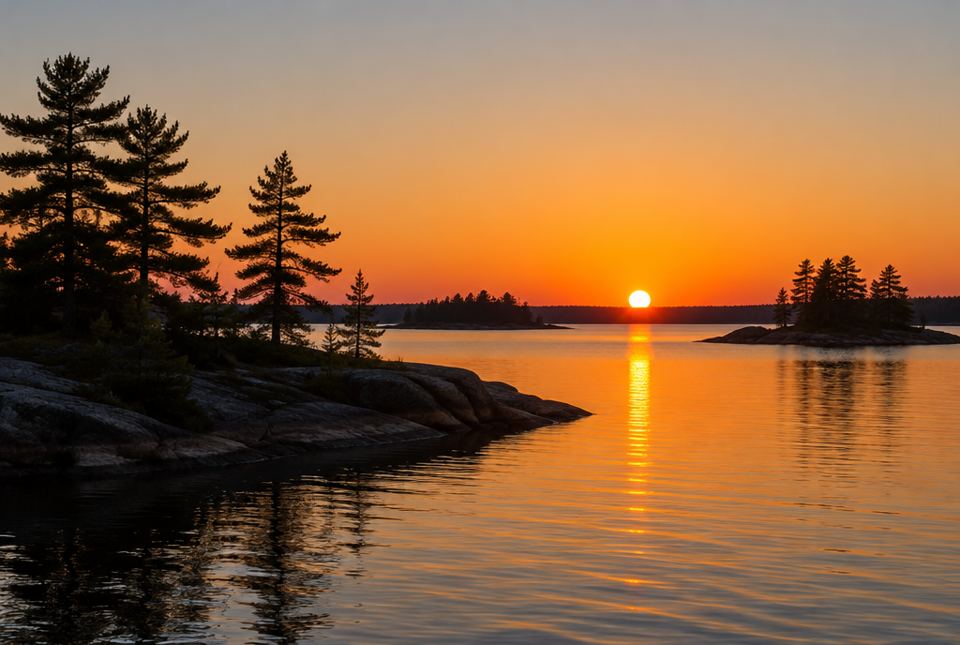 The Sun is a star, the only one in our solar system. Even from 150 million km away, it is bright enough to light up the whole sky and the lake. AI-generated image
The Sun: our star
The Sun is at the centre of the solar system. It is a star: a giant ball of extremely hot gas that makes its own light and heat.
- It is about 1.4 million km across. That is about 109 Earths lined up side by side.
- Its surface is about 5500 °C. (A hot kitchen oven is about 200 °C.)
- Its gravity holds all the planets in their orbits.
- Light from the Sun takes about 8 minutes to reach Earth.
The Sun looks bigger and brighter than other stars only because it is so much closer to us.
Safety: never look straight at the Sun, not even for a moment, and never through binoculars, a telescope, a camera or sunglasses. It can permanently damage your eyes.
The eight planets, in order
A sentence can help you remember the order: My Very Educated Mother Just Served Us Nachos.
The inner planets (Mercury, Venus, Earth, Mars) are small and rocky, with solid surfaces you could stand on.
The outer planets (Jupiter, Saturn, Uranus, Neptune) are giant planets made mostly of gases and liquids, with no solid surface to stand on. Jupiter and Saturn are called gas giants. Uranus and Neptune are called ice giants, because they contain a lot of water, ammonia and methane. All four giant planets have rings, though Saturn's are by far the easiest to see.
Between Mars and Jupiter is the asteroid belt, where many rocky asteroids orbit the Sun.
Farther out than Neptune are dwarf planets such as Pluto. Pluto was called a planet until 2006, when astronomers decided it belongs in the dwarf planet group because it shares its path with many other icy objects.
| Planet | Type | Diameter (km) | Average distance from Sun (million km) | One year (time to orbit the Sun) | Average temperature |
|---|
| Mercury | rocky | 4 879 | 57.9 | 88 Earth days | 167 °C |
| Venus | rocky | 12 104 | 108.2 | 225 Earth days | 464 °C |
| Earth | rocky | 12 756 | 149.6 | 365 days | 15 °C |
| Mars | rocky | 6 792 | 228.0 | 687 Earth days | −65 °C |
| Jupiter | gas giant | 142 984 | 778.5 | about 12 Earth years | −110 °C |
| Saturn | gas giant | 120 536 | 1 432.0 | about 29 Earth years | −140 °C |
| Uranus | ice giant | 51 118 | 2 867.0 | about 84 Earth years | −195 °C |
| Neptune | ice giant | 49 528 | 4 515.0 | about 164 Earth years | −200 °C |
What makes each planet special?
- Mercury: the smallest planet and closest to the Sun. Almost no air, so it is very hot in the day and very cold at night. Covered in craters.
- Venus: about the same size as Earth, but covered by thick clouds and a heavy atmosphere of carbon dioxide that traps heat. That is why Venus is the hottest planet, even though Mercury is closer to the Sun.
- Earth: the only planet known to have living things and liquid water on its surface.
- Mars: the "red planet", a cold desert with rusty, iron-rich dust, huge volcanoes and polar ice caps.
- Jupiter: the biggest planet. It has a giant storm called the Great Red Spot that is larger than Earth.
- Saturn: famous for its bright, wide rings made of chunks of ice and rock.
- Uranus: an ice giant that is tipped on its side, so it seems to roll around the Sun.
- Neptune: the farthest planet, with the strongest winds measured in the solar system.
Notice the pattern
The farther a planet is from the Sun, the longer its year. Neptune is so far away that one Neptune year lasts about 164 Earth years.
Just for funWhy didn't the Sun go to university?
Because it already had millions of degrees! ☀️ (Its core really is about 15 million °C.)
Worked exampleLet's build a scale model on paper
The real distances are too big to draw. Use the scale 1 cm = 10 million km to find how far from the Sun to place Earth, Jupiter and Neptune in a model.
- Each 10 million km becomes 1 cm. So divide the real distance (in millions of km) by 10.
- Earth: 149.6 ÷ 10 = 14.96, so about 15 cm from the Sun.
- Jupiter: 778.5 ÷ 10 = 77.85, so about 78 cm.
- Neptune: 4515 ÷ 10 = 451.5, so about 452 cm, which is 4.5 m!
- Look at the pattern: the inner planets are crowded near the Sun, and the outer planets are very spread out.
Earth ≈ 15 cm, Jupiter ≈ 78 cm, Neptune ≈ 4.5 m from the Sun. Even in a small model, the solar system stretches across a whole room.
Hands-on activityHallway solar system (scale model)
You need: a ball of string or yarn about 5 m long, masking tape, a metre stick or tape measure, a marker, and 9 small paper labels.
- Tape one end of the string to the floor at the end of a hallway. Label it Sun.
- Using the scale 1 cm = 10 million km, measure along the string and tape a label at each distance:
- Mercury 6 cm, Venus 11 cm, Earth 15 cm, Mars 23 cm
- Jupiter 78 cm, Saturn 143 cm, Uranus 287 cm, Neptune 452 cm
- Stand at Neptune and look back at the Sun. Then stand at Earth.
- Research (A1.1): pick one planet. Use a library book or a trusted website (for example NASA or the Canadian Space Agency) to find two more facts about it. Write down where each fact came from.
- Communicate (A1.5): make a fact card for your planet with its name, type (rocky, gas giant or ice giant), one number fact and one surprising fact.
What to look for: the first four planets are bunched within about a quarter of a metre of the Sun, while Neptune is more than 4 m away. At this scale Earth would be far smaller than a grain of sand, and even Jupiter would be only about the size of a speck of dust. That shows how much empty space there is.
Safety: tape the string flat so no one trips, and roll it up when you finish.
Your turn
1Name the eight planets in order from the Sun.
Mercury, Venus, Earth, Mars, Jupiter, Saturn, Uranus, Neptune.
2Is the Sun a planet or a star? How do you know?
A star. It is a huge ball of hot gas that makes its own light and heat.
3Which planet is the biggest?
Jupiter. Its diameter is about 143 000 km.
4Which planet is the hottest? Why is it not Mercury?
Venus. Its thick carbon dioxide atmosphere traps heat. Mercury has almost no air to hold heat in.
5Where is the asteroid belt?
Between Mars and Jupiter.
6Name the four rocky planets.
Mercury, Venus, Earth, Mars (the inner planets).
7Why is Pluto now called a dwarf planet?
It is round and orbits the Sun, but it shares its path with many other icy objects, so it has not cleared its orbit.
More practice: warm-up
1What does the Sun's gravity do for the planets?
It holds them in their orbits around the Sun.
2Which planet do we live on, and what number is it from the Sun?
3Which planet has the most famous bright rings?
4Which planet is closest to the Sun?
5Which planet is called the red planet?
More practice: on your own
1Saturn is 1432 million km from the Sun. Using 1 cm = 10 million km, how far from the Sun should it go in your model?
About 143 cm. 1432 ÷ 10 = 143.2 cm.
2Jupiter's diameter is 142 984 km and Earth's is 12 756 km. About how many Earths would fit side by side across Jupiter?
About 11. 142 984 ÷ 12 756 ≈ 11.2.
3Sort these into inner (rocky) and outer (giant): Neptune, Mars, Saturn, Venus.
Inner: Mars, Venus. Outer: Neptune, Saturn.
4Why can't an astronaut land on Jupiter the way they could on Mars?
Jupiter is a gas giant with no solid surface to stand on. Mars is rocky.
5Mars takes 687 Earth days to orbit the Sun. Is a Mars year longer or shorter than an Earth year? About how many Earth years is it?
Longer, almost 2 Earth years (687 ÷ 365 ≈ 1.9). Mars is farther from the Sun, so its orbit is longer.
Challenge
1Explain the pattern between a planet's distance from the Sun and the length of its year. Use two planets from the table as evidence.
The farther a planet is from the Sun, the longer its year. Example: Mercury (57.9 million km) takes 88 days, while Neptune (4515 million km) takes about 164 Earth years. Farther planets have a longer path to travel and move more slowly.
2Light travels about 300 000 km every second. Earth is about 150 000 000 km from the Sun. Show that sunlight takes about 8 minutes to reach us.
150 000 000 ÷ 300 000 = 500 seconds. 500 ÷ 60 ≈ 8.3 minutes, so about 8 minutes.
3A classmate says, "The Sun is the biggest star in the universe because it looks the biggest." Is this correct? Explain.
No. The Sun looks big and bright only because it is much closer to us than any other star. Other stars look like tiny dots because they are extremely far away, and many of them are actually bigger than the Sun.
Quiz
1. Which list shows the planets in order from the Sun?
2. What kind of object is the Sun?
3. Which planet is the hottest?
4. What is between the orbits of Mars and Jupiter?
5. Which planet is a gas giant?
6. In a model where 1 cm = 10 million km, Earth (about 150 million km from the Sun) goes about...
Big idea (E2.1): identify components of the solar system and describe their main physical characteristics. This lesson covers the Sun and the planets; the next lesson covers moons, asteroids, comets and meteoroids. Research and communication skills (A1.1, A1.5) are practised in the activity.
How to help: build the hallway model together. Most children (and adults!) are surprised by how spread out the outer planets are. Look up NASA's Solar System pages or the Canadian Space Agency website together, and talk about why these are trustworthy sources.
Common difficulties:
- Thinking the closest planet must be the hottest. Venus is hotter than Mercury because of its thick, heat-trapping atmosphere.
- Picture books show the planets close together. Remind your child that diagrams are rarely to scale.
- Calling the Sun a planet, or thinking stars are different from the Sun. The Sun is an ordinary star that happens to be close.
Safety: make sure your child knows never to look at the Sun directly or through binoculars, a telescope, a camera or sunglasses.
Source of numbers: NASA Planetary Fact Sheet (nssdc.gsfc.nasa.gov) and NASA Sun Fact Sheet.