A. Literacy Connections and Applications / C. Comprehension: Understanding and Responding to Texts · Understanding and Responding to TextsText Forms, Genres and Why We Read
C1.2 C2.2 C1.1 A3.1About 35 minutes
Learning goals- I can tell the difference between literary and informational texts.
- I can name some genres, like fable, fairy tale, realistic fiction, fantasy, biography and how-to.
- I can describe the characteristics (special features) of a genre.
- I can set a purpose before I read: to learn facts, or to gain a new idea or a new perspective.
Words to know
literary text
A text that tells a story or shares feelings, like a story, a fable or a poem. It is written to entertain or to make us think and feel.
informational text
A text that gives true facts or teaches how to do something, like a report, a how-to text or a biography.
genre
A kind or family of texts that share the same characteristics. Fairy tales are one genre; biographies are another.
characteristics
The special features that help you recognize something. A characteristic of a fable is a lesson at the end.
biography
A true story of a real person's life, written by someone else.
purpose
The reason why. A writer has a purpose for writing, and a reader has a purpose for reading.
perspective
The way someone sees or thinks about something.
Remember from Grade 2
In Grade 2 you learned that texts can be literary (stories and poems) or informational (facts and how-to). You read fables, poems, fact texts, how-to texts and journals.
In Grade 3 you will learn more genres, describe their characteristics, and choose your purpose before you read.
Hook: Three texts, one topic
All three short texts below are about maple syrup. But they are very different! As you read (or listen), ask yourself: Is this real or made up? Why did the writer write it?
Text 1: The Maple Who Wanted to Fly
Once upon a time, a young maple tree named Mapleton dreamed of flying. "The geese fly south every fall," he sighed. "Why can't I?"
All winter he stretched his branches and wiggled his roots. Nothing happened. Then, one warm spring morning, his sweet sap began to drip. A little girl tasted the syrup her family made and laughed, "This tastes like flying!"
Mapleton smiled. Maybe he could not fly, but he could make people's hearts soar.
Text 2: How Maple Syrup Is Made
Maple syrup comes from the sap of maple trees. Sap is a clear, watery liquid inside the tree.
In late winter and early spring, the days are warm and the nights are still below freezing. This makes the sap flow. People collect the sap and boil it for a long time. The water turns to steam and floats away. What is left is thick, sweet syrup.
It takes about 40 litres of sap to make just 1 litre of syrup! First Nations peoples, such as the Anishinaabe and the Haudenosaunee, made maple sugar long before Europeans came to North America.
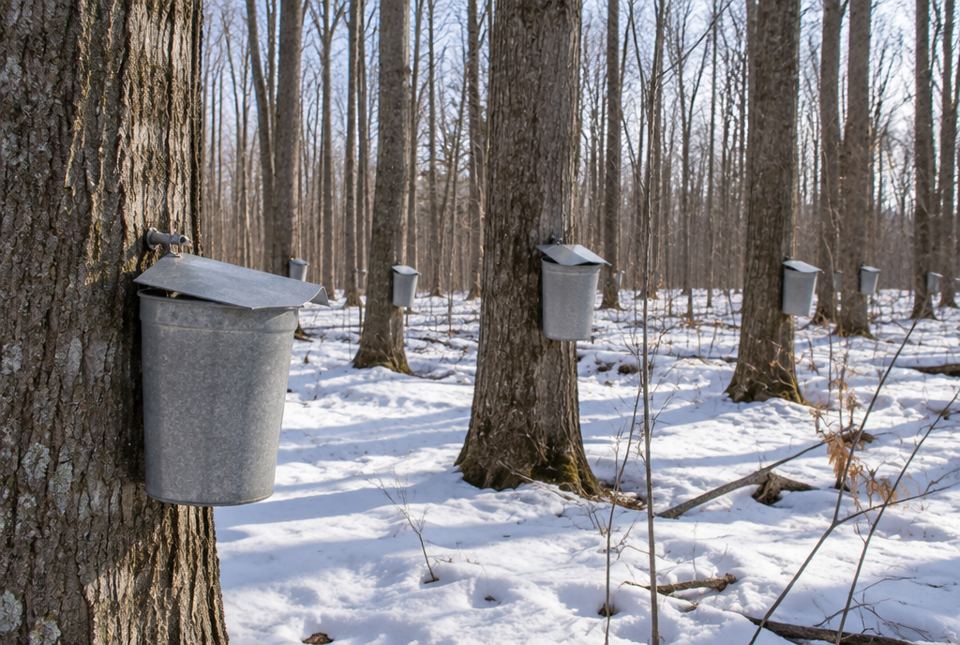 This is a real sugar bush in late winter. The buckets catch the sap that Text 2 tells about, before it is boiled into syrup. AI-generated image
Text 3: Maple Syrup Snow Taffy (a how-to text)
You need: clean snow packed in a baking pan, maple syrup, a pot, craft sticks, a grown-up to do the heating.
- A grown-up heats the syrup until it is very hot and thick.
- The grown-up pours thin lines of the syrup onto the snow.
- Wait a few seconds for it to firm up.
- Press a craft stick on one end and roll the taffy up.
- Enjoy!
Literary or informational?
- Text 1 is literary. It is a made-up story with a talking tree. Its purpose is to entertain and to give us a feeling or idea to think about.
- Text 2 is informational. It gives true facts. Its purpose is to teach.
- Text 3 is informational too. It is a how-to text (also called a procedure). Its purpose is to tell how to do something.
Genres: families of texts
A genre is a family of texts that are alike in some ways. Just like you can tell a dog from a cat by its features, you can tell a genre by its characteristics.
| Genre | Literary or informational? | Characteristics (what to look for) |
|---|
| Fable | Literary | Short; animal characters who talk; a lesson (moral) at the end |
| Fairy tale | Literary | Begins Once upon a time; magic; good and bad characters; often a happy ending |
| Fantasy | Literary | Things that could not really happen: talking trees, dragons, magic |
| Realistic fiction | Literary | Made up, but it could really happen: kids, families, school, sports |
| Poem | Literary | Lines and verses; may rhyme; describes feelings or pictures with few words |
| Report (fact text) | Informational | True facts about one topic; headings; photos, diagrams |
| How-to (procedure) | Informational | A goal, a list of things you need, numbered steps in order |
| Biography | Informational | The true story of a real person's life, often told in order from birth onward |
| Letter | Can be either | Date, greeting (Dear...), body, closing (From...), signature |
Worked exampleLet's name the genre
Read this text. What genre is it? How do you know?
Fox saw grapes hanging high on a vine. She jumped and jumped but could not reach them. "Those grapes are probably sour anyway," she said, and walked away.
Moral: It is easy to say you don't want something you can't have.
- Look for clues. The characters are animals that talk (Fox speaks).
- The text is short.
- At the end there is a moral: a lesson.
- Talking animals + short + a moral = the characteristics of a fable.
It is a fable. It is short, has a talking animal and ends with a moral.
Worked exampleLet's tell realistic fiction from fantasy
Text A: Amira scored her first goal at hockey practice. Her team cheered.
Text B: Amira's hockey stick whispered, "Shoot now!" and the puck flew by itself into the net.
- Ask: Could this really happen?
- Text A: a girl scoring a goal at hockey. Yes, this could really happen. But we don't know Amira; she is made up. So it is realistic fiction.
- Text B: a hockey stick that whispers and a puck that flies by itself. That could not really happen. So it is fantasy.
Text A is realistic fiction. Text B is fantasy.
Set a purpose before you read
Good readers ask, "Why am I reading this?" before they start. Your purpose helps you know how to read.
- To learn facts or information: read carefully, slow down at numbers and new words, use headings. Example: I am reading Text 2 to find out why sap flows in spring.
- To follow steps: read one step at a time, in order. Example: I am reading Text 3 so I can make snow taffy.
- To gain insight or a new perspective: think about characters' feelings and the big idea. Insight means understanding something more deeply. Example: I am reading Text 1 to think about how everyone has their own special gift.
- For enjoyment: relax, picture it, have fun!
Worked exampleLet's choose a purpose
You want to know how much sap makes 1 litre of syrup. Which text do you read, and how?
- Your purpose is to learn a fact.
- The fact will be in an informational text, so choose Text 2.
- Scan for numbers. You find: about 40 litres of sap to make 1 litre of syrup.
Read Text 2 and look for numbers. Answer: about 40 litres of sap.
Just for funRiddle: I am very short, my characters are talking animals, and I always end with a lesson. What am I?
A fable! (Sorry, Fox. Those grapes really were too high.)
Use what you learn everywhere
Knowing genres helps in every subject. In science you will read reports and how-to experiments. In social studies you will read biographies and letters from the past. In math you will read word problems. Ask: What kind of text is this, and why am I reading it?
Hands-on activityGenre hunt at home
You need: books, magazines, flyers, a recipe card or cereal box, paper and a pencil.
- Collect 6 different texts from around your home (you may also use a library visit).
- For each one, write: its title, literary or informational, and its genre.
- Write one characteristic you noticed (for example, "numbered steps" or "talking animals").
- Pick one text. Before you read it, say your purpose out loud: "I am reading this to..."
- Tell a grown-up whether your purpose changed how you read.
Your turn
1Is Text 2: How Maple Syrup Is Made literary or informational? How do you know?
Informational. It gives true facts about how syrup is made.
2Name two characteristics of a how-to text.
Any two: a goal or title; a list of things you need; numbered steps in order; bossy action words like pour and wait.
3A book tells the true story of the life of hockey player Hayley Wickenheiser, from childhood to the Olympics. What genre is it?
A biography: the true story of a real person's life.
4A dragon lived under the Peace Bridge and ate only pancakes. Is this fantasy or realistic fiction?
Fantasy. Dragons are not real, so it could not really happen.
5What is the purpose of a fable?
To teach a lesson (moral), and to entertain.
6You want to know when maple sap flows. Which is your purpose: to learn facts, to follow steps, or for a new perspective?
To learn facts (information).
7In Text 1, Mapleton cannot fly. What insight, or bigger idea, might the story give you?
Example: Everyone has their own special gift, even if it is not the one they wished for.
More practice: warm-up
1Which genre often begins with Once upon a time?
2Is a poem literary or informational?
3What do we call the lesson at the end of a fable?
4Is a recipe literary or informational?
Informational. It is a how-to text.
5Sam walked his dog to the park after school. Could this really happen?
More practice: on your own
1Your class reads a report about bats. What would be a good purpose for reading it?
Example: to learn facts about bats, such as what they eat and where they sleep. (Any fact-finding purpose with a reason.)
2What is the difference between realistic fiction and a biography?
Both could be about real-life things, but realistic fiction is made up, while a biography is true and about a real person.
3A text has a date, Dear Grandpa, a few paragraphs and Love, Mei. What genre is it? Name two characteristics.
A letter. It has a date, a greeting (Dear Grandpa), a body and a closing (Love, Mei).
4How should you read a how-to text differently from a fantasy story?
Read a how-to text one step at a time, in order, and check you did each step. A fantasy story you can read for fun, picturing the story and thinking about the characters.
5Is Text 3, Maple Syrup Snow Taffy, safe for a child to do alone? Find the evidence in the text.
No. The text says a grown-up heats the syrup and pours it. Hot syrup can burn.
Challenge
1Could a text be both a story and teach true facts? Give an example.
Yes. Example: a story about a girl visiting a sugar bush could be made up, but still teach true facts about how syrup is made. Some books mix genres.
2Write the first line of a fable about a beaver and a squirrel. What must your fable have at the end?
Example: Beaver was busy building, but Squirrel only wanted to play. At the end it must have a moral, such as Hard work pays off.
3Why might two people read the same text for different purposes? Give an example using Text 2.
People want different things. Example: one person reads Text 2 to learn how syrup is made for a school project; another reads it to understand why First Nations peoples' knowledge of maple sugar matters (a new perspective).
Quiz
1. Which text is informational?
2. Talking animals, a short story and a moral at the end are characteristics of a...
4. Liam's tooth fell out during lunch. What genre could this sentence come from?
5. Which is a good purpose for reading a how-to text?
What this lesson teaches: Grade 3 students identify and describe characteristics of literary and informational text forms and their genres (C1.2), and set a purpose for reading, such as learning facts or gaining insight or new perspectives (C2.2). Knowing a text's form helps children read it the right way (C1.1), and it carries into science, social studies and math (A3.1).
How to help at home:
- Before reading anything together, ask: "Is this real or made up? What kind of text is it? Why are we reading it?"
- Point out genres in daily life: recipes (how-to), flyers (persuasive/media), news (report), bedtime stories (fiction).
- At the library, let your child choose one fiction and one non-fiction book each visit.
Common difficulties:
- Fiction about real things. Children often think a story is true because it could happen. Ask: "Is it about a real person, with real facts? Or did the author make up the people?"
- Fantasy vs. fairy tale. All fairy tales are fantasy (they have magic), but not all fantasy is a fairy tale. Don't worry if your child blurs these; focus on the characteristics.
Safety: The snow taffy recipe needs a grown-up to heat and pour the syrup. Hot syrup can cause serious burns.