D. Composition: Expressing Ideas and Creating Texts · Writing with Purpose and VoicePersuasive Writing: Opinions, Reasons and Proof
D2.1 D2.3 D1.1 D1.4 A2.5About 45 minutes
Learning goals- I can state a clear opinion.
- I can give reasons and back them up with examples or facts.
- I can organize a persuasive text using O-R-E-O.
- I can choose reasons and words that will convince my audience.
- I can write a persuasive letter and a review.
Words to know
persuade
To try to get someone to agree with you or to do something.
opinion
What someone thinks or believes. Others may think differently.
fact
Something true that can be checked.
reason
Why you think something.
evidence
Facts or examples that prove a reason.
review
A text that gives an opinion about a book, movie, game or place, with reasons.
Remember from Grade 2
In Grade 2 you wrote persuasive texts with an opinion, reasons and an ending that asks the reader to act. In Grade 3 you will back up each reason with proof: an example or a fact. Proof makes a reason much harder to argue with!
Opinion or fact?
- A fact can be checked: Our school has 300 students. Ottawa is the capital of Canada.
- An opinion tells what someone thinks: Recess is the best part of the day. Ottawa is the most beautiful city.
Persuasive writing starts with an opinion, then uses facts and examples to convince the reader.
A model persuasive letter
Dear Mayor Tremblay and Town Council,
I think our town should put lights on the outdoor skating rink at Riverside Park.
First, in December it gets dark before 5 o'clock. Most kids get home from school after 3:30, so they have only about an hour to skate before it is too dark. With lights, families could skate together after supper.
Also, skating is great exercise. Canada's guidelines say that kids should get at least 60 minutes of active play every day. Evening skating would help kids get active all winter.
Most importantly, lights would make the rink safer. Right now, some teenagers skate after dark anyway, and they can't see the cracks and bumps in the ice. Last week my brother tripped on a bump he couldn't see.
Please vote to add lights to the Riverside Park rink. I know our whole community would use them.
Sincerely,
Hana Ali, Grade 3
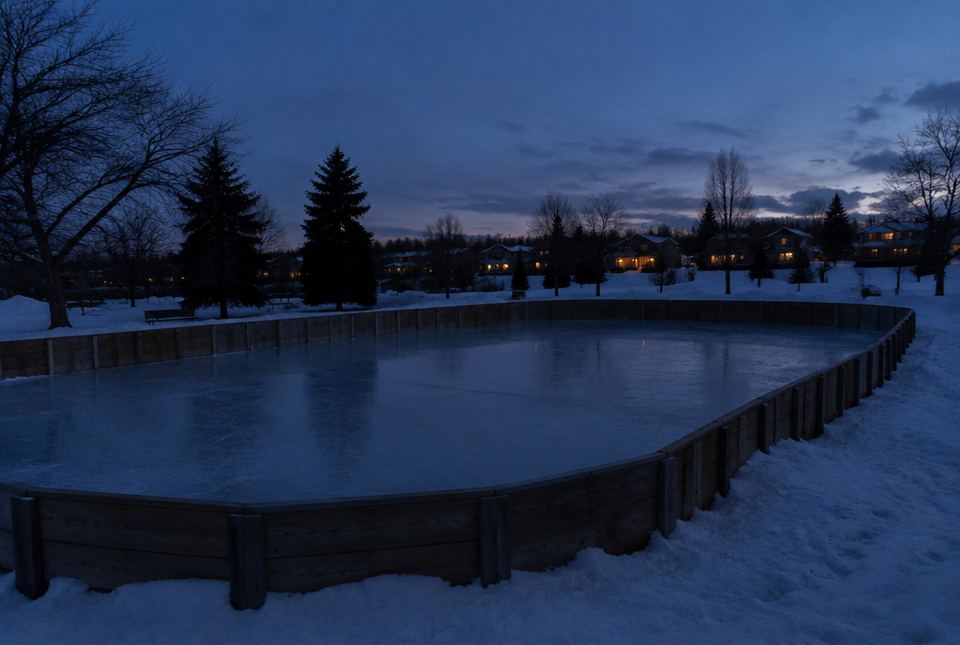 An outdoor rink in December, already dark in the late afternoon. Hana uses facts like this to persuade the town to put lights on the rink. AI-generated image
Worked exampleLet's find the O-R-E-O parts
- O, Opinion: I think our town should put lights on the outdoor skating rink.
- R, Reason 1: It gets dark early. E: dark before 5 o'clock; only about an hour after school.
- R, Reason 2: Skating is exercise. E: Canada's guidelines say 60 minutes of active play a day.
- R, Reason 3: Lights make it safer. E: people skate in the dark anyway; her brother tripped on a bump.
- O, Opinion again: Please vote to add lights... She asks the council to act.
- Linking words: First, Also, Most importantly. She saved her strongest reason (safety) for last.
Every reason has proof, and the letter is polite because the audience is the town council.
A model review
A review is a persuasive text about a book, movie, game or place.
Review: The Runaway Toque ⭐⭐⭐⭐⭐
If you like funny stories with a good lesson, you should read The Runaway Toque. It is about Kofi, whose new toque gets blown into a maple tree.
The story is really funny. My favourite part is when Ellie throws a snowball and the snow falls right on her own head! I also liked that the characters felt real. Kofi gets upset because his grandma made the toque, and I would feel the same way.
Best of all, the story has a great message: it's smart to ask for help. I think kids from Grade 1 to Grade 4 would enjoy it. Grab a copy and read it with a mug of hot chocolate!
Worked exampleLet's make reasons stronger with evidence
Omar writes: "Our class should get a pet fish because fish are good."
- Fish are good is a weak reason. It doesn't tell why.
- Make a better reason: A fish would teach us to be responsible.
- Add proof: We could take turns feeding it and cleaning the tank, and make a chart to track it.
- Think about the audience, his teacher: We could also observe it for our science lessons about living things.
"Our class should get a pet fish. A fish would teach us to be responsible, because we could take turns feeding it and cleaning the tank. We could also observe it for science."
Just for funWhat is a persuasive writer's favourite snack?
An O-R-E-O, of course. It has an Opinion on both ends!
Persuasive power words
To state your opinion: I believe, I strongly think, In my opinion, We should
To link reasons: First, Second, Also, Another reason is, Most importantly, For example
To end: Please, That is why, Imagine if, Don't miss...
Stay polite and respectful. Readers are more easily convinced by kind, clear reasons than by shouting or rude words.
Hands-on activityFamily debate night
You need: paper, a pencil and your family.
- Pick a fun family question: Should we have pancakes or waffles on Sunday? Should we go to the beach or a hiking trail? Should we get a family board game?
- Choose your opinion.
- Fill in an O-R-E-O plan: your opinion, three reasons, a fact or example for each reason, and your opinion again.
- Think about your audience: what does your family care about? (Time, money, fun, being healthy?)
- Write your persuasive paragraph or letter, then read it to your family with confidence.
- Let a family member respond with their reasons. Did anyone change their mind?
Your turn
1Fact or opinion? Hockey is the most exciting sport.
Opinion. Some people might disagree.
2Fact or opinion? A hockey team has six players on the ice at a time.
Fact. It can be checked. (Usually five skaters and one goalie.)
3What do the letters O-R-E-O stand for?
Opinion, Reasons, Examples (and facts), Opinion again.
4Give a reason and an example for this opinion: Kids should help cook supper.
Example: Kids learn real skills. For example, they can practise measuring, which is also math. Any reason with proof works.
5In Hana's letter, which reason did she save for last? Why?
Safety. It is her strongest reason, so it stays in the reader's mind.
6Write a polite ending for a letter asking your principal for a school garden.
Example: "Please think about starting a school garden. Thank you for reading my letter."
7Who was Hana's audience? How did that change her writing?
The mayor and town council. She used a polite greeting and closing, facts, and calm, respectful words.
More practice: warm-up
To try to get someone to agree with you or do something.
2Fact or opinion? Ottawa is the capital of Canada.
3Name one linking word for reasons.
Any: First, Second, Also, Another reason, Most importantly.
4What kind of text gives an opinion about a book, movie or game?
5Should a persuasive text be rude or polite?
More practice: on your own
1Turn this weak reason into a strong one with proof: We should have a longer recess because it's fun.
Example: A longer recess would help us focus, because running around gives our brains a break. After recess, we are ready to listen.
2Write an opinion sentence for a review of your favourite movie or book.
Example: "I think everyone should watch (title) because it is funny and exciting."
3You want your grandparents to visit for Diwali (or another holiday your family celebrates). Give two reasons that they would care about.
Examples: We would all be together. You could see how much I've grown. You could teach me the family recipe. Reasons that matter to grandparents are strongest.
4Find the opinion in this review: The new park has a zip line and a climbing wall. It is the best park in town.
It is the best park in town. (The zip line and climbing wall are facts that support it.)
5Why does proof make a reason stronger?
Because it shows the reason is true, with examples or facts the reader can believe or check.
Challenge
1Write a short persuasive paragraph using O-R-E-O: Our class should go on a field trip to a farm.
Model: I think our class should go on a field trip to a farm. First, we are learning about plants in science, and at a farm we could see how crops grow. Also, we could learn where our food comes from. For example, we could see cows being milked. That is why a farm trip would be perfect for our class! Look for an opinion, reasons with proof, and the opinion again.
2Hana's letter says "Last week my brother tripped on a bump he couldn't see." Is that a fact, an opinion or an example? Why does it help?
It is an example (a true event, so also a fact). It helps because it shows the danger is real, not just something Hana imagines.
3A toy company's ad says: "Every kid in Canada wants the Robo-Pup!" Is that a fact? Why might the company write it?
Not a fact. It can't be true that every kid wants it. The company writes it to persuade kids and parents to buy the toy, by making it sound like everyone has one.
Quiz
2. What does the E in O-R-E-O stand for?
3. Which reason is the strongest?
4. Which is a polite persuasive ending?
6. Why did Hana use facts like "dark before 5 o'clock" in her letter?
Big idea (D2.1, D2.3, D1.1): Grade 3 writers draft persuasive texts that state an opinion, give reasons, and back them up with examples or facts, organized with a plan like O-R-E-O (D1.4). They think about what will convince their audience (A2.5). The two model texts are a persuasive letter and a review.
How to help at home:
- Let your child persuade you about real family choices, in writing!
- Point out ads and ask, "What do they want you to do? Is that a fact or an opinion?"
- Model respectful disagreement: "I see your reason, but here's mine."
Common difficulties:
- Reasons without proof ("because it's good"). Ask "Why? Can you give an example?"
- Mixing facts and opinions. Ask "Could we check that?"
- Thinking only about their own wants. Ask "What does your reader care about?"