Strand A: Foundations of Language and Mathematics · Patterns, Shapes, Measuring and SortingPatterns All Around Us
A7.1 A7.4About 20 minutes
Learning goals- I can find a pattern that repeats.
- I can say a pattern out loud.
- I can tell what comes next in a pattern.
- I can find patterns in my home and outside.
Words to know
pattern
Things that go in the same order again and again, like clap, stomp, clap, stomp.
repeat
To happen again. A pattern repeats.
next
The one that comes right after.
Let's play a clapping game!
Grown-up, read this out loud and do the actions together.
Copy me: clap, stomp, clap, stomp, clap, stomp.
Now, what comes next? Did you clap? Yes! You found a pattern.
A pattern is something that goes in the same order again and again.
It repeats.
Look at this fruit pattern. Point to each one and say it out loud with me:
🍎🍌🍎🍌🍎🍌
"Apple, banana, apple, banana, apple, banana."
It sounds like a song! That is how you know it is a pattern.
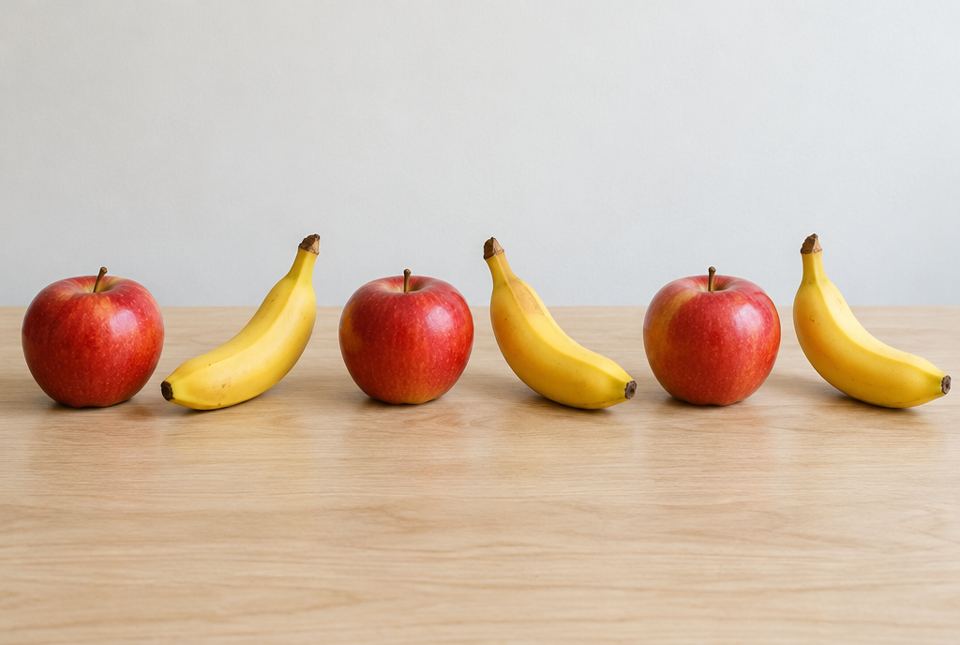 Here is the fruit pattern with real fruit! Point and say: apple, banana, apple, banana. What would come next? AI-generated image
Say it out loud
Patterns are easier to see when you say them in a sing-song voice and point to each thing.
Like this: "red, blue, red, blue ..."
When it starts to sound the same again and again, you have found the pattern.
Worked exampleLet's find what comes next
❄️⛄❄️⛄❄️⛄ ?
What comes next?
- Point to each picture and say it: "snowflake, snowman, snowflake, snowman, snowflake, snowman ..."
- Listen. Snowflake, snowman goes again and again.
- The last picture is a snowman. What always comes after a snowman? A snowflake.
Next comes a snowflake ❄️.
A striped scarf. Two colours take turns: first colour, second colour, first colour, second colour ... So the next two stripes are the first colour, then the second colour.Worked exampleLet's look for patterns at home
Where can we find patterns in our home?
- Look at your clothes. Is there a shirt or a scarf with stripes? Stripes often go in a pattern: red, white, red, white.
- Look at the floor. Some floors have tiles in a pattern.
- Look outside. A fence goes post, space, post, space.
- Listen to a song. Many songs repeat the same part again and again.
Patterns are everywhere: on clothes, floors, fences, in songs, and even in our day (wake up, play, sleep, then wake up again).
Hands-on activityPattern hunt and pattern dance
You need: your eyes, your body, and a few spoons and forks (or two kinds of toys).
- Walk around your home together. Find 3 patterns (stripes, tiles, a fence, a book cover). Say each one out loud.
- Lay out a pattern with spoons and forks: spoon, fork, spoon, fork. Ask: "What comes next?" Let your child add the next ones.
- Do a body pattern: jump, sit, jump, sit. Keep going for a while!
Talk about it: "How did you know what comes next?"
Just for funWhy does a zebra love pattern time?
Because it is already wearing one: black stripe, white stripe, black stripe, white stripe! 🦓
Your turn
1🔴🔵🔴🔵🔴🔵 ?
Say it out loud. What comes next?
🔴 Red. The pattern goes red, blue, red, blue. After blue comes red.
2Clap, pat your knees, clap, pat your knees, clap ...
What comes next?
Pat your knees. After a clap always comes a pat.
🐱 Cat. Dog, cat goes again and again.
4Is this a pattern? 🍎🍌🍌🍎🍎🍌
No. It does not repeat the same way. Sometimes there is one apple, sometimes two.
5Jump, sit, jump, sit ...
Do this pattern with your body. Then do 2 more.
The next two are jump, sit. Look for: your child jumps, then sits, and keeps the order.
6Find one pattern in your home. Tell about it.
Answers will vary. Examples: stripes on a shirt, tiles on the floor, slats on a fence, a rug with shapes. Look for: your child can say the part that repeats.
More practice: warm-up
3"La, lo, la, lo, la ..."
What do we sing next?
5🍪🥛🍪🥛
Point to the two things that take turns.
Cookie and milk. They go cookie, milk, cookie, milk.
More practice: on your own
1🔺🟦🔺🟦🔺 ? ?
What are the next two?
🟦🔺 Square, then triangle. After a triangle comes a square, and after a square comes a triangle.
2🍁🍂🍁🍂 ? ?
What are the next two?
🍁🍂 Maple leaf, then brown leaf. The pattern starts over again.
3🌞🌙🌞 ? 🌞🌙
One is missing. What is it?
🌙 Moon. Sun, moon, sun, moon ... so a moon goes in the gap.
4Snap your fingers, clap, snap, clap ...
What are the next two?
Snap, clap. Snap and clap take turns.
The fifth one should be 🔴 red. The pattern is red, blue, red, blue, so after the second blue comes red, not blue.
Challenge
1🍎🍎🍌🍎🍎🍌🍎🍎 ?
What comes next?
🍌 Banana. The pattern is apple, apple, banana. After two apples comes a banana.
2? 🐶🐱🐶🐱
What comes before the first dog?
🐱 Cat. The pattern goes cat, dog, cat, dog both ways. Before a dog comes a cat.
3🌧️☀️☀️🌧️☀️☀️🌧️ ?
What comes next?
☀️ Sun. The pattern is rain, sun, sun. After rain come two suns.
Quiz
3. Clap, stomp, clap, stomp, clap, ?
5. Where could you see a pattern?
What this is about: Kindergarten children learn to notice that patterns repeat, to say them aloud, and to tell what comes next (extend them).
How to help at home:
- Point out patterns everywhere: stripes, tiles, fences, music, the days of the week, daily routines.
- Always ask your child to say the pattern out loud while pointing. Hearing the rhythm helps a lot.
- Use real objects (spoons and forks, two colours of blocks, socks) more than pictures.
Common difficulties:
- Children may copy the last item instead of following the pattern. Ask them to say the whole pattern from the start.
- Some children make a "pattern" that does not repeat (red, blue, green, yellow ...). Gently ask, "What part comes again?"
- Children may stop extending after one item. Encourage them to keep going for a while.