Strand A: Foundations of Language and Mathematics · Talking, Listening, Reading and WritingHow Books and Print Work
A3.1 A3.2About 20 minutes
Learning goals- I can find the front cover and the title of a book.
- I know we read from left to right and top to bottom.
- I can point to a letter, a word and the space between words.
- I know that print tells a message.
- I can tell which books I like and why.
Words to know
cover
The outside of a book. The front cover has the title and usually a picture.
title
The name of a book.
author
The person who writes the words.
illustrator
The person who makes the pictures.
print
The letters and words written on a page.
word
A group of letters that means something. Words have spaces between them.
Let's explore a book!
(Grown-up: grab a picture book to use with this lesson.)
Books are full of stories and facts. But how does a book work? Where do we start? Let's find out!
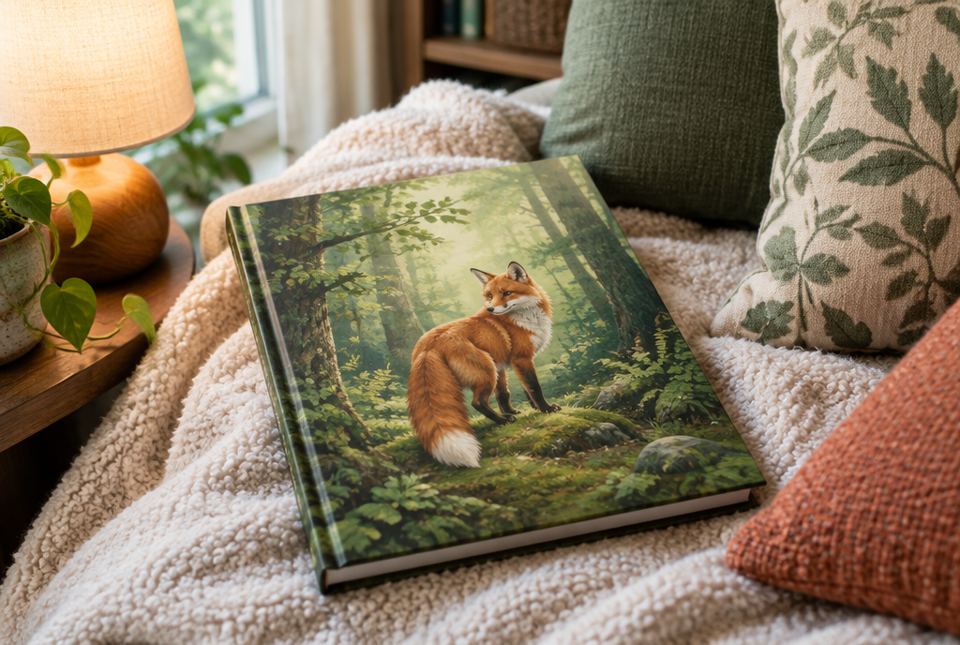 This is the front cover of a picture book. The picture gives us a clue: maybe the story is about a fox in the forest! AI-generated imageThe front cover of a book. It shows the title, a picture and the author's name. The spine is the edge that holds the pages together.
Parts of a book
- The front cover is where we start. It shows the title (the book's name) and often a picture.
- The author writes the words.
- The illustrator makes the pictures. Sometimes one person does both!
- The spine holds the pages together.
- The back cover is at the end.
Hold the book so the front cover faces you, right side up. Turn the pages one at a time.
How we read the words
The black marks on the page are called print. Print tells us a message. The grown-up isn't making up the words. They are reading the print!
In English, we read:
- from left to right →
- from top to bottom ↓
- then we go back to the left side of the next line, like a typewriter: ding!
Letters, words and spaces
Look at this sentence:
I see a moose.
- I, s, e are letters.
- see is a word. A word is a group of letters.
- Between the words there are spaces. Spaces show where one word ends and the next one starts.
- The dot at the end is a period. It means "stop, the sentence is done".
Worked exampleLet's count the words in a sentence
How many words are in: We like snow.
- Put your finger under the first word: We. That's 1.
- Jump over the space to the next word: like. That's 2.
- Jump over the space again: snow. That's 3.
- We reached the period. The sentence is done.
There are 3 words: We, like, snow. We counted by jumping from word to word over the spaces.
Books I like
Some books tell a made-up story, like a story about a bear who goes to school. Some books teach us real facts, like how beavers build dams.
What kind do you like? Do you like funny books? Animal books? Books about trucks? It is great to have favourites and to say why you like them.
Books from many voices
Books are written by all kinds of people. It's great to read books by authors from across Canada, including First Nations, Métis and Inuit authors and artists. Their books share stories, languages and ways of life from their communities.
- Sweetest Kulu by Celina Kalluk, an Inuk author, is a gentle bedtime poem for a baby.
- We Sang You Home by Richard Van Camp, a Tłı̨chǫ Dene author, has pictures by Cree-Métis artist Julie Flett.
We choose books for lots of reasons: to laugh, to learn facts, to read about things we love, and to hear about people and places that are like us or different from us.
Remember
Start at the front cover. Read left to right, top to bottom. Words have spaces between them. Print tells a message.
Just for funWhy did the book go to the book doctor?
It hurt its spine! 📖 (A book’s spine is the edge that holds the pages together.)
Hands-on activityBe the book leader
You need: a few picture books.
- Let your child choose a book. Ask: "Why did you pick this one?"
- Your child shows you the front cover and the title. You read the title and the author's name.
- Your child turns the pages, one at a time.
- On one page, your child shows you with a finger where to start reading. Read it aloud while they slide their finger left to right under the words.
- Find one short word and count its letters together.
Talk about it: "Do you like this book? What was your favourite part?"
Your turn
1Show me the front cover of a book.
Look for the child holding the book right side up with the front cover facing them.
2Where is the title? Point to it.
The title is usually on the front cover, often at the top in big letters. Check that the child points to the words, not the picture.
3Show me where I should start reading on this page.
Look for the child pointing to the first word at the top left of the print.
4Which way do we read: ← or →?
5How many words in: I see a moose.
4 words: I, see, a, moose.
6Who makes the pictures in a book?
7Tell me about a book you love. Why do you like it?
Answers will vary. Look for a reason, like "I like it because it's funny" or "because it has dinosaurs".
8Tell me one reason to choose a book.
Answers will vary. Good reasons: it is funny, it teaches facts, it is about something I love (like trucks or animals), it has beautiful pictures, or it tells about people and places that are like me or different from me.
More practice: warm-up
1Who writes the words in a book?
2Do we turn the pages one at a time, or lots at once?
3After we read the top line, where do we go next?
To the next line down, starting on the left.
4Is this a letter or a word: b?
5Is this a letter or a word: dog?
A word. It has 3 letters.
More practice: on your own
1How many words in: Look at the big moose.
5 words: Look, at, the, big, moose. Jump your finger over each space.
2How many letters are in the word cat?
3What do the spaces between words do?
They show where one word ends and the next word starts.
4Point to the period at the end of a sentence in a book. What does it mean?
The sentence is done, so we stop for a moment.
5A grown-up writes your name on a sticky note and puts it on your cup. Why?
So people know it is your cup. The print gives a message: whose cup it is.
Challenge
1Find a book that tells real facts and a book that tells a made-up story. How can you tell?
Answers will vary. Fact books often have photos and teach about real things (animals, trucks, space). Story books have characters and a story that someone made up.
2How many words in: My dog likes to run in the snow.
8 words: My, dog, likes, to, run, in, the, snow.
3A grown-up holds a book upside down and starts on the last page. What should they fix?
Turn the book right side up and start at the front cover. Then read from left to right, top to bottom.
Quiz
1. Where do we start a book?
2. Which way do we read the words?
3. Who makes the pictures in a book?
4. How many words are in I like snow.?
5. What do the black marks (print) on the page do?
Why this matters: Before children can read, they need concepts of print: knowing how a book is held, where to start, that print (not the pictures) carries the words, and that words are separated by spaces. These ideas seem obvious to adults but must be learned.
How to help at home:
- Read every day. Before you start, say: "The title is... The author is..."
- Sometimes run your finger under the words as you read.
- Let your child choose books, including non-fiction (animals, vehicles, space) and books in your home language. Ask why they chose it.
- Include books by Canadian authors and by First Nations, Métis and Inuit authors and illustrators. Your librarian can suggest some for young children.
- Visit your local public library. Library cards for children are generally free.
Common difficulties:
- Mixing up letters and words. Use a short sentence and frame each word with two fingers.
- "Reading" by memory. Children often recite a favourite book from memory. That's a great early reading behaviour! Gently invite them to point under the words as they say them.
- Not every child is interested in the same books. Following their interests is the fastest way to build a love of reading.