B. Number · Number Sense: Scientific Notation, Real Numbers, Square Roots and PercentsVery Small Numbers and Negative Exponents
B1.1About 40 minutes
Learning goals- I can explain what a negative exponent on 10 means, like 10⁻³ = 0.001.
- I can write a very small decimal number in scientific notation.
- I can change a small number in scientific notation back to standard form.
- I can connect powers of ten to metric units like millimetres and micrometres.
Words to know
negative exponent
On a power of 10, a negative exponent means dividing by 10 that many times. 10⁻³ = 1 ÷ 10³ = 0.001.
10⁰
Equal to 1. It is the step between 10¹ = 10 and 10⁻¹ = 0.1.
micrometre (µm)
One millionth of a metre: 0.000 001 m = 10⁻⁶ m.
nanometre (nm)
One billionth of a metre: 0.000 000 001 m = 10⁻⁹ m.
From huge to tiny
Last lesson you wrote huge numbers, like the distance to the Sun, in scientific notation. Science also needs tiny numbers. A human red blood cell is only about 0.000 007 5 m across (about 7.5 micrometres). A sheet of printer paper is about 0.000 1 m thick.
Counting all those zeros after the decimal point is just as tricky. Scientific notation works for tiny numbers too. We just need a new idea: negative exponents.
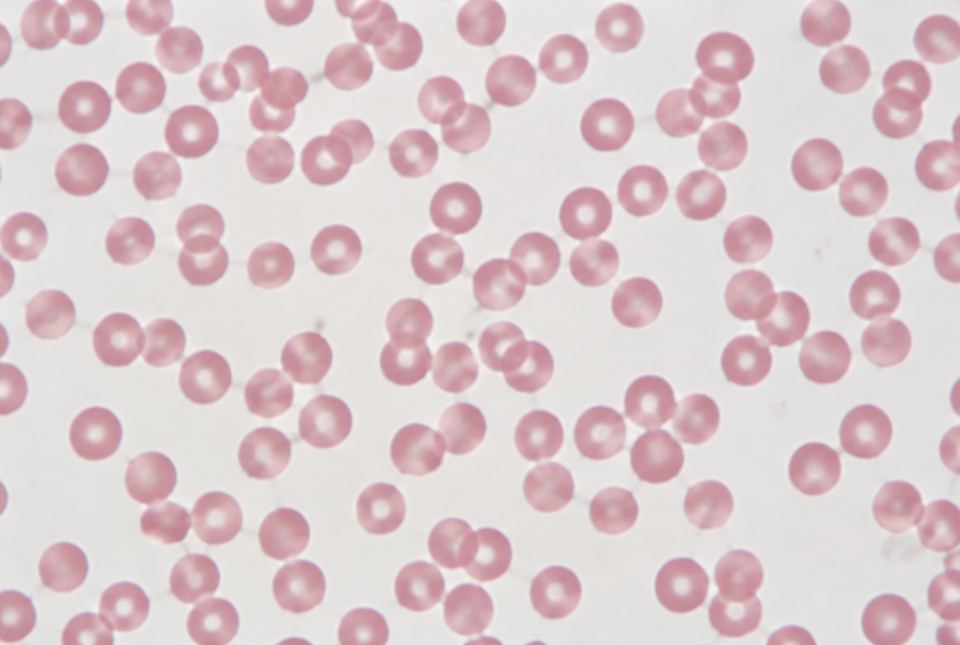 Each of these red blood cells is only about 0.000 007 5 m across. You need a microscope to see them, and scientific notation to write their size easily. AI-generated image
A pattern with powers of ten
Look at the table below. Each time the exponent goes down by 1, the value is divided by 10.
Keep the pattern going past 10¹ and you get:
- 10⁰ = 1
- 10⁻¹ = 1/10 = 0.1
- 10⁻² = 1/100 = 0.01
- 10⁻³ = 1/1000 = 0.001
A negative exponent on 10 does not make a negative number. It makes a small positive number: 10⁻ⁿ means 1 divided by 10ⁿ. The exponent tells how many places the 1 sits after the decimal point.
| Power | Fraction | Decimal |
|---|
| 10³ | 1 000 | 1 000 |
| 10² | 100 | 100 |
| 10¹ | 10 | 10 |
| 10⁰ | 1 | 1 |
| 10⁻¹ | 1/10 | 0.1 |
| 10⁻² | 1/100 | 0.01 |
| 10⁻³ | 1/1 000 | 0.001 |
| 10⁻⁶ | 1/1 000 000 | 0.000 001 |
Small numbers in scientific notation
The rule is the same as before: the coefficient must be at least 1 and less than 10.
- Move the decimal point to the right until it sits after the first non-zero digit.
- Count the places it moved. Because you moved right, the exponent is negative.
Quick check: numbers 10 or more have a positive exponent. Numbers from 1 up to 10 have exponent 0. Numbers between 0 and 1 have a negative exponent.
Worked exampleExample 1: Small number → scientific notation
Write 0.000 38 in scientific notation.
- The first non-zero digit is 3. Move the decimal point to sit after it: 3.8.
- Count the hops: 0.000 38 → 0.003 8 → 0.038 → 0.38 → 3.8. That is 4 places to the right.
- Moving right means a negative exponent: −4. Check: 3.8 × 0.000 1 = 0.000 38. ✓
Worked exampleExample 2: Scientific notation → standard form
Write 2.05 × 10⁻⁵ in standard form.
- The exponent −5 means divide by 10 five times. Move the decimal point 5 places to the left.
- 2.05 → 0.205 → 0.020 5 → 0.002 05 → 0.000 205 → 0.000 020 5.
- Check: the number should be very small, between 0 and 1. ✓
2.05 × 10⁻⁵ = 0.000 020 5
Worked exampleExample 3: Measurements
A sheet of printer paper is about 0.1 mm thick. Write this thickness in metres, in scientific notation.
- 1 mm = 0.001 m, so 0.1 mm = 0.1 × 0.001 m = 0.000 1 m.
- Move the decimal point 4 places right to get 1. The exponent is −4.
| Metric unit | Part of a metre | Power of ten |
|---|
| millimetre (mm) | 0.001 m | 10⁻³ m |
| micrometre (µm) | 0.000 001 m | 10⁻⁶ m |
| nanometre (nm) | 0.000 000 001 m | 10⁻⁹ m |
Watch out!
- 10⁻³ is not −1 000. It is 0.001, a small positive number.
- When writing a small number like 0.000 6 in scientific notation, count the hops to reach the 6, not the zeros you see: 0.000 6 = 6 × 10⁻⁴ (4 hops).
Just for funWhy was 10⁻³ so calm about getting a negative exponent?
Because it knew it was still positive (0.001)!
Hands-on activityHow thick is one sheet of paper?
You need: a ruler, and either a thick book or a stack of printer paper.
- Squeeze a stack of pages tightly and measure its thickness in millimetres. In a book, measure only the pages, not the covers.
- Count the sheets. In a book, each sheet (leaf) has two page numbers, so sheets = pages ÷ 2.
- Divide the thickness by the number of sheets to find the thickness of one sheet in millimetres.
- Change your answer to metres (divide by 1 000) and write it in scientific notation.
What to look for: printer paper is often about 0.1 mm, so 1 × 10⁻⁴ m. Book pages are often a bit thinner or thicker. For example, 300 pages = 150 sheets measuring 12 mm gives 12 ÷ 150 = 0.08 mm = 0.000 08 m = 8 × 10⁻⁵ m.
Math talk: "Why do we measure a big stack instead of one sheet?"
Your turn
1Write 0.003 in scientific notation.
3 × 10⁻³. The decimal point moves 3 places right to reach the 3.
2Write 0.000 07 in scientific notation.
7 × 10⁻⁵. 5 hops to the right.
3Write 0.000 512 in scientific notation.
5.12 × 10⁻⁴. 4 hops to the right to sit after the 5.
4Write 4 × 10⁻² in standard form.
0.04. Move the decimal point 2 places left.
5Write 9.3 × 10⁻⁶ in standard form.
0.000 009 3. Move the decimal point 6 places left.
6Write 10⁻³ as a fraction and as a decimal.
7Is 0.6 × 10⁻³ in scientific notation? If not, fix it.
No, 0.6 is less than 1. 0.6 × 10⁻³ = 0.000 6 = 6 × 10⁻⁴.
More practice: warm-up
3Write 0.1 as a power of 10.
4Write 0.008 in scientific notation.
5Write 5 × 10⁻¹ in standard form.
More practice: on your own
1Write 0.000 000 6 in scientific notation.
6 × 10⁻⁷. The 6 is in the 7th place after the decimal point, so the decimal point hops 7 places right.
2Write 0.020 4 in scientific notation.
2.04 × 10⁻². Hop 2 places right to sit after the 2. Check: 2.04 × 0.01 = 0.020 4.
3Write 7.07 × 10⁻⁴ in standard form.
0.000 707. Move the decimal point 4 places left.
4A nanometre is 10⁻⁹ m. Write this length in standard form.
0.000 000 001 m. The 1 is in the 9th place after the decimal point.
5A bead is 2.5 mm wide. Write its width in metres using scientific notation.
2.5 × 10⁻³ m. 2.5 mm = 2.5 ÷ 1 000 m = 0.002 5 m. Hop 3 places right to get 2.5.
Challenge
1A red blood cell is about 7.5 × 10⁻⁶ m across. About how many would fit side by side across 1 cm (which is 10⁻² m)?
About 1 300 cells. 0.01 ÷ 0.000 007 5 = 10 000 ÷ 7.5 ≈ 1 333.
2Use the table pattern to explain why 10⁰ = 1.
Each step down the table divides by 10. 10¹ = 10, and the next step down is 10 ÷ 10 = 1, so 10⁰ = 1. The pattern then continues to 10⁻¹ = 0.1.
3A tiny bacterium is 2 × 10⁻⁶ m long. How long is it in millimetres? Write your answer in standard form.
0.002 mm. 2 × 10⁻⁶ m = 0.000 002 m. There are 1 000 mm in a metre, so multiply by 1 000: 0.000 002 × 1 000 = 0.002 mm.
Quiz
1. What is 0.000 6 in scientific notation?
2. What is 3.4 × 10⁻³ in standard form?
5. A number between 0 and 1 written in scientific notation has:
6. A micrometre is 10⁻⁶ m. Which is equal to it?
Big idea: This lesson completes the scientific-notation part of B1.1 (very large and very small numbers). Grade 7 students used positive powers of ten only, so negative exponents are new here. The key message is that 10⁻ⁿ is a small positive number, not a negative number.
Common difficulties:
- Thinking 10⁻³ is negative. Use the pattern table: each step down divides by 10.
- Moving the decimal point the wrong way. Small numbers (between 0 and 1) always get negative exponents; check the answer is still small.
- Off-by-one errors in counting hops. Have your child draw the hops, as in the diagram.
How to help: Do the paper-thickness activity together. Look at the ruler: 1 mm is 10⁻³ m. Ask "How many millimetres in a metre?" and "What fraction of a metre is a millimetre?" Persevering through careful counting builds A1 skills too.