B. Canada, 1890–1914: A Changing Society · Canada, 1890–1914: A Changing SocietySettling the West: Sifton and the Newcomers
B3 B1 B2About 50 minutes
Learning goals- I can explain how and why the Canadian government recruited settlers for the Prairies after 1896.
- I can describe who came, where they came from, and what life was like for homesteaders.
- I can explain which newcomers the government preferred, and why that was unfair.
- I can describe how western settlement affected First Nations and Métis people.
Words to know
homestead
Land given to a settler under the Dominion Lands Act, usually 160 acres, in exchange for a small fee and for living on and farming it.
Dominion Lands Act
An 1872 law that offered 160 acres of Prairie land to a settler for a $10 fee, if they lived on it, built a home and broke (ploughed) part of it.
quarter section
A square of land of 160 acres (about 65 hectares), one quarter of a 640-acre section.
immigration
Moving to live permanently in a new country.
push factor
Something that makes people want to leave their home, such as poverty, war or persecution.
pull factor
Something that draws people to a new place, such as free land, jobs or freedom.
bloc settlement
A group of people from the same homeland settling together in one area, keeping their language, faith and customs.
Let's start with a question
What would make you leave everything you know and travel thousands of kilometres to a place you had only seen in a poster?
Between 1896 and 1914, more than two million people came to Canada. Many headed for the Prairies with a dream printed on a government poster: free land.
Why did the government want settlers?
After the CPR was finished in 1885, the government wanted the Prairies filled with farms. Farmers would:
- grow wheat to sell around the world,
- ship it on the railway, paying fares and freight,
- buy goods made in eastern Canada, like ploughs and clothes,
- make sure the West stayed Canadian, not American.
In 1896, Laurier made Clifford Sifton the Minister of the Interior, in charge of immigration until 1905. Sifton wanted farmers who would stay and work hard on difficult land.
How did Sifton attract settlers?
- Advertising: millions of pamphlets and posters in many languages, with titles like The Last Best West. Advertising showed sunny wheat fields, not -40°C winters.
- Agents in Britain, the United States and Europe, sometimes paid for each settler they sent.
- Exhibits at fairs and tours for reporters.
- Free land under the Dominion Lands Act: for a $10 fee, a settler could claim a 160-acre quarter section. To get ownership ("prove up") in about three years, they had to live on it, build a home and break (plough) part of the land.
It worked. In 1913 alone, more than 400,000 immigrants arrived, a yearly record that stood for more than a century, until 2021. Canada's population grew from about 5.4 million in 1901 to 7.2 million in 1911.
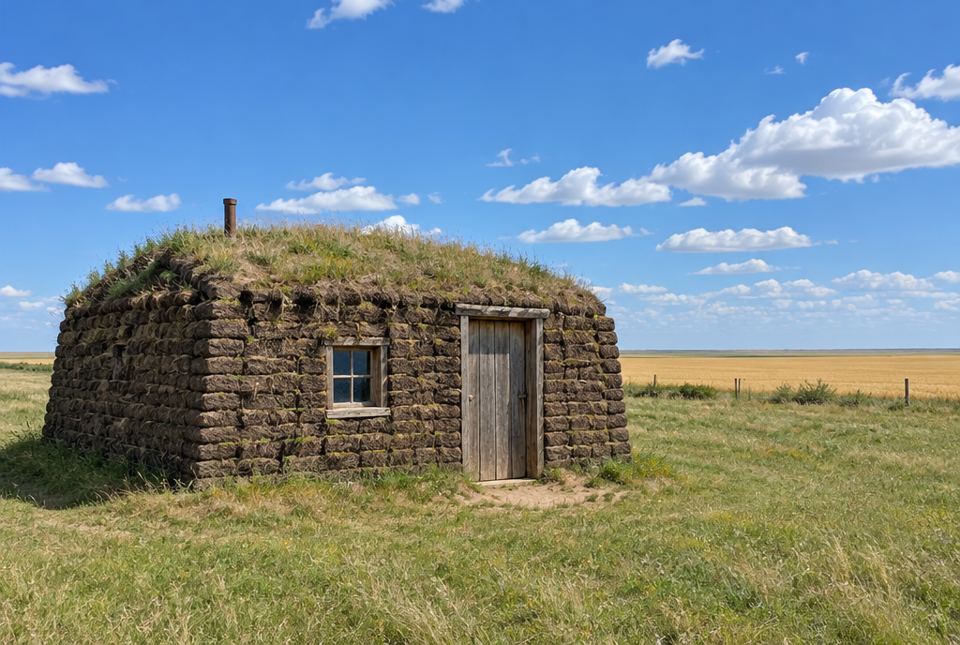 With few trees on the open prairie, many homesteaders built their first home from blocks of sod cut from the ground. This reconstructed sod house shows the kind of home settlers had to build to 'prove up' their claim. AI-generated imageThe Prairies were surveyed into square sections. A homesteader usually claimed one quarter section. (Drawing not to scale.)
Who came?
- British settlers, the government's first choice, including the Barr Colonists of 1903, who founded Lloydminster on today's Alberta–Saskatchewan border.
- Americans, many of them experienced farmers, who brought money and machines.
- Ukrainians from Galicia and Bukovyna (then in Austria-Hungary). The first two, Ivan Pylypiw and Wasyl Eleniak, came in 1891; many thousands followed. Sifton valued them as hardy farmers.
- Doukhobors, a Russian religious group who refused to fight in wars. About 7,500 came in 1899, with help from the writer Leo Tolstoy and the Quakers.
- Germans, Scandinavians, Poles, Hungarians, Icelanders, Jewish farmers and many others.
- Black American families, mostly from Oklahoma, about whom you will learn in the next lesson.
Not everyone was equally welcome
Immigration officials ranked newcomers in a preference list. British and American farmers were at the top. Northern and then Central and Eastern Europeans, like Ukrainians and Poles, came next. Southern Europeans were lower. Jewish, Asian, Roma and Black people were placed at the bottom.
Even "accepted" groups faced prejudice. Some English Canadians mocked Ukrainians as "Galicians" and "foreigners". When Frank Oliver replaced Sifton in 1905, he favoured British settlers more strongly. Because the Doukhobors would not swear an oath of allegiance for religious reasons, many of their homestead claims were cancelled, and from 1908 many moved to British Columbia.
Notice that the land being "given away" was not empty. It was the homeland of First Nations and Métis people.
Life on a homestead
- Shelter: the first home was often a sod house made of blocks of prairie turf, or a log cabin where there were trees.
- Work: breaking tough prairie sod with a plough and oxen or horses, planting, harvesting, hauling water, cutting firewood. Women and children did a huge share: cooking, gardening, sewing, caring for animals and nursing the sick.
- Hardships: long, cold winters, drought, hail, early frost, prairie fires, mosquitoes, isolation and homesickness. Some homesteaders gave up.
- Community: bloc settlements helped people support each other with their own churches, languages and schools. Neighbours from different backgrounds helped each other at harvest and in emergencies.
What did settlement mean for First Nations and Métis?
For First Nations, the flood of settlers came after the numbered treaties and the hard years after the bison disappeared. Many communities were confined to reserves, and an unofficial pass system tried to stop people leaving reserves without an agent's permission. Settlers moved onto land that First Nations had used for generations, while promises made in the treaties were often not kept.
For many Métis families, settlement meant losing land they had lived on. Many sold the scrip (certificates for land or money) they were given, sometimes to speculators for very little. Some lived on unused strips of Crown land by roads and became known as "road allowance people".
Meanwhile, First Nations and Métis people adapted and resisted: farming on reserves, petitioning the government, working for wages and keeping their languages and ceremonies alive.
Worked exampleModelled example: Sorting push and pull factors
Sort these reasons for coming to the Prairies around 1900: (a) not enough farmland for children in Ukraine; (b) free 160-acre homesteads; (c) Doukhobors punished in Russia for refusing to fight; (d) a railway to ship wheat to market; (e) racist laws and violence in Oklahoma.
- A push factor is a reason to leave home. A pull factor is a reason to come to the new place.
- (a) Shortage of land at home pushes people out: push.
- (b) Free land in Canada draws people in: pull.
- (c) Persecution at home: push.
- (d) A railway in Canada made farming there pay: pull.
- (e) Racism and violence at home: push.
Push: (a), (c), (e). Pull: (b), (d). Most newcomers had both: something pushing them out and something pulling them in.
Read the poster, not just the words
Government posters were propaganda: persuasive material made to get people to act. When you look at one, ask: What does it show? What does it leave out (winter, isolation, the First Nations whose land it was)? Who made it, and why?
Just for funFunny but true: a sod house was built from blocks of prairie turf, so in spring grass and even wildflowers could sprout on the roof. Some homesteaders had to weed their ceilings.
Hands-on activityPlan a homestead on paper
You need: a sheet of paper, a ruler and a pencil.
- Draw a big square. This is your 160-acre quarter section (about 800 m on each side, roughly a 10-minute walk).
- Decide where to put your house (sod or log?), well, garden, barn, wheat field and woodlot. Label them.
- Mark which part you will break (plough) in your first year. Remember: one person with oxen might break only a few hectares in a season.
- List five things you must bring or buy before winter.
- Write two sentences in a diary for your first January.
- Bonus: Use a map app with a grown-up to find a town on the Prairies founded in this era, such as Lloydminster, and look at the square patterns of farm fields from above.
Look for: a plan that puts water and shelter first, and a diary that shows real hardships.
Your turn
1Who was in charge of immigration from 1896 to 1905?
Clifford Sifton, Minister of the Interior.
2Under the Dominion Lands Act, what did a settler get for a $10 fee?
A 160-acre quarter section (homestead), which they could own after living on it, building a home and breaking part of the land, usually in about three years.
3Give two reasons the government wanted to fill the Prairies with farmers.
Any two: to grow wheat for export; to make the railway pay; to create customers for eastern factories; to keep the West Canadian.
4Name three groups of newcomers who settled on the Prairies.
Any three: British, Americans, Ukrainians, Doukhobors, Germans, Scandinavians, Poles, Icelanders, Jewish settlers, Black Americans from Oklahoma.
5Who did immigration officials place at the bottom of their preference list?
Jewish, Asian, Roma and Black people.
A house built from blocks of prairie turf (sod), used where there were few trees.
7How did western settlement affect many First Nations?
Many were confined to reserves, an unofficial pass system tried to control their movement, settlers moved onto their lands, and treaty promises were often not kept.
More practice: warm-up
1How many acres is a quarter section?
2In what year did more than 400,000 immigrants arrive?
3Which religious group arrived in 1899 with help from Leo Tolstoy?
4What town did the Barr Colonists found in 1903?
5Is "free land in Canada" a push factor or a pull factor?
More practice: on your own
1Why did Sifton's advertising not show Prairie winters?
Because it was propaganda meant to attract settlers. Showing -40°C winters, drought and isolation might have scared people away, so it showed only sunshine and wheat.
2Why did many Doukhobors lose their homesteads after 1905?
Their faith led them to refuse to swear an oath of allegiance, which was needed to get title. Frank Oliver applied the law strictly, so their claims were cancelled; many moved to British Columbia from 1908.
3Why might a bloc settlement help newcomers? Give one possible drawback.
Help: people shared a language, faith and customs, helped each other and felt less homesick. Drawback: some English Canadians saw them as not "fitting in", and it could be harder to learn English or join wider society.
4What were "road allowance people"?
Métis families who had lost land and lived on unused strips of Crown land set aside for roads.
5Compare Canada's immigration rules in 1905 with today's in one way.
1905: officials openly ranked people by race and nationality, preferring British and Americans. Today: Canada's immigration rules do not choose people by race; they use things like skills, family ties and refugee protection. (A good answer may add that people still debate whether today's system is fully fair.)
Challenge
1Sifton called his ideal settler a hard-working peasant farmer. Explain why he valued farmers over city workers, and how this connected to the National Policy.
Sifton wanted people who would stay on the land and farm. Farmers would grow wheat for export, use the railway, and buy goods from eastern factories protected by tariffs. These were the three parts of the National Policy: settlement, railways and tariffs. City workers would not fill the empty homesteads.
2From the perspective of a Cree family on a reserve in 1905, how might the arrival of thousands of settlers look different from how a newspaper in Toronto described it?
A Toronto newspaper might describe settlement as progress: new farms, towns and wealth. A Cree family might see strangers on their homeland, fewer places to hunt, the pass system limiting movement, and treaty promises being broken. The same event is "growth" in one perspective and "loss" in another.
3Was the settlement of the West a success? Write a balanced answer of three or four sentences.
Model: In economic terms it was a success: the population of the Prairies grew several times over, wheat exports boomed and two new provinces were created. Many newcomers built farms and communities. But the success came at a cost: First Nations and Métis lost land and freedom, and immigrants who were not British, American or Northern European faced discrimination or were kept out. So it was a success for some, and a loss for others.
Quiz
1. Who was Minister of the Interior in charge of immigration from 1896 to 1905?
2. What did the Dominion Lands Act offer?
3. Which of these is a push factor?
5. Which groups were placed at the bottom of officials' preference list?
6. What happened to many First Nations as settlers arrived?
Big idea: This lesson covers immigration and settlement of the West (B3), compares immigration policy then and now (B1), and contrasts newcomer and First Nations/Métis perspectives (B2).
How to help: If your family has immigration stories (any time period), share push and pull factors. If you visit the Prairies or a pioneer museum, look for a sod house replica. In Ontario, many local museums also have settler and immigration exhibits.
Sensitive points: The preference list was openly racist. Say so plainly, and make the link to how Canada's rules today are different and to how people still work for fairness.
Common difficulties: Calling the Prairies "empty land" (it was First Nations and Métis homeland); thinking the land was free with no conditions (settlers had to live on it, build and break land).