A. Global Settlement: Patterns and Sustainability · Global Settlement: Patterns and SustainabilityCurrent Trends: Urbanization, Sprawl and Making New Land
A3.4About 50 minutes
Learning goals- I can describe the trend of urbanization around the world and in Canada, and explain push and pull factors.
- I can describe megacities and the challenges of fast-growing cities.
- I can explain why some people move from big cities to smaller places.
- I can describe urban sprawl, habitat loss and land reclamation as current trends.
Words to know
urbanization
The growth in the share of a population living in towns and cities instead of rural areas.
rural-to-urban migration
People moving from the countryside to towns and cities.
push factor
Something that encourages people to leave a place, such as a lack of jobs or a drought.
pull factor
Something that attracts people to a place, such as jobs, schools or health care.
megacity
An urban area with more than 10 million people.
urban sprawl
Low-density growth spreading out from the edges of a city onto farmland or natural areas, usually depending on cars.
intensification
Fitting more homes and jobs into areas that are already built up, for example by building apartments near transit.
land reclamation
Creating new land from the sea, a lake, a river or a wetland, by filling it in or draining it.
Let's start with a question
Ask the oldest person in your family where they grew up. Many Canadian families have a story like this: a great-grandparent grew up on a farm or in a small town, and their children or grandchildren moved to a city for school or work. That family story is part of one of the biggest trends in human history: urbanization.
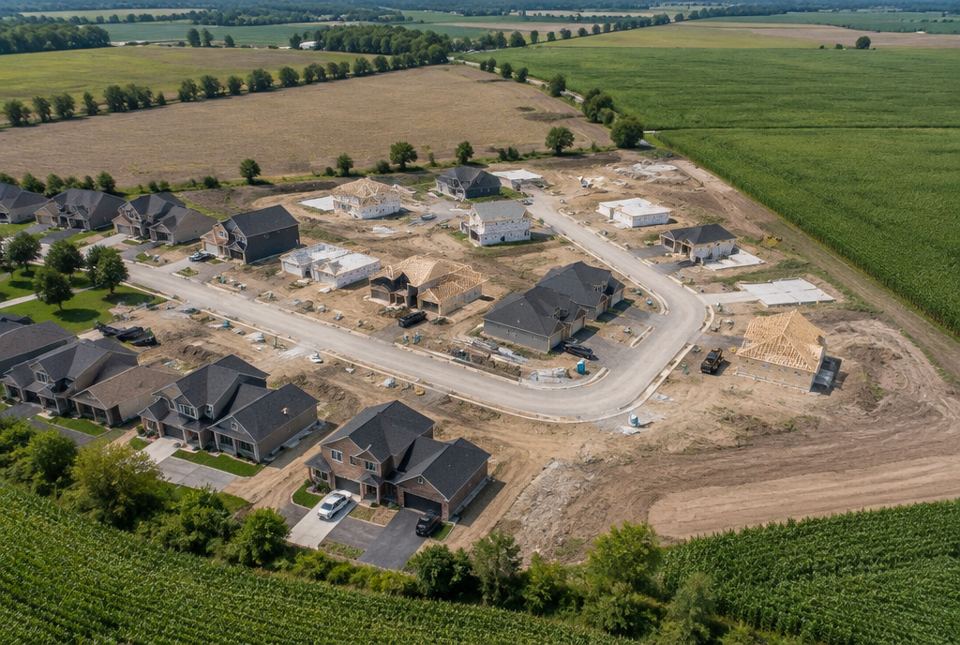 Urban sprawl: as cities grow outward, farmland at the edge is turned into new neighbourhoods like this one. AI-generated image
Urbanization: the move to cities
For most of human history, most people lived in rural areas and farmed. That has changed. According to the United Nations (World Urbanization Prospects, 2018):
- In 1950, about 30% of the world's people lived in urban areas.
- By 2018, about 55% did. More than half the world's people now live in urban areas.
- By 2050, the UN projects (predicts) about 68%.
Countries define "urban" in different ways, so different reports can give somewhat different numbers, but they all show the same trend: the world is becoming more urban. Most of the growth is now in Asia and Africa.
Why do people move to cities?
Pull factors attract people to cities: jobs, higher wages, schools and universities, health care, entertainment, and family or friends who already live there.
Push factors encourage people to leave rural areas: farms that need fewer workers because of machines, few jobs, drought or poor harvests, distance from services, and sometimes conflict or disasters.
Megacities
A megacity has more than 10 million people. In 2018 the UN counted 33 megacities. Examples include Tokyo, Delhi, Shanghai, São Paulo, Mexico City, Cairo and Mumbai.
When a city grows very fast, it can be hard to build enough housing, roads, transit, water pipes and sewers in time. In many fast-growing cities, people who arrive with little money build homes in informal settlements: neighbourhoods built without official permission, which often lack clean water, sewers or secure housing. The people who live there work hard, and over time many of these neighbourhoods are improved with water, electricity and better homes.
Canada: an urban country
In the 2021 Census, Statistics Canada found that 17.8% of Canadians lived in rural areas, so about 82% lived in urban areas. Most population growth is in and around large cities such as Toronto, Montréal, Vancouver, Calgary, Edmonton and Ottawa–Gatineau. Many newcomers to Canada settle in these large cities.
A counter-trend: leaving the big city
Not everyone is moving into big cities. Some people move from big cities to smaller towns and rural areas, for example because of high housing costs, the chance to work from home, or a quieter life. Statistics Canada reported that during the COVID-19 pandemic (2020–2021), more people than usual moved out of the Toronto and Montréal areas to other parts of their provinces. This trend helps some small towns grow, but it can also raise housing prices there.
Urban sprawl and habitat loss
When cities grow outward with low-density suburbs, big parking lots and wide roads, geographers call it urban sprawl. Sprawl usually means:
- Farmland and natural areas (forests, wetlands, meadows) are paved over. Much of Canada's best farmland is in southern Ontario, close to its growing cities.
- Animals lose habitat, and roads cut through the areas they need to move between.
- People depend on cars, because homes, stores and jobs are far apart.
Many cities now encourage intensification: building up instead of out, with apartments and mixed-use buildings near transit, on land that is already developed.
Making new land: land reclamation
Where land is scarce, people sometimes create it:
- The Netherlands: about a quarter of the country is below sea level. The Dutch have drained lakes and coastal waters to make polders (low land protected by dikes and kept dry by pumping).
- Kobe, Japan: hemmed in by mountains, Kobe built Port Island in its harbour between 1966 and 1981, using soil from the mountains, to make room for port facilities and homes.
- Hong Kong: its international airport, opened in 1998, was built largely on reclaimed land.
- Toronto: much of today's downtown waterfront south of Front Street was once part of Lake Ontario and was filled in over many years. The Leslie Street Spit, built from construction fill, is now Tommy Thompson Park, an important place for birds.
Reclaimed land gives cities room to grow, but it is expensive, it destroys shoreline and wetland habitat, and it can be at risk of flooding and of liquefaction (shaking soil acting like a liquid) in earthquakes.
| Trend | What it means | One effect |
|---|
| Urbanization | More people living in towns and cities | Cities need more housing, transit and services |
| Megacities | Urban areas over 10 million people | Very fast growth can outpace housing and services |
| Moving to smaller places | Some people leave big cities for towns | Small towns grow; housing prices may rise there |
| Urban sprawl | Low-density growth at a city's edges | Loss of farmland and habitat; more driving |
| Land reclamation | Making new land from water or wetlands | Room to grow, but costly and risky for habitats |
Worked exampleExample: Let's read a trend in data
Pretend data for a region in Ontario:
- 1981: city 60 000; rural township 15 000
- 2001: city 85 000; rural township 13 500
- 2021: city 120 000; rural township 12 000
Describe the trend and suggest reasons.
- City: grew from 60 000 to 120 000, so it doubled in 40 years.
- Rural township: fell from 15 000 to 12 000, a drop of 3 000, or 20% (3 000 ÷ 15 000 = 0.2).
- Name the trend: people are moving from rural areas to the city, which is urbanization (rural-to-urban migration).
- Suggest reasons: pull factors in the city (jobs, college, hospital); push factors in the township (bigger farm machines needing fewer workers, fewer local services).
The region shows urbanization: the city doubled while the rural township shrank by 20%, likely because of city jobs and services and fewer farm jobs.
Hands-on activityFamily migration interview
You need: paper and a pencil (or a phone to record, with permission), and two or three family members or family friends.
- Ask each person: Where did you grow up? Was it urban or rural? Where have you lived since? Why did you move?
- Record each move as an arrow on a simple sketch map or list (for example: farm near Brandon → Winnipeg → Toronto).
- Sort each reason into push or pull factors.
- Write two sentences: Does your family's story show urbanization, moving to smaller places, or both?
What to look for: reasons such as jobs, school, family, housing costs or quality of life, sorted correctly into push and pull. Every family's story is different, and stories of immigration, moving for work or staying in one place for generations all count.
Just for funThe land under Toronto's CN Tower used to be the bottom of Lake Ontario. Two hundred years ago, the trip to that spot needed a canoe, not an elevator ticket.
Your turn
The growth in the share of a population living in towns and cities.
2According to the UN (2018), about what share of the world's people lived in urban areas in 1950, in 2018, and projected for 2050?
About 30% in 1950, 55% in 2018, and a projected 68% by 2050.
3Give two pull factors and two push factors for rural-to-urban migration.
Pull: for example jobs, higher wages, schools and universities, health care. Push: for example fewer farm jobs because of machines, drought or poor harvests, few services, conflict.
4What is a megacity? Name two.
An urban area with more than 10 million people. For example: Tokyo, Delhi, Shanghai, São Paulo, Mexico City, Cairo, Mumbai.
5About what share of Canadians lived in urban areas in 2021?
About 82% (17.8% lived in rural areas, Statistics Canada 2021 Census).
6What is urban sprawl, and name one problem it causes.
Low-density growth spreading out at a city's edges. Problems: loss of farmland or habitat, more car dependence and traffic, higher costs for roads and pipes.
7Give one example of land reclamation and one reason people do it.
Examples: Dutch polders, Kobe's Port Island, Hong Kong's airport, Toronto's waterfront or the Leslie Street Spit. Reason: to create more land where flat land is scarce.
More practice: warm-up
1Is a new job in the city a push or a pull factor?
2How many people does a megacity have?
Low land, usually reclaimed from the sea or a lake, protected by dikes and kept dry by pumping.
4What does intensification mean?
Fitting more homes and jobs into areas that are already built up, building up instead of out.
5Which country is about a quarter below sea level?
More practice: on your own
1Explain why fast-growing cities often have informal settlements.
People arrive faster than the city can build affordable housing, water pipes and sewers. Newcomers with little money build homes wherever they can, often without official permission, and these areas may lack services.
2Give two reasons some people move from big cities to smaller towns.
For example: lower housing costs, the chance to work from home, a quieter life, being closer to family or nature.
3Why is building on reclaimed land risky?
It can be at risk of flooding (it is often low), it can liquefy in earthquakes, and making it destroys shoreline and wetland habitat. It is also very expensive.
4Pretend data: A township's population fell from 8 000 to 6 000. What percentage decrease is this?
25%. 8 000 − 6 000 = 2 000, and 2 000 ÷ 8 000 = 0.25.
5How does intensification help reduce urban sprawl?
By building more homes on land already developed (for example apartments near transit), the city does not need to spread out as much onto farmland and natural areas.
Challenge
1A newspaper says urbanization is "good" and another says it is "bad". Give one benefit and one challenge of urbanization, and explain why both papers could be partly right.
Benefit: cities give access to jobs, education and health care, and services like transit can reach many people efficiently. Challenge: fast growth can cause housing shortages, traffic, pollution and sprawl onto farmland. Both are partly right because the effects depend on how well the growth is planned and on whose perspective you take.
2Different organizations report different urban percentages for the same country. Explain why, and what you should do when comparing data.
Organizations define "urban" differently (for example by minimum population or density). When comparing, use data from the same source and same definition, and check the year and how the data was collected.
3Kobe built Port Island using soil from nearby mountains. Explain how this one project connects two physical features and one settlement trend.
The mountains limit Kobe's flat land, which is why the city needed more space, and they also supplied the soil to fill part of the harbour (the sea). The project is an example of the trend of land reclamation to make room for growing cities.
Quiz
2. Which is a pull factor toward a city?
4. What does urban sprawl usually lead to?
5. According to the 2021 Census, about what share of Canadians lived in rural areas?
6. Which is an example of land reclamation?
7. Which is a reason some people move from big cities to smaller towns?
Big idea: A3.4 asks students to identify and describe significant current trends in human settlement. The curriculum's examples include rural-to-urban migration, people moving from big cities to smaller towns, habitat loss, urban sprawl and land reclamation (including Kobe). All five are in this lesson.
Common difficulties:
- Mixing up push and pull. Push is about the place people leave; pull is about the place they go.
- Thinking urbanization means cities are getting bigger only. It means the share of people in urban areas grows.
- Treating data as exact. Remind your child that different definitions give different numbers, and to note the source and year.
How to help: The family migration interview is the heart of this lesson: it turns a global trend into a personal story. Be sensitive if moves involved hardship; your child only needs the general reasons.