A. Literacy Connections and Applications / C. Comprehension: Understanding and Responding to Texts · Understanding and Responding to TextsBefore and During Reading: Prior Knowledge, Predictions and Fixing Comprehension Problems
C2.1 C2.3 C2.4 C1.1 A3.1About 50 minutes
Learning goals- I can identify and explain prior knowledge from personal experience, other texts and other subjects that helps me understand a new text.
- I can make predictions using background knowledge and text clues, pose questions to check them, and adjust my understanding.
- I can choose strategies such as visualizing, reading ahead, asking questions and consulting references or other sources to solve comprehension problems.
- I can read complex sentences by finding the main clause and following cohesive ties.
Words to know
prior knowledge
What you already know before you read, from your experiences, other texts and other subjects.
prediction
A thoughtful guess about what will happen or what a text will say, based on clues and what you know.
checking question
A question you pose to test whether your prediction is right, such as Will they reach shore before the storm?
monitoring
Keeping track of whether you understand as you read, and noticing when you don't.
fix-up strategy
A strategy you use when your understanding breaks down, such as rereading, reading ahead, visualizing or looking something up.
consulting references
Using a dictionary, glossary, diagram, encyclopedia or another reliable source to understand a word or idea.
cohesive tie
A word that links ideas across sentences, such as a pronoun (it, she, they) or a transition (then, however, by the time).
main clause
The part of a sentence that has a subject and a verb and could stand alone as a sentence.
Remember from Grade 6
In Grade 6 you used prior knowledge, made and revised predictions, and used fix-up strategies when you got stuck. You also found main clauses and cohesive ties.
In Grade 7 you'll do these things with more complex texts, and you'll do something new with predictions: pose questions that test them, so you know exactly what evidence to watch for.
Hook: What do you already know?
The story in this lesson is about a canoe trip and a thunderstorm. Before reading, jot down what you already know:
- Personal experience: Have you been in a canoe? Been caught in a storm?
- Other texts: Have you read stories or watched videos about wilderness trips?
- Science: What do you know about lightning and thunder? (In science you may have learned that light travels much faster than sound, so you see lightning before you hear thunder.)
- Geography and health: What do you know about Ontario's lakes and safety outdoors?
This is your prior knowledge. It will help you make predictions and understand what the characters do.
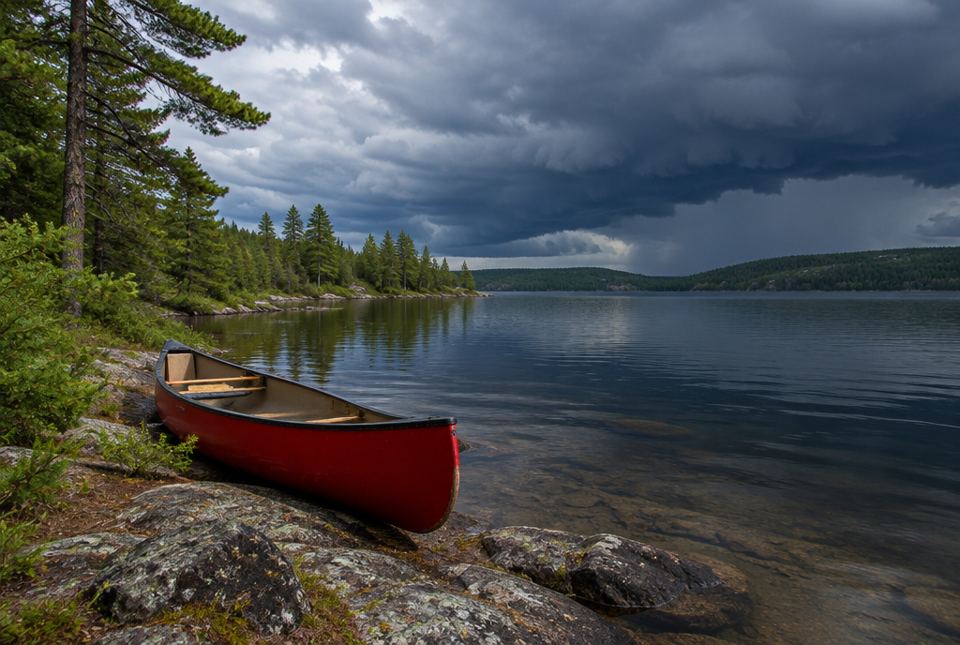 What do you predict will happen on a canoe trip when clouds like these build? Your prior knowledge about storms and lakes helps you make predictions as you read. AI-generated image
After the Haze (a story written for this website), Part 1
Aunt Rosa had promised Priya three things about the canoe trip: loons, stars, and no cell service. By the second afternoon, Kettle Lake had delivered all three.
Now, as Priya lifted her paddle, she noticed that the far shore, which had been sharp and green all morning, was fading behind a grey haze. A gust wrinkled the water. Aunt Rosa, who had paddled these lakes for twenty years, stopped mid-stroke and turned her head to the west, listening.
Worked exampleLet's make a prediction and pose checking questions
Stop after Part 1. Make a prediction using text clues and prior knowledge, then write questions to check it.
- Text clues: the shore is fading behind a grey haze; a gust wrinkled the water; Aunt Rosa, an experienced paddler, stops paddling and listens toward the west.
- Prior knowledge: haze and sudden wind can come before a storm. In Ontario, weather often moves in from the west. Experienced people notice danger early. From science: thunder is the sound of lightning.
- Prediction: A thunderstorm is coming. Aunt Rosa is listening for thunder, and they will head for shore.
- Checking questions: Will Aunt Rosa hear thunder? Will they get off the water? Will they reach shore before the storm hits? Each question tells you what evidence to watch for in Part 2.
Prediction: a storm is coming and they will head for shore. Checking questions: Will they hear thunder? Will they get off the water in time?
After the Haze, Part 2
Then Priya heard it too: a low rumble, like furniture being dragged across a floor upstairs.
"Thunder," said Aunt Rosa. "We're getting off the water. Now."
The nearest landing was the portage at the north end, marked by a yellow sign nailed to a cedar. They dug in their paddles. By the time the bow scraped gravel, the first fat drops were pocking the lake. They hauled the canoe high onto the shore, flipped it over and tied it to a stump. Then Aunt Rosa led Priya away from the water, past a tall, lonely pine, into a thick stand of young spruce, where they crouched on their packs.
Worked exampleLet's check our prediction and adjust
Use the checking questions from Part 1. Was the prediction correct? What do we need to adjust?
- Will Aunt Rosa hear thunder? Yes: a low rumble... "Thunder," said Aunt Rosa. Confirmed.
- Will they get off the water? Yes: We're getting off the water. Now. Confirmed.
- Will they reach shore before the storm hits? Mostly: they land just as the first fat drops fall. Confirmed, but it was close.
- New information to adjust our understanding: they don't stay at the shore or take shelter under the tall pine. They move into a stand of young spruce, away from the water. Our prior knowledge of lightning safety explains why: lightning tends to strike tall, isolated objects and open water. Aunt Rosa knows what she's doing.
- New prediction for Part 3: They'll wait until the storm passes, then continue. Checking question: How will they know it's safe?
The prediction was confirmed. We adjusted our understanding of Aunt Rosa: she is not just cautious, she is knowledgeable about lightning safety. New prediction: they'll wait out the storm. Checking question: How will they know when it's safe?
Predicting is a cycle. Checking questions tell you exactly what evidence to watch for, and each new part of the text lets you confirm or adjust.After the Haze, Part 3
They waited, counting the seconds between each flash and its thunder: eight, twelve, twenty.
"It's moving away," Priya said, half rising.
"Not yet," said Aunt Rosa. "Thirty minutes after the last thunder. That's the rule."
Priya, whose legs had begun to cramp, wanted to argue, but she thought of the lonely pine by the shore, its top split and blackened by some storm years ago. She sat back down.
When they finally carried the canoe across the portage to the next lake, Aunt Rosa walking under it with the padded yoke on her shoulders, the sky was washed clean, and a rainbow arched over the water.
"Worth the wait?" asked Aunt Rosa.
Priya nodded, imperceptibly at first, then with a grin she couldn't hide.
Fixing comprehension problems
Complex texts have tricky words, long sentences and references back to earlier ideas. When you notice you're confused, name the problem, then choose a strategy that fits it.
| Problem | Example from the story | Strategy that fits |
|---|
| I can't picture what's happening | the first fat drops were pocking the lake | Visualize: picture big raindrops making little pits or dents in the water's surface. |
| I don't know what a pronoun refers to | Then Priya heard it too | Read ahead (and back): it turns out to be the rumble, the thunder that Aunt Rosa was listening for. |
| A word is new and the context isn't enough | portage, yoke, bow | Consult a reference: a dictionary or a labelled canoe diagram. A portage is a trail for carrying a canoe between lakes; the yoke is the padded crossbar that rests on your shoulders; the bow is the front of the canoe. |
| I don't understand why a character does something | Thirty minutes after the last thunder | Ask a question (Why 30 minutes?), then consult another source: lightning safety guides advise waiting 30 minutes after the last thunder before going back out. |
| A long sentence loses me | Priya, whose legs had begun to cramp, wanted to argue... | Find the main clause: Priya wanted to argue. The part between the commas adds extra information. |
Worked exampleLet's untangle a complex sentence
Read this sentence from Part 1: Now, as Priya lifted her paddle, she noticed that the far shore, which had been sharp and green all morning, was fading behind a grey haze. What does it mean, and how is it built?
- Find the main clause (subject + verb that can stand alone): she noticed (that something was happening).
- **Find who she is** (cohesive tie): she = Priya.
- Find what she noticed: that the far shore... was fading behind a grey haze. The core is the far shore was fading.
- Set aside the extra parts: as Priya lifted her paddle tells when; which had been sharp and green all morning describes the shore before the change.
- Put it together in plain words: While Priya paddled, she saw that the far shore, which had looked clear all morning, was now hard to see because of haze.
Main clause: she (Priya) noticed that the far shore was fading. The other clauses add when it happened and what the shore was like before. That contrast (clear before, hazy now) is the clue that weather is changing.
Just for funFun fact: Light travels nearly a million times faster than sound. That's why Priya and Aunt Rosa can count the seconds between the flash and the thunder: roughly every 3 seconds means the storm is about 1 km away.
Using other words to unlock new words
Imperceptibly looks hard, but you can break it apart: im- (not) + percept (notice, as in perceive) + -ible (able to be) + -ly (in a way). So imperceptibly means in a way that can hardly be noticed. Priya's nod starts so small you can barely see it, then becomes a grin. That shows she's a bit embarrassed to admit Aunt Rosa was right, but happy all the same.
Monitor, name, choose
Monitor: Do I understand? Name the problem: a word? a sentence? a reference? a reason? Choose a strategy that fits: visualize, reread, read ahead, ask a question, break the word apart, consult a dictionary, diagram or reliable source. Then check whether it worked.
Hands-on activityPrediction checkpoints at home
You need: a short story, chapter or news article you haven't read; sticky notes or a notebook; a dictionary (print or online with a grown-up).
- Before reading, list three pieces of prior knowledge: one from experience, one from another text and one from another subject (science, history, geography, math).
- Divide the text into three parts with sticky notes. At each stop, write a prediction and one or two checking questions.
- After each part, mark each question confirmed, partly confirmed or not confirmed, and write how you adjusted your understanding.
- Mark every place you got confused with a ?. Next to it, name the problem and the strategy you used (for example: new word, looked it up; long sentence, found main clause).
- Tell a family member which strategy helped most and why.
Your turn
1Name one piece of prior knowledge from science that helps you understand After the Haze.
Any one: light travels faster than sound, so you see lightning before you hear thunder; thunder is caused by lightning; lightning tends to strike tall, isolated objects; counting seconds between flash and thunder tells you roughly how far away the lightning is.
2Which three clues in Part 1 suggest a storm is coming?
The far shore is fading behind a grey haze; a gust wrinkles the water; Aunt Rosa stops paddling and listens toward the west.
3Write one checking question you could pose after Part 2.
Sample: How will they know when it's safe to go back on the water? or Will lightning hit the tall pine? (Any question that tests a prediction.)
4In Then Priya heard it too, what does it refer to? Which strategy helps you figure it out?
It is the low rumble of thunder (what Aunt Rosa was listening for). Reading ahead to the next words (a low rumble) and back to Aunt Rosa listening helps.
5Why does Aunt Rosa lead Priya past the tall pine instead of sheltering under it?
Lightning tends to strike tall, isolated objects, so sheltering under a lone tall tree is dangerous. A stand of young, low trees away from the water is safer.
6Why do the numbers eight, twelve, twenty show the storm is moving away?
The gap between flash and thunder is getting longer, which means the lightning is getting farther away (sound takes longer to reach them).
7Find the main clause: When they finally carried the canoe across the portage to the next lake, Aunt Rosa walking under it with the padded yoke on her shoulders, the sky was washed clean.
The sky was washed clean. The other parts tell when and describe Aunt Rosa carrying the canoe.
More practice: warm-up
What you already know before you read.
A trail for carrying a canoe over land between lakes or around rapids.
3Where were Priya and Aunt Rosa canoeing?
4What does the prefix im- mean in imperceptibly?
5Name one fix-up strategy.
Any one: rereading, reading ahead, visualizing, asking a question, consulting a dictionary or diagram, breaking a word into parts.
More practice: on your own
1Why is it useful to pose a checking question after making a prediction?
It tells you exactly what evidence to look for as you keep reading, so you can tell if the prediction is confirmed or needs to be adjusted.
2Priya wanted to argue, but she thought of the lonely pine. What does the pine make her realize? Use evidence.
The pine's top is split and blackened from an old lightning strike. It reminds her that lightning is real and dangerous, so she decides Aunt Rosa's rule is worth following.
3What does the simile like furniture being dragged across a floor upstairs help you visualize?
A low, rumbling, distant sound, like thunder far away. It makes the sound familiar and easy to imagine.
4A reader thinks yoke means the yellow part of an egg. Which strategy would fix this, and what does it mean here?
Consult a reference (a dictionary or a canoe diagram) and use context (padded yoke on her shoulders). Here, a yoke is the padded crossbar of a canoe that rests on your shoulders when you carry it. (The egg part is spelled yolk.)
5What does the word imperceptibly tell you about Priya's feelings at the end?
Her nod starts so small it can hardly be seen, suggesting she's a little reluctant to admit Aunt Rosa was right, before her happiness shows in a grin.
Challenge
1Light reaches you almost instantly, but sound travels about 1 km in 3 seconds. Using this, about how far away was the lightning when Priya counted twelve seconds? What subject did you borrow this knowledge from?
About 4 km away (12 ÷ 3 = 4). This prior knowledge comes from science (and uses math).
2Explain how Aunt Rosa's character is revealed gradually across the three parts, and how your understanding of her changes.
Part 1: she has paddled for 20 years and notices a change early (experienced, alert). Part 2: she acts quickly and firmly (Now.) and chooses a safe place, away from the tall pine and water (knowledgeable). Part 3: she sticks to the 30-minute rule even when Priya is impatient, then teases her kindly (Worth the wait?). At first she seems simply cautious; by the end she seems wise, caring and confident. Readers adjust their understanding with each part.
3Choose two different comprehension problems you might have with a science textbook page, and the best strategy for each. Explain why each fits.
Sample: (1) A diagram I can't follow: reread the caption and labels and visualize the process step by step, because diagrams are explained by their labels. (2) **A technical word like condensation: check the glossary or break it apart and use context, because textbooks often define key terms. The best strategy matches the type of problem**.
Quiz
1. Which is the best prediction after Part 1 of After the Haze?
2. What is the purpose of a checking question?
3. A reader doesn't know what yoke means even after rereading. Which strategy fits best?
4. What is the main clause in Priya, whose legs had begun to cramp, wanted to argue?
5. Why did they wait 30 minutes after the last thunder?
6. Which piece of prior knowledge comes from another subject area?
What this lesson teaches: Grade 7 students identify and explain prior knowledge from various sources, including other subjects (C2.1); make predictions, pose questions to check them and adjust their understanding (C2.3); select strategies such as visualizing, reading ahead, asking questions and consulting references to solve comprehension problems (C2.4); and read complex texts using knowledge of words, grammar, cohesive ties and sentence structures (C1.1). Using science knowledge to understand a story shows cross-curricular learning (A3.1).
How to help at home:
- Pause during a read-aloud or a TV show and ask: "What do you predict? What question would tell us if you're right?"
- When your child is stuck, ask: "What kind of problem is it: a word, a sentence, or why something happened?", then help them pick a matching strategy.
- Encourage using a dictionary or a reliable website to check a word, then rereading the sentence.
Common difficulties:
- Wild predictions with no evidence. Ask: "Which clue made you think that?"
- Skipping confusion. Many readers keep going without understanding. Praise your child for noticing when they're confused.
- Long sentences. Help them find who did what first, then add the extra parts.
About the story: After the Haze was written for this site; Kettle Lake is invented. The safety information is accurate and general: lightning tends to strike tall, isolated objects and open water; you should get off the water when you hear thunder; wait 30 minutes after the last thunder; sound travels about 1 km in 3 seconds. A canoe's yoke is the padded crossbar used to carry it on the shoulders, and the bow is the front.