A. Literacy Connections and Applications / C. Comprehension: Understanding and Responding to Texts · Understanding and Responding to TextsText Patterns and Features: Cause and Effect, Bibliographies and Accessible Fonts
C1.3 A2.6About 45 minutes
Learning goals- I can analyze the cause-and-effect pattern in an expository text, including chains and multiple causes or effects.
- I can explain how a bibliography helps readers check and extend a text.
- I can explain how accessible fonts and other accessibility features help readers, listeners and viewers.
- I can analyze the patterns and features of a cultural text, such as a bilingual event program.
- I can use what I know about features to redesign a real text so more people can use it.
Words to know
expository text
A non-fiction text that explains or informs, such as a report, an article or a textbook chapter.
cause and effect
A text pattern that explains why something happens (cause) and what happens as a result (effect).
cause-and-effect chain
A series in which each effect becomes the cause of the next event.
signal words
Words that show how ideas connect, such as because, as a result, therefore, leads to and so.
bibliography
A list of the sources a writer used, placed at the end of a text, with enough information for readers to find each source.
accessible font
A typeface that is easy for many people to read, with clear, simple letter shapes, good spacing and a comfortable size.
text feature
A part of a text that helps readers find or understand information, such as a heading, caption, diagram or bibliography.
alt text
A short written description of an image, which screen readers read aloud for people who are Blind or have low vision.
Remember from Grade 6
In Grade 6 you analyzed the problem-solution pattern in reports and features such as subheadings and pull-down menus. In earlier grades you followed simple cause-and-effect chains.
In Grade 7 you'll analyze cause and effect in expository texts more closely: chains, several causes for one effect, and several effects from one cause. You'll also study two features that are about trust and access: the bibliography and accessible fonts.
Hook: Where does the salt go?
After a winter storm, trucks spread salt on Ontario's roads and sidewalks. By spring, the ice is gone, and so is the salt. But where did it go? Read the expository text below to find out. Notice the words that connect causes and effects.
Where Does Road Salt Go? (an expository text written for this website)
Why We Use Salt
Ice on roads and sidewalks causes slips, falls and crashes. Salt helps because it lowers the temperature at which water freezes. When salt touches ice, it makes salty water called brine, and the ice melts. As a result, roads become safer to drive and walk on.
Down the Drain
But salt doesn't disappear. When the ice melts, the brine flows into ditches and storm drains. In many towns, storm drains carry water straight to creeks, rivers and lakes without cleaning it first. Therefore, much of the salt ends up in our fresh water.
Effects on Living Things
Salt is made of sodium and chloride. Chloride does not break down, so it can build up in streams and lakes year after year. High chloride levels can harm tiny water animals, such as the zooplankton that fish eat. Salt spray can also damage plants along roads, and salt speeds up rust on cars and bridges.
What Can People Do?
Many towns now use less salt by spreading brine before a storm, so ice doesn't stick as easily. At home, families can shovel early, use only a small amount of salt, and sweep up leftover salt when the ice is gone.
Bibliography (sample entries made up for this lesson)
Cedar Bend Public Works. Winter Road Maintenance Plan. Town of Cedar Bend, 2025.
Patel, Riya. Salt and Fresh Water: A Guide for Young Scientists. Northern Lights Press, 2024.
Wong, Marcus. "How Brine Keeps Roads Safer." Cedar Bend Weekly, 14 Jan. 2026.
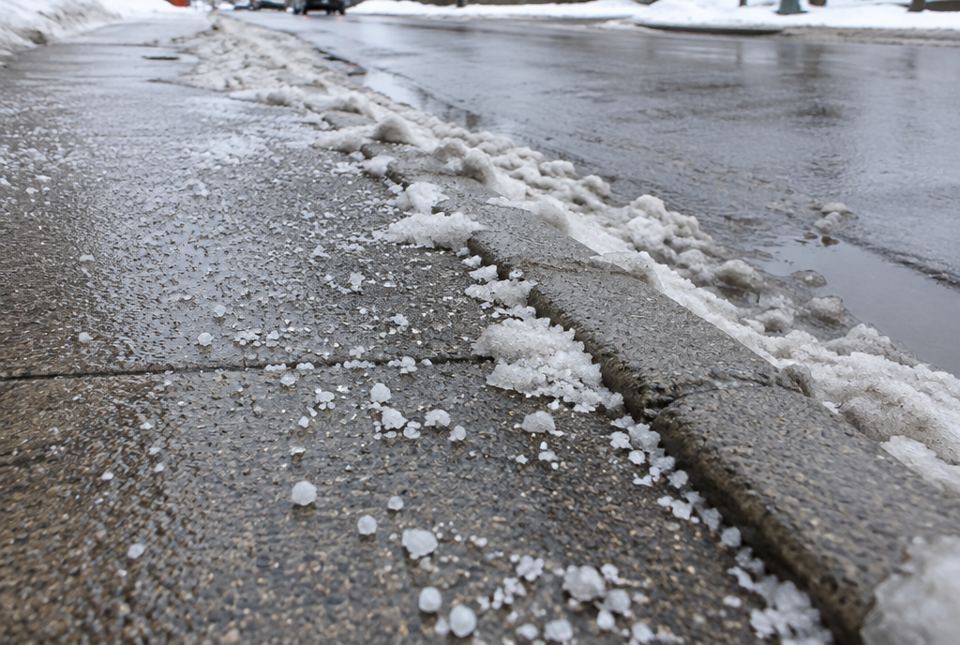 Look at the slush along the curb: that salty meltwater is the brine the text describes. Where it flows next is the cause-and-effect chain the article follows. AI-generated imageA cause-and-effect map of Where Does Road Salt Go? The main chain runs along the top row and then down: salt on ice forms brine, which flows into storm drains and then into creeks. Salty creeks can harm tiny water animals. Salt on roads has other effects too, such as harming roadside plants (and rusting cars, not shown).
The cause-and-effect pattern
Expository texts often explain why things happen. Cause-and-effect texts can be organized in different ways:
- One cause, one effect: Salt touches ice, so the ice melts.
- A chain: each effect becomes the next cause: salt melts ice → brine forms → brine flows into storm drains → salt reaches creeks → chloride builds up.
- One cause, many effects: road salt affects water animals, plants and cars.
- Many causes, one effect: a slippery sidewalk might be caused by freezing rain, no shovelling and shade that keeps ice from melting.
Signal words help you spot the pattern: because, since, so, as a result, therefore, consequently, leads to, causes, due to, if... then.
The subheadings in this text also follow the pattern: Why We Use Salt (cause), Down the Drain (chain), Effects on Living Things (effects), What Can People Do? (a solution section at the end).
Worked exampleLet's trace a cause-and-effect chain
Use the text to explain, step by step, how salt spread on a sidewalk in January could affect a fish in a lake.
- Step 1: Salt is spread on the icy sidewalk. It melts the ice and forms brine (signal word: As a result).
- Step 2: The brine flows into a storm drain.
- Step 3: In many towns, storm drains carry water straight to creeks, rivers and lakes (signal word: Therefore).
- Step 4: Chloride doesn't break down, so it builds up over the years.
- Step 5: High chloride can harm zooplankton, the tiny animals that fish eat. So the fish could have less food.
Salt → brine → storm drain → lake → chloride builds up → zooplankton are harmed → fish have less food. This is a cause-and-effect chain: each effect becomes the next cause. Notice that the last link (fish could have less food) is an inference you make from the text, not a sentence it states.
Just for funFun fact: Salt water freezes at a lower temperature than fresh water. That's why the ocean usually freezes at about −2 °C instead of 0 °C, and it's the same science that makes road salt melt ice.
The bibliography: a feature about trust
A bibliography is a list of the sources the writer used, usually at the end. Each entry gives enough information to find the source: usually the author, the title, the publisher or website, and the date. (Your teacher may ask for a particular style. The sample entries above use a common style.)
How a bibliography helps readers:
- Checking: you can look up the sources to see if the facts are accurate.
- Judging reliability: you can see who the information came from (a town's public works department? a science book? a blog with no author?) and how recent it is.
- Learning more: if a topic interests you, the bibliography is a ready-made reading list.
- Respect: it gives credit to the people whose work the writer used.
Accessible fonts and other access features
A text only works if people can read it. Accessible fonts help many readers, including people with low vision and some people with dyslexia. Things to look for:
- Clear, simple letter shapes. Many accessible fonts are sans serif (no little "feet" on the letters), so letters like I, l and 1 look different.
- A comfortable size and enough space between letters and lines.
- Strong contrast, such as dark text on a light background.
- Not too much ALL CAPITALS, italics or decorative script for long passages, because they are harder to read.
- Left-aligned text with even spacing between words.
Some fonts are designed especially for readers with dyslexia, though different people find different things helpful. Other access features include alt text for images, captions on videos, headings that screen readers can jump between, and plain language.
| Harder to read | Easier to read | Why it helps |
|---|
| ALL CAPITALS FOR A WHOLE PARAGRAPH | Normal capital and lowercase letters | Lowercase letters have different shapes that help the eye recognize words. |
| Light grey text on a white background | Dark text on a light background | High contrast makes letters stand out, especially for people with low vision. |
| Tiny print squeezed together | Larger print with space between lines | Spacing keeps lines from blurring together. |
| Fancy script or very decorative fonts | A clear, simple font | Simple letter shapes are quicker to recognize. |
| A photo with no description | A photo with alt text or a caption | People using screen readers get the same information. |
Patterns and features in a cultural text
Cultural texts have patterns and features too. Here is a program for a Franco-Ontarian Day celebration (September 25) at a made-up school.
Fête des Franco-Ontariens / Franco-Ontarian Day École Cedar Bend Public School, le 25 septembre / September 25
- 9 h 00 / 9:00 a.m.: Lever du drapeau / Flag raising
- 9 h 30 / 9:30 a.m.: Chorale / Choir
- 10 h 15 / 10:15 a.m.: Atelier de danse / Dance workshop
- 11 h 30 / 11:30 a.m.: Dîner partagé / Shared lunch
Pattern: chronological (time order), so people know what happens when.
Features: bilingual text (French first, then English), times written both the way French speakers usually write them (9 h 00) and the way English speakers usually write them (9:00 a.m.), and bold times so readers can scan quickly. The bilingual layout welcomes both language communities and shows pride in French in Ontario. Putting French first signals that the celebration centres Franco-Ontarian culture.
Worked exampleLet's analyze how features help readers
A reader with low vision and a reader who is just starting to learn English both look at the Franco-Ontarian Day program. Which features help each of them?
- Reader with low vision: bold times stand out; a clear font with good contrast (if the printed program uses one) makes the text easier to see; a short list is easier to follow than a paragraph.
- Reader learning English: the bilingual layout lets them read in French if they know it, and compare it with the English.
- Both readers: the chronological pattern makes it easy to find what happens next; times are written in two familiar ways.
- What could be improved? A larger font, an accessible digital version that a screen reader can read, and icons (a flag, a music note) would help even more people.
Features like bold times, a bilingual layout, time order and a clear, high-contrast font help different readers understand quickly. Adding a larger font, a screen-reader-friendly version and icons would make it more accessible still.
Patterns and features help you read and take notes
When you spot signal words such as because and as a result, draw a cause-and-effect map as you read. When you see a bibliography, check at least one source. When you design your own texts, choose accessible fonts and add alt text so everyone can use them.
Hands-on activityRedesign a notice so everyone can use it
You need: a notice, flyer or letter from home, school or a community board; paper and coloured pencils, or a computer with a word processor (with a grown-up's permission).
- Analyze it: What is its pattern (time order, cause and effect, problem-solution, list)? List its features (headings, bold words, pictures, contact information).
- Check access: Is the font clear? Is the text big enough? Is the contrast strong? Are there long stretches of ALL CAPS? Would someone who uses a screen reader get the information from the pictures?
- Define the problem in one sentence, for example: The flyer's tiny script font is hard for my grandmother to read.
- Redesign the notice to fix the problems: choose an accessible font and size, add headings, write alt text for one picture, and use plain language.
- Test it: ask a family member to find one piece of information on the old and the new version. Which was faster? Write two sentences about what you changed and why.
Your turn
1In Where Does Road Salt Go?, what causes the ice to melt?
Salt lowers the temperature at which water freezes. When it touches ice, it forms brine, and the ice melts.
2Find two signal words in the text that show cause and effect.
Any two: because, As a result, Therefore, so (so it can build up).
3Name three effects of road salt described in the section Effects on Living Things.
It can harm tiny water animals such as zooplankton, damage plants along roads, and speed up rust on cars and bridges.
4Why does chloride build up in lakes over time?
Because chloride does not break down, so each winter adds more.
5Look at the bibliography. Which source is the most recent? How do you know?
Wong, Marcus, How Brine Keeps Roads Safer, dated 14 Jan. 2026. The other two are from 2024 and 2025.
6Give two reasons a reader might use a bibliography.
Any two: to check that facts are accurate; to judge who the information came from and how reliable it is; to find more to read; to see that the writer gave credit.
7Name three features of an accessible font or layout.
Any three: clear, simple letter shapes (often sans serif); large enough size; space between letters and lines; strong contrast; avoiding long passages in ALL CAPS, italics or script; left-aligned text.
More practice: warm-up
1Is an expository text fiction or non-fiction?
Non-fiction. It explains or informs.
2In The rain froze, so the sidewalk was slippery, what is the cause?
3Where in a text do you usually find the bibliography?
It describes an image in words so a screen reader can read it aloud.
5What pattern does the Franco-Ontarian Day program use?
Chronological (time order).
More practice: on your own
1Explain the difference between one cause, many effects and a cause-and-effect chain.
In one cause, many effects, a single cause leads to several separate results (road salt harms animals, plants and cars). In a chain, each effect becomes the cause of the next event, like dominoes (salt → brine → drains → creeks).
2Why do the subheadings in Where Does Road Salt Go? help readers?
They follow the pattern (why we use salt, where it goes, its effects, what to do), so readers can predict what each section explains and find information quickly.
3A school website puts its announcements in pale yellow text on a white background. What problem does this cause, and how would you fix it?
The contrast is too low, so many people, especially those with low vision, can't read it easily. Use dark text on a light background (or light text on a dark one).
4Why is it useful that the Franco-Ontarian Day program writes times in two ways?
Readers who are used to French time format (9 h 00) and those used to English format (9:00 a.m.) can both understand quickly. It matches the bilingual purpose of the text.
5A text about road salt has no bibliography and no author. Should you trust it? Explain.
Be careful. Without an author or sources, you can't check where the facts came from or whether the writer is an expert. Compare it with reliable sources before using it.
Challenge
1Write a short paragraph (3 or 4 sentences) explaining the many causes of a single effect: Our backyard rink melted early this year. Use at least two signal words.
Sample: Our backyard rink melted early because February had several days above zero. Also, the rink was in full sun all afternoon. We didn't flood it after a big snowfall, so the ice was thin. As a result of all three causes, the rink turned to slush by early March. (Look for two or more causes, one effect and signal words.)
2The road salt text ends with the section What Can People Do? Why might an expository cause-and-effect text include solutions at the end? Is the text still mainly cause and effect?
Once readers understand the causes and effects, they naturally ask What can we do?, so solutions make the text useful and end on a hopeful note. It is still mainly cause and effect, because most sections explain why salt is used and what it does; the solution section is a short addition. Many texts combine patterns.
3A classmate says, Accessible fonts only matter for people with disabilities. Do you agree? Explain with an example.
Partly disagree. Accessible design helps people with disabilities, and it also helps everyone: a clear font and strong contrast help someone reading a phone in bright sunlight, a tired reader, or someone reading quickly at a bus stop. Designing for access makes texts better for all.
Quiz
1. Which sentence shows a cause-and-effect chain?
2. Which word is a cause-and-effect signal word?
3. What is the main job of a bibliography?
4. Which choice makes a text more accessible?
5. Why does the road salt text say chloride builds up?
6. The Franco-Ontarian Day program is written in French and English. What does this feature mostly show?
What this lesson teaches: Grade 7 students analyze text patterns, such as cause and effect in an expository text, and text features, such as a bibliography and accessible fonts, in various text forms including cultural texts, and explain how they help readers, listeners and viewers understand meaning (C1.3). The redesign activity applies the design process to a real problem (A2.6).
How to help at home:
- When you read the news together, ask: "What caused this? What were the effects? Did one effect cause another?"
- Look at product labels, school notices and websites together and talk about which are easy or hard to read, and why.
- If your child uses a computer for the activity, help them choose a clear font and check the contrast.
Common difficulties:
- Mixing up cause and effect. Ask: "Which happened first? Which one made the other happen?"
- Ignoring the bibliography. Encourage your child to open at least one source and check one fact.
- Thinking accessibility is only about disabilities. Point out how captions help in a noisy room and clear fonts help on a sunny day.
About the texts: The road salt text was written for this site. Its science is accurate: salt lowers the freezing point of water; chloride does not break down and can accumulate in fresh water; high chloride levels can harm small aquatic organisms such as zooplankton; salt can damage roadside plants and speeds corrosion. Many municipalities use pre-storm brine (anti-icing) to reduce salt use. The bibliography entries and the school are made up. Franco-Ontarian Day is celebrated on September 25 each year.