C. Matter and Energy · Electrical Phenomena, Energy, and DevicesImpacts of Making Electricity in Canada
C1.1 A1.1 A3.3About 45 minutes
Learning goals- I can describe short-term and long-term impacts of different ways of making electricity in Canada.
- I can explain how some electricity projects have affected First Nations, Métis and Inuit communities, and how some communities lead energy projects today.
- I can explain how making electricity from fossil fuels contributes to climate change.
- I can research a technology and weigh its benefits and drawbacks.
Words to know
impact
A strong effect that something has on people, other living things or the environment.
short-term impact
An effect that happens soon, or lasts a short time.
long-term impact
An effect that lasts for many years, or shows up many years later.
reservoir
A large lake made by building a dam across a river.
greenhouse gas
A gas, like carbon dioxide, that traps heat in the atmosphere and contributes to climate change.
radioactive waste
Used nuclear fuel and other materials that give off harmful radiation and must be stored safely for a very long time.
trade-off
Giving up some of one thing to get more of another.
Every choice has a cost
All the ways of making electricity have benefits: lights, heat, hospitals, schools and jobs. But every way also has impacts on society and the environment. Some impacts show up right away (short-term). Others last for many years, or appear later (long-term).
In this lesson you'll weigh the trade-offs, the way engineers, governments, communities and families do when deciding how to make electricity.
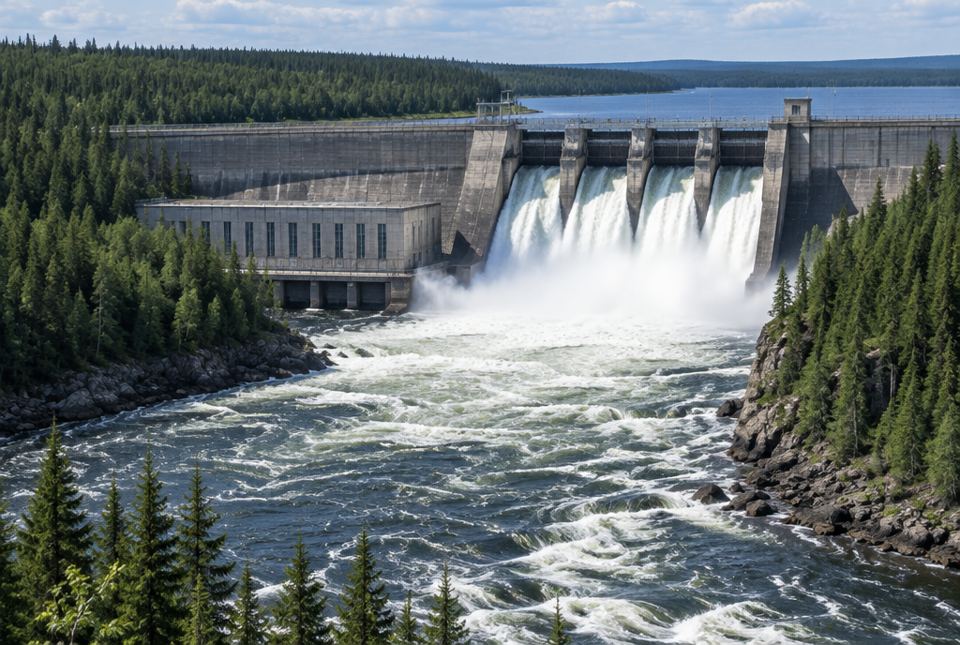 Hydroelectric dams make electricity without burning fuel, but they also flood land and change the river for fish and wildlife. AI-generated image
| Technology | Some short-term impacts | Some long-term impacts |
|---|
| Hydroelectric dam | Building it floods land, forests and places where people lived, hunted, fished and gathered. Creates construction jobs. | Renewable, with no fuel burned. Lasts for many decades. Changes rivers and fish habitat, and can block fish from swimming upstream. Flooding can raise mercury levels in fish for many years. |
| Nuclear station | Makes a lot of electricity day and night without releasing greenhouse gases while running. Provides many jobs. | Used fuel stays radioactive for thousands of years and must be stored safely. Mining uranium affects the land. Non-renewable. |
| Natural gas station | Can be turned on quickly when lots of electricity is needed. Burning gas releases air pollution and carbon dioxide. | Carbon dioxide adds to climate change. Non-renewable. Drilling for gas affects land and water. |
| Coal station (no longer used in Ontario) | Burning coal releases smoke and pollution that contributed to smog and breathing problems. | Releases the most carbon dioxide of these sources, adding to climate change. Mining affects land. |
| Wind farm | No fuel and no air pollution while running. Turbines can harm birds and bats, and some neighbours dislike the noise or the view. | Renewable. Only makes electricity when the wind blows. Old blades are hard to recycle. |
| Solar farm or rooftop panels | No fuel and no air pollution while running. Large solar farms need lots of land. | Renewable. Only works in daylight. Making panels uses mined materials, and old panels need recycling. |
Climate change
When fossil fuels (natural gas, coal and oil) are burned to make electricity, they release carbon dioxide, a greenhouse gas. Greenhouse gases trap heat in the atmosphere and are causing Earth's climate to warm. In Canada, that can mean more heat waves, wildfires, shorter ice seasons in the North, and changes for plants and animals.
Ontario stopped using coal to make electricity in 2014. Coal stations were replaced mostly with nuclear, natural gas, hydro, wind and solar. This cut the province's greenhouse gas emissions and air pollution, and smog days became much less common. Using less electricity, and making more of it from sources that don't burn fossil fuels, helps even more.
Impacts on First Nations, Métis and Inuit communities
Many large electricity projects are built on or near the lands of First Nations, Métis and Inuit peoples, so their impacts are often felt most by these communities.
- Flooding from dams. In Ontario and other provinces, some dams built in the 1900s flooded parts of First Nations reserves, burial grounds, and lands used for hunting, trapping, fishing and gathering. Often the communities were not asked for their consent. Some communities have reached settlements with governments in recent years.
- The James Bay project (northern Quebec). In the 1970s, the Quebec government began building huge hydroelectric dams on rivers in the lands of the Cree and Inuit. The Cree and Inuit went to court to protect their lands and ways of life. This led to the James Bay and Northern Quebec Agreement (1975), which recognized rights and set up compensation. Reservoir flooding also raised mercury levels in fish, an important food for many Cree families.
- Diesel in remote communities. Many remote First Nations and Inuit communities have had to rely on diesel generators. The fuel is expensive, must be flown or trucked in, can spill, and releases greenhouse gases.
Leading the way today (A3.3). First Nations, Métis and Inuit communities are also leaders in electricity projects today, often as owners and partners.
- Remember from Grade 5: Henvey Inlet First Nation partnered to build a large wind farm, and Wataynikaneyap Power, a company owned mostly by First Nations, has been building power lines to connect remote First Nations in northwestern Ontario to the grid.
- Moose Cree First Nation is a partner and part-owner, with Ontario Power Generation, of hydroelectric stations on the Lower Mattagami River that were rebuilt and expanded in the 2010s.
- Communities bring knowledge of the land and teachings about thinking of future generations to these decisions.
Thinking from different points of view
When you assess an impact, ask: Who is affected? What changes, now and later? Who decides, and were the people affected asked? Think about society (people, health, jobs, costs), the environment (land, water, air, wildlife), First Nations, Métis and Inuit communities, and the climate.
Worked exampleLet's assess a proposed wind farm
A company wants to build 20 wind turbines on farmland near a small Ontario town. Assess the short- and long-term impacts.
- Short-term, society: construction jobs; trucks and noise during building. Some people may like or dislike the view.
- Short-term, environment: some land is cleared for roads and bases; birds and bats near the turbines could be harmed.
- Long-term, climate: the turbines make renewable electricity with no greenhouse gases while running, so less natural gas may need to be burned.
- Long-term, society: farmers may be paid for land; the town may get income. But wind doesn't blow all the time, so other sources are still needed.
- Who decides? The town, nearby farmers, and any First Nations whose traditional lands include the area should be consulted and have a say.
- Weigh it: the benefits (clean electricity, income) seem to outweigh the costs if the turbines are placed carefully (away from bird migration routes and homes) and the community agrees.
A good assessment lists impacts on society, the environment and the climate, both short-term and long-term, asks whose voices count, and makes a reasoned judgement.
Just for funSolar panels may have the easiest job description in the world: "Go sit in the sun all day." (They still take the night off, though!)
Hands-on activityResearch and assess: an electricity technology
Your research question (A1.1): What are the short- and long-term impacts of one way of making electricity in Canada?
- Choose one technology: hydroelectric, nuclear, natural gas, wind, solar or biomass.
- With a grown-up, find two or three reliable sources: for example, government websites (Natural Resources Canada, the Government of Ontario), Ontario's electricity system operator (IESO), Ontario Power Generation, a library book, or a First Nation's own website about an energy project. Check: Who wrote it? Is it up to date? Is it trying to sell something?
- Make a chart with four boxes: Society, Environment, First Nations, Métis and Inuit communities, Climate change. Split each box into short-term and long-term.
- Fill it in with facts from your sources. Write down where each fact came from.
- Conclude: In two or three sentences, say whether you think this technology should be used more in Canada, and why. Name one way to reduce its harmful impacts.
What to look for: at least one impact in each box, facts tied to sources, and a conclusion that weighs benefits and drawbacks rather than saying a technology is all good or all bad.
Your turn
1What is the difference between a short-term and a long-term impact?
A short-term impact happens soon or lasts a short time. A long-term impact lasts for many years or shows up years later.
2Give one benefit and one drawback of hydroelectric dams.
Benefit (any one): renewable; no fuel burned; lasts many decades; no greenhouse gases from burning. Drawback (any one): floods land and homes; changes rivers and fish habitat; can raise mercury in fish; has affected First Nations and Inuit lands.
3Why is nuclear waste a long-term impact?
Used nuclear fuel stays radioactive for thousands of years, so it must be stored safely for a very long time.
4How does burning natural gas to make electricity contribute to climate change?
Burning it releases carbon dioxide, a greenhouse gas that traps heat in the atmosphere and warms the climate.
5In what year did Ontario stop using coal to make electricity?
6Give one way a large electricity project has affected a First Nations or Inuit community.
Any one: dams flooded reserve lands, burial grounds or hunting and fishing areas, often without consent; the James Bay project flooded Cree and Inuit lands and raised mercury in fish; remote communities have had to rely on expensive, polluting diesel.
7Give one example of a First Nation leading or partnering in an electricity project.
Any one: Moose Cree First Nation (Lower Mattagami hydro stations); Henvey Inlet First Nation (wind farm); Wataynikaneyap Power (power lines owned mostly by First Nations).
More practice: warm-up
1Renewable or non-renewable? Wind.
2Renewable or non-renewable? Natural gas.
3Renewable or non-renewable? Uranium for nuclear stations.
4Which gas, released by burning fossil fuels, is a greenhouse gas?
A large lake made by building a dam across a river.
More practice: on your own
1Why do electricity systems still use some natural gas, even though it adds to climate change?
Gas stations can be turned on quickly when lots of electricity is needed (for example, on a hot summer afternoon), and they work whether or not the wind blows or the sun shines.
2Wind and solar don't release greenhouse gases while running. Give one drawback of each.
Wind (any one): only works when the wind blows; can harm birds and bats; noise or view concerns; blades hard to recycle. Solar (any one): only works in daylight; large farms need lots of land; making panels uses mined materials; old panels need recycling.
3Why is it important for communities to be asked before an electricity project is built on their lands?
Because they are the ones who will live with the impacts (flooding, noise, changes to hunting and fishing). Asking them respects their rights and their knowledge of the land, and leads to fairer, better decisions.
4How did closing Ontario's coal stations help people's health?
Coal smoke caused air pollution and smog, which causes breathing problems. Without coal, the air got cleaner and smog days became much less common.
5What problems do diesel generators cause for remote communities?
Diesel is expensive and must be flown or trucked in, it can spill, and burning it releases air pollution and greenhouse gases.
Challenge
1A province must choose between a new natural gas station and a new hydroelectric dam. Give one long-term reason to choose each, and say which you'd choose and why.
Gas: quick to turn on and off; no land flooded. Hydro: renewable and no greenhouse gases from burning, lasts for decades. Sample choice: hydro, because over the long term it doesn't add to climate change, as long as the First Nations and others affected agree and the flooding is kept as small as possible. (Other well-reasoned choices are fine.)
2Explain why we should still save electricity in a province where most electricity comes from sources that don't burn fossil fuels.
Every source has impacts (flooding, radioactive waste, land use, mining). Using less means fewer new stations are needed, and at busy times the extra electricity often comes from natural gas, which adds to climate change. Saving electricity also saves money.
3Many First Nations teachings ask people to think about the effects of decisions on future generations. Apply this to choosing how to make electricity.
Sample answer: choose sources that won't leave harmful problems for people far in the future, such as climate change from fossil fuels or long-lasting waste, and protect the land and water that future generations will need. Use only what we need and conserve energy.
Quiz
1. Which is a long-term impact of a nuclear power station?
2. Burning natural gas to make electricity contributes to climate change because it releases...
3. Ontario stopped using coal to make electricity in...
4. The James Bay hydroelectric project flooded lands of which peoples?
5. Which is a short-term drawback of building a wind farm?
6. Why have many remote northern communities relied on diesel generators?
7. Which statement is the best conclusion about making electricity?
Big idea (C1.1): assess short- and long-term impacts of electrical energy generation technologies in Canada on society and the environment, including impacts on First Nations, Métis and Inuit communities and on climate change. The research activity practises the scientific research process (A1.1), and the section on Indigenous-led projects supports analysing contributions from various communities (A3.3).
How to help: help your child find reliable sources and check them (who wrote it, how recent, any reason to persuade). Encourage a balanced conclusion: the goal is to weigh trade-offs, not to pick a "good" or "bad" source.
Common difficulties:
- Thinking renewable means no impact. Dams flood land; wind and solar need land and materials.
- Forgetting who is affected. Ask "Whose land? Were they asked?"
- Treating Indigenous peoples only as people things happened to. Many First Nations, Métis and Inuit communities lead and own energy projects today.
Sensitive content: the history of flooding and lack of consent can be discussed simply and factually. If your family has a connection to an affected community, your child's experiences and knowledge are welcome.
Facts used: the James Bay and Northern Quebec Agreement was signed in 1975; Ontario ended coal-fired electricity in 2014. Electricity mixes change year to year.