B. Foundations of Language · Listening, Speaking and Word PowerPrefixes for Grade 6: Good, Bad, All, Over, Under and Together
B2.1 B2.2 A3.1About 45 minutes
Learning goals- I can read and explain the prefixes bene-, mal-, omni-, pan-, hyper-, hypo-, ultra-, intra-, contra- and syn-/sym-.
- I can tell apart prefixes that look alike, like ante- (before) and anti- (against), and hyper- (over) and hypo- (under).
- I can use prefixes to understand words in science, math and health.
- I can use a prefix and the context together to figure out a new word.
Words to know
prefix
A morpheme added before a base that changes its meaning.
omnivore
An animal that eats both plants and animals. omni- (all) + vor (eat).
hypothermia
A dangerous drop in body temperature. hypo- (under) + therm (heat) + -ia (condition).
ultraviolet
Light just beyond violet, which our eyes can't see.
symmetry
When two halves of a shape match. sym- (together) + metr (measure) + -y.
Remember from earlier grades
You already know many prefixes: un-, re-, dis-, pre-, mis-, sub- (Grades 2 and 3); inter-, trans-, super-, semi-, multi-, fore-, de-, anti-, co- (Grade 4); and number, metric and position prefixes like mono-, poly-, kilo-, post-, circum-, extra-, counter- (Grade 5). Grade 6 adds prefixes that you'll see a lot in science, health and math.
Let's start with a puzzle
A bear eats berries, fish, roots and insects. A deer eats plants. A wolf eats meat. Which one is an omnivore?
The prefix omni- means all, and vor means eat. An omnivore eats all kinds of food, plants and animals. It's the bear! (A deer is a herbivore: herb = plant. A wolf is a carnivore: carn = meat.)
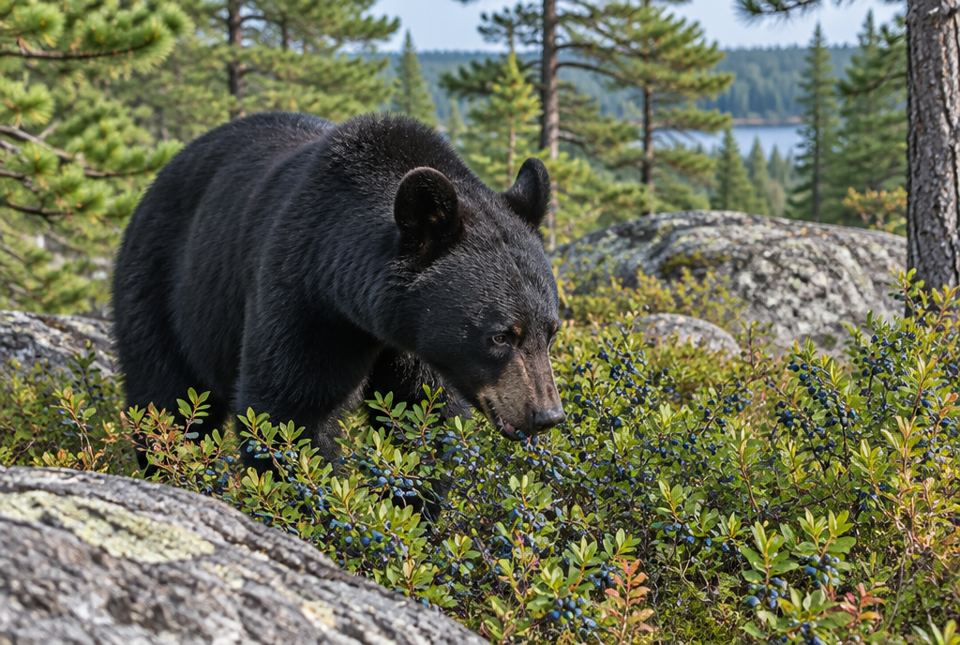 Black bears eat berries, roots, insects and fish. Omni- means all, so an animal that eats all kinds of food is an omnivore. AI-generated image
Good and bad, all and every
| Prefix | Means | Examples |
|---|
| bene- | good, well | benefit (a good result), beneficial, benevolent (wishing others well) |
| mal- | bad, badly | malfunction (works badly), malnutrition (poor nutrition) |
| omni- | all | omnivore, omnipresent (present everywhere) |
| pan- | all, every | panorama (a view of all around), pandemic (a disease spreading among people in many countries) |
Over, under, beyond and within
| Prefix | Means | Examples |
|---|
| hyper- | over, too much | hyperactive, hyperventilate (breathe too fast) |
| hypo- | under, too little | hypothermia (body temperature too low), hypodermic (under the skin) |
| ultra- | beyond, extremely | ultraviolet, ultrasound (sound too high for humans to hear) |
| intra- | within, inside | intramural (sports within one school), intravenous (into a vein) |
| contra- | against, opposite | contradict (say the opposite), contrast |
| syn-, sym- | together, with | synonym, synthesize, symphony, symmetry, sympathy |
| ante- | before | a.m. (ante meridiem: before midday) |
Look-alike prefixes
Some prefixes look almost the same but mean very different things:
- ante- (before) vs. anti- (against): a.m. (ante meridiem, before midday) vs. antifreeze (against freezing).
- hyper- (over) vs. hypo- (under): hyperthermia (overheating) vs. hypothermia (body too cold).
- inter- (between) vs. intra- (within): interprovincial (between provinces) vs. intramural (within one school).
One letter can flip the meaning, so read carefully!
Prefixes in your subjects
- Science: omnivore, ultraviolet, hypothermia, symbiosis (sym- together + bio life: two different living things in a close partnership).
- Math: symmetry: two halves that match when measured together.
- Health and safety: hypothermia is a risk in Canadian winters. Dress in layers and come inside to warm up. Ultraviolet (UV) rays from the sun can burn skin, even on cloudy days, so wear sunscreen and a hat.
- Language: synonym (syn- + onym, name: words that name the same idea).
Worked exampleLet's use a prefix and context together
After two hours outside in the blizzard without mittens, the hiker showed signs of hypothermia: shivering, confusion and slurred speech.
- Prefix: hypo- means under or too little.
- Base: therm means heat (like thermometer, thermos).
- Suffix: -ia names a condition.
- Meaning from parts: a condition of having too little heat.
- Context check: a blizzard, no mittens, shivering. The hiker's body is too cold. It fits!
hypothermia = a dangerous condition where the body gets too cold.
Worked exampleLet's tell look-alikes apart
Our school runs an intramural basketball league at lunch. Next month, our team plays in an interschool tournament.
- intramural: intra- (within) + mur (wall) + -al: within the walls, so teams within our school.
- interschool: inter- (between) + school: games between different schools.
- Context check: the lunch league happens at our school; the tournament is against other schools.
intramural = within one school; interschool = between schools.
Check the meaning
Not every pan or mal is a prefix: a frying pan and a shopping mall aren't! Ask: Does the prefix meaning fit the whole word?
Just for funNot every pan is the prefix pan- (all, every). A panorama is a view of all around, but a pancake is definitely not a cake made of everything. (Although that would be an interesting breakfast!)
Hands-on activityPrefix posters around the house
You need: paper, markers or pencils, and sticky tape. Optional: a sunscreen bottle and a winter jacket.
- Look at a sunscreen label. Find UV (ultraviolet). Write what ultra- means and why the label mentions it.
- Think about your family's meals. Are people omnivores? Is your pet a herbivore, carnivore or omnivore?
- Fold a paper in half and draw half a butterfly or maple leaf along the fold. Cut it out with a grown-up's help (scissors) and open it to see symmetry.
- Make a mini-poster for five prefixes from this lesson, each with a word and a small picture clue.
- Tape them up where your family will see them, and quiz each other at dinner.
What to look for: correct meanings (ultra = beyond, omni = all, sym = together), and pictures that match the words.
Your turn
1What does mal- mean? Read malfunction.
Mal- = bad, badly. Malfunction = to work badly or fail to work properly.
2Is a raccoon (which eats fruit, insects, eggs and small animals) a herbivore, carnivore or omnivore? Explain with the prefix.
An omnivore: omni- = all. It eats both plants and animals.
3What's the difference between hyperthermia and hypothermia?
Hyperthermia = body too hot (hyper- = over). Hypothermia = body too cold (hypo- = under).
4What does a.m. stand for, and what does it mean?
Ante meridiem = before midday (morning).
5Explain synonym using its parts.
syn- (together, same) + onym (name): words that name the same idea, like big and large.
6What does benefit mean? Use it in a sentence.
A good result or advantage. Example: One benefit of walking to school is getting exercise.
7Why does sunscreen protect against UV rays? What does UV stand for?
UV stands for ultraviolet: light beyond violet that we can't see but that can burn skin. Sunscreen helps block it.
More practice: warm-up
5Which prefix means against: ante- or anti-?
More practice: on your own
1Read: The two stories contradict each other. Explain using the parts.
contra- (against) + dict (say): the stories say opposite things.
2Why is it symphony and not synphony?
Syn- changes to sym- before p (and b, m), because it's easier to say. It's a chameleon prefix.
3Read: The new library will benefit the whole community. Is this good news or bad news? How do you know?
Good news. Bene- means good, so the library will bring good things.
4What is the difference between an interprovincial highway and an intraprovincial trip?
Interprovincial = between provinces (crossing a border). Intraprovincial = within one province.
5A panorama photo shows a whole lake and its shoreline. Explain the word using the prefix.
Pan- = all: a panorama shows a view of all around, a very wide scene.
Challenge
1Bees get nectar from flowers, and flowers get pollinated by bees. Many scientists describe close partnerships like this as a kind of symbiosis. Explain the word using its parts and the example.
sym- (together) + bio (life) + -sis (process): living together, or a close partnership between two different living things. In this example, the partnership helps both: the bee gets food and the flower gets pollinated.
2Invent a sensible definition for ultracold and malnourished using their prefixes. Then check: are these real words?
Ultracold = extremely cold (ultra- = beyond, extremely). Malnourished = badly nourished, not getting enough healthy food. Both are real words.
3Read: The doctor said the medicine was given intravenously. Explain using the parts, and say why context matters.
intra- (within) + ven (vein) + -ous + -ly: given into a vein. Context (a doctor, medicine) tells us ven means a body vein, not something else.
Quiz
1. What does omni- mean in omnivore?
2. Hypothermia means the body is...
4. Intramural sports happen...
5. Why is it symmetry and not synmetry?
6. What does ultra- mean in ultraviolet?
7. Which word means to work badly?
Big idea (B2.1, B2.2, A3.1): Grade 6 students use generalized knowledge of morphemes to read and understand complex words, including vocabulary from science, health and math (A3.1). Many of these prefixes come from Greek and Latin.
How to help at home:
- Point out prefixes on labels: UV protection, anti-bacterial, multi-vitamin.
- In winter, talk about hypothermia and how layers keep us safe. In summer, talk about ultraviolet rays and sunscreen.
- Play "herbivore, carnivore or omnivore?" with animals you see.
Common difficulties:
- Mixing up look-alikes (ante/anti, hyper/hypo, inter/intra). Make a two-column chart of pairs.
- Seeing prefixes that aren't there (pan in pancake, mal in mall). Check that the meaning fits.
Safety note: The activity uses scissors; supervise as needed.