B. Drama / D. Visual Arts · Drama and Visual ArtsVisual Arts: Art with a Message, Across Times and Cultures
D2.1 D2.4 D3.1 D3.2About 45 minutes
Learning goals- I can interpret an art work and identify the feelings, issues, themes and social concerns it shows.
- I can describe how forms and styles of visual and media arts send messages, in the past and today.
- I can describe how art reflects the beliefs and traditions of different peoples, including First Nations, Métis and Inuit artists.
- I can identify my strengths, interests and areas for improvement as an artist, an interpreter and a viewer of art.
Words to know
interpret
To figure out what an art work might mean, using evidence from what you see.
social concern
A problem that affects people in a community or the world, like pollution, fairness or homelessness.
media arts
Art made with technology, like photography, film, animation and digital art.
form (of art)
A type of art, like painting, sculpture, printmaking, photography, a mural or beadwork.
tradition
A way of making or doing something that is passed down through generations.
artist statement
A short piece of writing where an artist explains their art work and their choices.
portfolio
A collection of your art works and sketches that shows your growth over time.
Remember from Grade 4
You read signs, symbols and styles, and explored art traditions such as Métis floral beadwork, wampum belts, the Kinomagewapkong petroglyphs, ancient Egyptian painting, Ukrainian pysanky and community murals. You also kept a portfolio.
In Grade 5, you will become an art interpreter: finding the feelings, issues, themes and social concerns in art works, comparing how art sends messages in the past and today, and learning how art reflects the beliefs and traditions of many peoples.
What is this wall trying to tell me?
Imagine a new mural appears on the side of the hockey arena in your town. It shows kids of many backgrounds holding hands around a giant tree, with birds flying out of its branches.
Nobody explains it. But you can still figure out a lot: it might be about community, belonging, nature, or growing together. That's interpreting art: reading the clues the artist left for you.
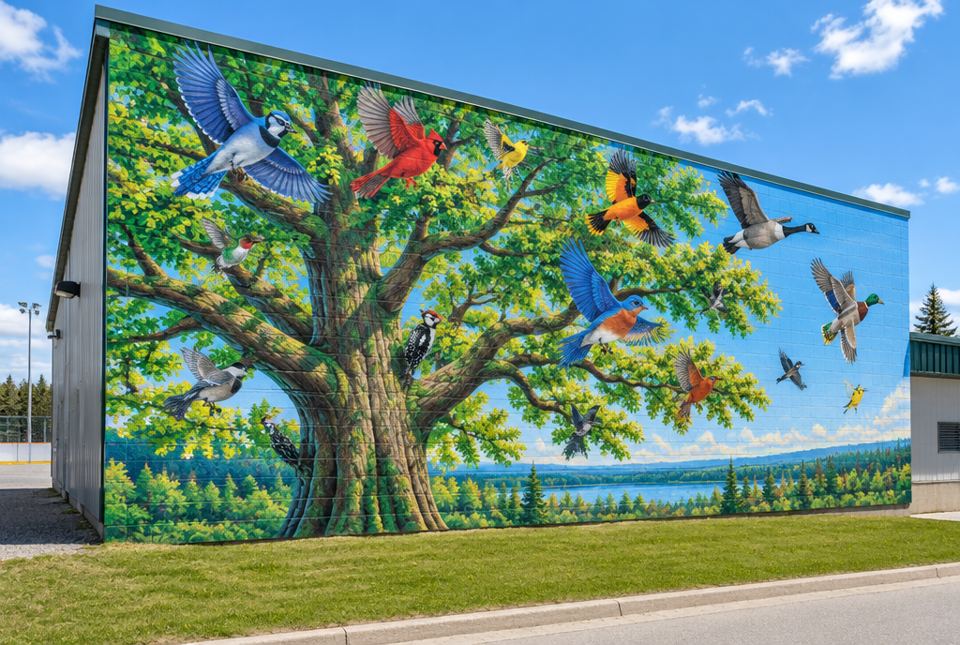 Be an art interpreter: what message might this mural send? Look for clues, like the many different birds sharing one tree. AI-generated image
How to interpret an art work
Use these steps (they work for paintings, photos, sculptures, beadwork, ads and more):
- First reaction: What do I notice first? How does it make me feel?
- Describe: What do I see? (people, objects, colours, setting) Just the facts.
- Analyse: How did the artist use the elements (line, shape, colour, value, texture, space) and principles (emphasis, proportion...)? What's the focal point?
- Interpret: What might it mean? What feelings, issues, themes or social concerns does it show? Give evidence.
- My point of view: What do I think of it now, and why? Does it connect to my life or my community?
Art sends messages: then and now
People have always used art to send messages. Forms and styles change with the materials and technology people have and the contexts they live in.
| Form | Past or present | Example of a message | Context |
|---|
| Rock paintings and carvings | thousands of years ago, and some places are still honoured today | animals, people and important events | made with natural materials (stone, ochre); often connected to beliefs and sacred places |
| Printed posters | about 100 or more years ago | "Come to the fall fair!" "Travel by train!" | printed in large numbers once printing became cheaper; bold lettering to be read on the street |
| Photography | invented in the 1800s and used every day now | showing real events: a flood, a celebration, a protest | a camera can show the world as it is, so photos can make people care about real problems |
| Comics and graphic novels | 1900s to today | stories about heroes, friendship, history | panels and speech bubbles mix pictures and words |
| Murals and street art | long ago and very much today | community pride, history, welcoming newcomers, caring for the environment | large, public, free for everyone to see |
| Digital art, animation and memes | today | advertising, awareness campaigns, jokes | made and shared instantly on screens, to huge audiences |
Media messages: who made it, and why?
Media art works, like ads, posters, videos and photos, are made on purpose to send a message. Ask:
- Who made it? Why?
- Who is it for (the target audience)?
- What does it want me to think, feel or do?
- What is left out?
An ad for a sugary cereal might show happy kids and bright colours, but it doesn't show the sugar content. Being a smart viewer means noticing how art tries to persuade you.
Art reflects beliefs and traditions
Art from different peoples often reflects what they believe, value and celebrate. Here are some traditions that are living today:
- Mi'kmaw porcupine quillwork (Mi'kmaq, in Atlantic Canada and Quebec): dyed porcupine quills are worked into birchbark, often in bold geometric designs, to make boxes and other objects. It uses materials from the land, and artists still make it and teach it today.
- Inuit wall hangings from Qamani'tuaq (Baker Lake), Nunavut: artists stitch and embroider pieces of wool cloth into large pictures of animals, people, stories and life on the land.
- Haudenosaunee raised beadwork: beads are stacked into raised arches so the designs, such as flowers and birds, stand out from the fabric. Families have passed down this skill for generations, and beadworkers today keep creating new designs.
- Papel picado (Mexico, and Mexican communities in Canada): designs are cut into tissue paper and hung as colourful banners at celebrations, including Día de los Muertos (Day of the Dead, at the start of November), when families remember loved ones who have died.
- Islamic geometric patterns: repeating stars and shapes in tiles, wood and plaster decorate many mosques and other buildings. In many Muslim religious spaces, patterns and beautiful writing (calligraphy) are used instead of pictures of people. Many viewers see the endless repeating patterns as a reflection of unity and order.
Learning about art from other cultures with respect
- Use the name of the people, Nation or community (Mi'kmaq, Inuit, Haudenosaunee), not just "Indigenous" or "from Mexico."
- Remember that these are living traditions, practised by artists today.
- Some designs are sacred or belong to certain families. Learn about them and admire them, but don't copy them as your own. Be inspired to make art about your life and traditions.
- Look for information from the community itself: museums that work with communities, Indigenous artists' own websites, or books by authors from that culture.
Just for funWhy did the art interpreter bring a magnifying glass to the gallery?
Because every art work is full of clues! 🔍
Worked exampleExample: Interpreting a photograph with a social concern
A news photograph shows a turtle tangled in a plastic six-pack ring on a rocky shore. Let's interpret it.
- First reaction: I feel sad and worried.
- Describe: a turtle on rocks by the water; a clear plastic ring wrapped around its shell; a few bits of garbage in the background.
- Analyse: the turtle is in the centre and in sharp focus; the background is blurry, so the turtle is the focal point. The shiny plastic stands out against the dull, natural colours of the rocks.
- Interpret: the social concern is plastic pollution hurting wildlife. The theme might be our responsibility to protect nature.
- My point of view: it's a powerful photo because it shows a real animal, not a drawing. It makes me want to cut up plastic rings before recycling and to pick up litter at the beach.
Following the steps lets you move from a feeling to a reasoned interpretation of the art work's social concern.
Worked exampleExample: Comparing two traditions
Compare Haudenosaunee raised beadwork and papel picado.
- Materials: beadwork uses glass beads sewn on fabric; papel picado uses cut tissue paper.
- How long it lasts: beadwork is made to last for many years; papel picado is delicate and often made for a celebration.
- Designs: beadwork often shows flowers and birds in raised beads; papel picado often shows flowers, birds, patterns and decorated skulls (calaveras) for Día de los Muertos.
- Beliefs and traditions: beadwork shows Haudenosaunee identity and skills passed through families; papel picado is part of celebrations, including remembering loved ones who have died.
- Alike: both are living traditions, both use pattern and positive and negative shapes, and both are passed down through generations.
Comparing materials, designs and purposes shows how each art form reflects its people's beliefs and traditions.
Reflecting on yourself: creator, interpreter, viewer
At the end of a unit, look through your portfolio and think about yourself in three roles:
- As a creator: Which art work are you proudest of? Which skill grew the most (hatching, shading, colour mixing, proportion, lettering)? What will you practise next?
- As an interpreter: Can you explain what an art work means, using evidence and art words?
- As a viewer: Do you look closely and respectfully, and ask questions about art from other cultures and times?
Write a short artist statement for your favourite piece: what it is, what it means, which elements and principles you used, and what you would do differently next time.
Hands-on activityGallery walk and artist statement
You need: your art works from this unit (or any art you've made this year), tape or clothespins and string, paper, a pencil, and a device for looking up art with a grown-up (museum websites are great).
- Find three art works online with a grown-up: one from the past, one from today, and one from a tradition in this lesson (for example, Inuit wall hangings from Baker Lake or Mi'kmaw quillwork, from a museum website).
- Interpret one using the five steps. Write a sentence for each step.
- Compare the past and present works: What message does each send? How do the materials or technology affect the message?
- Hang your own gallery at home: three to five of your best art works.
- Write an artist statement for one piece: "My art work is called ___. It shows ___. I used ___ (elements and principles) to ___. I'm proud of ___. Next time I will ___."
- Gallery walk: family members walk through your gallery. Ask them to interpret one piece before you explain it. Did they see what you hoped?
Your turn
1What does it mean to interpret an art work?
To figure out what it might mean, using evidence from what you see.
2Name the five steps for interpreting art.
First reaction, describe, analyse, interpret, my point of view (judgement with reasons).
3What is a social concern? Give an example.
A problem that affects people in a community or the world. Examples: pollution, litter, homelessness, fairness, bullying, climate change.
4Name one form of media art.
Any one: photography, film or video, animation, digital art, ads, memes.
5What are Inuit wall hangings from Baker Lake made of, and what do they often show?
Pieces of wool cloth stitched and embroidered together; they often show animals, people, stories and life on the land.
6What is special about Haudenosaunee raised beadwork?
The beads are stacked into raised arches, so the designs (like flowers and birds) stand out from the fabric.
7When you look at an ad, what are two questions to ask?
Any two: Who made it and why? Who is it for? What does it want me to think, feel or do? What is left out?
More practice: warm-up
1What material is used in Mi'kmaw quillwork, besides porcupine quills?
Mexican cut tissue-paper banners hung at celebrations, including Día de los Muertos.
A collection of your art works and sketches that shows your growth.
4True or false: First Nations, Métis and Inuit art traditions are only from long ago.
False. They are living traditions practised by artists today.
5In the describe step, do you share your opinion or just the facts?
Just the facts: what you see.
More practice: on your own
1Why might a photograph of a real event make people care about a problem more than a drawing?
Because a photograph shows the world as it really is, so viewers know the problem is real, which can make them feel more strongly and want to help.
2How do the materials of a tradition connect to the people's beliefs or way of life? Use Mi'kmaw quillwork as an example.
Quillwork uses porcupine quills and birchbark, materials from the land where the Mi'kmaq live. It shows a close relationship with the land and the skills passed down through generations.
3A mural shows newcomers arriving with suitcases, being welcomed by neighbours holding warm drinks in the snow. Interpret its theme.
Example theme: welcoming and belonging: Canadians helping newcomers feel at home, even in a cold winter. Evidence: the suitcases (arriving), the warm drinks and smiles (kindness), the snow (Canada).
4Write an artist statement sentence about your hatching drawing from this unit.
Example: "In my drawing of a mug, I used curved hatching and cross-hatching to make it look round; next time I'll make my gradation smoother." Look for the art words and a next step.
5Why should you learn about a tradition from the community itself, when you can?
Because people from the community know its true meanings and rules best, which helps you avoid mistakes and stereotypes and shows respect.
Challenge
1Compare how a message about protecting nature might be sent by (a) a rock painting long ago and (b) a digital ad today.
(a) A rock painting uses natural materials, stays in one place, and was seen by people who travelled there; it might show animals with deep respect, connected to beliefs. (b) A digital ad is made quickly with technology, reaches millions of people instantly, might use photos, music and text to persuade, and might be seen only for seconds. The context and technology change how the message is made and shared.
2Explain how Islamic geometric patterns can reflect beliefs without showing any people.
In many Muslim religious spaces, patterns and calligraphy are used instead of pictures of people. The endless repeating patterns can make viewers think of ideas like unity and order, and their careful mathematics and beauty show great skill and devotion.
3Write a full self-reflection on yourself as a creator, an interpreter and a viewer, with one strength, one interest and one area for improvement.
Example: Creator: strength: shading with gradation; area for improvement: proportions of faces. Interpreter: strength: finding social concerns with evidence. Viewer: interest: Inuit wall hangings; area for improvement: asking more questions about where art comes from. Look for all three roles, specific examples, and a next step.
Quiz
1. To interpret an art work means to ___.
2. In which step do you describe only what you see, without opinions?
3. A photograph of a turtle tangled in plastic shows the social concern of ___.
4. Inuit wall hangings from Qamani'tuaq (Baker Lake) are made by ___.
5. Papel picado banners are often hung during ___.
6. Which question helps you think critically about an ad?
7. An artist statement is ___.
Big idea: Grade 5 students interpret a variety of art works and identify the feelings, issues, themes and social concerns they convey (D2.1); identify and explain their strengths, interests and areas for improvement as creators, interpreters and viewers of art (D2.4); describe how forms and styles of visual and media arts represent various messages and contexts in the past and present (D3.1); and show awareness of ways in which visual arts reflect the beliefs and traditions of a variety of peoples and of people in different times and places (D3.2).
How to help:
- Visit a gallery, museum or public mural, or explore museum websites together. Many Canadian museums share collections of First Nations, Métis and Inuit art online.
- Talk about ads you see together: "Who made this? What do they want us to do?"
- Ask your child to explain their artist statement to you, and ask one curious question.
Common difficulties:
- Jumping straight to "I like it" or "It's weird." Slow down with the describe and analyse steps first.
- Interpretations without evidence. Ask, "What do you see that makes you say that?"
- Treating other cultures' art as exotic or only historical. Emphasize that these are living traditions with artists working today.