B. Drama / D. Visual Arts · Drama and Visual ArtsDrama: Shaping the Drama Together
B1.1 B1.3 B2.1About 40 minutes
Learning goals- I can collaborate with others to plan and shape where a drama goes, both in role and out of role.
- I can bring a new perspective or idea into a drama to move it forward.
- I can use flashback, flash-forward and "rewind and replay" to explore an issue.
- I can listen to other people's ideas, build on them and find a way forward when we disagree.
- I can explain my interpretation of a drama and connect it to other people's ideas and experiences.
Words to know
collaborate
To work together as a team, sharing and building on ideas.
perspective
A point of view; how a person sees a situation.
in role / out of role
In role you speak and act as your character. Out of role you are yourself, planning or talking about the drama.
flashback
A scene that jumps back in time to show something that happened earlier.
flash-forward
A scene that jumps ahead in time to show what might happen later.
rewind and replay
Freezing a scene, "rewinding" it, and playing it again with a different choice.
role-play interview
A convention where one person interviews a character, like a news reporter, and the character answers in role.
compromise
A solution where each side gives up a little so everyone can agree.
Remember from Grade 4
You planned dramas in and out of role, asked who, why, what if and how questions, explored multiple perspectives in a meeting in role, and used conscience alley to help a character decide.
In Grade 5, you will collaborate even more: bringing in new perspectives, jumping back and forward in time, and replaying scenes to test different choices.
Who's driving this drama?
In a movie, the writer decides everything. In process drama, the group is the writer! Everyone helps decide what happens next.
That means you need two kinds of skills:
- Drama skills: staying in role, using your voice and body, building belief.
- Collaboration skills: listening, sharing ideas, building on other people's ideas, and solving disagreements kindly.
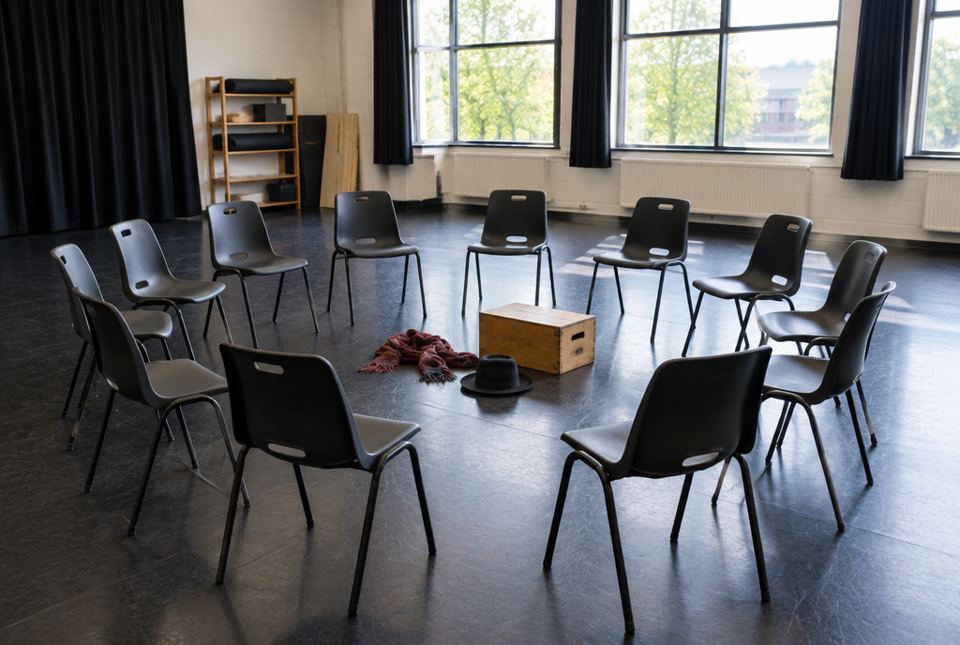 In process drama, the whole group plans together, often sitting in a circle so everyone can see and hear each other. A few simple props can spark a whole story. AI-generated image
Bringing in a new perspective
A drama can get stuck when everyone just repeats the same two sides. To move it forward, someone can bring in a new perspective: a character who sees the issue in a different way.
In Birch Bay, the drama is stuck between "build the houses" and "save the marsh." New perspectives could include:
- A farmer downstream who worries that without the marsh, her fields will flood in spring.
- A family waiting for a home, living in a small apartment with three kids.
- A scientist who has counted the herons nesting at the marsh for ten years.
- Mira's little brother, who just wants to know if he can still skate there.
A new perspective can be added in role (a new character walks into the town meeting) or out of role ("What if we add a farmer whose fields might flood?").
Jumping through time
Three conventions let you explore the past and the future of a drama:
- Flashback: jump back to show something that explains the present. Luis, age ten, fishing at the marsh with his father.
- Flash-forward: jump ahead to show what might happen. Birch Bay in 20 years: if the marsh is filled... and if it is saved.
- Rewind and replay: freeze a scene, say "Rewind!", and play it again with a different choice. Mira stays quiet at dinner. Rewind! This time she tells Dad how she feels.
Signal the time jump clearly so the audience follows: a sound (a chime), a change in lighting, someone saying "Twenty years later...", or a change in posture (bent and slow for old age).
Collaboration skills (out of role)
- Listen fully before you answer. Look at the speaker.
- Build on ideas: "Yes, and..." ("Yes, and the farmer could bring a photo of last year's flood!")
- Offer a new direction: "What if...?"
- Disagree kindly: "I see why you like that idea. Another way could be..."
- Try both: if two ideas clash, act out each one quickly and decide which works better.
- Share the spotlight: make sure everyone gets a turn to suggest and to perform.
- Look for a compromise: each side gives a little.
| Convention | What happens | How it shapes the drama |
|---|
| Role-play interview | A reporter interviews a character in role | Brings out new facts and feelings; can reveal a secret |
| Flashback | A scene from the past | Explains why a character feels or acts a certain way |
| Flash-forward | A scene from a possible future | Shows consequences of a choice |
| Rewind and replay | A scene is replayed with a new choice | Tests different solutions |
| Meeting in role | Characters gather to discuss the issue | Lets many perspectives be heard and a decision be made |
Worked exampleExample: Planning a flash-forward together (out of role)
Your group wants to show what might happen to Birch Bay. Let's plan out of role.
- Ava: "What if we do a flash-forward to twenty years from now?"
- Sam: "Yes, and we could do two futures: one where the marsh is filled and one where it's saved."
- Ava: "I'm not sure two futures will fit. Maybe one is enough?" Sam: "Let's try both quickly and see." (They try both.)
- They decide two futures work, because the audience can compare the consequences.
- Future A: grown-up Mira walks past new houses and a store. A child asks, "What's a heron?" Mira pauses and looks at the ground.
- Future B: grown-up Mira leads a school trip on a boardwalk through the marsh. Behind the marsh, there are new houses built on the old empty lot by the arena.
- Signal the jump: a chime sound and someone says, "Twenty years later..."
The group collaborated by building on ideas ("Yes, and"), disagreeing kindly, and trying both ideas. Future B also brings in a new idea: a compromise (build somewhere else).
Worked exampleExample: Adding a new perspective in role
The town meeting is stuck. Everyone has said "Build!" or "Save the marsh!" twice. Let's move the drama forward in role.
- You enter as a new character: Mrs. Ndlovu, a farmer whose fields are downstream from the marsh.
- In role: "I've farmed by Birch Creek for thirty years. Every spring, the marsh holds back the meltwater. If you fill it in, where will that water go? Into my fields?"
- Now the builder, Ms. Kowalski, must answer a new question: "We could build a drainage pond..." The drama is unstuck.
- Another character adds: "What about the empty lot behind the arena? Could some of the houses go there?" A compromise starts to grow.
A new perspective (the farmer) added a new problem to think about, so the characters had to find new solutions. That is how you shape the direction of a drama in role.
Interpreting a drama: there's more than one way to see it
After a drama, people often interpret it differently. One person thinks the most important moment was the flashback. Another thinks it was the farmer's speech. Both can be right!
When you share your interpretation, give your evidence, then listen to others and connect to their ideas: "I agree with Sam that Future B was hopeful, and I also noticed..." or "I see it differently because..."
Just for funWhat if real life had a rewind button? You could un-spill your juice and un-tell a joke that flopped. Drama is the one place where "Rewind!" really works, so use it as often as you like! ⏪
Hands-on activityKitchen-table time travel
You need: two or more people, a kitchen table and chairs, a few props (a mug, a hat, a scarf, a piece of paper), something that makes a chime or a ding (a spoon tapped gently on a pot lid, or just say "ding").
- Choose a story: continue Birch Bay, or use a family story (the day a grandparent arrived in Canada, a big snowstorm, the first day at a new school).
- Present scene: play a 1-minute scene at the table where a character must make a decision.
- Flashback: ding! Play a short scene from the past that explains why the decision is hard.
- Flash-forward: ding! Play two quick futures, one for each choice.
- Rewind and replay: go back to the present scene and replay it with the character's final decision.
- New perspective: before the replay, each person secretly adds a new character or new fact ("A letter arrives..."). Use "Yes, and..." to build on it.
- Out of role: each person shares their interpretation: "The most important moment was... because..." Then connect to someone else's answer.
Your turn
1What does collaborate mean in drama?
To work together, sharing and building on each other's ideas to plan and shape the drama.
2What is the difference between a flashback and a flash-forward?
A flashback jumps back in time to show the past. A flash-forward jumps ahead to show what might happen.
3Give one way to signal a time jump to the audience.
Any one: a sound (chime), a lighting change, someone saying "Twenty years later...", or a clear change in posture or voice.
4The Birch Bay meeting is stuck. Suggest a new perspective that could be added.
Examples: a farmer downstream worried about floods; a family waiting for a home; a scientist who counts the herons; a store owner; a child who skates there. Look for a character who sees the issue differently.
5Your partner wants the scene to be funny, and you want it to be serious. Give a collaboration move to solve this.
Examples: try both quickly and decide; find a compromise (a serious scene with one funny moment); say "I see why you like that, another way could be..." Look for a kind, fair solution.
6What happens in rewind and replay?
The scene is frozen, "rewound," and played again with a different choice, so you can test another solution.
7Finish this sentence to connect to someone else's interpretation: "I agree with ___ that ___, and I also noticed ___."
Example: "I agree with Dad that the flashback made Luis's choice harder, and I also noticed that Mira looked at the marsh photo before she spoke." Look for a real link to another person's idea plus a new idea.
More practice: warm-up
1Are you in role or out of role when you say, "Let's add a scientist character"?
Out of role (you are planning as yourself).
2What two words help you build on someone's idea?
A solution where each side gives up a little so everyone can agree.
4Which convention shows a scene from the past?
5True or false: In process drama, the whole group helps decide what happens next.
More practice: on your own
1Plan a flashback that would help the audience understand why Mira loves Heron Marsh.
Example: Mira, age five, sees a great blue heron for the first time with her mom and they sit very still to watch it fish. The flashback explains her strong feelings now. Any past scene that explains her feelings is fine.
2How can a role-play interview move a drama forward? Give an example question a reporter could ask Ms. Kowalski.
It can reveal new facts, feelings or secrets. Example question: "Is there anywhere else in town you could build these houses?" (This might lead to a compromise.)
3Why is it helpful to try both ideas when your group disagrees?
You can see which works better instead of just arguing, everyone's idea is respected, and sometimes you find a mix of both.
4Explain how a flash-forward can help characters make a decision.
It shows the possible consequences of each choice, so characters (and the audience) can think about what the future would really be like.
5Two people interpret the Birch Bay drama differently: one thinks it's about nature, one thinks it's about family. Write how you could respond respectfully.
Example: "I can see why you think it's about family, because Luis needs the job for Mira. I thought it was about nature because of the heron scene. Maybe it's about both." Look for listening, a reason, and respect.
Challenge
1A drama about a school deciding whether to cancel a winter carnival is stuck. Add two new perspectives and explain how each changes the drama.
Example: (1) a custodian who says the outdoor rink wasn't flooded this year because of the warm weather, adding a new problem (safety). (2) a student council member who suggests moving the carnival indoors to the gym, adding a possible solution. Each new perspective adds a new question or solution, so the drama moves forward.
2Plan a sequence for a 4-part drama using present scene, flashback, flash-forward, and rewind and replay. Use a story of your choice.
Example: Present: a girl hesitates before telling the coach she broke a team rule. Flashback: last year, she saw a teammate lie and lose everyone's trust. Flash-forward: if she hides it, she worries every practice. Rewind and replay: she goes back and tells the coach; the coach respects her honesty. Look for all four parts in a logical order.
3Explain how collaboration skills and drama skills both matter in process drama. Give an example of what goes wrong if one is missing.
Drama skills make the drama believable; collaboration skills let the group create it together. Example: if one person is a great actor but ignores everyone's ideas, the group gets frustrated and the drama goes only one way. If everyone collaborates well but nobody stays in role, the audience doesn't believe the story.
Quiz
1. A flash-forward shows ___.
2. Which sentence builds on a partner's idea?
3. Adding a farmer who worries about flooding to the Birch Bay meeting is an example of ___.
4. In rewind and replay, the group ___.
5. Your group disagrees about two ideas. A good collaboration move is to ___.
6. A flashback is most useful for showing ___.
Big idea: Grade 5 students plan and shape the direction of the drama by collaborating with others to develop ideas, both in and out of role (B1.3), while exploring issues and themes (B1.1). They express personal responses, interpret dramas and make connections to others' ideas (B2.1).
How to help:
- Play "Yes, and..." storytelling in the car: each person adds one sentence that starts with "Yes, and..."
- Retell a family story using a flashback: start at the exciting part, then say, "But to understand why, we have to go back..."
- When siblings or friends disagree about a game, coach them to "try both" or find a compromise. It's the same skill used in drama.
Common difficulties:
- Taking over. Some children want to direct everything. Teach them to ask, "What do you think should happen?" before adding their own idea.
- Not contributing. Quieter children can bring in a new perspective with a written note or a prop, or by entering in role as a new character.
- Confusing time jumps. Insist on a clear signal (a sound or words like "Twenty years later...").