B. Life Systems · Human Organ SystemsCells, Tissues, Organs and Organ Systems
B2.1 A1.5About 40 minutes
Learning goals- I can explain how cells, tissues, organs and organ systems are connected.
- I can name six major systems of the human body and the main job of each one.
- I can point to where major organs are found in my body.
- I can use science words to describe my body.
Words to know
cell
The smallest living part of your body. Your body is made of trillions of cells.
tissue
A group of the same kind of cells working together, like muscle tissue.
organ
A body part made of different tissues that does a special job, like the heart or the stomach.
organ system
A group of organs that work together to do one big job, like digesting food.
organism
A whole living thing. You are an organism!
function
The job something does.
Your body is like a busy city
Think about a city. It has roads and delivery trucks, a control centre, a water-cleaning plant, garbage pickup and strong buildings. Each part has a job. If one part stops working, the whole city has a problem.
Your body works the same way, day and night, even while you sleep. In this unit you will find out who does which job inside you.
Remember from Grade 1
In Grade 1 you learned some important body parts: your brain helps you think, your heart pumps blood, your lungs take in air, your bones hold you up and your muscles move you.
Now you will look deeper. You will learn what these parts are made of and how they team up.
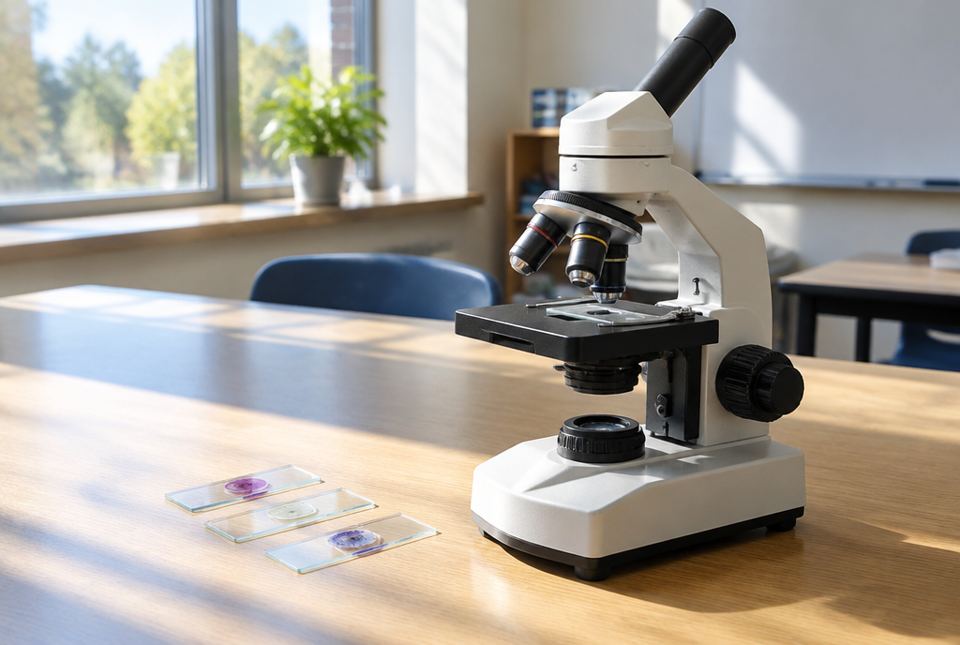 Cells are too small to see with your eyes alone. Scientists use a microscope to look at the cells that make up tissues and organs. AI-generated image
From tiny cells to the whole you
Cells are the smallest living parts of your body. They are so small you need a microscope to see them. You have trillions of them!
There are many kinds of cells: muscle cells, nerve cells, blood cells, bone cells, skin cells. Each kind has a shape that fits its job.
- Many cells of the same kind working together make a tissue. Example: muscle tissue.
- Different tissues working together make an organ. Example: your heart is made of muscle tissue, nerve tissue and more.
- Organs working together make an organ system. Example: the heart, blood vessels and blood make the circulatory system.
- All your systems working together make you, a whole organism.
| System | Main organs and parts | Main job (function) |
|---|
| Respiratory | nose, trachea (windpipe), lungs, diaphragm | brings oxygen into the body and removes carbon dioxide |
| Circulatory | heart, blood vessels, blood | carries oxygen, nutrients and wastes all around the body |
| Digestive | mouth, esophagus, stomach, small and large intestines, liver, pancreas | breaks food down into nutrients the body can use |
| Excretory | kidneys, ureters, bladder, urethra (lungs and skin help too) | removes wastes from the body |
| Nervous | brain, spinal cord, nerves | controls the body and senses the world |
| Musculoskeletal | bones, muscles, joints | supports, protects and moves the body |
Organs have a place
Your organs are packed in carefully:
- Your brain is inside your skull.
- Your lungs fill most of your chest. Your heart sits between them, a little to the left. Your ribs protect them.
- A dome-shaped muscle called the diaphragm separates your chest from your belly.
- Just under the diaphragm, your liver is on the right and your stomach is on the left.
- Your intestines fill the lower belly. Your bladder sits low, at the bottom.
- Your kidneys are toward your back, one on each side of your spine.
Your body has other systems too, such as the immune system that fights germs. You learn about some of them in Health class.
Worked exampleLet's sort organs into systems
Which system does each part belong to: stomach, trachea, spinal cord, bladder, artery, thigh bone?
- Stomach: it breaks down food, so it belongs to the digestive system.
- Trachea: it is the tube that carries air to the lungs, so it belongs to the respiratory system.
- Spinal cord: it carries messages between the brain and the body, so it belongs to the nervous system.
- Bladder: it stores urine (a waste), so it belongs to the excretory system.
- Artery: it is a blood vessel, so it belongs to the circulatory system.
- Thigh bone: it is a bone, so it belongs to the musculoskeletal system.
Ask yourself: What is this part's job? The job tells you the system.
Talk like a scientist
Scientists use exact words so everyone understands. Instead of "the tube in your neck," say trachea. Instead of "your belly stuff," say digestive system. Try to use at least three new science words when you explain your body to someone today.
Just for funIf you counted one cell every second, just one trillion of your cells would take you about 31,700 years to count. And you have trillions! Better pack a snack.
Hands-on activityLife-sized body map
You need: a large sheet of paper (or newspapers taped together), markers or crayons, a partner or grown-up.
- Lie down on the paper. Ask your partner to trace around your body.
- Make a fist. Your heart is about the size of your fist. Trace your fist on paper and draw the heart between where the lungs go, a little to your left.
- Draw the lungs on both sides of the heart, the diaphragm under them, the liver on the right and the stomach on the left under the diaphragm, the intestines below, the bladder at the bottom, and the brain in the head.
- Draw the kidneys with dotted lines, because they are toward your back.
- Label each organ and write which system it belongs to. Keep your body map. You will add to it in later lessons!
What to look for: organs in the right places (heart between the lungs and a little to the left, stomach on the left, liver on the right) and correct labels.
Your turn
1Put these in order from smallest to biggest: organ, cell, organ system, tissue.
cell → tissue → organ → organ system
A group of the same kind of cells working together.
3Name the system that brings oxygen into your body.
4Which system breaks down food into nutrients?
In your chest, between your lungs, a little to the left.
6What are the three main parts of the nervous system?
The brain, the spinal cord and the nerves.
7Is the stomach an organ or an organ system? Explain.
An organ. It is one body part made of tissues. It is part of the digestive system.
More practice: warm-up
1What is the smallest living part of your body?
2Which organ is about the size of your fist and pumps blood?
3Which bones protect your heart and lungs?
4Which system includes your bones and muscles?
The musculoskeletal system.
Inside your skull (in your head).
More practice: on your own
1Sort into systems: kidney, nerve, lung, small intestine.
Kidney: excretory. Nerve: nervous. Lung: respiratory. Small intestine: digestive. Each part goes with the job it does.
2Explain the difference between an organ and an organ system. Give an example.
An organ is one body part, like the lung. An organ system is a team of organs doing one big job, like the respiratory system (nose, trachea, lungs, diaphragm).
3Why do you think different cells have different shapes?
Each shape fits its job. For example, nerve cells are long so they can carry messages far, and muscle cells are long so they can shorten and pull.
4A friend says, "The stomach is in the middle of your belly button area." Correct them.
The stomach is higher, just under the diaphragm and the ribs, on the left side. The intestines are lower, around the belly button.
5Which system carries nutrients from your food to your toes?
The circulatory system. Blood carries the nutrients everywhere.
Challenge
1Your heart is made of muscle tissue, nerve tissue and other tissues. Why does the heart need nerve tissue as well as muscle tissue?
The muscle tissue squeezes to pump blood. The nerve tissue carries the signals that tell the heart when to beat and how fast. The heart needs both to do its job.
2Look at the body diagram. Why is it important to say "the person's left" instead of just "the left"?
In a front-view diagram the person faces you, so their left is on your right. If you don't say whose left, people could put the heart or stomach on the wrong side.
3A city has delivery trucks, a control centre and garbage pickup. Match each to a body system and explain.
Delivery trucks = circulatory system (blood delivers oxygen and nutrients). Control centre = nervous system (the brain controls the body). Garbage pickup = excretory system (removes wastes).
Quiz
1. Which list goes from smallest to biggest?
2. A group of organs working together to do one big job is...
3. Which system controls the body?
5. Which organ belongs to the excretory system?
6. Your heart is about the size of...
Big idea: the body is organized in levels: cells → tissues → organs → organ systems → organism. Each system has a main job.
How to help at home:
- Do the body map together, and keep it on the wall. Later lessons add organs to it.
- Play "Which system?": you name a body part, your child names the system and its job.
- Use a front-view diagram and point out that the person's left is on the viewer's right.
Common difficulties:
- Mixing up organ and organ system. An organ is one part; a system is a team.
- Thinking the stomach is behind the belly button. It is higher, under the left ribs.
- Thinking the heart is far to the left. It is near the middle of the chest, tipped a little to the left.