A. Dance / C. Music · Music and DanceMusic: Reading Notes on the Staff in Treble Clef
C1.5 C1.1About 40 minutes
Learning goals- I can name the lines and spaces of the five-line staff in treble clef.
- I can read the absolute pitch names A, B, C, D, E, F and G, including middle C.
- I can read sharp, flat and natural signs.
- I can sing or play a simple melody from notes on the staff.
Words to know
staff
The five lines and four spaces that music is written on. (Also called a stave.)
treble clef
A sign at the start of the staff that sets the note names. It curls around the second line, which is G, so it is also called the G clef.
pitch
How high or low a sound is.
absolute pitch names
The letter names of notes: A, B, C, D, E, F, G. They always mean the same exact pitch.
ledger line
A short extra line above or below the staff for notes that don't fit on it.
middle C
The C near the middle of a piano. In treble clef, it sits on a ledger line just below the staff.
sharp (♯)
A sign that raises a note a half step (a tiny bit higher).
flat (♭)
A sign that lowers a note a half step (a tiny bit lower).
natural (♮)
A sign that cancels a sharp or a flat.
Remember from Grade 3
In Grade 3 you sang with solfège names like do, re, mi, so, la, and low so and low la, and drew melody maps where higher dots meant higher pitches.
Solfège names can move: do can be any note. This year you will learn the letter names that musicians all over the world use to name an exact pitch, and you will read them on the five-line staff.
The musical alphabet
Music uses only seven letters: A, B, C, D, E, F, G. After G, it starts again at A.
... E, F, G, A, B, C, D, E, F, G, A, B ...
Going up the alphabet means going higher in pitch. Going down means lower.
The staff
The staff has 5 lines and 4 spaces. We count them from the bottom up. A note can sit on a line (the line goes through its middle) or in a space (between two lines).
The treble clef at the start tells us the note names. Its curl wraps around line 2, and that line is G. That's why it's also called the G clef. Treble clef is used for higher sounds: most singing, recorder, flute and violin music.
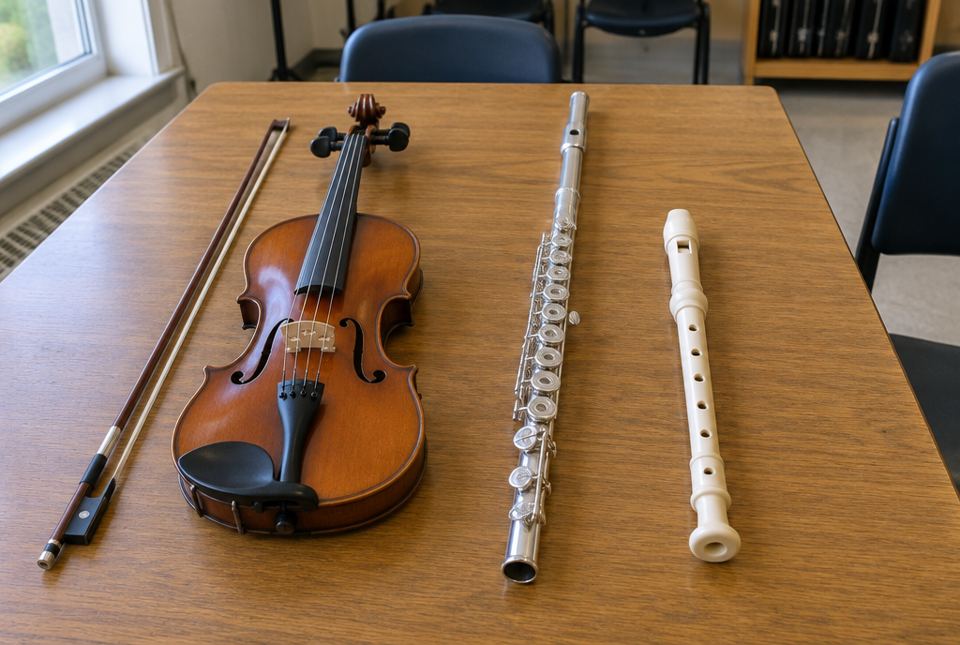 The violin, flute and recorder all play higher sounds, so their music is written in the treble clef. AI-generated imageThe notes on the five lines of the treble clef staff, from bottom to top: E, G, B, D, F.
Lines and spaces
- Lines, bottom to top: E, G, B, D, F. A saying to remember: Every Good Boy Deserves Fudge. (Or make up your own, like Elephants Get Big Dirty Feet!)
- Spaces, bottom to top: F, A, C, E. They spell FACE!
Notice the pattern: from a line to the very next space is just one letter higher (E line, F space, G line, A space...).
Middle C and D
Middle C is near the middle of a piano keyboard. In treble clef it sits on its own short ledger line just below the staff. The note D sits in the space just under the bottom line, touching it.
So going up from middle C, the notes are: C (ledger line), D (below the staff), E (line 1), F (space 1), G (line 2), and so on.
Sharps, flats and naturals
Sometimes a note needs to be a tiny bit higher or lower. Musicians use these signs, called accidentals, written just before the note:
- Sharp (♯) raises the note a half step. F♯ is a little higher than F.
- Flat (♭) lowers the note a half step. B♭ is a little lower than B.
- Natural (♮) cancels a sharp or flat, so the note goes back to normal.
On a piano, many sharps and flats are the black keys. An accidental lasts until the end of the bar it is in.
Just for funWhy did the singer bring a ladder to music class?
To reach the high notes! (On the staff, higher notes really do sit higher up.)
Worked exampleExample: Let's read a melody you know
These notes are written on the staff: E (line 1), D (just below the staff), C (middle C, ledger line), then the same again, then C C C C, D D D D, E D C. What song is it?
- Name each note: E, D, C ... E, D, C ... C C C C, D D D D, E D C.
- Look at the shape: E is the highest of the three, C the lowest. So the melody goes down, down, then repeats.
- In solfège, if C is do, then D is re and E is mi: mi re do, mi re do, do do do do, re re re re, mi re do.
- Sing it: "Hot cross buns, hot cross buns, one a pen-ny, two a pen-ny, hot cross buns!"
It is Hot Cross Buns! When C is do, D is re and E is mi. The letter names tell us the exact notes.
Worked exampleExample: Let's spell words with notes
Write the word CAGE using notes on the treble clef staff.
- C: the third space (or middle C on its ledger line).
- A: the second space.
- G: the second line (the line the treble clef curls around).
- E: the bottom line (or the top space).
C (space 3), A (space 2), G (line 2), E (line 1). Some letters can be written in two places on the staff, because the alphabet repeats. Both are correct!
Hands-on activityStaff on the floor
You need: 5 long strips of masking tape, painter's tape or skipping ropes (ask a grown-up first), 10 or more paper plates or sheets of paper, and a marker.
- Make a giant staff on the floor with 5 lines, about one big step apart.
- Write A, B, C, D, E, F, G on the plates (make extra E, F and G plates too).
- Have a grown-up call out a letter. Place the plate on the correct line or space in treble clef.
- Stand on the lines from bottom to top and say "E, G, B, D, F". Then jump through the spaces saying "F, A, C, E".
- Spell words on your floor staff: BAG, CAFE, EGG, FADE, BEAD. Your family reads them back.
- If you have a keyboard or a piano app, play the notes of Hot Cross Buns: E D C.
Your turn
1Name the lines of the treble clef staff, from bottom to top.
2Name the spaces, from bottom to top.
F, A, C, E (they spell FACE).
3Which line does the treble clef curl around? What note is it?
4Where is middle C written in treble clef?
On a short ledger line just below the staff.
5A note is in the third space. What is it?
6What does a sharp sign do to a note?
It raises it a half step (a tiny bit higher).
7What letter comes after G in the musical alphabet?
A (the alphabet starts again).
More practice: warm-up
1How many lines does a staff have? How many spaces?
2What are the seven letters of the musical alphabet?
The bottom line (line 1).
4What does a flat sign look like?
Like a small, pointy lower-case b: ♭.
5Going up the staff makes the pitch higher or lower?
More practice: on your own
1Write the word spelled by these notes: line 3, space 2, line 2.
Line 3 = B, space 2 = A, line 2 = G: BAG.
2Write the word spelled by: space 1, space 2, space 3, space 4.
3A melody goes E, F, G. Does it go up, down or stay the same?
Up: each note is one letter higher (line 1, space 1, line 2).
4In one bar, a note has a ♯ before it, and the same note appears again later in that bar with no sign. Is the second note sharp too?
Yes. An accidental lasts until the end of the bar.
5Why do we need a natural sign?
To cancel a sharp or flat, so the note goes back to its normal pitch.
Challenge
1Write a 4-letter word using only the letters A to G, and say where each note goes on the treble clef staff.
Examples: CAFE: C (space 3), A (space 2), F (space 1), E (line 1 or space 4). BEAD: B (line 3), E (line 1), A (space 2), D (line 4 or below the staff). FADE, DEAF, CAGE, BADGE (5 letters) also work.
2These notes are written: E E F G G F E D C C D E E D D. Sing them with solfège (C = do) and name the song.
mi mi fa so so fa mi re do do re mi mi re re: Ode to Joy by Ludwig van Beethoven (from his Ninth Symphony).
3Solfège names can move, but letter names can't. Explain the difference with an example.
Do can be any note: if a song starts on G, G can be do. But G is always the same exact pitch. That's why letter names are called absolute pitch names.
Quiz
1. What are the lines of the treble clef staff, from bottom to top?
2. What do the spaces spell, from bottom to top?
3. The treble clef is also called the G clef because ___.
4. Where is middle C in treble clef?
6. What comes after G in the musical alphabet?
Big idea: Students learn standard notation on the five-line staff with absolute pitch names (A to G) in treble clef, plus the accidentals sharp, flat and natural (C1.5), and use them to sing or play melodies from notation (C1.1).
How to help at home:
- Use the sayings: lines E-G-B-D-F (Every Good Boy Deserves Fudge) and spaces F-A-C-E. Let your child invent a funny one.
- A free piano or keyboard app is a great tool: find middle C, then play E D C (Hot Cross Buns) and E E F G G F E D C C D E E D D (Ode to Joy).
- Write "note words" (BAG, CAFE, BEAD) on a staff for each other to decode.
Common difficulties:
- Counting lines from the top. Lines and spaces are always counted from the bottom.
- Mixing up "on a line" and "in a space". A line note has the line through its middle.
- Two places for the same letter. E is on line 1 and in space 4; both are E, one higher than the other.
- Forgetting middle C. Practise its ledger line separately.