A. Dance / C. Music · Music and DanceMusic: Steps, Skips, Leaps, Scales, Major and Minor
C1.5 C1.2 C2.2 C1.1About 40 minutes
Learning goals- I can name intervals: unison, step, skip and leap.
- I can sing and write the C major scale with letters, solfège and numbers.
- I can read key signatures with no sharps or flats, one sharp, or one flat.
- I can hear the difference between major and minor tonality and use it to create a mood.
Words to know
interval
The distance between two notes.
unison
Two notes that are the same pitch.
step / skip / leap
A step moves to the very next note (line to space). A skip jumps over one note (line to line or space to space). A leap is a bigger jump.
scale
A ladder of notes going up or down in order.
major scale
The scale do re mi fa so la ti do. In C major: C D E F G A B C.
half step / whole step
A half step is the smallest step on a keyboard (to the very next key). A whole step is two half steps.
key signature
Sharps or flats written at the start of every line of music. They tell you which notes are always sharp or flat in the piece.
tonality
Whether music sounds major or minor.
major / minor
Major music often sounds bright or happy. Minor music often sounds darker, sad or mysterious.
Remember from Grade 3
In Grade 3 you saw that melodies step, skip, leap and repeat, and you drew melody maps. Last lesson you learned the letter names on the staff.
Now you will measure the distance between notes (intervals), build the major scale, and hear the difference between major and minor.
Intervals: how far apart?
An interval is the distance between two notes. On the staff:
- Unison: the same note twice (E to E).
- Step: to the very next note, from a line to the next space or a space to the next line (E to F).
- Skip: jump over one note, from a line to the next line or a space to the next space (E to G).
- Leap: a bigger jump (E up to the C in the third space).
The major scale
A scale is a ladder of notes in order. The C major scale uses all the white keys from C to the next C:
C D E F G A B C
You can sing it with solfège, do re mi fa so la ti do, or with numbers, 1 2 3 4 5 6 7 8. In Grade 2 and 3 you sang do re mi so la; now you add fa and ti to fill the whole ladder.
The steps in a major scale are not all the same size. Most are whole steps, but two are half steps: between mi and fa (E and F) and between ti and do (B and C). On a keyboard, those pairs have no black key between them.
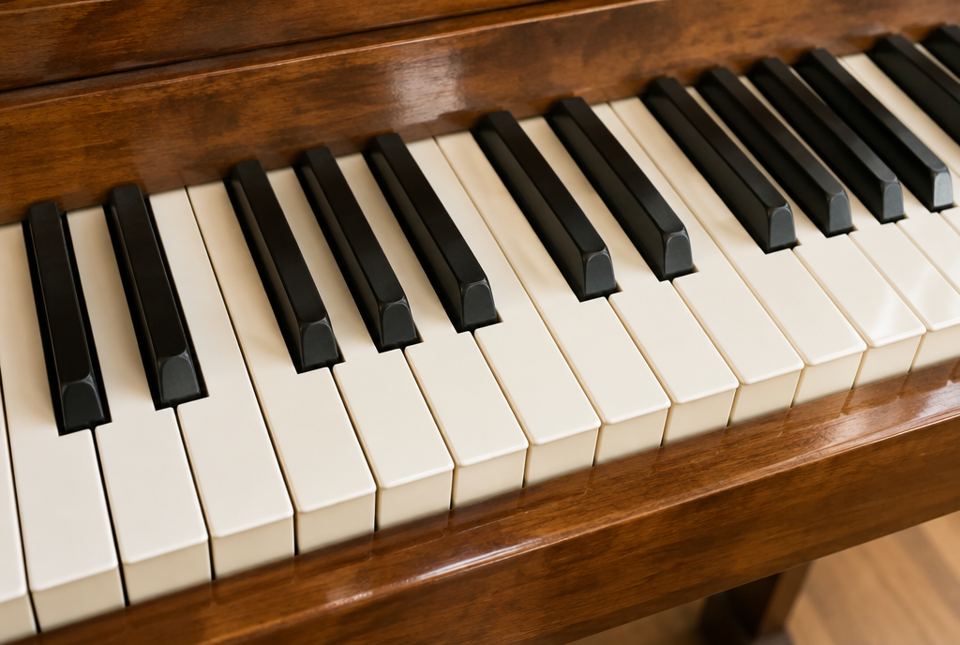 Notice the black keys come in groups of two and three. The C major scale uses only the white keys, from one C up to the next C. AI-generated imageOne octave of a keyboard from C to C. The shaded pairs, E to F and B to C, are half steps: there is no black key between them.
The pattern of the major scale
Every major scale uses the same pattern of steps: whole, whole, half, whole, whole, whole, half.
If you start a major scale on a note other than C, you need a sharp or a flat to keep that pattern. That's what a key signature is for. In Grade 4, you will meet these:
| Key | Key signature | Scale |
|---|
| C major | no sharps or flats | C D E F G A B C |
| G major | one sharp: F♯ | G A B C D E F♯ G |
| F major | one flat: B♭ | F G A B♭ C D E F |
Major and minor
Tonality means whether music sounds major or minor.
- Major music is built around do. It often sounds bright, happy or strong. Twinkle, Twinkle, Little Star, Hot Cross Buns and Ode to Joy are major.
- Minor music is built around la. It often sounds darker, sad, serious or mysterious. The round Hey, Ho, Nobody Home is in minor.
The A minor scale uses the same white keys as C major, but starts on A: A B C D E F G A (la ti do re mi fa so la). Starting on la changes the whole mood!
These moods are only "often" true: composers can write happy-sounding minor music and sad major music. Always trust your ears.
Just for funSing Twinkle, Twinkle, Little Star, then the Alphabet Song, then Baa, Baa, Black Sheep. Surprise: they all use the same melody! One tune, three songs, and it's in major.
Worked exampleExample: Let's name intervals in a melody
A melody goes: C D E C, then E F G. Name each interval.
- C to D: the next note. Step.
- D to E: step.
- E to C: E is line 1; middle C is on the ledger line below. E down to C jumps over D, so it is a skip.
- C to E: up over D again. Skip.
- E to F, F to G: step, step.
step, step, skip, skip, step, step. This melody moves mostly by steps, which makes it easy to sing. (It's the start of Frère Jacques in C: C D E C, C D E C, E F G!)
Worked exampleExample: Let's use major and minor to create a mood
Ana wants music for two scenes in a puppet show: a sunny birthday party and a dark, spooky cave.
- For the party, she chooses major tonality: she plays C E G (do mi so) on a keyboard app, bright and happy. She makes it fast and forte too.
- For the cave, she chooses minor: she plays A C E (la do mi), which sounds darker. She makes it slow and piano.
- She tests both on her little brother. He says the first sounds like a party and the second makes him feel nervous!
Ana used tonality (major and minor) on purpose, along with tempo and dynamics, to create two different moods. That's applying the elements to create an effect.
Hands-on activityGlass scale and major-minor game
You need: 8 identical drinking glasses (ask a grown-up; plastic cups won't ring), a jug of water, a metal spoon, and a free keyboard app if you have one.
- With a grown-up's help, fill the glasses with different amounts of water. Tap each gently with the spoon. More water = lower pitch.
- Arrange them from lowest to highest and adjust the water until they sound like do re mi fa so la ti do. (It's tricky; close is fine!)
- Play a step, a skip and a leap.
- On a keyboard app, play C E G together (major), then A C E together (minor). Ask your family to close their eyes and guess: major or minor? Bright or dark?
- Make up a short tune for a happy moment in major, and a short tune for a sad moment in minor.
Safety: tap glass gently, keep it on a towel on the table, and let a grown-up handle any broken glass.
Your turn
The distance between two notes.
2E to F is a step, a skip or a leap?
A step (line 1 to the very next space).
3G to B is a step, a skip or a leap?
A skip (line 2 to line 3, jumping over A).
4Sing the major scale with solfège, going up.
do re mi fa so la ti do. Look for each note a little higher than the last, ending on high do.
5Write the C major scale with letters.
6Where are the half steps in a major scale?
Between mi and fa (E and F in C major) and between ti and do (B and C).
7A key signature has one sharp. Which note is sharp, and what key is it often?
F♯. The key is often G major.
More practice: warm-up
Two notes that are the same pitch.
2Which two solfège notes did you add to fill the major scale?
3Which often sounds brighter: major or minor?
4What number is so in the major scale?
5 (do 1, re 2, mi 3, fa 4, so 5).
5How many sharps or flats does C major have?
More practice: on your own
1Name the intervals in this melody: G G A G.
G to G: unison. G to A: step. A to G: step.
2E (line 1) up to D (line 4) is a step, a skip or a leap? How do you know?
A leap. From line 1 up to line 4 is a big jump over many notes (F, G, A, B, C).
3Write the G major scale. Which note needs a sharp?
G A B C D E F♯ G. The F needs a sharp to keep the major-scale pattern (the half step must be between F♯ and G).
4The A minor scale and the C major scale use the same notes. Why do they sound different?
They start and end on different notes. C major is built around do (C); A minor is built around la (A). The home note changes the mood.
5A composer wants a lullaby to sound calm and warm. Would you suggest major or minor? Explain.
Many lullabies are major because it often sounds warm and gentle, but a gentle minor can sound calm and dreamy too. Either can work if explained, for example: "major, slow and piano, to sound warm and safe".
Challenge
1Use the pattern whole, whole, half, whole, whole, whole, half to explain why the F major scale needs B♭.
F to G (whole), G to A (whole), then the pattern needs a half step. A to B is a whole step, so B must be lowered to B♭ to make a half step. Then B♭ to C (whole), C to D (whole), D to E (whole), E to F (half).
2Write a 6-note melody that has at least one unison, one step, one skip and one leap. Label each interval.
Example: E E F A F then middle C. E to E: unison. E to F: step. F to A: skip (space 1 to space 2). A to F: skip. F down to middle C: leap (it jumps over E and D). Any melody with correctly labelled intervals counts.
3Listen to two songs you know. For each, say whether it sounds major or minor, and which other elements add to the mood.
Answers will vary. Example: "Happy Birthday sounds major, bright and cheerful, with a lilting 3/4 time." Look for a tonality choice plus one more element (tempo, dynamics, timbre) and a reason.
Quiz
1. E to G on the staff (line 1 to line 2) is a ___.
2. Which is the C major scale?
3. In a major scale, the half steps are between ___.
4. A key signature with one flat (B♭) is often the key of ___.
5. Minor music is built around which solfège note?
6. Which description usually fits minor tonality?
Big idea: Grade 4 pitch includes intervals (unison, step, skip, leap), the major scale (written with notes or numbers), key signatures in the music students perform (no sharps or flats, one sharp, one flat), and major and minor tonality (C1.5). Students apply these to create a mood (C1.2) and identify them in what they hear (C2.2).
How to help at home:
- A keyboard app is the best tool: play C major (white keys C to C) and A minor (white keys A to A) and talk about how they feel.
- Sing the scale up and down with numbers (1 to 8) and solfège.
- Play "major or minor?" with songs and film music. There's no shame in a wrong guess; listening closely is the skill.
Safety: if you make water glasses, use glass with care on a towel, tap gently, and handle any breakage yourself.
Common difficulties:
- Calling every jump a leap. A skip jumps over one note (line to line, space to space); a leap is bigger.
- Thinking minor always means sad. Say "often" and encourage listening.
- Key signatures look scary. At Grade 4, only three: none (C), one sharp F♯ (G), one flat B♭ (F).