A. Heritage and Identity · Early Societies to 1500 CEThe Haudenosaunee: People of the Longhouse
A3.3 A3.5 A3.7 A3.10 A1.1 A3.2About 45 minutes
Learning goals- I can describe daily life in an early Haudenosaunee village: longhouses, the Three Sisters and clans.
- I can explain how the Haudenosaunee environment met their needs.
- I can explain how the Haudenosaunee Confederacy was governed, including the role of clan mothers.
- I can describe how the Great Law of Peace helped nations stop fighting and work together.
Words to know
Haudenosaunee
"People of the Longhouse". A confederacy of First Nations: Mohawk, Oneida, Onondaga, Cayuga and Seneca, later joined by the Tuscarora.
confederacy
A group of nations that join together and agree to work as allies, while each keeps its own identity.
longhouse
A long building covered with bark, where several related families of the same clan lived together.
clan
A large family group traced back to a shared ancestor. Haudenosaunee clans have animal names, such as Turtle, Wolf and Bear.
matrilineal
Family and clan are passed down through the mother. Children belong to their mother's clan.
clan mother
A respected woman leader of a clan. Clan mothers choose the chiefs and can remove them.
Three Sisters
Corn, beans and squash, grown together in the same mounds.
Great Law of Peace
The Haudenosaunee constitution: the laws that joined the nations in peace and set out how they make decisions together.
wampum
Beads made from shells, woven into belts or strings to record agreements, laws and important events.
Remember from Grade 3
In Grade 3 you learned that around 1784 many Haudenosaunee moved to the Grand River and the Bay of Quinte in what is now Ontario. Today we go back hundreds of years earlier, before Europeans came to Haudenosaunee lands, to see how this society lived and governed itself.
Who are the Haudenosaunee?
Haudenosaunee (say: hoe-deh-no-SHOW-nee) means "People of the Longhouse". Long ago, five nations joined together in a confederacy:
- Mohawk (in their own language, Kanien'kehá:ka)
- Oneida
- Onondaga
- Cayuga
- Seneca
In the early 1700s, the Tuscarora joined too, so today it is often called the Six Nations.
Their homelands were south and east of Lake Ontario, in what is now New York State, near lakes, rivers and rich forests. Today there are Haudenosaunee communities in Ontario, Quebec and New York, such as Six Nations of the Grand River, Tyendinaga, Akwesasne and Kahnawà:ke.
Life in a longhouse village
Villages were built near fresh water and good farmland, often on a hill, with a tall wall of wooden posts (a palisade) around them for protection.
Inside were longhouses:
- A frame of bent wooden poles, covered with big sheets of elm bark.
- Several related families lived in one longhouse. They all belonged to the same clan.
- Fires burned in a row down the middle. Two families, one on each side, shared each fire.
- Smoke escaped through holes in the roof.
- Food like dried corn was stored inside.
After many years, when the soil was tired and the firewood nearby was used up, a village would move to a new place.
The Three Sisters
Haudenosaunee women were the farmers. They planted corn, beans and squash together in small hills of soil. These three plants are called the Three Sisters, because they help each other grow:
- Corn grows tall and gives the beans a pole to climb.
- Beans help make the soil richer for the other plants.
- Squash has big leaves that shade the ground, keeping the soil damp and blocking weeds.
Men hunted deer and other animals, fished, cleared new fields, built longhouses, and travelled to trade and to meet with other nations. Everyone gathered berries, nuts and plants for food and medicine.
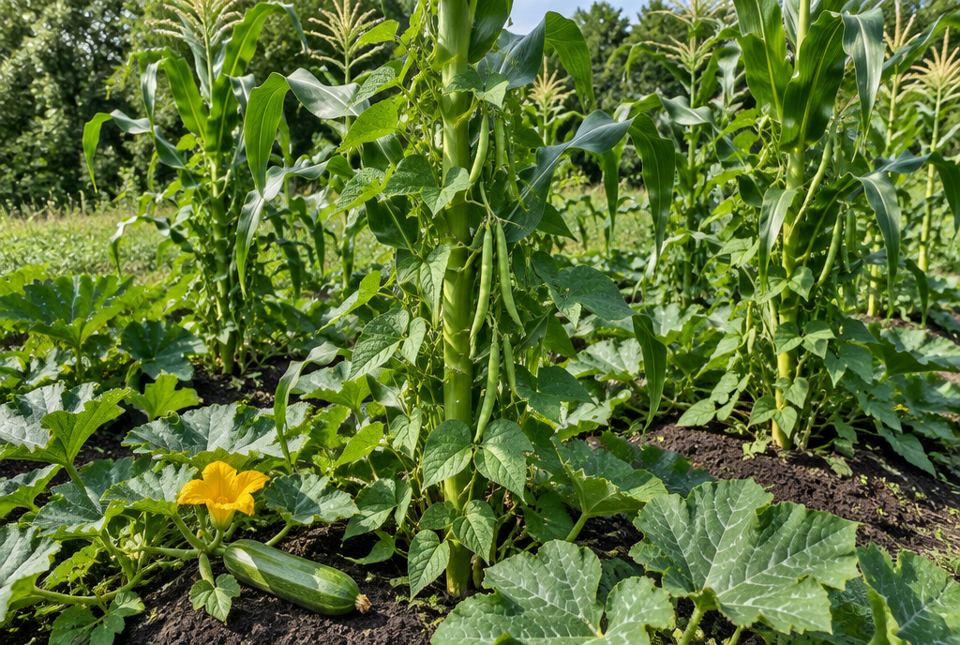 The Three Sisters growing together: the beans climb the corn, and the wide squash leaves shade the soil and block weeds. AI-generated image
🌽🫘🎃
Corn, beans and squash: the Three Sisters. (A pumpkin is one kind of squash.)Giving thanks
Haudenosaunee gatherings begin with the Thanksgiving Address, words that give thanks to the people, the Earth, the waters, the plants, the animals, the sun, the moon, the stars and more. It shows a deep respect for the natural world. It is still spoken today.
Clans and clan mothers
Every Haudenosaunee person belongs to a clan, such as Turtle, Wolf or Bear. The clan comes from your mother. This is called matrilineal.
Each clan has a clan mother, a respected woman chosen for her wisdom. Clan mothers have great responsibility:
- They choose the chiefs for their clan.
- They can remove a chief who does not do his job well.
- They help make sure decisions are good for the people and the future.
In many other early societies, women had much less say in government. In Haudenosaunee society, women and men each had important roles in leadership.
The Great Law of Peace
Haudenosaunee oral history tells that long ago, the five nations were often at war with each other. A messenger called the Peacemaker, helped by Hiawatha and a woman leader named Jigonsaseh, travelled to each nation with a message of peace, unity and good minds.
The nations agreed to the Great Law of Peace. People give different dates for when this happened, but it was hundreds of years ago, before Europeans came to these lands.
Symbols of the Great Law:
- A white pine, the Tree of Peace. The nations buried their weapons under its roots.
- An eagle on top of the tree, watching for danger.
- A bundle of arrows: one arrow breaks easily, but five tied together are strong.
How decisions are made
- The Grand Council has 50 chiefs from the nations.
- They talk until they all agree. This is called consensus.
- The Onondaga are the firekeepers, where the council meets.
- The Great Law was recorded with wampum belts. The Hiawatha Belt shows the five nations joined together, with a tree in the middle for the Onondaga.
The Haudenosaunee Grand Council still meets today.
Worked exampleLet's compare: who chooses the leaders?
Compare how leaders were chosen in the Haudenosaunee Confederacy with how leaders are chosen in Canada today.
- Haudenosaunee long ago: clan mothers chose the chiefs and could remove them. The Grand Council made decisions by consensus (everyone agrees).
- Canada today: citizens 18 and older vote in elections to choose members of Parliament. Decisions are made by majority (more than half agree).
- Same: leaders are chosen by the people (or by people the community trusts), and leaders can be replaced if they don't do a good job.
- Different: consensus vs. majority vote; clan mothers choose vs. all adult citizens vote.
Both have ways for people to choose and replace leaders. The Haudenosaunee decided by consensus, with clan mothers choosing chiefs. Canada decides by voting and majority.
Hands-on activityBundle of arrows, and a Three Sisters model
Part 1 (with a grown-up): You need 5 wooden craft sticks or uncooked spaghetti strands, and an elastic band.
- Try to bend one stick or strand until it snaps. Easy!
- Now hold five together with the elastic band and try to bend them. Much harder!
- Talk about it: what does this teach about nations working together?
Part 2: On paper, draw a Three Sisters mound. Label how each plant helps the others. If it is spring or summer, you could plant a bean seed beside a corn seed in a pot and watch the bean climb.
Safety: snapped spaghetti or sticks can have sharp ends. Do this at a table and clean up the pieces.
Just for funReaching consensus, where everyone agrees, takes patience and good listening. Try it at home: can your whole family agree on one pizza topping without anyone giving up? That's the kind of careful talking a council needs!
Your turn
1What does Haudenosaunee mean?
"People of the Longhouse".
2Name the five original nations of the Haudenosaunee Confederacy.
Mohawk, Oneida, Onondaga, Cayuga, Seneca. (The Tuscarora joined later, making six.)
3What are the Three Sisters?
Corn, beans and squash, grown together.
4Who lived together in one longhouse?
Several related families of the same clan.
5Your clan comes from your mother. What is this called?
6What two powers did clan mothers have over chiefs?
They chose the chiefs and could remove them.
7What is the Tree of Peace, and what was buried under it?
A white pine. The nations buried their weapons under its roots as a sign of peace.
8What does consensus mean?
Talking until everyone agrees on a decision.
More practice: warm-up
1What were longhouses covered with?
2Who did most of the farming in Haudenosaunee villages?
3Name one Haudenosaunee clan.
Turtle, Wolf or Bear (there are others too).
4What sits on top of the Tree of Peace, watching for danger?
5Name a Haudenosaunee community in Ontario today.
Six Nations of the Grand River or Tyendinaga (others: Akwesasne is partly in Ontario).
More practice: on your own
1How do beans help corn and squash?
Beans help make the soil richer, which helps the other plants grow.
2Why did villages move every so often?
After many years the soil was tired and firewood nearby was used up, so they moved to fresh land.
3What does the bundle of arrows mean?
One arrow breaks easily, but many together are strong. The nations are stronger united.
4How was the Great Law of Peace recorded?
With wampum belts (like the Hiawatha Belt) and through oral history, passed on by speaking.
5How does the Thanksgiving Address show the Haudenosaunee relationship with the environment?
It gives thanks to the Earth, waters, plants, animals, sun, moon and stars. It shows respect and care for nature.
Challenge
1Compare the role of women in early Haudenosaunee society with a society where only men could be leaders. Why might it matter that clan mothers chose chiefs?
Haudenosaunee women had real power: they chose and could remove chiefs and ran the farms. It matters because decisions included women's views, and chiefs had to stay responsible to the clan or they could lose their title.
2The Great Law of Peace turned enemies into allies. Name two ideas in it that helped prevent conflict.
Any two: burying weapons under the Tree of Peace; a council where all nations meet; decisions by consensus so no nation is left out; the eagle watching for danger together; being stronger united (bundle of arrows).
3Why was a palisade useful, and what does it tell us about life at the time?
A wall of posts protected the village from attack. It tells us there was sometimes conflict between nations, which is one reason the Great Law of Peace was so important.
Quiz
1. What does Haudenosaunee mean?
2. Who chose the chiefs in the Haudenosaunee Confederacy?
3. Which plants are the Three Sisters?
4. How does the Grand Council make decisions?
5. A Haudenosaunee child belongs to...
6. What is a symbol of the Great Law of Peace?
Big idea: The Haudenosaunee are one of the First Nation societies required by this strand. This lesson covers daily life and environment (longhouses, the Three Sisters), social organization (matrilineal clans, clan mothers) and governance (the Great Law of Peace, consensus), which is also an example of a way to resolve conflict and build cooperation (A3.10).
How to help at home:
- Use the present tense for Haudenosaunee people today: the Confederacy, clans and the Grand Council are living institutions.
- Compare consensus with voting at a family meeting: try deciding a weekend activity by consensus.
- If you live in Ontario, find Six Nations of the Grand River or Tyendinaga on a map. Many communities share culture publicly (e.g., lacrosse, which originated with Haudenosaunee and other First Nations and is Canada's national summer sport).
Common difficulties:
- Mixing up nations: the Haudenosaunee are one confederacy among many First Nations. Not all First Nations lived in longhouses.
- "Women just farmed": emphasize that clan mothers held real political power.
- Dates: the founding date of the Confederacy is debated; Haudenosaunee oral history and historians give different dates. It is fine to say "hundreds of years ago, before Europeans arrived".