A. Heritage and Identity · Early Societies to 1500 CEThe Anishinaabe: Living with the Seasons
A3.3 A3.5 A3.6 A1.4 A3.7About 45 minutes
Learning goals- I can describe how Anishinaabe families moved with the seasons to meet their needs.
- I can explain how the Anishinaabe used birch bark, wild rice and maple sap.
- I can describe Anishinaabe technologies like the birchbark canoe.
- I can compare the Anishinaabe relationship with the environment to life in Canada today.
Words to know
Anishinaabe
A group of related First Nations around the Great Lakes, including the Ojibwe, Odawa, Potawatomi, Algonquin and Mississauga. The plural is Anishinaabeg.
seasonal round
Moving to different places through the year to find food and materials as the seasons change.
wiigiwaam
An Anishinaabe home (wigwam) made of bent poles covered with birch bark or woven mats.
manoomin
Wild rice, a grain that grows in shallow lakes and rivers. It is a sacred food for the Anishinaabe.
sugar bush
A grove of maple trees where sap is collected in early spring.
doodem
An Anishinaabe clan, named for an animal, such as Crane, Loon, Bear or Fish. Each clan has responsibilities.
technology
Tools and ways of doing things that people invent to solve problems.
sustainable
Using the land in a way that it can keep providing for future generations.
Remember from Grade 3
In Grade 3 you met the Mississauga, Ojibwe and Odawa around 1800, and learned that many Anishinaabe families moved with the seasons. Now we go back even farther, hundreds of years before Europeans arrived, to see how the Anishinaabe lived with the land.
Who are the Anishinaabe?
The Anishinaabe (say: ah-nish-ih-NAH-bay) are a group of related First Nations who speak closely related languages, such as Anishinaabemowin (the Ojibwe language), and share many teachings. They include the Ojibwe, Odawa, Potawatomi, Algonquin and Mississauga.
Their lands are around the Great Lakes: forests, lakes, rivers and rocky shores across much of what is now Ontario and beyond.
Today there are many Anishinaabe communities, such as Wiikwemkoong on Manitoulin Island, Curve Lake First Nation and the Mississaugas of the Credit First Nation.
Moving with the seasons
The land around the Great Lakes changes a lot through the year: deep snow in winter, rushing sap in spring, warm summers, and ripe rice in fall. Anishinaabe families moved to where the food was. This is called a seasonal round.
| Season | Where families went and what they did |
|---|
| Spring | Families gathered at the sugar bush. They collected maple sap in birch bark containers and boiled it down into maple sugar, which kept all year. |
| Summer | Large groups camped by lakes and rivers to fish, gather berries, and grow gardens of corn and squash in some areas. Many people met, traded and held ceremonies. |
| Fall | Families harvested manoomin (wild rice) from canoes. They also fished and dried and smoked fish and meat for winter. |
| Winter | Smaller family groups moved to winter hunting grounds to hunt deer, moose and rabbit. Long winter nights were a time for storytelling and teachings. |
Gifts of the birch tree
The birch tree was very important. Its bark is light, waterproof and bends without breaking. People used it for:
- Canoes: a frame of cedar wood covered with birch bark, sewn with spruce roots and sealed with tree gum. Light enough for one or two people to carry between lakes (this is called a portage).
- Homes: the wiigiwaam (wigwam), a dome of bent poles covered with birch bark.
- Containers: baskets and buckets for maple sap, berries and rice.
- Scrolls: birch bark scrolls with drawings that record songs, teachings and maps.
The birchbark canoe was an amazing technology. It let people travel fast across the many lakes and rivers of the Great Lakes region to hunt, trade and visit.
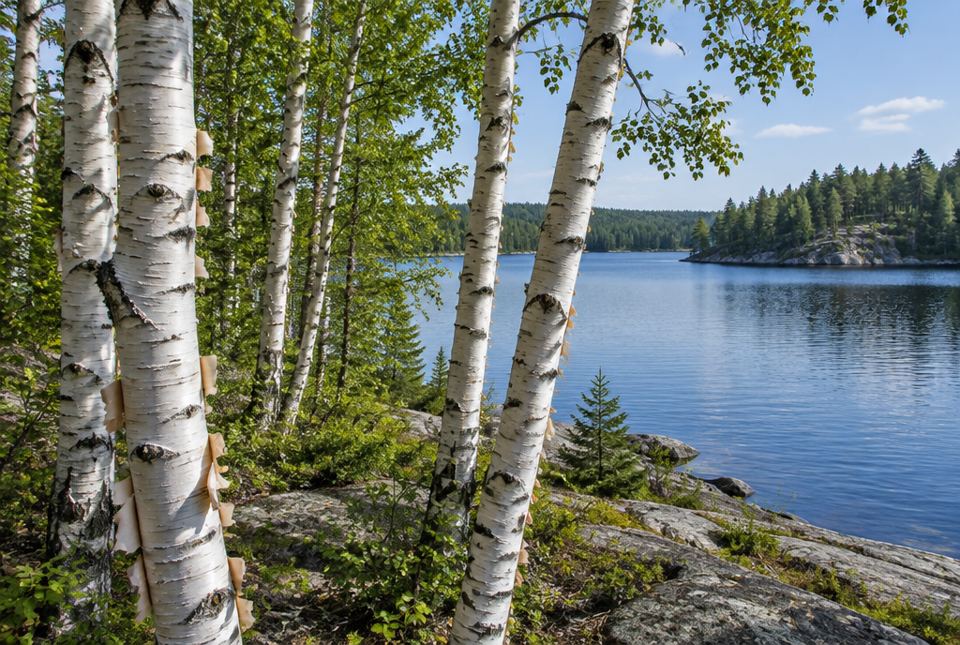 The white bark of the birch tree is light, waterproof and bends without breaking, which made it perfect for canoes, wigwams and containers. AI-generated imageBirch bark is light, waterproof and bends without breaking. Those properties made it useful for canoes, homes, containers and scrolls.
Wild rice: taking only what you need
In the fall, two people go out in a canoe into the shallow water where manoomin grows. One pushes the canoe with a pole. The other gently bends the rice stalks over the canoe and taps them with two sticks, so the ripe grains fall into the canoe.
Some grains fall into the water. They become next year's rice! This is a sustainable way of harvesting: the rice keeps coming back for future generations.
Many Anishinaabe still harvest manoomin this way today.
Just for funFunny but true: it takes about 40 litres of maple sap to boil down into just 1 litre of maple syrup. That's a LOT of boiling for your pancakes!
Clans and leadership
The Anishinaabe have a clan system, called doodem. Each clan is named for an animal, such as Crane, Loon, Bear, Fish or Marten. Each clan has responsibilities for the community, such as leadership, protection, teaching or healing.
Leaders, called ogimaa, were respected for their wisdom and generosity. Important decisions were made in councils, where people talked things through. Elders were honoured for their knowledge.
Anishinaabe teachings, such as the Seven Grandfather Teachings (wisdom, love, respect, bravery, honesty, humility and truth), guide how people treat each other and the land.
Worked exampleLet's compare then and now: getting food
Compare how an Anishinaabe family got food in fall long ago with how many Canadian families get food today.
- Long ago: they harvested wild rice by canoe, fished and smoked the fish, and stored food for winter. They took only what they needed and left some rice to reseed.
- Today: many families buy food at a grocery store. Food is often grown far away and travels by truck, ship or plane.
- Same: both need to plan for winter and store food (we use fridges, freezers and cans).
- Different: long ago people gathered food from the land around them, following the seasons. Today many people get food from stores, any time of year.
Long ago, food came from the local land, season by season, harvested carefully. Today, many families buy food from stores, often grown far away. Both store food for winter.
Hands-on activityMake a seasonal round wheel
You need: a paper plate or a circle of paper, a pencil, crayons, and a paper fastener (optional).
- Divide the circle into 4 parts. Label them spring, summer, fall and winter, going clockwise.
- In each part, draw what Anishinaabe families did in that season (maple sugar, fishing and berries, wild rice, hunting and storytelling).
- On the back, make a second wheel for your family: what do you do, eat or wear in each season?
- Compare the two sides. What changes with the seasons for both?
Bonus (late winter or early spring, with a grown-up): visit a sugar bush or maple syrup festival in your area. Many Ontario conservation areas hold one.
Your turn
1Name three Anishinaabe nations.
Any three: Ojibwe, Odawa, Potawatomi, Algonquin, Mississauga.
2What is a seasonal round?
Moving to different places through the year to find food and materials as the seasons change.
3What did Anishinaabe families do at the sugar bush in spring?
They collected maple sap and boiled it into maple sugar.
Wild rice, which grows in shallow lakes and rivers.
5Name three things the Anishinaabe made from birch bark.
Any three: canoes, wiigiwaam (homes), containers/baskets, scrolls.
An Anishinaabe clan, named for an animal, with responsibilities for the community.
7Name two of the Seven Grandfather Teachings.
Any two: wisdom, love, respect, bravery, honesty, humility, truth.
More practice: warm-up
1Around which big lakes are Anishinaabe lands?
An Anishinaabe home of bent poles covered with birch bark or mats.
3In which season was wild rice harvested?
4What were long winter nights a time for?
Storytelling and teachings (and families hunted in winter too).
Carrying a canoe over land between lakes or rivers.
More practice: on your own
1Why was birch bark so useful?
It is light, waterproof and bends without breaking.
2Explain why harvesting wild rice by canoe is sustainable.
Some grains fall into the water and grow into next year's rice, so the rice keeps coming back.
3Why did families split into smaller groups in winter?
There was less food in winter. Small groups could spread out over different hunting grounds so there was enough for everyone.
4Why did people smoke fish in the fall?
To preserve it so it would last through the winter.
5Give one way the environment shaped Anishinaabe homes.
The forest gave poles and birch bark, so they built wiigiwaam that were light and could be made again at each camp.
Challenge
1The birchbark canoe is called an important technology. What problem did it solve, and why was it a good design for the Great Lakes region?
It solved the problem of travelling across many lakes and rivers. It was light (could be carried on portages), fast, and made from local materials (birch, cedar, spruce roots, gum) that could be repaired easily.
2Compare the Anishinaabe seasonal round with how many Canadians live today. Give one similarity and one difference.
Similarity: we also change what we do with the seasons (e.g., winter clothes, summer camping, maple syrup in spring). Difference: most Canadians stay in one home all year and buy food from stores instead of moving to where the food is.
3How do the Seven Grandfather Teachings connect to taking only what you need from the land?
Teachings like respect and humility mean not being greedy and caring for the land, plants and animals, so there is enough for others and for future generations.
Quiz
1. What is the Anishinaabe word for wild rice?
2. What did families do at the sugar bush in spring?
3. Why was the birchbark canoe a good design?
4. Moving to different places through the year to find food is called...
5. Why is ricing by canoe sustainable?
6. Which of these is an Anishinaabe nation?
Big idea: The Anishinaabe are the second First Nation society in this unit, chosen to show a different relationship with the environment than the Haudenosaunee (seasonal movement rather than settled farming villages). This lesson focuses on environment, technology and comparison with today (A1.4, A3.5, A3.6).
How to help at home:
- Talk about what your family does differently in each season; connect it to the seasonal round.
- If possible, visit a sugar bush or maple festival in spring, or buy hand-harvested wild rice and cook it together.
- Use the present tense: Anishinaabe people continue to harvest manoomin, make maple sugar, and teach Anishinaabemowin today.
Common difficulties:
- "Moving around" seen as having no home: explain that families returned to the same places each year; their whole territory was home.
- Over-generalizing: not all Anishinaabe communities did exactly the same things; gardens, for example, were more common in southern areas.
- Words in Anishinaabemowin: spellings vary between communities. It is fine to use the English word too.