A. Literacy Connections and Applications / C. Comprehension: Understanding and Responding to Texts · Understanding and Responding to TextsMaking Connections: Diversity, Inclusion and Accessibility in Texts
C2.5 C3.6 A3.2About 40 minutes
Learning goals- I can describe how ideas in a text connect to my own knowledge and experiences, to other texts, and to the world.
- I can explain how a connection helps me understand a text more deeply.
- I can explain how texts address topics like diversity, inclusion and accessibility.
- I can describe the message or insight a text shares.
- I can learn about the experiences and contributions of diverse people in Canada through texts.
Words to know
connection
A link between a text and something else: yourself, another text or the world.
diversity
Differences among people, such as culture, language, ability, religion and family.
inclusion
Making sure everyone is welcomed and can take part.
accessibility
Designing places, things and activities so people of all abilities can use them.
barrier
Something that blocks a person from taking part.
insight
A new understanding you get from a text.
Remember from Grade 3
In Grade 3 you made text-to-self, text-to-text and text-to-world connections, and you shared thoughts and feelings about ideas like diversity, inclusion and belonging.
In Grade 4 you will explain how each connection deepens your understanding, and how a text addresses a big topic: what message or insight it gives.
Hook: A wall or a door?
Imagine your friends are playing a game in a room at the top of a flight of stairs, and you can't climb stairs. For you, the stairs are a wall. Now imagine someone adds a ramp or an elevator. The wall becomes a door!
Many texts are about walls and doors like this: barriers that keep people out, and the changes that let everyone in.
Read 1: The Path to the Rink
Every February, Lakeview School held its Winter Carnival at the outdoor rink in the park. Sam couldn't wait. Sam uses a wheelchair and loves hockey more than anything.
But on carnival morning, the path from the school to the rink was buried under deep snow. Sam's wheels sank. He pushed and pushed, then stopped. His friends were already lacing their skates.
"Go ahead," he told his friend Leila. "I'll watch from the window."
Leila didn't go. She looked at the path. Then she ran to the school office. Ten minutes later, the caretaker, Mr. Bui, was clearing the path with the snowblower, and half of Sam's class was shovelling the edges.
That afternoon, the class wrote a letter to the town council. Please clear the park path every time it snows, so everyone can get to the rink. Two weeks later, the town wrote back: they would clear the path after every snowfall, and the community centre would start a sledge hockey program, where players sit on sledges and push themselves across the ice with two short sticks.
On the first Saturday of sledge hockey, Sam scored. So did Leila. She'd never sat on a sledge before, and she fell over four times.
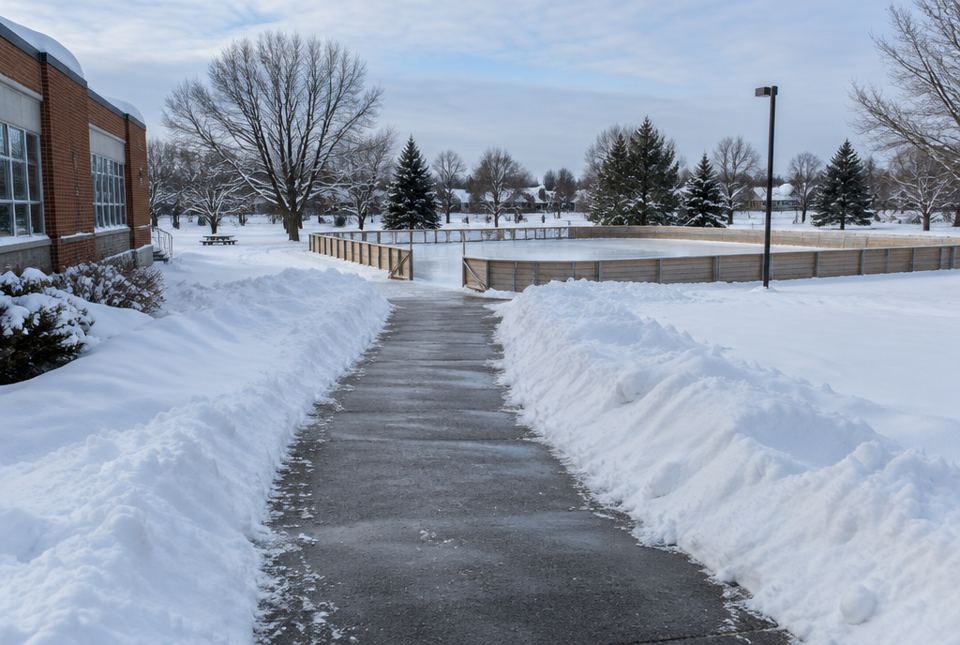 A cleared path like this one turns a barrier into a door: now everyone, including someone using a wheelchair, can get to the rink. AI-generated image
Three kinds of connections, explained
A strong connection doesn't just say That reminds me of.... It explains how it helps you understand.
- Text-to-self (my knowledge and lived experiences): I broke my leg last year and used crutches. Snowy sidewalks were really hard. That helps me understand why Sam stopped and felt left out.
- Text-to-text: In another book, a girl who is Deaf teaches her class sign language. Both texts show that small changes can include everyone.
- Text-to-world: In my town, some buildings have automatic doors and ramps. That helps me see that accessibility is a real-world issue, not just a story.
Worked exampleLet's find the topic and the message
How does The Path to the Rink address accessibility and inclusion? What message does it share?
- The barrier: deep snow on the path. Sam's wheels sank. The barrier isn't Sam; it's the path.
- How Sam feels: He tells Leila to go ahead and says he'll watch from the window. He feels left out.
- The change: Leila gets help, the path is cleared, and the class writes to the town council. The town clears the path after every snowfall and starts sledge hockey.
- Inclusion: In sledge hockey, Sam and Leila play together, and Leila is the beginner this time!
- Message: When we remove barriers, everyone can take part. Small actions, like asking for help or writing a letter, can change a community.
The text shows that the barrier was the snowy path, not Sam. Its message: removing barriers lets everyone belong, and anyone can help make that change.
Read 2: Viola Desmond
Viola Desmond was a Black businesswoman in Nova Scotia. She ran a beauty salon and opened a school to train beauticians.
In 1946, Viola went to a movie theatre in New Glasgow, Nova Scotia. She sat in a seat on the main floor. She was told that the main floor was only for white customers, and that Black customers had to sit in the balcony. That was unfair, and Viola refused to move.
She was arrested, kept in jail overnight, and fined. Viola fought the unfair treatment in court, but she lost. Still, her courage inspired other people to keep working for equal rights in Canada.
Many years later, in 2010, the government of Nova Scotia officially pardoned her and apologized. In 2018, Viola Desmond's portrait appeared on Canada's $10 bill.
Worked exampleLet's connect and find the insight
How does Viola Desmond connect to The Path to the Rink? What insight does it give about Canada?
- Text-to-text: Both texts show a person being kept out of something everyone should be able to enjoy: a rink, a theatre seat.
- Difference: For Sam, the barrier was snow on a path. For Viola, the barrier was an unfair rule about who could sit where, because of the colour of people's skin. That was racism.
- Both: Someone stood up and asked for change. The change came quickly for Sam, but took many years for Viola.
- Text-to-world: Today Viola's face is on the $10 bill, so Canadians remember her story.
- Insight: Canada's history includes unfair treatment of Black Canadians, and people like Viola Desmond contributed by standing up for equal rights.
Both texts are about barriers and belonging. The insight: unfair rules and barriers can be challenged, and people's courage helps make Canada fairer.
Respectful talk about diversity
Use respectful words like a person who uses a wheelchair. Talk about barriers (stairs, snow, unfair rules) instead of saying something is wrong with a person. Everyone's identity, culture and abilities are part of what makes a community strong.
Just for funRiddle: What kind of connection never needs Wi-Fi?
A text-to-self connection! All you need is a good book and your own memories.
Hands-on activityBarrier hunt and connection web
You need: paper, a pencil, and a walk around your home, school yard or neighbourhood with a grown-up.
- Look for accessibility features: ramps, automatic doors, curb cuts (low spots in the curb), elevators, braille on signs, wide doorways.
- Look for barriers: a step with no ramp, snow on a sidewalk, a sign that's too high to read.
- Draw a connection web: put The Path to the Rink in the middle. Draw three lines out, labelled self, text, world. Write one connection on each, and finish each with This helps me understand ___.
- Read a picture book or chapter book about a person whose life is different from yours. What message does it give?
Your turn
1What was the barrier in The Path to the Rink?
The deep snow on the path to the rink.
2How do you know Sam felt left out? Give evidence.
He stopped, told Leila to go ahead, and said he'd watch from the window while friends laced their skates.
3Name two actions that removed the barrier.
Any two: Leila went to the office for help; Mr. Bui cleared the path; the class shovelled; the class wrote a letter to the town council; the town agreed to clear the path after every snowfall.
Hockey where players sit on sledges and push themselves across the ice with two short sticks.
5Why did Viola Desmond refuse to move?
Because the rule was unfair: Black customers were told to sit in the balcony because of the colour of their skin.
6Make a text-to-world connection to The Path to the Rink and explain how it helps your understanding.
Example: My library has an automatic door button. That shows me that places can be designed so everyone can get in, just like the cleared path.
7What message do both texts share?
Barriers and unfair rules can be changed, and when they are, everyone can belong. People's actions can make change.
More practice: warm-up
1What does accessibility mean?
Designing places and things so people of all abilities can use them.
2Name the three kinds of connections.
Text-to-self, text-to-text, text-to-world.
3In what year did Viola Desmond refuse to move?
4Whose portrait appeared on Canada's $10 bill in 2018?
5Who did Leila run to for help?
The school office (then the caretaker, Mr. Bui, cleared the path).
More practice: on your own
1Why is it important that Leila fell over four times in sledge hockey?
It shows Leila was the beginner this time. In sledge hockey, Sam and Leila are equals. It's a fun way to show inclusion.
2What is the difference between That reminds me of my cousin and a strong connection?
A strong connection explains how it helps you understand the text, like: My cousin uses a wheelchair, and I've seen how hard snowy sidewalks are, so I understand why Sam stopped.
3How did Viola Desmond contribute to Canada?
Her courage in standing up to unfair treatment inspired others to keep working for equal rights.
4What does diversity mean? Give two examples from your own life or community.
Differences among people. Examples: people who speak different languages, have different cultures or religions, have different abilities or different kinds of families.
5Why did the class write to the town council, instead of just clearing the path once?
So the path would be cleared every time it snows. They wanted a lasting change, not just a one-time fix.
Challenge
1Change happened in days for Sam, but took many years for Viola Desmond. Why might some changes take longer?
Viola faced an unfair rule based on racism, which many people with power supported. Changing laws and attitudes is harder and slower than clearing snow. (Accept thoughtful answers with reasons.)
2Design an accessible winter carnival. Name three features and who each one helps.
Examples: cleared, flat paths (people who use wheelchairs or strollers); sledge hockey sledges (people who can't skate standing up); picture signs (people who can't read English yet, or young children); a quiet warm room (people who find noise and crowds overwhelming).
3Explain an insight you got from these texts that you didn't have before.
Example: I used to think a disability was the problem. Now I see the snowy path was the real problem. Communities can change barriers. (Look for a new understanding, explained.)
Quiz
2. In The Path to the Rink, what was the barrier?
3. Which is a text-to-world connection?
4. Viola Desmond is remembered for...
5. Which message fits both texts?
What this lesson teaches: Grade 4 students describe how ideas in texts connect to their knowledges and lived experiences, other texts and the world (C2.5). They explain how topics like diversity, inclusion and accessibility are addressed in texts and describe the insights or messages (C3.6), and learn about the experiences and contributions of diverse people in Canada (A3.2).
Facts used: Viola Desmond, a Black businesswoman, refused to leave the main-floor section of a New Glasgow, Nova Scotia, movie theatre in 1946; she was arrested, jailed overnight and fined. Nova Scotia granted her a free pardon and apology in 2010, and she appeared on the $10 bill issued in 2018. Sledge hockey (also called para ice hockey) is played sitting on sledges with two short sticks.
How to help at home:
- When your child makes a connection, ask: "How does that help you understand the story?"
- Notice accessibility features (and barriers) on walks and in buildings.
- Read books with characters of many backgrounds and abilities, by authors from those communities.
Talking about racism: Children this age can understand fairness. Keep it simple: the rule was unfair because it treated people differently because of their skin colour, and people worked to change it. Answer questions honestly.
Common difficulties:
- Shallow connections ("I have a friend named Sam"). Push for connections that deepen understanding.
- Describing disability as a problem. Gently reframe: the barrier is the problem.