A. Heritage and Identity · Communities in Canada, 1780–1850Settlers Arrive: French, Loyalist and British Communities
A3.2 A3.4 A2.3About 40 minutes
Learning goals- I can name some settler groups who lived in Upper and Lower Canada between 1780 and 1850.
- I can explain why the Loyalists came and where they settled.
- I can describe how French settlers in Lower Canada lived on their farms.
- I can describe some challenges settlers faced when they arrived.
Words to know
habitant
A French-speaking farmer in Lower Canada.
seigneury
A large area of land in Lower Canada, split into long, narrow farms that reached down to the river.
Loyalist
A person who stayed loyal to Britain during the American Revolution and later moved to British lands, such as Upper Canada and Nova Scotia.
American Revolution
A war from 1775 to 1783 in which thirteen British colonies fought to become the United States.
immigrant
A person who moves to a new country to live there.
survey
To measure and map land. Surveyors divided Upper Canada into townships and lots for settlers.
pioneer
One of the first settlers to make a farm or home in a place.
A new home far away
Imagine packing everything you own into one trunk. You leave your home, your friends and maybe some of your family. You travel for weeks by ship or wagon to a place you have never seen. That is what many settlers did between 1780 and 1850.
Who were these settlers, and why did they come?
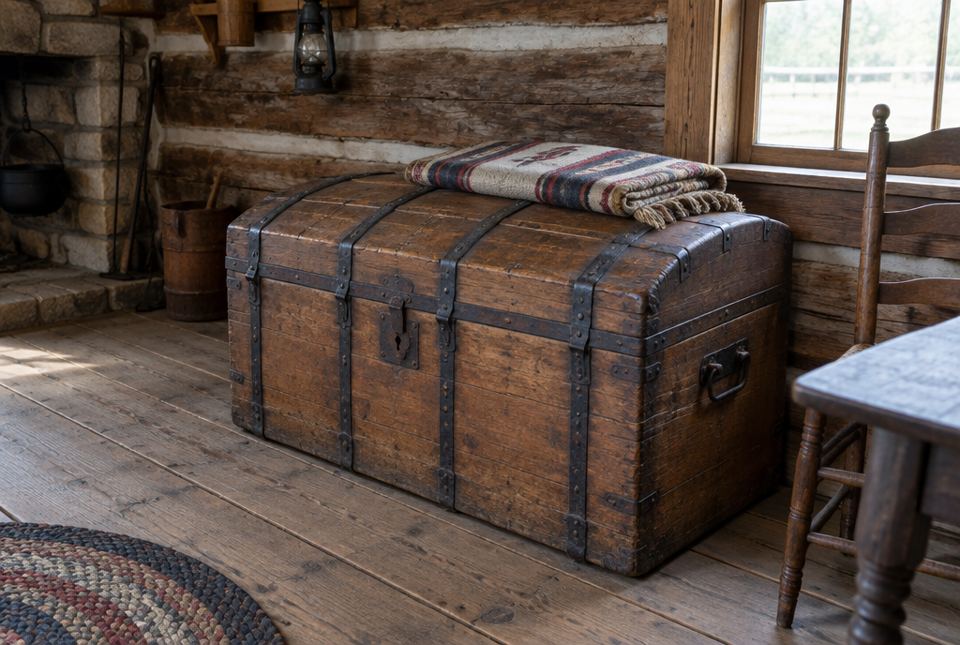 Many settler families carried everything they owned in a trunk like this one. What would you pack? AI-generated image
French settlers in Lower Canada
French settlers had been living along the St. Lawrence River since the 1600s, when this land was called New France. By 1791, most settlers in Lower Canada spoke French. Most were habitants (farmers).
The land was divided into seigneuries. Each seigneury was split into long, narrow farms that stretched back from the river. Why? So that every family could reach the river! The river was the main "road" for travelling and moving goods, and it gave water and fish.
Each community had a parish church at its centre. Most habitants were Catholic.
There were also French families in Upper Canada, for example along the Detroit River, where French farms had been started in the 1700s.
The Loyalists
From 1775 to 1783, people in thirteen British colonies to the south fought a war to break away from Britain. This was the American Revolution, and it created the United States.
Some people wanted to stay loyal to Britain. They were called Loyalists. Many were treated badly by their neighbours, and some lost their homes and land. When Britain lost the war, tens of thousands of Loyalists moved north to the British lands that were left.
- Most went to Nova Scotia and New Brunswick.
- Several thousand came to the land along the upper St. Lawrence River, Lake Ontario and the Niagara River, in what became Upper Canada: places like Kingston, the Bay of Quinte and Niagara.
The Loyalists were not all the same. They included people with English, Scottish, Irish, German and Dutch roots, Black Loyalists (you will learn about them in the next lesson), and Haudenosaunee allies, like Joseph Brant's people.
Britain gave the Loyalists land, plus tools, seeds and food for the first years. Because so many English-speaking Loyalists had arrived, Britain created Upper Canada in 1791, with British laws.
Whose land?
The land the British gave to settlers was the territory of First Nations, especially the Mississauga and other Anishinaabe nations. The British made agreements with them, called treaties or land purchases, but many were unfair or not understood the same way by both sides. You will learn more in the lesson on treaties.
More settlers keep coming
After the War of 1812, many more immigrants came from England, Scotland and Ireland. Some were poor families looking for land to farm. In the 1840s, many Irish families came to escape a terrible famine (a time when there is not enough food). Others came from the United States looking for land.
The government surveyed Upper Canada into townships, split into lots and concessions (rows of lots). Many country roads in Ontario today still follow these old survey lines!
Upper Canada grew very fast. By 1851, almost one million people lived there.
| # | Place | Who settled there |
|---|
| 1 | York (now Toronto) | British settlers and officials; it became the capital of Upper Canada |
| 2 | Kingston | Loyalists, starting in 1784 |
| 3 | Niagara | Loyalists; Newark (now Niagara-on-the-Lake) was the first capital of Upper Canada |
| 4 | Montreal | French settlers, and later many English, Scottish and Irish merchants |
| 5 | Quebec | French settlers; the capital of Lower Canada |
| 6 | Glengarry, along the St. Lawrence | Scottish Highlanders and Loyalists |
| 7 | Detroit River farms | French settlers, since the 1700s |
Hard times for new settlers
Settlers faced many challenges:
- The journey: crossing the ocean by sailing ship took weeks. Ships were crowded, and sickness spread easily.
- Thick forests: before planting, families had to cut down huge trees by hand and pull out stumps. This took years.
- Winter: long, cold winters. Families needed enough firewood and stored food to last until spring.
- Being far apart: neighbours, doctors and stores could be very far away. Roads were rough or muddy, or there were none.
- Sickness: there were few doctors and no modern medicines.
Many settlers learned from First Nations people how to survive: how to make maple sugar, use snowshoes and canoes, and find food in the forest.
Worked exampleLet's sort the settlers
Read each clue. Which settler group is it: French habitants, Loyalists, or British immigrants?
- "My family has farmed this long, narrow strip by the St. Lawrence for over 100 years. We speak French."
- "We stayed loyal to the King during the war. Our neighbours took our farm, so we came north in 1784."
- "We sailed from Ireland in 1847 because there was not enough food at home."
- Clue 1: long, narrow farm by the river, French, here for 100 years → French habitants.
- Clue 2: loyal to the King, came north in 1784 after the war → Loyalists.
- Clue 3: sailed from Ireland in the 1840s → British immigrants (Irish).
1 = French habitants, 2 = Loyalists, 3 = British immigrants (Irish).
Worked exampleLet's read the settler map
Use the map and key. Which settler places were on Lake Ontario? Which were on the St. Lawrence River?
- Find Lake Ontario. Numbers 1 (York) and 2 (Kingston) are on its shore. Number 3 (Niagara) is where the Niagara River meets Lake Ontario.
- Follow the St. Lawrence River from Lake Ontario toward the ocean: 6 (Glengarry), 4 (Montreal) and 5 (Quebec).
- Notice: almost every settlement is beside water. Water was the easiest way to travel.
On Lake Ontario: York, Kingston and Niagara. On the St. Lawrence: Glengarry, Montreal and Quebec. Nearly all were beside water.
Just for funRiddle: What has a trunk but never packs for a trip?
A tree! (Settler families had to fit everything they owned into just one trunk.)
Hands-on activityPack your trunk
You need: a shoebox (your "trunk"), paper and crayons.
- Pretend you are a settler family moving to Upper Canada in 1820. You can only bring what fits in one trunk.
- Draw and cut out (with a grown-up's help with scissors) 8 to 10 things you would bring. Remember: no electricity, no stores nearby, and winter is coming!
- Explain each choice. Examples: an axe, seeds, warm blankets, a cooking pot, a Bible or a book, a spinning wheel part, a family keepsake.
- What did you have to leave behind? How does that feel?
Your turn
People who stayed loyal to Britain during the American Revolution and then moved to British lands like Upper Canada and Nova Scotia.
2Why were the farms in Lower Canada long and narrow?
So that every family's farm touched the river, for travel, water and fish.
3What language did most habitants speak?
4Name two places where Loyalists settled in Upper Canada.
Any two: Kingston, the Bay of Quinte, Niagara, along the upper St. Lawrence.
5Name two countries many immigrants came from after the War of 1812.
Any two: England, Scotland, Ireland (also the United States).
6Name two challenges settlers faced.
Any two: a long, crowded ship journey; clearing thick forest; cold winters; being far from neighbours and doctors; bad roads; sickness.
7What did Britain give the Loyalists to help them start?
Land, plus tools, seeds and food for the first years.
More practice: warm-up
A French-speaking farmer in Lower Canada.
2What war made the Loyalists leave their homes?
The American Revolution (1775 to 1783).
3What was at the centre of most habitant communities?
4What was the capital of Lower Canada?
5True or false: all Loyalists were the same.
False. They had many different backgrounds, including Black Loyalists and Haudenosaunee allies.
More practice: on your own
1Why did Britain create Upper Canada in 1791?
Many English-speaking Loyalists had settled there, and they wanted British laws. So Britain split the colony into Upper (mostly English) and Lower (mostly French) Canada.
2Why did many Irish families come in the 1840s?
To escape a terrible famine in Ireland, when there was not enough food.
3Why did most settlements grow beside lakes and rivers?
Water was the easiest way to travel and move goods. It also gave drinking water and fish.
4How did First Nations people help some settlers survive?
They shared knowledge, like how to make maple sugar, use snowshoes and canoes, and find food in the forest.
5The land given to Loyalists was not empty. Whose territory was it?
The territory of First Nations, especially the Mississauga and other Anishinaabe nations.
Challenge
1A Loyalist family and a Mississauga family both lived near the Bay of Quinte in 1790. How might each family feel about new settlers arriving? Explain both points of view.
Loyalist family: relieved and hopeful to have a new home and land after losing everything. Mississauga family: worried or upset, because settlers were cutting down forests and building farms on their hunting and fishing lands. Both points of view are real.
2Upper Canada went from a fairly small number of settlers in 1791 to almost one million people by 1851. What problems might fast growth cause for First Nations?
More land was taken for farms and towns, so First Nations had less land for hunting, fishing and gathering. Forests were cut down and animals became harder to find. More settlers also meant more sickness spreading.
3Compare a habitant farm in Lower Canada with a Loyalist farm in Upper Canada. Give one way they were alike and one way they were different.
Alike: both families farmed, cut wood and needed water nearby. Different: the habitant farm was a long, narrow strip reaching the river, in a French-speaking, Catholic community that had been there since the 1600s; the Loyalist farm was a newer lot on a surveyed grid, often still being cleared from forest, with English as the main language.
Quiz
1. Why did Loyalists move north after 1783?
2. Habitant farms were long and narrow so that...
3. Most settlers in Lower Canada spoke...
4. Which is a challenge settlers faced?
5. Many Irish families came to Canada in the 1840s because...
6. The land the British gave to settlers in Upper Canada was...
Big idea: Settler communities in this period included long-established French habitants in Lower Canada, Loyalists who arrived after the American Revolution (1783–84), and later immigrants from England, Scotland and Ireland. Their settlement was on First Nations territory, a point we keep returning to.
How to help at home:
- If you live in Ontario, look up when your town or township was surveyed and who settled it first, and whose traditional territory it is.
- Notice concession roads and "lines" when driving in the country; they come from the survey grid.
- If you have family history from this period, share it, alongside the question "Whose land was it before?"
Common difficulties:
- Thinking all Loyalists were white, English-speaking people: they included Black Loyalists, Haudenosaunee allies and people of many European backgrounds.
- Romanticizing pioneers: settlers were brave and hard-working, and settlement also took land from First Nations. Both can be true; encourage your child to hold both ideas.
- Confusing the American Revolution with the War of 1812: the Revolution came first (1775–1783); the War of 1812 was later (1812–1815).
Scissors are used in the activity; supervise as needed.