D. Data · Data and ProbabilitySorting by Two Attributes: Tables and Carroll Diagrams
D1.1About 35 minutes
Learning goals- I can name two attributes of a thing, like its colour and its size.
- I can sort things by two attributes at the same time.
- I can show my sorting in a table and in a Carroll diagram.
- I can explain my sorting rule.
Words to know
attribute
A feature of a thing, like its colour, size, shape, or what it is used for.
sort
To put things into groups that are the same in some way.
sorting rule
The rule that tells which group each thing goes in, like "red" and "not red".
Carroll diagram
A grid of boxes for sorting. Each row and each column has a label. Every thing goes in exactly one box.
not
A sorting word that means "everything else". "Not red" means any colour except red.
Let's get started!
It is a cold winter morning. There is a big messy pile of mittens by the door! Some are red and some are blue. Some are big (for grown-ups) and some are small (for kids).
How could you sort them so everyone finds their mittens fast?
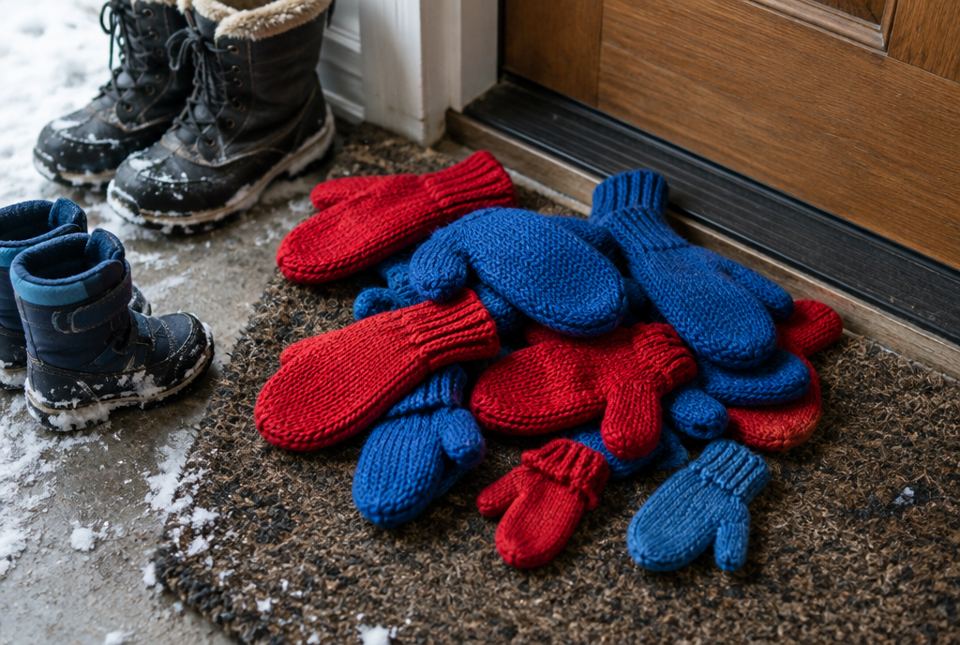 Each mitten has a colour (red or blue) and a size (big or small). Sorting by both attributes makes 4 groups. AI-generated image
🧤🧤🧤🧤🧤🧤🧤🧤🧤🧤🧤🧤🧤🧤
A pile of 14 mittens, all mixed up: big and small, red and blue.Remember from Grade 1
In Grade 1 you sorted things by one attribute. An attribute is a feature, like colour, size, or shape.
For example, you sorted buttons by colour: a red group, a blue group, a yellow group.
Sorting by two attributes
Now you are in Grade 2. You can sort by two attributes at the same time!
For the mittens, we can look at colour (red or blue) and size (big or small). That makes 4 groups:
- big and red
- big and blue
- small and red
- small and blue
Each mitten fits in exactly one group.
A sorting table
A table is a neat way to sort by two attributes. One attribute goes across the top. The other attribute goes down the side. Each box is where the row and the column meet.
| Red | Blue |
|---|
| Big | 🧤 3 mittens | 🧤 2 mittens |
| Small | 🧤 4 mittens | 🧤 5 mittens |
To read a box, look at its row and its column. The box in the Small row and the Blue column tells us there are 5 small blue mittens.
You can also find totals:
- All the red mittens: 3 + 4 = 7
- All the big mittens: 3 + 2 = 5
- All the mittens: 3 + 2 + 4 + 5 = 14
Carroll diagrams
A Carroll diagram is a sorting grid that often uses the word not. It is named after Lewis Carroll, a writer who loved math puzzles.
Instead of listing every colour, we can use red and not red. Not red means any colour that is not red: blue, green, yellow, and all the rest.
The same goes for size: big and not big.
Worked exampleSorting shapes in a Carroll diagram
Sort these shapes: 🔴🟦🔴🟥🔵🟦🔴🟦🟥🟦 Use the attributes red / not red and circle / not a circle.
- Make a grid with 2 columns and 2 rows. Label the columns Circle and Not a circle. Label the rows Red and Not red.
- Take one shape at a time. Ask two questions: Is it red? Is it a circle?
- 🔴 is red and a circle. It goes in the top left box. There are 3 of these.
- 🟥 is red but not a circle. It goes in the top right box. There are 2 of these.
- 🔵 is not red but it is a circle. It goes in the bottom left box. There is 1.
- 🟦 is not red and not a circle. It goes in the bottom right box. There are 4.
- Check: 3 + 2 + 1 + 4 = 10. There were 10 shapes, so every shape has a home.
Red circles: 3. Red, not circles: 2. Not red circles: 1. Not red, not circles: 4.
| Circle | Not a circle |
|---|
| Red | 🔴🔴🔴 | 🟥🟥 |
| Not red | 🔵 | 🟦🟦🟦🟦 |
One thing, one box
Every item goes in exactly one box. If you count all the boxes, you get back to the total number of items. That is a great way to check your work!
Just for funFunny but true: Lewis Carroll, the puzzle-lover the Carroll diagram is named after, also wrote Alice's Adventures in Wonderland. It has a white rabbit who is always running late! 🐇⏰
Worked exampleSorting Canadian animals
Sort these animals by two attributes: has fur / no fur and can fly / cannot fly.
moose, robin, bat, frog, Canada goose, red fox, turtle
- Think about each animal. A moose has fur and cannot fly.
- A robin and a Canada goose have feathers, not fur. They can fly.
- A bat has fur and it can fly! It goes in the has fur, can fly box.
- A red fox has fur and cannot fly.
- A frog and a turtle have no fur and cannot fly.
- Check: 1 + 2 + 2 + 2 = 7 animals.
Has fur and can fly: bat. Has fur, cannot fly: moose, red fox. No fur, can fly: robin, Canada goose. No fur, cannot fly: frog, turtle.
| Can fly | Cannot fly |
|---|
| Has fur | 🦇 bat | 🫎 moose, 🦊 red fox |
| No fur | 🐦 robin, 🪿 Canada goose | 🐸 frog, 🐢 turtle |
Sorting people
You can sort people too, using things like wearing boots / not wearing boots and has a hood / no hood. Sorting people should always be kind. Use attributes that are about things people choose or have on, like clothing or what they like, not things that could hurt feelings.
Hands-on activitySock sort
You need: a pile of clean socks (or toy blocks, or crayons), and a big piece of paper or 4 pieces of tape on the floor.
- Make a grid with 4 boxes. Choose two attributes, for example striped / not striped and mine / not mine.
- Write the labels on sticky notes or paper at the top and side.
- Sort every sock into one box.
- Count each box. Add them up. Does the total match the number of socks?
- Ask a grown-up to sort the pile a different way. Can you guess their two attributes?
Math talk: "How did you decide where this one goes?"
Your turn
1What are the two attributes in this sorting rule: big or small, and red or blue?
Size (big or small) and colour (red or blue).
2Use the mitten table above. How many big red mittens are there?
3Use the mitten table above. How many blue mittens in all?
2 big blue + 5 small blue = 7 blue mittens.
4In a Carroll diagram, where does a yellow circle go if the rows are Red / Not red and the columns are Circle / Not a circle?
In the Not red row and the Circle column, because yellow is not red and it is a circle.
5A green triangle is sorted using Red / Not red and Circle / Not a circle. Which box?
Not red and Not a circle.
6Where does a duck go in the animal Carroll diagram?
No fur and Can fly. Ducks have feathers and can fly.
7Why do we add up all the boxes at the end?
To check that every item was sorted once. The total should match the number of items we started with.
Math talk
When you explain your sorting, use the word and: "This one is small and red." Use the word not for everything else: "This one is not red."
More practice: warm-up
1Name two attributes of an apple.
Answers will vary. Examples: colour (red, green, yellow), size (big, small), shape, taste (sweet, sour).
2🔴🔴🟥🔵
How many shapes are red?
3 red shapes: two red circles and one red square.
3🔴🔴🟥🔵
How many shapes are circles?
3 circles: two red circles and one blue circle.
Any colour except red, like blue, green, yellow or black.
5A sorting grid has 2 rows and 2 columns. How many boxes does it have?
More practice: on your own
1Sort these by wheels / no wheels and has a motor / no motor: bicycle, car, canoe, snowmobile, skateboard. Which go in wheels, no motor?
Bicycle and skateboard. They have wheels and you push or pedal them, they have no motor. (Car: wheels and motor. Snowmobile: motor, no wheels, it has a track and skis. Canoe: no wheels, no motor.)
2In a Carroll diagram, the boxes have 4, 3, 2 and 6 things. How many things were sorted?
4 + 3 + 2 + 6 = 15 things. Every thing is in exactly one box.
3A table sorts buttons. Big: 2 with 2 holes, 5 with 4 holes. Small: 6 with 2 holes, 1 with 4 holes. How many buttons have 4 holes?
5 big + 1 small = 6 buttons with 4 holes.
4Same buttons. How many small buttons are there?
5Maya sorted fruit into: red and round, red and not round, not red and round, not red and not round. Where does a banana go?
Not red and not round. A banana is yellow and long, not round.
Challenge
1Ben put a red square in the Red, Circle box. What mistake did he make? Where should it go?
A square is not a circle. It should go in the Red, Not a circle box. Ben checked the colour but forgot to check the shape.
2Look at this Carroll diagram. Box 1 (striped, has a hood): 2 shirts. Box 2 (striped, no hood): 4 shirts. Box 3 (not striped, has a hood): 3 shirts. Box 4 (not striped, no hood): 1 shirt. Are there more shirts with hoods or more striped shirts? How many more?
Hoods: 2 + 3 = 5. Striped: 2 + 4 = 6. There are more striped shirts, 1 more. 6 − 5 = 1.
3Make up your own two attributes to sort the people in your home. Write the 4 box labels.
Answers will vary. Example: wearing socks / not wearing socks and likes winter / does not like winter. The 4 boxes are: socks and likes winter; socks and does not like winter; no socks and likes winter; no socks and does not like winter. Look for 2 attributes where each person fits in exactly one box.
Quiz
2. Sorting by colour (red, blue) and size (big, small) makes how many groups?
3. A Carroll diagram has the rows Red and Not red. Where does a green block go?
4. Which animal goes in the box has fur and can fly?
5. The 4 boxes of a Carroll diagram have 5, 2, 3 and 4 items. How many items were sorted?
6. Shapes are sorted by Circle / Not a circle and Blue / Not blue. Where does a blue square go?
What your child is learning: to sort objects, animals and people by two attributes at once, and to show the sorting in a table and in a Carroll diagram (a grid that often uses yes/not labels such as red / not red). This is part of Ontario expectation D1.1. Venn diagrams come in the next lesson.
Common difficulties:
- Checking only one attribute ("It's red, so it goes here") and forgetting the second. Encourage your child to ask two questions for every item: Is it ...? Is it ...?
- Not understanding not. Hold up an object and ask, "Is this red? No? Then it's not red." Not red includes every other colour.
- Losing items. Have your child count the items first and then add the boxes at the end to check.
At home: sort laundry (socks: mine / not mine, striped / not striped), groceries (fruit / not fruit, in a box / not in a box) or toys. Take turns guessing each other's two sorting attributes.