C. Algebra · Patterns, Variables, Coding and ModellingPatterns in Geometric Designs
C1.1About 35 minutes
Learning goals- I can find patterns in designs made with shapes, at home and outside.
- I can tell if a pattern is repeating, growing or shrinking.
- I can tell which attributes change in a pattern: colour, shape, size or the way a shape is turned.
- I can describe a pattern clearly so someone else could build it.
Words to know
geometric design
A picture or decoration made with shapes, like squares, triangles and circles.
repeating pattern
A pattern where a core repeats again and again.
growing pattern
A pattern that gets bigger by the same amount each time.
shrinking pattern
A pattern that gets smaller by the same amount each time.
attribute
Something you can notice about a shape, like its colour, shape, size or the way it is turned.
term
One part, or one step, of a pattern. The first term, the second term, and so on.
Look closely!
Look at a quilt, a tiled floor, a brick wall or the stripes on a winter scarf. Shapes and colours are arranged in a special way. Some designs repeat. Some designs grow, like a staircase! Today you are a design detective.
Remember from Grade 1
A pattern follows a rule, so you can tell what comes next. In a repeating pattern, the smallest part that repeats is called the core.
🍁 ⛄ 🍁 ⛄ 🍁 ⛄ has the core 🍁 ⛄.
This year you will look at patterns in designs made with shapes, and at patterns that grow and shrink.
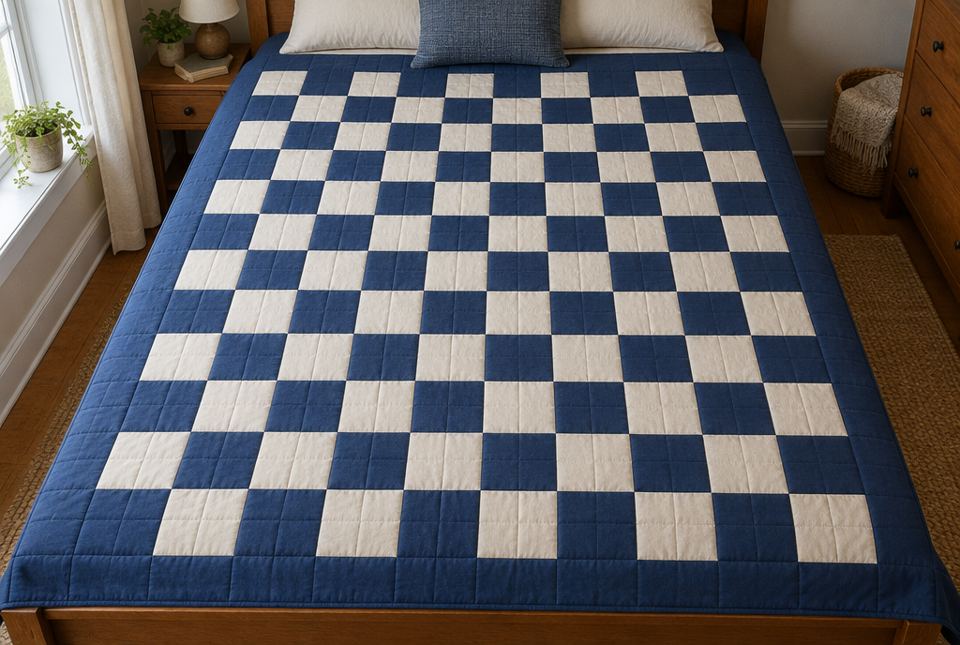 Look along any row of this quilt: blue, cream, blue, cream. The core of the pattern is one blue square and one cream square, repeated again and again. AI-generated image
Shapes that make designs
A geometric design is a picture made with shapes. You can find them on quilts, floor tiles, wallpaper, wrapping paper, brick walls, hockey jerseys and blankets.
Many First Nations, Métis and Inuit artists make beautiful designs with repeating shapes and colours. You might see them in beadwork, quillwork, weaving and clothing. Métis artists are well known for colourful floral beadwork, and some Métis sashes are woven with patterns of arrows and stripes. When you look at an artist's work, notice the patterns and remember that every design was made with care and skill by a real person.
Attributes: what can change?
An attribute is something you can notice about a shape. In a pattern, these attributes can change:
- colour (dark, light, red, blue)
- shape (square, triangle, circle)
- size (big, small)
- orientation, which means the way the shape is turned (pointing up, pointing down)
Sometimes more than one attribute changes in the same pattern!
Worked exampleDescribe a design
Describe this pattern:
🔺 🟦 🔵 🔺 🟦 🔵 🔺 🟦 🔵
- Look for where the first shape comes again. The triangle 🔺 is first, and it comes again in the 4th spot.
- So the core might be 🔺 🟦 🔵. Check it: 🔺 🟦 🔵 | 🔺 🟦 🔵 | 🔺 🟦 🔵. Yes, it repeats 3 times.
- Which attributes change? The shape changes (triangle, square, circle). The colour changes too (red, blue, blue).
- Say it clearly so someone could build it: A repeating pattern. The core is red triangle, blue square, blue circle. It repeats 3 times.
A repeating pattern with the core 🔺 🟦 🔵 (red triangle, blue square, blue circle). Shape and colour change. The core repeats 3 times.
Growing patterns
Some patterns do not repeat. They grow! Each term (each step) gets bigger by the same amount.
Look at these towers of squares. Count the squares in each term.
| Term | 1 | 2 | 3 | 4 |
|---|
| Number of squares | 2 | 4 | 6 | 8 |
Shrinking patterns
A shrinking pattern gets smaller by the same amount each time. Think of a stack of snowballs melting in the spring sun:
⚪⚪⚪⚪⚪⚪⚪⚪⚪ → ⚪⚪⚪⚪⚪⚪⚪ → ⚪⚪⚪⚪⚪ → ⚪⚪⚪
9, 7, 5, 3. Each term has 2 fewer snowballs.
Worked exampleRepeating, growing or shrinking?
What kind of pattern is this? How do you know?
🟩 🟩🟩🟩 🟩🟩🟩🟩🟩 🟩🟩🟩🟩🟩🟩🟩
- Count the squares in each term: 1, 3, 5, 7.
- Do the terms get bigger or smaller? Bigger.
- By how much? 1 to 3 is 2 more. 3 to 5 is 2 more. 5 to 7 is 2 more.
- The amount added is the same each time, so it is a growing pattern.
A growing pattern. It starts with 1 square and grows by 2 squares each time.
Three questions for a pattern detective
- Does a core repeat? Then it is a repeating pattern.
- Does each term get bigger by the same amount? Then it is a growing pattern.
- Does each term get smaller by the same amount? Then it is a shrinking pattern.
Just for funFunny but true: honeybees build honeycomb out of six-sided shapes called hexagons, and the hexagons fit together with no gaps. Bees are pattern designers! 🐝
Your turn
1What is the core? 🟥 🟥 🔷 🟥 🟥 🔷 🟥 🟥 🔷
🟥 🟥 🔷 (red square, red square, blue diamond). It repeats 3 times.
2Repeating, growing or shrinking? 🍩 | 🍩🍩 | 🍩🍩🍩 | 🍩🍩🍩🍩
Growing. 1, 2, 3, 4. It grows by 1 each time.
3Repeating, growing or shrinking? 10 blocks, 8 blocks, 6 blocks, 4 blocks
Shrinking. It gets 2 smaller each time.
4Which attribute changes? ⬛ ▪️ ⬛ ▪️ ⬛ ▪️ (big black square, small black square...)
The size changes: big, small, big, small. The shape and colour stay the same.
5A pattern goes: red triangle pointing up, blue triangle pointing down, red triangle pointing up, blue triangle pointing down. Which two attributes change?
The orientation (up, down) and the colour (red, blue) both change.
6Name two places you could see a geometric design.
Many answers, for example: a quilt, floor tiles, wallpaper, a brick wall, a hockey jersey, beadwork, a woven blanket, a sidewalk.
Hands-on activityDesign detective walk
- With a grown-up, look around your home and outside for geometric designs: tiles, quilts, fences, bricks, rugs, wrapping paper, a winter coat or mittens.
- Find 3 designs with a repeating pattern. For each one, point to the core and say which attributes change (colour, shape, size, orientation).
- Look for a growing pattern: stairs, a stack of cups, nesting bowls, or a row of fence posts that get taller.
- Draw your favourite design on paper. Under it, write one sentence that describes it, like The core is big circle, small circle.
Math talk
When you describe a pattern, pretend you are on the phone with a friend who cannot see it. Can your friend build the exact same pattern from your words? Use words like core, repeats, grows by and shrinks by.
More practice: warm-up
1What is the core? 🔵 🟡 🔵 🟡 🔵 🟡
🔵 🟡 (blue circle, yellow circle).
2True or false? A growing pattern gets bigger by the same amount each time.
3Repeating, growing or shrinking? ⭐⭐⭐⭐ | ⭐⭐⭐ | ⭐⭐ | ⭐
Shrinking. 4, 3, 2, 1. It gets 1 smaller each time.
4What comes next? ⬆️ ⬇️ ⬆️ ⬇️ ⬆️ ___
⬇️. The arrows take turns pointing up and down.
5What does attribute mean?
Something you can notice about a shape, like its colour, shape, size or the way it is turned.
More practice: on your own
1Describe this pattern so a friend could build it: 🟢 🟢 🔺 🔺 🟢 🟢 🔺 🔺
A repeating pattern. The core is circle, circle, triangle, triangle. It repeats 2 times. The core has 4 parts, so I looked for where two circles start again.
2Towers have 3, 6, 9, 12 cubes. Describe the pattern.
A growing pattern. It starts at 3 and grows by 3 each time (3 + 3 = 6, 6 + 3 = 9, 9 + 3 = 12).
3A quilt row goes: big square, small square, small square, big square, small square, small square. Which attribute changes? What is the core?
The size changes. The core is big, small, small. The shape stays a square the whole time.
4Is this a pattern? 🔺 🔺 🟦 🔺 🟦 🟦 🔺
No. I tried 🔺 🔺 🟦 as a core, but the next three are 🔺 🟦 🟦, not 🔺 🔺 🟦. No core repeats the same way.
5Stacks of pancakes: 12, 10, 8, 6. Repeating, growing or shrinking? By how much?
Shrinking by 2. 12 − 2 = 10, 10 − 2 = 8, 8 − 2 = 6.
Challenge
1In this design, three attributes change. Name them.
big red circle, small blue square, big red circle, small blue square...
Size (big, small), colour (red, blue) and shape (circle, square). The core is big red circle, small blue square.
2Sam's growing pattern of towers goes 1, 4, 7, 10. Sam says it grows by 4. Is Sam right? Explain.
No. 1 to 4 is 3 more, 4 to 7 is 3 more, 7 to 10 is 3 more. It grows by 3. Sam may have looked at the number 4 instead of the jump between terms.
3Look at the staircase pattern in the picture above. Term 1 has 1 square, term 2 has 3 squares, term 3 has 6 squares. Does it grow by the same amount each time? Describe how it grows.
No, the jump gets bigger. 1 to 3 is 2 more, 3 to 6 is 3 more, and 6 to 10 is 4 more. Each new term adds one more column, and the new column is one square taller than the last one. It is still a pattern because it follows a rule.
Quiz
1. What is a geometric design?
2. What kind of pattern is this? 2 cubes, 4 cubes, 6 cubes, 8 cubes
3. What is the core? 🟨 🔺 🔺 🟨 🔺 🔺
4. Which attribute changes in this pattern? 🔺 🔻 🔺 🔻 (all the same colour and size)
5. What kind of pattern is this? 15, 12, 9, 6
6. Which of these is not an attribute of a shape?
This lesson builds on Grade 1 repeating patterns. New this year: a closer look at growing and shrinking patterns, and patterns where more than one attribute changes (colour, shape, size and orientation).
Common mistakes
- Noticing only one attribute. If a pattern is big red, small blue, ask: What else changes?
- Calling any increasing list a growing pattern. A growing pattern increases by a rule. Ask: How much bigger is each term?
- Describing too vaguely (It goes red, blue...). Ask your child to describe it so precisely that you can build it without looking.
How to help
- Use blocks, Lego, cereal, buttons or coloured paper to build designs together.
- Point out designs on clothing, quilts, tiles and in art. If you visit a museum, a cultural centre or a powwow, notice the patterns in beadwork and clothing, and talk about the skill of the artists who made them.
- Ask Is it repeating, growing or shrinking? How do you know?