E. Earth and Space Systems · Daily and Seasonal ChangesThe Sun Gives Us Light and Heat
E2.1 E2.3 A1.1 A1.2 A1.4 A1.5About 35 minutes
Learning goals- I can explain that the Sun gives Earth light and heat.
- I can explain that Earth spins, which gives us day and night.
- I can describe how the Sun seems to move across the sky each day.
- I can stay safe in the Sun.
Words to know
Sun
The star closest to Earth. It gives us light and heat.
star
A giant, hot, glowing ball of gas in space.
Earth
The planet we live on.
spin
To turn around and around, like a top.
shadow
A dark shape made when an object blocks light.
sunrise / sunset
When the Sun first comes up in the morning / goes down in the evening.
Warm and bright
Go stand by a sunny window. Close your eyes. What do you feel on your face?
You feel warm! And even with your eyes closed, it looks bright.
That warmth and brightness come from the Sun, a very long way from here.
The Sun is a star
The Sun is a star. It is a giant, very hot, glowing ball. It is much, much bigger than Earth. It looks small only because it is so far away.
The Sun gives Earth two very important things:
- Light, so we can see, and so plants can grow.
- Heat, so Earth is warm enough for people, animals and plants to live.
Without the Sun, Earth would be dark and frozen.
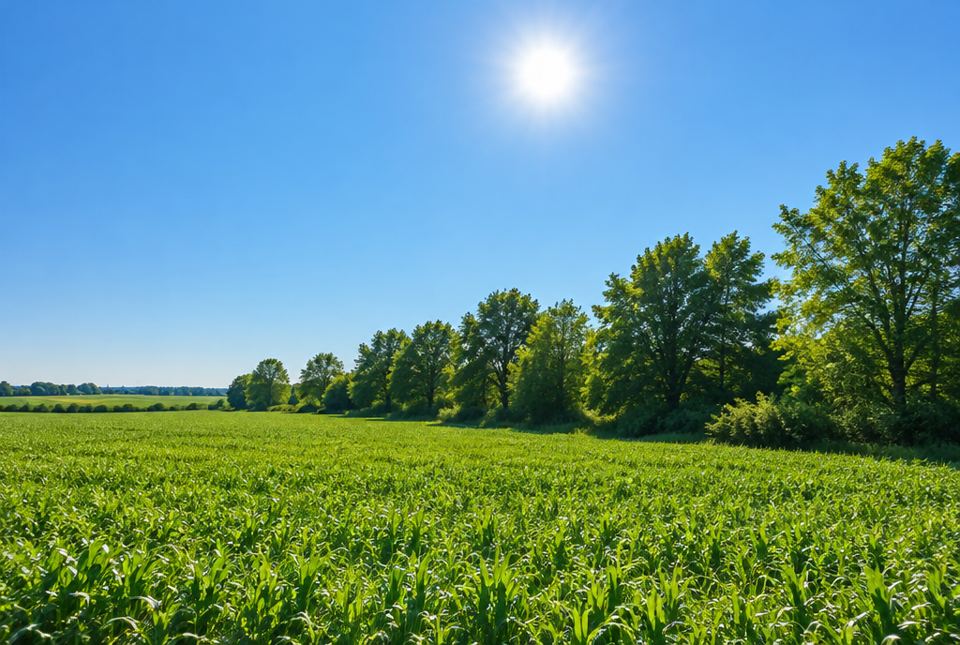 The Sun gives this field light and heat. Its light helps the plants grow green, and its heat warms the land. AI-generated image
Never look at the Sun!
The Sun is so bright that looking straight at it can hurt your eyes, even with sunglasses. Never look directly at the Sun. Look at the light and shadows it makes instead.
Day and night
Our Earth is always spinning, like a slow top. It turns around once every day.
The side of Earth that faces the Sun has day. The side facing away from the Sun has night. As Earth spins, our home turns into the sunlight (morning), and later turns away from it (evening).
The Sun seems to move
In the morning, the Sun is low in the sky in the east. In the middle of the day, it is high in the sky. In the evening, it is low in the west, and then it sets.
It looks like the Sun is moving across the sky. But really, Earth is spinning! It's like riding on a merry-go-round: the trees seem to move past you, but really you are moving.
Light and heat change during the day
- Morning: The Sun is low. The light is soft. It is often cool outside.
- Middle of the day: The Sun is high. The light is strongest. It gets warmer.
- Afternoon: It is often the warmest time of day, because the ground has been warming up all day.
- Evening and night: The Sun goes down. There is less light, then darkness. It gets cooler.
Shadows change too. When the Sun is low, shadows are long. When the Sun is high, shadows are short.
| Time of day | Where is the Sun? | Light | Heat | Your shadow |
|---|
| morning | low, in the east | getting brighter | cool | long |
| middle of the day | high in the sky | brightest | warm | short |
| evening | low, in the west | getting darker | cooling down | long |
| night | we can't see it | dark | coolest | no Sun shadow |
Worked exampleLet's figure out the time of day from clues
Jayden's shadow is very short. The Sun is high in the sky. It feels warm. What time of day is it?
- Clue 1: The shadow is short. Short shadows happen when the Sun is high.
- Clue 2: The Sun is high. The Sun is highest in the middle of the day.
- Clue 3: It feels warm. The middle of the day is warmer than the morning.
It is the middle of the day (around lunchtime).
Worked exampleLet's investigate: sun or shade?
Which spot is warmer: a sunny spot or a shady spot?
- Question: Is a towel warmer in the sun or in the shade?
- Predict: I think the sunny towel will be warmer.
- Make it fair: Use two towels that are the same. Put one in a sunny spot and one in the shade, both outside. Wait the same time (about 15 minutes).
- Observe: Touch each towel with your hand. The sunny towel feels warm. The shady towel feels cooler.
- Tell: "The towel in the sun was warmer because the Sun's heat warmed it."
The sunny spot is warmer. The Sun gives heat as well as light.
Just for funFun fact: the Sun is so huge that about one million Earths could fit inside it!
Hands-on activityShadow tracker
You need: chalk (or small stones) and a sunny day. A toy that stands up also works.
- In the morning, stand in the same spot on a sidewalk or driveway. Have a grown-up trace around your feet so you can stand there again.
- A grown-up traces your shadow with chalk (or marks its end with a stone). Write the time.
- Stand in the same place around lunchtime, then again in the late afternoon. Trace your shadow each time.
- Compare: Which shadow is longest? Which is shortest? Which way did your shadow point each time?
- Tell or draw what you found.
What to look for: Long shadows in the morning and late afternoon, the shortest shadow in the middle of the day, and the shadow pointing a different way as the day goes on.
Safety: Do not look at the Sun. Wear a hat and sunscreen in summer.
Your turn
1What two things does the Sun give Earth?
2Is the Sun a planet or a star?
3Why do we have day and night?
Because Earth spins. The side facing the Sun has day, and the side facing away has night.
4Where does the Sun rise: east or west?
5When is the Sun highest in the sky?
In the middle of the day.
6When is your shadow longest: in the morning or at lunchtime?
In the morning (and in the late afternoon), when the Sun is low.
7Why should you never look straight at the Sun?
It is so bright that it can hurt your eyes.
More practice: warm-up
1Does the Sun give us light?
2Is it usually warmer in the middle of the day or in the middle of the night?
In the middle of the day.
4What do we call the planet we live on?
An object blocking the light.
More practice: on your own
1It is night in Ontario. Where is the Sun?
It is still shining, but our side of Earth has spun away from it. It is daytime on the other side of Earth.
2Why does the Sun look like it moves across the sky?
Because Earth is spinning. We are moving, so the Sun looks like it moves, like trees going past a car window.
3Your shadow is long and the Sun is low in the west. Is it morning or evening?
Evening. The Sun sets in the west.
4Why does a sidewalk feel warmer at 3 o'clock in the afternoon than at 8 o'clock in the morning?
The Sun has been heating it all day. In the morning it had cooled down overnight.
5What would happen to plants if there were no sunlight?
They could not grow. Plants need sunlight to make their food.
Challenge
1If Earth stopped spinning, what would happen to day and night?
One side of Earth would have day all the time, and the other side would have night all the time. Day and night would not take turns.
2Why does the Sun look small if it is much bigger than Earth?
Because it is very, very far away. Far-away things look small, like an airplane high in the sky.
3Draw (or describe) your shadow in the morning and at lunchtime. How are they different?
Model: In the morning the shadow is long. At lunchtime it is short, because the Sun is high. The shadow also points a different way. Look for a long and a short shadow.
Quiz
2. What gives us day and night?
4. When is your shadow the shortest?
5. Which spot is warmer on a sunny day?
6. What is the safest way to observe the Sun?
Big idea: The Sun is Earth's source of light and heat. Earth spins once a day, which causes day and night and makes the Sun appear to move from east to west (E2.1). Light and heat change through the day (E2.3).
How to help: Notice the Sun at different times: "Where is the Sun now? Is it low or high? How long is your shadow?" The shadow tracker is the most memorable activity; it works best on a clear day.
Common difficulties:
- Thinking the Sun goes away or "goes to sleep" at night. Use a lamp (Sun) and a ball or orange (Earth) with a sticker for your home. Spin the ball slowly to show day and night.
- Thinking the Sun really moves across the sky. The merry-go-round or car-window comparison helps.
- Thinking noon is the hottest time. The afternoon is often warmer, because the ground keeps warming.
Safety: Children must never look directly at the Sun, even with sunglasses. Use sun protection in warm months.