E. Earth and Space Systems · Daily and Seasonal ChangesThe Four Seasons and Their Weather
E2.1 E2.2 E2.3 E2.4 A1.1 A1.5About 40 minutes
Learning goals- I can name the four seasons in order.
- I can explain that the seasons are a cycle that repeats every year.
- I can describe the weather in each season where I live, including temperature and precipitation.
- I can describe how daylight and the Sun's heat change from summer to winter.
- I can observe and record the weather.
Words to know
season
One of the four parts of the year: spring, summer, fall (autumn) and winter.
weather
What it is like outside: hot or cold, sunny or cloudy, rainy, snowy or windy.
temperature
How hot or cold something is. We measure it in degrees Celsius (°C).
precipitation
Water falling from the clouds: rain, snow, sleet or hail.
thermometer
A tool that measures temperature.
year
The time it takes Earth to travel once all the way around the Sun.
A snowy surprise?
Imagine you wake up on Canada Day, July 1, and look outside. Would you see snow? No way! In Ontario, July is in summer. It is warm and green.
But on a January morning, there is often snow on the ground, and you need your snow pants!
The weather changes a lot through the year. These big changes are called seasons.
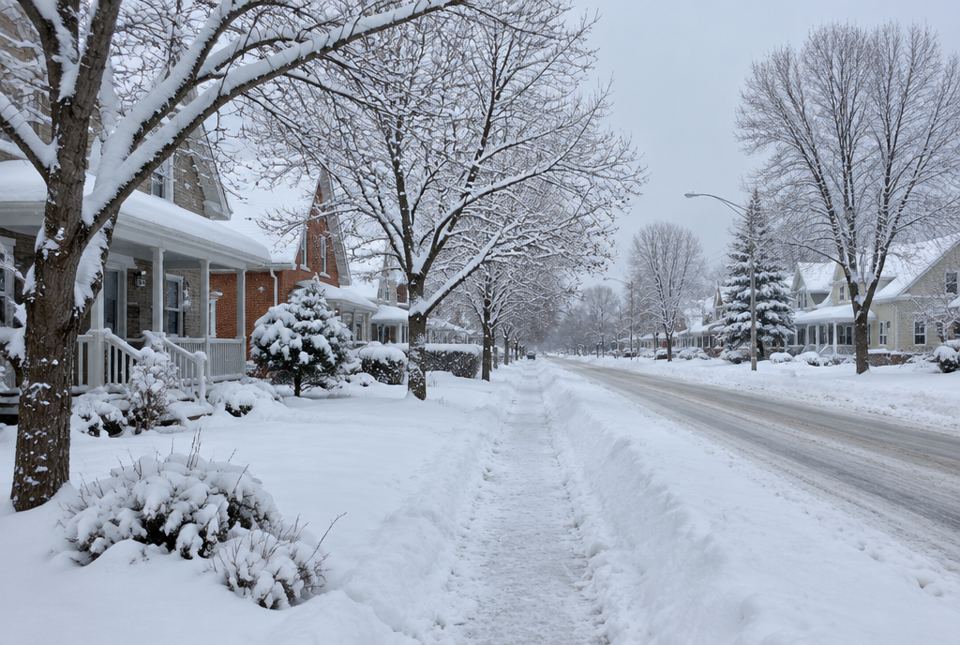 Winter in Ontario: snow covers the ground and the trees have no leaves. In summer this same street would be warm and green. AI-generated image
Four seasons
There are four seasons: spring, summer, fall (also called autumn) and winter.
They always come in the same order. After winter, spring comes again. The seasons are a cycle!
Why do we have seasons?
Earth does two things at once:
- It spins, once every day. That gives us day and night.
- It travels around the Sun. One full trip takes one year.
Earth is a little tilted, like a tipped top. So for part of the year, our part of Earth leans toward the Sun. The Sun is high, the days are long, and we get more heat. That is summer.
Half a year later, our part of Earth leans away from the Sun. The Sun stays low, the days are short, and we get less heat. That is winter.
Spring and fall are in between.
| Season | Daylight | Sun's heat | Weather where we live (southern Ontario) |
|---|
| spring (about March to June) | days get longer | getting warmer | melting snow, rain, mud, cool to mild days, some warm days |
| summer (about June to September) | longest days | hottest | often hot and sunny, thunderstorms; often 20°C to 30°C |
| fall (about September to December) | days get shorter | getting cooler | cool, windy, rainy days; first frost |
| winter (about December to March) | shortest days | coldest | snow and ice; often below 0°C |
Long days, short days
In summer, the Sun rises early and sets late. In Toronto, the longest day in June has about 15 hours of daylight. You might go to bed while it is still light out!
In winter, the Sun rises late and sets early. The shortest day in December has only about 9 hours of daylight. It can be dark when you eat dinner.
In the far North of Canada, in parts of Nunavut, the difference is even bigger. In summer the Sun stays up all night for a while, and in winter there are days when it does not rise at all.
Measuring the weather
We measure temperature with a thermometer, in degrees Celsius (°C).
- 0°C: water freezes into ice. Snow can fall.
- 10°C: cool. You need a jacket.
- 20°C: warm and comfortable.
- 30°C: hot!
Precipitation is water falling from the clouds. Rain falls when it is warmer. Snow falls when it is cold. Sleet and hail are bits of ice.
🌧️🌨️☀️🌬️⛈️
Weather words: rain, snow, sunny, windy, thunderstormWorked exampleLet's match the weather to the season
Today it is −8°C. Snow is falling. The Sun set before 5 o'clock. Which season is it?
- Clue 1: −8°C is below 0°C. Water freezes. It is very cold.
- Clue 2: Snow is falling. Snow needs cold air.
- Clue 3: The Sun set early. Short days happen in winter.
Worked exampleLet's read a weather chart
Here is a chart Maya made for one week in April. What does it tell us about spring?
- Look at the weather column: rain on Monday and Tuesday, sun on Wednesday, cloudy on Thursday, rain on Friday.
- Count the rainy days: Monday, Tuesday, Friday. That's 3 rainy days.
- Look at the temperature: from 6°C to 14°C. Cool, but above freezing.
- Think: lots of rain and cool to mild temperatures fit spring.
Maya's chart shows spring is often rainy and cool, getting warmer. 3 of the 5 days had rain.
| Day | Weather | Temperature |
|---|
| Monday | 🌧️ rain | 6°C |
| Tuesday | 🌧️ rain | 8°C |
| Wednesday | ☀️ sunny | 14°C |
| Thursday | ☁️ cloudy | 11°C |
| Friday | 🌧️ rain | 9°C |
Just for funWhat does a snowman eat for breakfast?
Frosted flakes!
Hands-on activityBe a weather watcher
You need: paper, a pencil and, if you have one, an outdoor thermometer (or a grown-up can check the temperature in a weather app or on the radio).
- Make a chart with the days of the week, a weather column and a temperature column.
- Every day at about the same time, look outside. Draw the weather: sunny, cloudy, rainy, snowy or windy.
- Write the temperature in °C.
- Also notice: Was it light or dark when you woke up? When you ate dinner?
- After a week, tell a grown-up: How many days had precipitation? What was the warmest day? What season do your observations show?
Tip: Do this again in a different season and compare!
Your turn
1Name the four seasons in order, starting with spring.
Spring, summer, fall, winter.
2Which season comes after winter?
Spring (the cycle starts again).
3Which season has the longest days?
4What is precipitation? Give two examples.
Water falling from clouds. Examples: rain, snow, sleet, hail.
5What tool measures temperature?
6It is 28°C and sunny. Which season is it most likely?
7How long does it take Earth to travel once around the Sun?
More practice: warm-up
1In which season does snow usually fall where we live?
Winter (sometimes late fall or early spring too).
Cold. Water freezes at 0°C.
3Name one kind of weather.
Answers will vary. Examples: sunny, rainy, snowy, windy, cloudy, foggy.
4What is another name for fall?
5Is Canada Day (July 1) in summer or winter?
More practice: on your own
1Why is summer warmer than winter?
In summer our part of Earth leans toward the Sun. The Sun is high and the days are long, so we get more of the Sun's heat.
2Why do we get snow in winter and rain in summer?
Snow needs cold air (around 0°C or colder). In summer it is warm, so precipitation falls as rain.
3Your shadow at lunchtime is very long, and it's cold. Is it summer or winter?
Winter. The Sun stays low in winter, even at lunchtime, so shadows are long.
4Which is colder: −5°C or 5°C?
−5°C. It is below 0°C, the freezing point.
5Why are the seasons a cycle?
They come in the same order every year and repeat: spring, summer, fall, winter, spring...
Challenge
1Look at Maya's chart. Which day was warmest? How much warmer was it than Monday?
Wednesday at 14°C. 14 − 6 = 8 degrees warmer than Monday.
2In winter, you eat dinner in the dark. In summer, it's light at dinner. Explain why.
In winter the days are short: the Sun sets early. In summer the days are long: the Sun sets late.
3Is it ever winter in Canada while it is summer somewhere else on Earth? Explain what you think.
Yes. When our part of Earth leans away from the Sun (our winter), the other half of Earth, like Australia, leans toward it and has summer. Accept any thoughtful answer that connects to Earth's tilt.
Quiz
1. Which season comes after summer?
2. Which season has the shortest days?
4. At what temperature does water freeze?
5. One trip of Earth around the Sun takes...
6. It is 12°C, rainy, and the snow is melting. Which season is it most likely?
7. Why is summer warmer than winter?
Big idea: The four seasons are a yearly cycle (E2.2). Earth's tilt and its trip around the Sun change how high the Sun is, how long the days are and how much heat we get (E2.1, E2.3), which shapes each season's weather (E2.4).
How to help: Keep the weather chart for a week, then repeat it in another season. Use a real thermometer or weather report and talk about °C. Notice daylight at dinner and bedtime through the year.
About the "why": Grade 1 children need only the simple idea: Earth goes around the Sun once a year and is tilted, so sometimes our part leans toward the Sun (summer) and sometimes away (winter). A lamp and a tilted orange can show it. Common misconception: Summer is not caused by Earth being closer to the Sun.
Common difficulties:
- Negative temperatures. Just say "below zero means freezing cold."
- Seasons don't start on the same date every year in weather terms. The month ranges are approximate; real weather varies.
Daylight figures are approximate for Toronto; other places in Ontario differ a little.