D. Data · Data and LikelihoodSorting Things by One Attribute
D1.1About 25 minutes
Learning goals- I can sort things into groups using one attribute.
- I can say the sorting rule I used.
- I can figure out someone else's sorting rule.
- I can sort the same things in more than one way.
Words to know
sort
To put things that are the same in some way into groups.
attribute
Something you can notice about a thing or a person, like its colour, size, shape, or kind.
sorting rule
The words that tell how things were sorted. For example: "sorted by colour".
group
A set of things that belong together because they follow the same rule.
data
Information we collect, like what we find out when we sort, count, or ask questions.
Let's get started!
It is a snowy day in January. You come inside and drop your mittens, hats, scarves and boots in one big messy pile. Oh no! How can you find your things quickly?
You can sort them. Sorting means putting things that are the same in some way into groups. Mathematicians sort things all the time. Sorting helps us count, find things, and learn about the world.
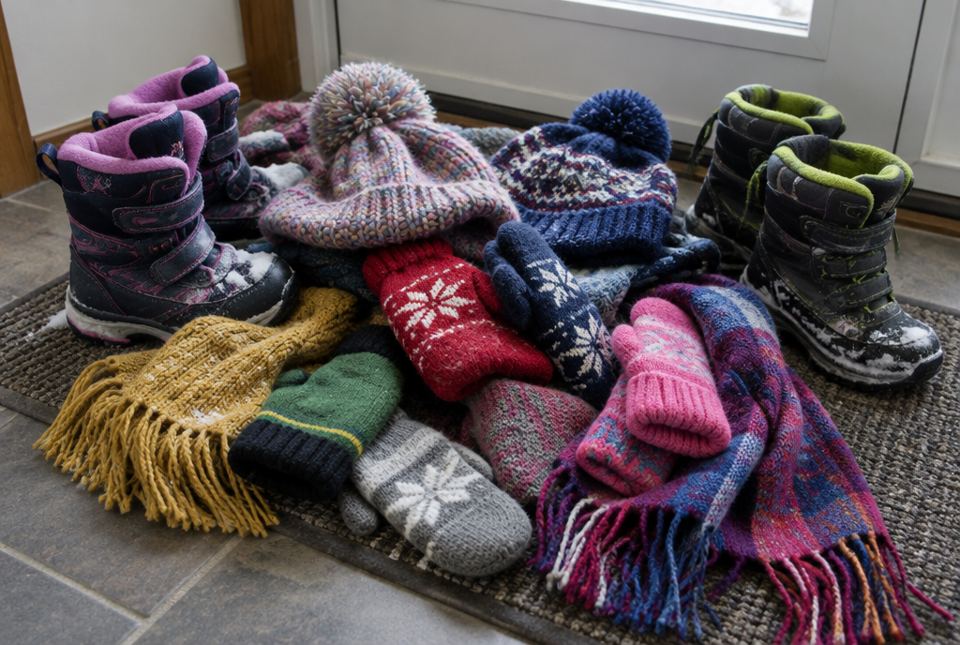 A big messy pile! How could you sort these winter clothes? Try sorting by where you wear them, or by colour. AI-generated image
What is an attribute?
An attribute is something you can notice about a thing. Here are some attributes:
- colour (red, blue, yellow)
- size (big, small)
- shape (round, square)
- kind (fruit, toy, animal)
- what it is used for (to wear on your hands, to eat with)
- how many legs (0 legs, 2 legs, 4 legs)
People have attributes too: hair colour, age, if they wear glasses, if they have a pet, if they like hockey.
When we sort by one attribute, we only think about ONE thing at a time. If we sort by colour, we only look at the colour. We do not worry about size or shape.
🍎🍎🍎🍎🍌🍌🍌🍇🍇
A fruit bowl: 4 apples, 3 bananas, and 2 bunches of grapes. These are already sorted by kind of fruit.Sorting rules
The sorting rule tells how the things were sorted. A good sorting rule is clear. Anyone who hears it can put each thing into the right group.
Here is a sorting rule: "Sort the winter clothes by where you wear them."
That gives us groups like on your head, on your hands, and on your feet.
| On your head | On your hands | On your feet |
|---|
| 🧢 tuque | 🧤 mitten | 🥾 boot |
| 🧢 tuque | 🧤 mitten | 🥾 boot |
| 🧤 mitten | |
Remember
When you sort:
- Use only one attribute at a time.
- Every thing must go into one group, and only one.
- Say your rule out loud: "I sorted by ___."
Worked exampleSorting buttons by colour
Here are 8 buttons: red, blue, red, yellow, blue, red, yellow, red. Sort them by colour. How many are in each group?
- Choose the attribute: colour. We only look at colour.
- Make one group for each colour we see: a red group, a blue group, and a yellow group.
- Put each button in its group, one at a time. Cross it off the list so you do not count it twice.
- Count each group. Red: 4. Blue: 2. Yellow: 2.
- Check: 4 + 2 + 2 = 8. All 8 buttons have a group.
Red: 4, blue: 2, yellow: 2. My sorting rule is "I sorted by colour."
Sorting the 8 buttons by one attribute, colour. Every button goes into exactly one group: red 4, blue 2, yellow 2. That is 8 buttons in all.One set, many ways to sort
The same things can be sorted in different ways. It depends on which attribute you choose.
Look at these Canadian animals: 🐻 bear, 🐟 fish, 🦆 duck, 🐿️ squirrel, 🐸 frog, 🦫 beaver.
| Sorting rule | Group 1 | Group 2 |
|---|
| Has fur or does not have fur | Has fur: 🐻 🐿️ 🦫 | No fur: 🐟 🦆 🐸 |
| Number of legs | 2 legs: 🦆; 4 legs: 🐻 🐿️ 🐸 🦫 | 0 legs: 🐟 |
| Can fly or cannot fly | Can fly: 🦆 | Cannot fly: 🐻 🐟 🐿️ 🐸 🦫 |
Two groups or more?
Sometimes a rule makes more than two groups (like colour), and sometimes it makes two groups: things that have the attribute and things that do not (like "has fur" and "does not have fur").
Worked exampleGuess my sorting rule
Maya sorted some fruit.
Group A: 🍎 apple, 🍓 strawberry, 🍒 cherries
Group B: 🍌 banana, 🍋 lemon
What was her sorting rule?
- Look at Group A. What is the same about all of them? They are all red.
- Look at Group B. What is the same? They are all yellow.
- Check that the rule works for every fruit. Is there any red fruit in Group B? No. Any yellow fruit in Group A? No.
- Say the rule: Maya sorted by colour.
Maya's sorting rule was colour (red fruit and yellow fruit).
Worked exampleSorting people
Ask 6 people: "Do you have a pet?" Leo: yes. Ava: no. Sam: yes. Mia: yes. Noor: no. Ben: yes. Sort the people.
- The attribute is has a pet. This makes two groups: yes and no.
- Yes group: Leo, Sam, Mia, Ben.
- No group: Ava, Noor.
- Count: 4 people have a pet. 2 people do not. 4 + 2 = 6, so everyone is sorted.
4 people have a pet and 2 people do not. Rule: sorted by whether they have a pet.
Just for funWhy did the sock go to the sorting party all alone?
It could not find its pair!
Hands-on activitySort it out at home
Pick one of these sorting jobs:
- Laundry: sort clean socks by colour, or by whose socks they are.
- Cutlery: sort spoons, forks and knives (the attribute is kind).
- Toy bin: sort toys by size (big and small) or by what they are made of (plastic, wood, cloth).
- Fridge: sort fruit and vegetables.
When you finish:
- Tell a grown-up your sorting rule.
- Count how many are in each group.
- Mix everything up and sort the same things a different way.
- Play Guess My Rule: a grown-up sorts something secretly, and you guess the rule!
Your turn
1Sort these by colour: 🔴 🔵 🔴 🔴 🔵 🟡. How many in each group?
Red: 3, blue: 2, yellow: 1.
2Name three different attributes you could use to sort the shoes by your front door.
Some answers: colour, size, kind (boots, running shoes, sandals), who owns them, if they have laces or not.
3Group 1: 🚗 🚌 🚲. Group 2: ✈️ 🚁. What is the sorting rule?
The rule is where it travels: Group 1 goes on land (roads), Group 2 goes in the air.
4Sort these numbers into less than 10 and 10 or more: 3, 12, 7, 25, 10, 9.
Less than 10: 3, 7, 9. 10 or more: 12, 25, 10.
5Jack sorted blocks into "big" and "red". Why is this not a good sorting rule?
It uses two attributes (size and colour). A big red block could go in both groups! A good rule uses one attribute, like "big or small".
6Sort the animals 🐄 🐔 🐖 🦆 🐑 by number of legs. How many have 2 legs? How many have 4 legs?
2 legs: 🐔 🦆 (2 animals). 4 legs: 🐄 🐖 🐑 (3 animals).
710 children were sorted by wears glasses. 3 wear glasses. How many do not?
10 − 3 = 7 children do not wear glasses.
Math talk
Great mathematicians explain their thinking. Try saying: "I put this here because...". If you get stuck, look at just one thing at a time and ask, "What do I notice about it?"
More practice: warm-up
1Sort by kind of fruit: 🍎🍌🍎🍎🍌. How many apples? How many bananas?
2True or false? When you sort by colour, you only look at the colour.
True. When you sort by one attribute, you only think about that one thing.
3Fill in the blank: Mittens go in the group on your ___.
Mittens go on your hands.
4Which one does NOT belong? 🐶 🐱 🚗 🐰
The car 🚗. The others are all animals.
5Blocks were sorted into a red group, a blue group and a green group. Were they sorted by colour, size, or shape?
More practice: on your own
1Sort by shape: 🔺 ⚫ 🔺 🟥 ⚫ 🔺 🟥. How many are in each group? Check your total.
Triangles: 3. Circles: 2. Squares: 2. Check: 3 + 2 + 2 = 7, and there are 7 shapes, so every shape has a group.
2Group 1: 🐄 🐑 🐖 🐎. Group 2: 🐟 🐬 🐙. What is the sorting rule?
Where the animal lives: Group 1 lives on land, Group 2 lives in the water. Every animal in Group 1 walks on land, and every animal in Group 2 swims.
3Sort these words by how many letters they have: cat, dog, snow, moose, sun, loon. How many words are in each group?
3 letters: cat, dog, sun (3 words). 4 letters: snow, loon (2 words). 5 letters: moose (1 word). Check: 3 + 2 + 1 = 6 words.
48 children were sorted by likes hockey. 5 are in the yes group. How many are in the no group?
3 children. 5 + 3 = 8, so 3 children are in the no group. (Or 8 − 5 = 3.)
5Sort these things by where you wear them: 🧤 🥾 🧢 🧤 🥾 🧤 🧤 🥾. How many go on your hands, your feet, and your head?
Hands 🧤: 4. Feet 🥾: 3. Head 🧢: 1. Check: 4 + 3 + 1 = 8 things.
Challenge
1Find the mistake! Noah sorted by colour.
Red group: 🍎 🍓 🍌
Yellow group: 🍋 🌽
What did he do wrong? How many should be in each group?
The banana 🍌 is yellow, so it belongs in the yellow group. Fixed: red group 🍎 🍓 (2), yellow group 🍋 🌽 🍌 (3).
2Here are 6 animals: 🐻 🦆 🐟 🐸 🦉 🐿️. Sort them by can fly or cannot fly. Then sort them a different way. Say your rule each time.
Can fly: 🦆 🦉 (2). Cannot fly: 🐻 🐟 🐸 🐿️ (4). Another way, has fur or no fur: has fur 🐻 🐿️ (2), no fur 🦆 🐟 🐸 🦉 (4). Other rules work too, like has legs or no legs.
312 mittens are sorted by colour: red, blue and green. There are 5 red and 4 blue. How many are green? How do you know?
3 green. First add the groups you know: 5 + 4 = 9. Then find how many more make 12: 9, then 10, 11, 12. That is 3 more. (12 − 9 = 3.)
Quiz
2. Group A: 🟦 🟥 🟩 (squares). Group B: 🔵 🔴 🟢 (circles). What is the sorting rule?
3. Which is a good sorting rule that uses one attribute?
4. You sort 9 crayons by colour. You get 4 red and 3 blue. The rest are green. How many are green?
5. Can the same toys be sorted in more than one way?
6. Group A: 🐶 🐱 🐰. Group B: 🍎 🍌 🍇. What is the sorting rule?
7. Ella sorted 10 socks by colour. 6 are white. The rest are black. How many are black?
What your child is learning: to sort objects and people by one attribute (colour, size, shape, kind, use) and to state the sorting rule clearly (Ontario expectation D1.1). Sorting is the first step in organizing data.
Common mistakes:
- Switching attributes halfway through (starting by colour, then putting something in a group because of its size). Ask: "What is your rule? Does this one follow it?"
- Rules that use two attributes ("big red ones"). Point out that some things could fit in two groups or none.
- Forgetting items. Have your child cross off or physically move each item, then add the group counts to check the total.
How to help: Sort real things together: laundry, groceries, recycling, Halloween candy. Play Guess My Rule often. It builds reasoning and the language of explaining. Praise your child for trying a second or third way to sort the same things.