C. Algebra · Patterns, Integers, Equations, Inequalities, Coding and ModellingComparing Linear Patterns: Constant Rate and Initial Value
C1.1 C1.2 A1About 45 minutes
Learning goals- I can find the constant rate and the initial value of a linear pattern.
- I can write the equation of a linear pattern as t = (constant rate)n + (initial value).
- I can see the constant rate and the initial value on a graph.
- I can compare two linear patterns and find where one catches up to the other.
Words to know
constant rate
The amount a linear pattern changes from one term to the next. It is the same every time. In t = 3n + 4, the constant rate is 3.
initial value
The value of the pattern at term 0: where it starts before any jumps. In t = 3n + 4, the initial value is 4.
term number (n)
The position of a term: 0, 1, 2, 3, ...
term value (t)
The number at that position.
steeper
Rising more quickly. On a graph, the pattern with the bigger constant rate is steeper.
Remember from Grade 6
In Grade 6 you wrote equations like t = 3n + 1 for linear growing patterns. The 3 was the jump, and the 1 was what you added to make it match. You also made graphs whose points lined up in a straight line.
In Grade 7 those two numbers get names: the constant rate and the initial value. They are the two best tools for comparing linear patterns.
Let's start with a choice
You want to rent skates at an outdoor rink on a snowy Saturday.
- Rink A charges $8 to start, plus $2 for each hour.
- Rink B charges $4 for each hour, with no starting fee.
(The prices in this lesson are made up for practice.)
Which is cheaper? The answer is: it depends how long you skate! By the end of this lesson you'll be able to say exactly when each rink is the better deal.
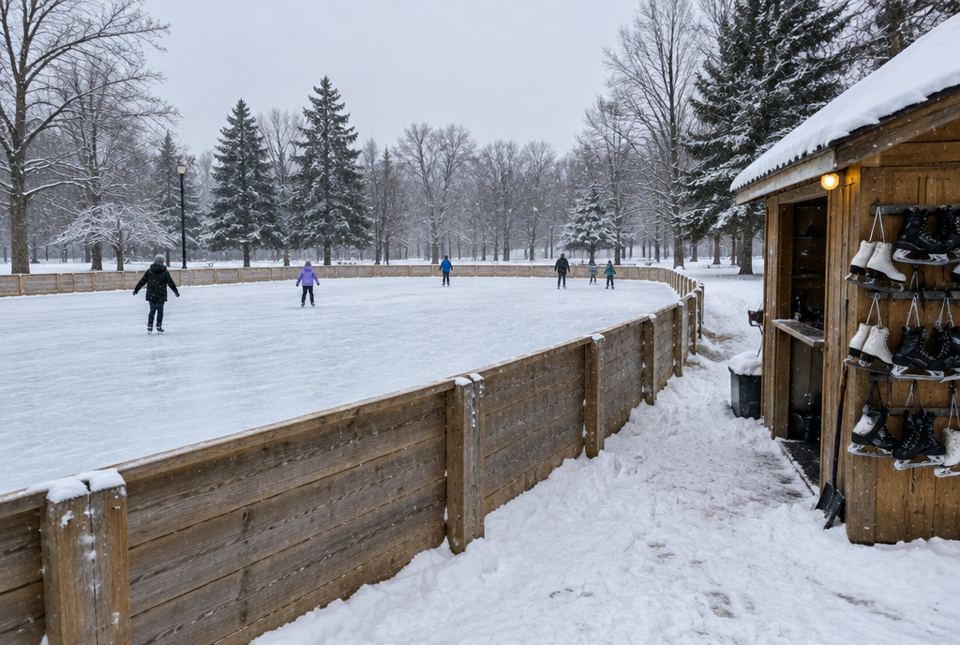 At a rink like this, a starting fee is the initial value and the price per hour is the constant rate. Together they tell you the total cost for any number of hours. AI-generated image
Two numbers tell you everything
Every linear pattern can be described with two numbers:
- The constant rate: how much the pattern changes from one term to the next.
- The initial value: the value at term 0, before any jumps happen.
Then the equation is:
t = (constant rate) × n + (initial value)
To find the initial value from a list that starts at term 1, go back one jump. For 7, 10, 13, 16, the jump is 3. Go back one jump from 7: 7 − 3 = 4. So t = 3n + 4.
For Rink A, the initial value is $8 (what you pay before skating at all) and the constant rate is $2 per hour: A = 2h + 8. For Rink B: B = 4h + 0, or just B = 4h.
| hours (h) | 0 | 1 | 2 | 3 | 4 | 5 | 6 |
|---|
| Rink A: 2h + 8 ($) | 8 | 10 | 12 | 14 | 16 | 18 | 20 |
| Rink B: 4h ($) | 0 | 4 | 8 | 12 | 16 | 20 | 24 |
Reading the graph
- The initial value is where the points start, on the vertical axis (at h = 0). A starts at 8, B starts at 0.
- The constant rate is how much the points go up for each step to the right. A goes up 2, B goes up 4. The bigger the constant rate, the steeper the line.
- Where the points meet, the two patterns are equal. Here that's 4 hours and $16.
Answer to the skating question: for less than 4 hours, Rink B is cheaper. At exactly 4 hours they cost the same ($16). For more than 4 hours, Rink A is cheaper.
A shrinking linear pattern has a constant rate that takes away. For t = 50 − 4n, the initial value is 50 and the pattern decreases by 4 each term. Its graph goes down to the right.
Check your equation
After you write an equation, test it with a term you know. For t = 3n + 4 and term 2: 3 × 2 + 4 = 10. ✓ (The 2nd term of 7, 10, 13 is 10.)
Worked exampleExample 1: Find the constant rate and initial value
The pattern 9, 14, 19, 24, ... starts at term 1. Find the constant rate, the initial value and the equation.
- Jumps: 14 − 9 = 5, 19 − 14 = 5, 24 − 19 = 5. Constant rate = 5.
- Go back one jump from term 1: 9 − 5 = 4. That is term 0, the initial value.
- Equation: t = 5n + 4.
- Check with term 3: 5 × 3 + 4 = 19. ✓
Constant rate 5, initial value 4, equation t = 5n + 4.
Worked exampleExample 2: Decimals
For term numbers 1, 2, 3 and 4, the term values are 2.75, 3.5, 4.25 and 5. Find the equation.
- Jumps: 3.5 − 2.75 = 0.75, 4.25 − 3.5 = 0.75, 5 − 4.25 = 0.75. Constant rate = 0.75.
- Initial value: 2.75 − 0.75 = 2.
- Equation: t = 0.75n + 2.
- Check term 4: 0.75 × 4 + 2 = 3 + 2 = 5. ✓
Worked exampleExample 3: Compare two patterns by their equations
Pattern P: t = 6n + 1. Pattern Q: t = 4n + 15. Which starts higher? Which grows faster? When are they equal?
- Initial values: P starts at 1, Q starts at 15. Q starts higher.
- Constant rates: P grows by 6, Q grows by 4. P grows faster (its graph is steeper).
- At term 0, Q is ahead by 15 − 1 = 14. Each term, P catches up by 6 − 4 = 2. 14 ÷ 2 = 7 terms.
- Check term 7: P = 6 × 7 + 1 = 43. Q = 4 × 7 + 15 = 43. ✓
Q starts higher, P grows faster, and they are equal at term 7 (both 43). After that, P is bigger.
Worked exampleExample 4: Two shrinking patterns
In March, snowbank A is 120 cm tall and melts 8 cm a day. Snowbank B is 90 cm tall and melts 5 cm a day. When are they the same height?
- A: initial value 120, decreases by 8: A = 120 − 8d. B: initial value 90, decreases by 5: B = 90 − 5d.
- A starts 30 cm taller. Each day A loses 3 cm more than B (8 − 5 = 3), so the gap shrinks by 3 cm a day.
- 30 ÷ 3 = 10 days.
- Check day 10: A = 120 − 80 = 40 cm. B = 90 − 50 = 40 cm. ✓
After 10 days, both are 40 cm tall. After that, A is shorter.
A quick way to compare
Gap at the start ÷ difference in constant rates = number of terms until they meet. It works when the pattern that starts lower grows faster (or the one that starts higher shrinks faster).
Just for funWhat did the initial value say to the constant rate?
"I'll get us started. You keep us going!"
Hands-on activityTwo-jar race
You need: two clear jars or glasses, a measuring cup, water and a ruler. Do this at the sink, with a grown-up's OK.
- Put 2 cm of water in jar A. Leave jar B empty.
- Each "turn", pour a little water into jar A and twice as much into jar B (for example, ¼ cup into A and ½ cup into B).
- After each turn, measure the water height in each jar with the ruler. Record it in a table.
- Find the initial value (turn 0) and the constant rate (cm per turn) for each jar. (If your jars are different sizes, the rates won't be exactly 1 to 2. That's OK. Real data is a little messy!)
- Predict on which turn jar B will catch up to jar A. Test your prediction.
Math talk: "Which jar has the bigger initial value? Which has the bigger constant rate? Why did B catch up?"
Your turn
1Find the constant rate, the initial value and the equation: 11, 14, 17, 20, ... (starts at term 1)
Constant rate 3, initial value 11 − 3 = 8, so t = 3n + 8. Check term 2: 6 + 8 = 14 ✓.
2Find the equation: 10, 17, 24, 31, ... (starts at term 1)
Constant rate 7, initial value 10 − 7 = 3: t = 7n + 3.
3Find the equation: 1.5, 2.5, 3.5, 4.5, ... (starts at term 1)
Constant rate 1, initial value 0.5: t = n + 0.5 (or t = 1n + 0.5).
4Find the equation: 0.6, 1.0, 1.4, 1.8, ... (starts at term 1)
Constant rate 0.4, initial value 0.6 − 0.4 = 0.2: t = 0.4n + 0.2. Check term 3: 1.2 + 0.2 = 1.4 ✓.
5What are the constant rate and the initial value of t = 9n + 2?
Constant rate 9, initial value 2.
6Pattern X: t = 3n + 10. Pattern Y: t = 5n + 2. Which starts higher? Which grows faster? When are they equal?
X starts higher (10). Y grows faster (5). The gap is 8 and closes by 2 each term: 8 ÷ 2 = term 4. Check: X = 22, Y = 22 ✓.
7A graph's points start at 5 on the vertical axis and go up 3 for each step right. Write the equation.
More practice: warm-up
1What is the constant rate of 4, 8, 12, 16, ...?
2Pattern 4, 8, 12, 16 starts at term 1. What is its initial value?
0 (4 − 4). Its equation is t = 4n.
3What is the initial value of t = 2n + 7?
4What is the constant rate of t = 10n + 1?
5Pattern 25, 30, 35, ... starts at term 1. What is its initial value?
More practice: on your own
1Bike rental: Shop A charges $12 plus $3 an hour. Shop B charges $6 an hour. Which is cheaper for 3 hours? For 6 hours? When do they cost the same?
3 h: A = 12 + 9 = $21, B = $18, so B. 6 h: A = 12 + 18 = $30, B = $36, so A. Same cost when the $12 gap is closed by $3 an hour: 12 ÷ 3 = 4 hours ($24 each).
2Term values for n = 1, 2, 3 are 4.5, 6, 7.5. Write the equation and find term 10.
Constant rate 1.5, initial value 4.5 − 1.5 = 3: t = 1.5n + 3. Term 10: 15 + 3 = 18.
3The pattern 60, 55.5, 51, 46.5, ... starts at term 1. Describe its constant rate and initial value. Write the equation.
It decreases by 4.5 each term. Initial value: 60 + 4.5 = 64.5 (go back one jump, so add). Equation: t = 64.5 − 4.5n. Check term 2: 64.5 − 9 = 55.5 ✓.
4Line R has initial value 9 and constant rate 2. Line S has initial value 0 and constant rate 5. Which line is steeper? At which term do they meet?
S is steeper (5 > 2). Gap 9, closing by 3 a term: 9 ÷ 3 = term 3. Check: R = 9 + 6 = 15, S = 15 ✓.
5Will t = 4n + 1 and t = 4n + 6 ever be equal? Explain.
No. They have the same constant rate, so they grow by the same amount every term. The second is always 5 more. Their graphs are parallel lines.
Challenge
1Use the snowbanks from Example 4 (A = 120 − 8d, B = 90 − 5d). Which snowbank melts away completely first? On what day?
A: 120 ÷ 8 = 15 days. B: 90 ÷ 5 = 18 days. Snowbank A melts first, on day 15, even though it started taller, because it melts faster.
2Make up two linear patterns: one with initial value 20, one with initial value 5, that are equal at term 5.
The gap is 15. To close it in 5 terms, the second pattern's constant rate must be 3 more than the first's. Example: t = 2n + 20 and t = 5n + 5. Check term 5: 30 and 30 ✓. (Any pair with rates differing by 3 works, like t = n + 20 and t = 4n + 5.)
3A linear pattern has term 3 = 17 and term 7 = 33. Find the equation.
From term 3 to term 7 is 4 jumps, and the value rises 33 − 17 = 16. Constant rate = 16 ÷ 4 = 4. Initial value: 17 − 3 × 4 = 5. Equation: t = 4n + 5. Check term 7: 28 + 5 = 33 ✓.
Quiz
1. What is the initial value of t = 6n + 11?
2. The pattern 8, 13, 18, 23, ... starts at term 1. What is its equation?
3. Which pattern has the steepest graph?
4. Plan A: $20 plus $5 a visit. Plan B: $9 a visit. After how many visits do they cost the same?
5. Where do you find the initial value on a graph of a linear pattern?
6. Pattern 40, 37, 34, 31, ... starts at term 1. Which is true?
Big idea: Grade 7 students compare linear growing patterns on the basis of their constant rates and initial values (C1.1) and represent them with equations (C1.2). In t = 3n + 4, 3 is the constant rate (the jump, or slope of the graph) and 4 is the initial value (term 0, the starting amount). This is the foundation of the linear relations students will study in Grade 8 and high school.
Common difficulties:
- Using term 1 as the initial value. For 7, 10, 13, the initial value is 4, not 7. Remind your child to go back one jump.
- Thinking the line that starts higher is steeper. Steepness depends only on the constant rate.
- Shrinking patterns: going back one jump means adding the jump.
How to help: Real-life price plans are great practice: a gym membership with a joining fee, a taxi fare, a cell phone plan. Ask "What's the starting amount? What's the amount per ...? When is the other plan better?" This lesson builds A1 skills: making connections, reasoning about choices, and explaining a decision.