B. Foundations of Language · Foundations: Grammar, Sentences and PunctuationClear Sentences: Parallel Structure and Misplaced Modifiers
B3.1 B3.2About 40 minutes
Learning goals- I can keep items in a list or pair in the same grammatical form (parallel structure).
- I can use paired conjunctions like both...and and not only...but also with parallel parts.
- I can place describing words and phrases next to the words they describe.
- I can fix sentences that say something silly because a modifier is in the wrong place.
Words to know
parallel structure
Using the same grammatical form for items that go together in a list or pair: skating, skiing and snowshoeing.
correlative conjunctions
Pairs of joining words: both...and, either...or, neither...nor, not only...but also, whether...or.
modifier
A word, phrase or clause that describes or limits another word, like only, with a red roof or who lives next door.
misplaced modifier
A modifier that is in the wrong spot, so it seems to describe the wrong word.
Did the moose really drive?
I saw a moose driving to Algonquin Park.
Read it again. The sentence says the moose was driving! The writer meant that they were driving. The phrase driving to Algonquin Park is in the wrong place.
And what's wrong with this one? This summer I like swimming, biking and to read. Two items end in -ing, but the last one doesn't match. It sounds bumpy.
In this lesson you'll learn two ways to make sentences clear and smooth: keep matching parts parallel, and keep modifiers next to what they describe.
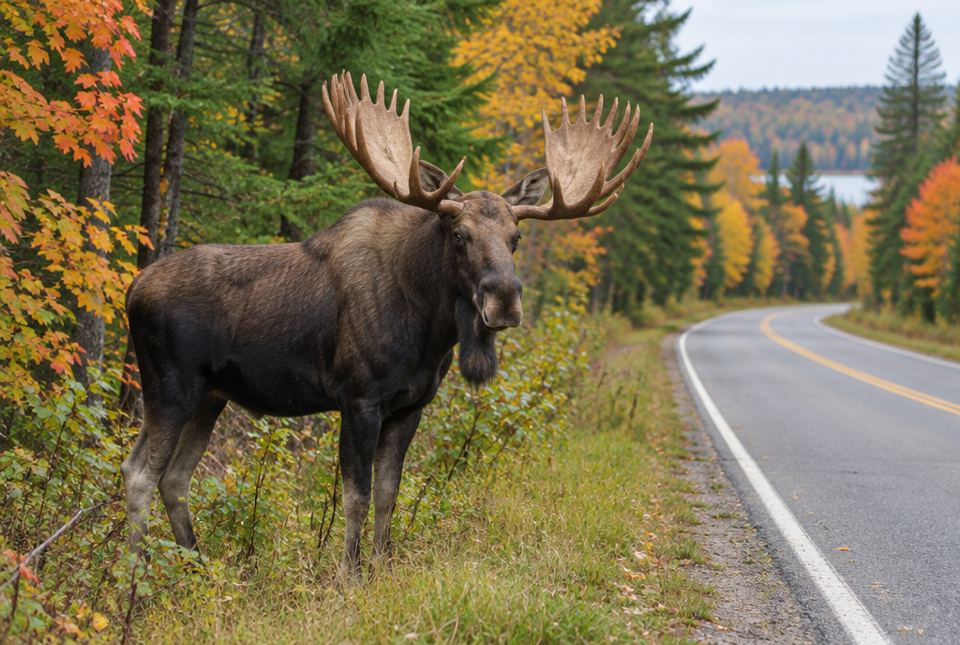 The moose is standing beside the road, not driving on it! A misplaced modifier can make a sentence say something silly like that. AI-generated image
Parallel structure
When you list or pair ideas, give them the same form.
- ❌ I like swimming, biking and to read.
- ✅ I like swimming, biking and reading. (all -ing words)
- ✅ I like to swim, to bike and to read. (all to + verb)
Parallel structure works for phrases and clauses too:
- ❌ Our goals are to recycle more and that we waste less food.
- ✅ Our goals are to recycle more and to waste less food.
Paired conjunctions
With both...and, either...or, neither...nor and not only...but also, the part after each word should match.
- ❌ She not only plays the fiddle but also the guitar.
- ✅ She plays not only the fiddle but also the guitar. (two nouns)
| Not parallel | Parallel |
|---|
| Mix the flour, adding the eggs and then stir. | Mix the flour, add the eggs and then stir. |
| He is kind, funny and has a lot of patience. | He is kind, funny and patient. |
| You can either walk or taking the bus. | You can either walk or take the bus. |
| The club meets to plan events and for raising money. | The club meets to plan events and to raise money. |
Misplaced modifiers
A modifier describes or limits something. Put it as close as possible to the word it describes.
- ❌ We bought a dog for my brother with floppy ears. (Does my brother have floppy ears?)
- ✅ We bought a dog with floppy ears for my brother.
Small words like only, almost, just and even change the meaning depending on where you put them:
- Only Sam ate the pizza. (Nobody else ate it.)
- Sam only ate the pizza. (He didn't do anything else with it.)
- Sam ate only the pizza. (He didn't eat anything else.)
In everyday talk, people often say I only ate two cookies. In careful writing, put only right before what it limits: I ate only two cookies.
Worked exampleLet's fix a misplaced modifier
Fix: I saw a moose driving to Algonquin Park.
- Ask: who was driving? I was, not the moose.
- Option 1: move the phrase next to I: Driving to Algonquin Park, I saw a moose.
- Option 2: turn the phrase into a clause: I saw a moose while I was driving to Algonquin Park.
- If a grown-up was driving the family, use we: While we were driving to Algonquin Park, we saw a moose.
While we were driving to Algonquin Park, we saw a moose. Now it's clear who was driving.
Worked exampleLet's make a list parallel
Fix: To get ready for winter, we cleaned the gutters, the snow tires were put on, and we were stacking firewood.
- List the three items: we cleaned..., the snow tires were put on (passive voice), we were stacking... (different tense).
- Pick one pattern: past-tense action verbs with the same subject we.
- Rewrite each item: cleaned the gutters, put on the snow tires, stacked firewood.
To get ready for winter, we cleaned the gutters, put on the snow tires and stacked firewood.
Just for funSpotted in an ad: Bicycle for sale by a boy with a squeaky horn. Does the boy honk? Move the modifier and the mystery is solved: Bicycle with a squeaky horn for sale by a boy.
Hands-on activitySilly sentence detective
You need: paper, coloured pencils or markers, and a family member.
- Write these misplaced-modifier sentences: The man walked his dog in a raincoat. / We gave the cake to the neighbours covered in icing. / Hanging on the wall, Mom admired the painting.
- Draw a quick funny picture of what each sentence actually says (a dog in a raincoat, icing-covered neighbours, Mom hanging on the wall).
- Under each drawing, rewrite the sentence so it says what the writer meant.
- Make up two silly sentences of your own and trade them with your family member to fix.
Model answers: The man in a raincoat walked his dog. / We gave the cake covered in icing to the neighbours. / Mom admired the painting hanging on the wall.
Your turn
1Make it parallel: I enjoy hiking, canoeing and to fish.
I enjoy hiking, canoeing and fishing.
2Make it parallel: The coach told us to stretch, hydrate and that we should rest.
The coach told us to stretch, hydrate and rest.
3Make it parallel: Our new teacher is friendly, organized and has lots of energy.
Our new teacher is friendly, organized and energetic.
4Fix the paired conjunction: You can either take the stairs or you could use the elevator.
You can either take the stairs or use the elevator. Both parts are now verbs.
5Fix the misplaced modifier: She served sandwiches to the children on paper plates.
She served sandwiches on paper plates to the children. (The plates hold the sandwiches, not the children.)
6Fix the misplaced modifier: We saw a bear on our way to school in a tree.
On our way to school, we saw a bear in a tree.
7Where should only go to show that Ravi had no other homework? Ravi had math homework.
Ravi had only math homework.
More practice: warm-up
1Which word doesn't match? running, jumping, to throw
to throw (the others are -ing words). Fix: throwing.
2Make it parallel: She likes reading and to paint.
She likes reading and painting. (or to read and to paint)
3Name the correlative conjunction pair in Both my sister and my brother play lacrosse.
A word or group of words that describes or limits another word.
5Is this parallel? We packed tents, sleeping bags and flashlights.
Yes. All three are nouns.
More practice: on your own
1Make it parallel: The science fair judges look for accuracy, creativity and whether the student explains clearly.
The judges look for accuracy, creativity and clarity. All three are now nouns.
2Fix: Not only did we visit the museum but also the art gallery.
We visited not only the museum but also the art gallery. After each part of the pair comes a noun phrase.
3Fix the modifier: Covered in mud, Dad hosed down the dog.
Dad hosed down the dog, which was covered in mud. (or Dad hosed down the mud-covered dog.) The dog was muddy, not Dad.
4Explain the difference: I almost ate the whole pie. / I ate almost the whole pie.
First: I almost ate it but didn't eat any (I nearly started). Second: I ate most of the pie. The position of almost changes the meaning.
5Make it parallel: Canada's three territories are Yukon, the Northwest Territories and Nunavut is the third.
Canada's three territories are Yukon, the Northwest Territories and Nunavut. Remove is the third so all three items are names.
Challenge
1Write a sentence about a school event using not only...but also with parallel parts.
Model: The winter concert raised not only money for the food bank but also our school spirit. Both parts after the pair are noun phrases.
2Fix both problems: Walking into the gym, the decorations amazed us, and we saw balloons, streamers and the lights were twinkling.
Walking into the gym, we were amazed by the decorations: balloons, streamers and twinkling lights. (The walkers are we, and the list is now three noun phrases.) Other correct fixes are fine.
3The sign says: Dogs must be kept on a leash in the park only. What might it mean, and how could you make it clearer?
It could mean dogs need leashes only in the park (not elsewhere). It probably means Only leashed dogs are allowed in the park or In the park, dogs must be on a leash at all times. Placing only carefully, or rewording, removes the confusion.
Quiz
1. Which sentence uses parallel structure?
2. Which sentence has a misplaced modifier?
3. Which sentence uses either...or correctly?
4. Only Maya finished the quiz. What does this mean?
5. Choose the best fix: Sizzling on the barbecue, I smelled the burgers.
What this lesson is about: writing clear sentences. Parallel structure keeps items in a list or pair in the same form; correct modifier placement keeps descriptions next to what they describe.
How to help at home:
- Enjoy funny misplaced modifiers together (newspaper headlines and signs are full of them). Laughing at what a sentence literally says builds the skill.
- When your child writes a list, ask: "Do all the items match? Are they all -ing words, all nouns, all verbs?"
Common difficulties:
- The last item in a list changes form (swimming, biking and to read).
- Placing not only too early in the sentence.
- Not noticing a misplaced modifier because the reader already knows the intended meaning. Reading literally (like a robot) helps.