B. Foundations of Language · Foundations: Speaking, Listening, Words and FluencySpeaking with Purpose: Know Your Audience, Plan Your Talk, Speak on the Spot
B1.3 A1.1 A1.2About 45 minutes
Learning goals- I can identify the purpose and audience for speaking in formal and informal situations.
- I can analyze what an audience knows and needs, and change my talk to fit them.
- I can organize a talk with a clear structure so it is easy to follow.
- I can use the PREP plan to speak clearly when I have little time to prepare.
Words to know
purpose
The reason you are speaking: to inform, explain, persuade, entertain, inspire, honour or request.
audience analysis
Thinking about who your listeners are, what they know and what they need before you speak.
structure
The way a talk is organized from beginning to end.
impromptu
Done on the spot, with little or no time to prepare.
PREP
A plan for short talks: Point, Reason, Example, Point again.
coherent
Easy to follow because the ideas are connected and in a sensible order.
Remember from Grade 6
In Grade 6 you asked two questions before speaking (What is my purpose? Who is my audience?), chose a formal or informal register, and made talks clear with an opening, signposts, definitions and a strong closing. In Grade 7 you'll analyze your audience more deeply, pick a structure that fits your purpose, and practise impromptu speaking: talking clearly when you only have a minute to get ready.
Let's start with a puzzle
Zara has to tell people about the new water-bottle refill station at school. She gives the talk twice.
To her Grade 2 reading buddies: "Guess what? We have a magic water fountain! Well, not magic. It fills your bottle in five seconds! Who has a water bottle? Put your hand up!"
To the school council (parents and the principal): "Good evening. Since the refill station was installed, our class has been counting how often students use it. In two weeks, it was used more than 600 times. We'd like to ask the council to consider a second station near the gym."
Same topic. Different audience, different purpose (to excite vs. to request), different words, structure and length. That's what strong speakers do.
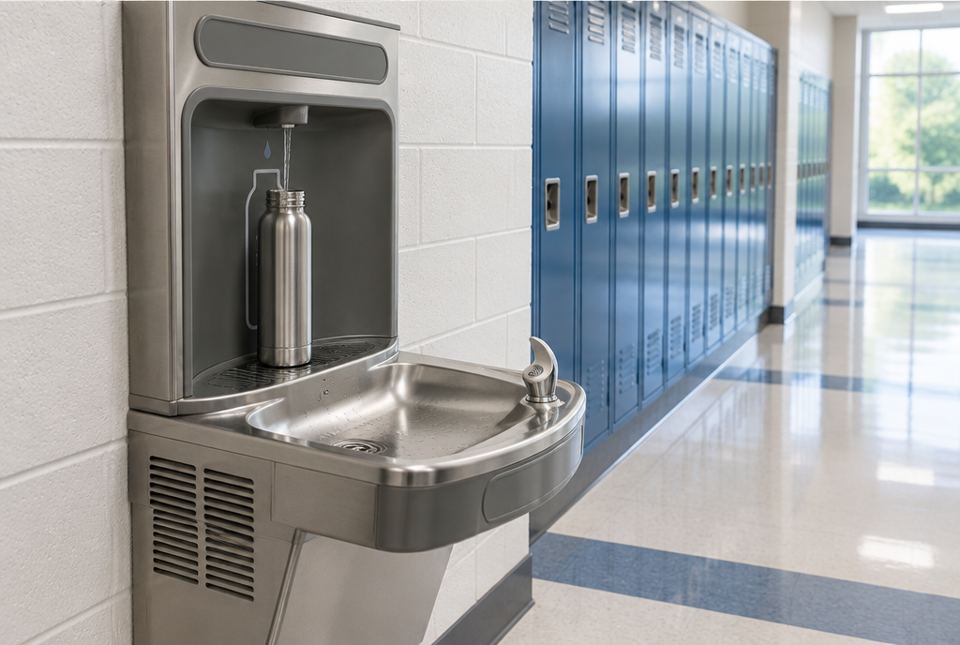 Zara talks about a refill station like this to two very different audiences. The topic stays the same; the purpose, words and length change. AI-generated imageSame topic, two audiences. Zara changes her purpose, register, words and ending to fit each group.
Purposes for speaking
Most talks have one main purpose (and sometimes a second one):
- Inform or explain: a report on Arctic sea ice; how to wax cross-country skis.
- Persuade: convince the class to vote for your idea.
- Entertain: tell a funny story about your first time skating.
- Inspire: encourage people to join a cleanup or try something hard.
- Honour or commemorate: a speech at a Remembrance Day assembly, or thanking a retiring crossing guard.
- Request: ask the principal for permission to start a club.
| Ask about your audience | Why it matters | Example decision |
|---|
| How many people? Where? | A big gym needs more volume and slower speech than a small group | Use a microphone or project your voice; use big visuals |
| How formal is the situation? | Sets your register | Student council meeting: formal; club meeting with friends: informal |
| What do they already know? | Don't bore experts or lose beginners | Define aquifer for Grade 4s; skip the definition for the science club |
| What do they care about? | Connect your topic to their interests | Parents: safety and cost. Students: fun and time |
| What do they need to do afterwards? | Your closing should make it clear | "Sign up by Friday in Room 12." |
Choosing a structure
A clear structure helps listeners follow, because they can't flip back like a reader. Choose one that fits your purpose:
- Chronological (time order): for stories, histories and how-to talks. First... then... finally.
- Problem–solution: for persuading or requesting. Describe the problem, give your solution, answer worries, ask for action.
- Main points (topic order): for informing. Preview your points ("I'll talk about three things..."), then cover each one.
- Compare and contrast: for choices. Option A... Option B... Here's why I choose B.
All structures need a hook at the start (a question, surprising fact or short story), signposts in the middle, and a closing that sums up and tells the audience what to remember or do.
Speaking on the spot: PREP
Sometimes you're asked to speak with no time to plan: answering a question in class, giving your opinion at a meeting, or explaining your idea in a group. Use PREP:
- Point: say your main idea in one sentence.
- Reason: give the most important reason.
- Example: give a fact, story or example that supports it.
- Point again: restate your idea, a little differently.
PREP keeps you coherent: no rambling, no losing track.
Worked exampleLet's give an impromptu PREP answer
Your teacher asks: "Should our school have a longer winter break?" You have 30 seconds to think.
- Point: "I think our winter break should stay the same length."
- Reason: "If the break gets longer, the school year would have to end later in June or start earlier in the fall."
- Example: "Many families plan summer jobs, camps and cottage trips around the usual school dates, so a later end could cause problems."
- Point again: "So, even though more holiday sounds great, keeping the break the same length works better for most families."
A clear, coherent answer in four sentences: point, reason, example, point again. (You could use PREP for the other side too. The structure works for any opinion.)
Just for funIf your mind goes blank when someone asks you to speak on the spot, think of PREP as a GPS for your mouth: Point, Reason, Example, Point again, and you have arrived.
Clarity checklist
- Preview your main points.
- One idea at a time, each with an example.
- Define words your audience may not know.
- Slow down for numbers, names and key ideas.
- Repeat your most important idea at the end. Listeners need to hear it more than once.
Hands-on activityImpromptu speaking cards
You need: 10 small slips of paper, a pencil, a bowl or hat, and a timer.
- With a family member, write one question on each slip, like: Is it better to live in the country or the city? Should pets be allowed at school? What is the best winter activity? Should Grade 7s have homework? What skill should every Canadian kid learn?
- Fold the slips and put them in the bowl.
- Pick one. Take 30 seconds to plan using PREP (you can write four words on paper, one for each letter).
- Speak for about 1 minute.
- Your listener gives feedback: Was the point clear? Did you give a reason and an example? Did you finish by restating your point?
- Bonus: pick a slip and give the talk twice, once for a Grade 2 audience and once for a formal meeting.
What to look for: all four PREP parts, a clear first sentence, and changes in words and examples when the audience changes.
Your turn
1What is the main purpose of a speech at a Remembrance Day assembly?
To honour or commemorate (remember and show respect for) people who served and died in wars and conflicts.
2Name three questions to ask when analyzing an audience.
Any three: How many people and where? How formal is it? What do they already know? What do they care about? What should they do afterwards?
3Which structure fits a talk asking the principal to add a bike rack? Why?
Problem–solution. You describe the problem (nowhere to lock bikes), give the solution (a rack) and ask for action.
4What do the letters in PREP stand for?
Point, Reason, Example, Point (again).
5You're explaining how maple syrup is made to Grade 1 students. Name one change you'd make for this audience.
Examples: use simple words, define words like sap, show pictures, keep it short, add a question to keep them involved.
6Why do listeners need signposts more than readers do?
Listeners can't see paragraphs or headings and can't flip back, so signposts tell them where they are in the talk.
7Give one type of hook for the start of a talk.
Any one: a question, a surprising fact, a short story, a quotation.
More practice: warm-up
1What does impromptu mean?
Done on the spot, with little or no time to prepare.
2What is the purpose of a funny story about your first time skating?
3Which structure uses first, then, finally?
Chronological (time order).
4True or false: You should give the same talk in the same way to every audience.
False. Change your words, examples and structure to fit the audience.
5What does the last P in PREP remind you to do?
Restate your point at the end.
More practice: on your own
1Use PREP to answer: Should students be allowed to listen to music while doing homework?
Example: P: I think students should be allowed music while doing some homework. R: For some people, quiet music helps them focus. E: My cousin finishes math faster with instrumental music on. P: So music can help, as long as it doesn't have lyrics that distract.
2A talk on recycling is for the school's Eco Club, who already know a lot. What should the speaker skip and what should they add?
Skip basic definitions they already know (like what recycling is). Add new or deeper information, such as local numbers or a new project idea.
3Why would a speaker slow down when giving the date and time of an event?
Numbers and details are easy to miss when listening, and the audience needs that information to take part.
4Explain the difference between a talk to inform and a talk to persuade about the same topic: school uniforms.
An informing talk explains facts (what uniforms are, which schools use them) without taking a side. A persuading talk takes a side and gives reasons and evidence to convince the audience.
5Your speech to the school council sounds like this: "Um, so, yeah, we kind of want a garden, I guess." Rewrite your opening to be clear and formal.
Example: "Good evening. Our class is asking the council to support a vegetable garden beside the portables."
Challenge
1Plan a 1-minute talk with a problem–solution structure on this topic: The school's lost-and-found is overflowing. Give one sentence for each part (problem, solution, answer a worry, call to action).
Example: Problem: "Our lost-and-found has more than 50 jackets and mittens, and most are never claimed." Solution: "Let's display items in the front hall every Friday." Worry: "It won't take much time; the Eco Club can set it up in 10 minutes." Action: "Please check the display this Friday before you go home."
2Analyze: A speaker gives a great talk about volcanoes to a Grade 8 science class, then gives the exact same talk to a group of kindergarten children. What will probably go wrong, and why?
The kindergarten children will probably lose interest and not understand, because the talk uses words they don't know, is too long, and has no pictures or actions for them. The speaker didn't analyze the new audience.
3Why can PREP make an impromptu answer more coherent than just saying whatever comes to mind?
PREP gives the answer a clear order: the main idea first, then support, then a return to the idea. Each sentence connects to the point, so listeners can follow, and the speaker doesn't ramble or lose track.
Quiz
1. What is the main purpose of a talk asking the principal to start a chess club?
2. Which question is part of audience analysis?
3. Which structure is best for a talk that tells how to build a snow fort, step by step?
4. In PREP, what comes right after the Reason?
5. Which opening is best for a formal talk to the school council?
6. Why should a speaker repeat the most important idea at the end?
Big idea (B1.3, A1.1, A1.2): Grade 7 students identify the purpose and audience for speaking in formal and informal contexts and choose strategies to communicate clearly and coherently. This lesson adds deeper audience analysis, choosing a structure to fit the purpose, and the PREP plan for impromptu speaking.
How to help at home:
- Use dinner-table impromptu questions with PREP. Keep it light and fun.
- Before a real situation (calling to book an appointment, asking a coach a question), help your child decide on the purpose and their first sentence.
- Notice speakers together (a news anchor, a coach, a guide at a museum) and ask, "Who is the audience? How can you tell?"
Common difficulties:
- Rambling. PREP gives a stopping point: once you've restated your point, stop.
- Forgetting the example. A reason without an example often sounds vague. Ask, "Can you give me one example?"
- Nervousness. Practise short, low-stakes talks often; confidence grows with repetition.