A. Literacy Connections and Applications / C. Comprehension: Understanding and Responding to Texts · Understanding and Responding to TextsBefore and During Reading: Using Prior Knowledge and Making Predictions
C2.1 C2.3 A3.1About 40 minutes
Learning goals- I can identify prior knowledge from my own life, other texts and other subjects, and use it to understand a new text.
- I can make predictions using what I know and clues in the text.
- I can check my predictions by asking questions as I read.
- I can revise my understanding when a prediction doesn't match the text.
Words to know
prior knowledge
What you already know before you read, from experience, other texts and other subjects.
prediction
A thoughtful guess about what will happen or what you will learn, based on evidence.
confirm
To show that something is right.
revise
To change your thinking when you get new information.
lift
In flight, the upward force that holds an aircraft up.
bush pilot
A pilot who flies small planes to remote places, often with no roads, landing on water, snow or short airstrips.
Remember from Grade 5
In Grade 5 you used prior knowledge from other subjects and made, checked and revised predictions.
In Grade 6 you will be more precise: you will say exactly where your prior knowledge came from, use both background knowledge and text clues for every prediction, and ask questions to test your predictions while you read.
Hook: What do you already know about flying?
Before reading the story below, take one minute and list everything you know about airplanes and flying. Think about:
- Your life: Have you flown, watched planes, or flown a paper airplane?
- Other texts: books, movies or videos about flight.
- Other subjects: In Grade 6 science you study flight, including forces like lift, weight, thrust and drag.
That list is your prior knowledge. It will help you understand and predict.
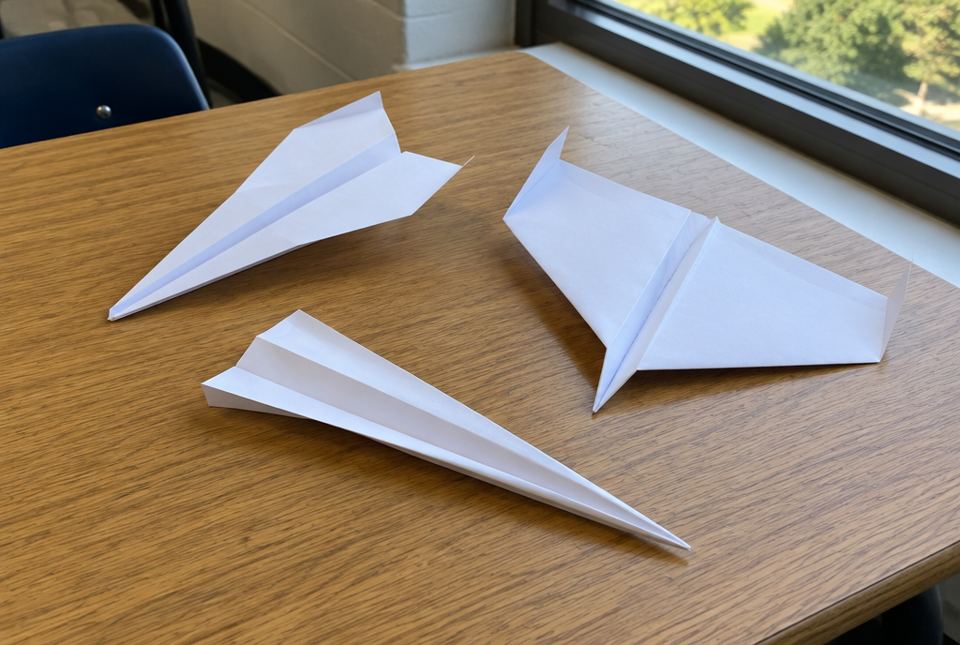 Three paper airplane designs. What do you already know about which shape might fly farthest? That is prior knowledge you can bring to the story. AI-generated image
Float Plane North (a story written for this website, Part 1)
Nia's aunt Rosa was a bush pilot. Every summer she flew a small float plane from a lake near Sioux Lookout to communities in northern Ontario where there were no roads.
This July, Nia got to come along. The plane was packed with boxes of fresh vegetables, a crate of library books and a new part for a water pump.
"Seat belt," said Aunt Rosa. She checked the gauges, then frowned at the sky in the west. A grey bank of cloud sat low on the horizon.
"Is that a problem?" Nia asked.
"Not yet," said Aunt Rosa. But she tapped the radio and asked for a weather report.
Stop and predict: What do you think will happen? What makes you think so?
Worked exampleLet's use prior knowledge and text clues to predict
Make a prediction at the end of Part 1. Show which part comes from prior knowledge and which from text clues.
- Text clues: Aunt Rosa frowned at the sky; there is a grey bank of cloud; she said Not yet; she asked for a weather report.
- Prior knowledge (other texts and life): In stories, a worried character and dark clouds often mean trouble is coming. Grey, low clouds can bring rain or storms.
- Prior knowledge (science): Small planes are affected by wind and weather. Pilots need to see where they are going and avoid storms.
- Prediction: The weather will get worse, and Aunt Rosa will have to land early or change course.
Prediction: the storm will force Aunt Rosa to change her plan. Evidence: the frown, the clouds, the weather report (text), plus knowing that storms are dangerous for small planes (prior knowledge).
A strong prediction uses both sides: clues from the text plus what you already know. Either one alone is just a guess.Float Plane North (Part 2)
The radio crackled. "Thunderstorms moving east, arriving in about an hour."
Aunt Rosa looked at her map. "We'll make our first stop before it hits," she said, "and wait it out there."
They landed smoothly on a wide lake, the floats skimming the water. A group of kids ran down to the dock to help unload. A woman in a ball cap shook Aunt Rosa's hand. "The pump part! Finally. Our water plant has been down for three days."
While they waited out the storm in the community's band office, Nia helped carry the crate of library books to the school. A boy named Daniel opened it first and held up a hockey novel. "I've been waiting for book two!" he said.
Stop and check: Was your prediction confirmed, partly confirmed, or not confirmed? What do you predict now?
Worked exampleLet's check and revise our prediction
Use questions to test the prediction The weather will get worse, and Aunt Rosa will have to land early or change course.
- Question: Did the weather get worse? Yes, thunderstorms were coming, so that part is confirmed.
- Question: Did she land early or change course? She planned ahead: she landed at the first stop before the storm and waited. That is partly confirmed: she didn't change course in danger, she made a safe plan early.
- Revise: I expected a scary emergency, but the story is really about a careful pilot and how important the deliveries are (the pump part, the books).
- New prediction: Nia will learn how much these flights matter to the community, and they'll continue once the storm passes.
Partly confirmed. The weather did get worse, but there was no emergency; Aunt Rosa planned ahead. I revised my understanding: the story's focus is the importance of the deliveries and the community, not danger.
Predicting is a loop, not a one-time guess. In Float Plane North, the storm prediction was only partly confirmed, so readers revised it and kept going.| Question to test a prediction | When to use it |
|---|
| Is there new evidence that supports my prediction? | Every time you finish a section |
| Is there evidence that goes against it? | When something surprises you |
| Was I using the right prior knowledge? | When the text turns out to be a different kind than you expected |
| What do I predict now, and why? | After you confirm or revise |
When prior knowledge gets in the way
Prior knowledge helps, but sometimes it misleads you. Many readers expected a disaster in Float Plane North because, in many adventure stories, storms lead to crashes. This story went a different way.
Prior knowledge can also be incomplete or wrong. If someone only knows about northern communities from a single movie, they might bring stereotypes to the story. A good reader holds prior knowledge loosely and lets the text teach them.
Prediction checkPrediction: you will smile at this sentence.
Confirmed? Partly confirmed? Not confirmed? If it's "not confirmed," revise your prediction: the next joke might be funnier.
Prior knowledge from other subjects
Science: forces of flight, weather, ecosystems. Social studies: Canada's geography, communities, and how people in different places meet their needs. Math: reading maps with scales, distances and times. Health: safety and decision-making. When you read, ask: Where have I learned something about this before?
Hands-on activityPrediction flight log
You need: a novel or long story you haven't read, paper, a pencil, sticky notes.
- Before reading, make a K-W-L chart (Know, Want to know, Learned) and fill in the K column. Label each fact with where you learned it: life, text or subject.
- Fold a paper into a flight log with columns: Stop, My prediction, Text clue, Prior knowledge, Confirmed / Partly / Revised.
- Read one chapter. Stop three times. Fill in a row each time.
- Make a paper airplane. Before you throw it, predict how far it will fly using what you know about lift and drag. Throw it, check, then revise the design and predict again. Talk about how this is like predicting in reading.
Your turn
1Name three sources of prior knowledge.
Your own experiences, other texts (books, movies, videos), and other subjects (science, social studies, math).
2Which text clues in Part 1 suggest trouble?
Aunt Rosa frowned at the sky, there was a grey bank of cloud, she said Not yet, and she asked for a weather report.
3How does science prior knowledge help you understand Part 1?
Knowing that weather and wind affect small planes and that pilots must avoid storms helps you understand why Aunt Rosa is worried.
4Was the prediction There will be a crash confirmed? Explain.
No. Aunt Rosa landed safely at the first stop before the storm and waited it out.
5Why did the woman at the dock say Finally?
The community's water plant had been down for three days, and the plane brought the pump part they needed.
6What is one question you can ask to test a prediction while reading?
Any one: Is there new evidence for it? Is there evidence against it? Was I using the right prior knowledge? What do I predict now?
More practice: warm-up
A thoughtful guess based on evidence.
To change your thinking when you get new information.
3What kind of plane did Aunt Rosa fly?
4What did Daniel find in the crate?
A hockey novel, book two of a series he was waiting for.
5Name one force of flight.
Any one: lift, weight (gravity), thrust, drag.
More practice: on your own
1Why is a prediction that uses both a text clue and prior knowledge stronger than a guess?
It has evidence from two sources: what the text shows and what you already know, so it is more likely to make sense.
2How did prior knowledge from adventure stories mislead some readers of Float Plane North?
Adventure stories often turn storms into disasters, so readers expected a crash, but this story showed careful planning and focused on the community.
3What do the pump part and library books suggest about the bush pilot's job?
The flights bring things communities really need: essential supplies (like the pump for clean water) and things that bring joy and learning (books).
4Make a new prediction for what happens after the storm. Give one clue.
Example: Aunt Rosa and Nia will fly on to the next community. Clue: Aunt Rosa said they would wait it out at the first stop, which means they planned to continue. (Any prediction with a clue is acceptable.)
5How could math prior knowledge help someone reading about a flight?
Reading map scales, calculating distance and time, and understanding numbers on gauges help them follow the trip.
Challenge
1A reader's only prior knowledge about northern communities is a cartoon showing igloos everywhere. How could this affect their reading of Float Plane North, and what should they do?
They might bring a stereotype and misunderstand the story (the community has a dock, a band office, a school, a water plant). They should let the text correct them, and learn from accurate sources, especially texts by people who live in northern communities.
2Explain how throwing a paper airplane, checking and redesigning is like predicting while reading.
In both you predict using what you know, test it (throw / read on), check the result against the evidence, and revise your thinking (redesign / new prediction).
3Write a stop-and-predict question for Part 2 that makes readers use both a text clue and prior knowledge. Then answer it.
Example: Daniel has been waiting for book two. What does this tell you about getting books in his community? Answer: Books probably come only by plane, so they arrive less often (text clue: I've been waiting; prior knowledge: communities with no roads get supplies by air or winter road).
Quiz
1. Which is an example of prior knowledge from another subject?
2. A strong prediction is based on...
3. In Float Plane North, what did Aunt Rosa do about the storm?
4. If your prediction is not confirmed, you should...
5. Why did the community need the pump part?
6. Which question best helps you check a prediction?
What this lesson teaches: Grade 6 students identify prior knowledge from various sources, including other subjects, and use it to understand new texts (C2.1). They make predictions using background knowledge and text information, check them by asking questions, and revise understanding (C2.3). They see how literacy connects to science, social studies and math (A3.1).
How to help at home:
- Before reading, ask: "What do you already know about this? Where did you learn it?"
- Pause at chapter ends: "What do you predict? What clue made you think that?"
- When a prediction is wrong, celebrate the revision: "What did the author do that surprised you?"
Common difficulties:
- Predictions without evidence. Ask for one clue from the text.
- Never revising. Some children defend their first prediction; model changing your mind.
- Stereotypes as prior knowledge. Gently point out when prior knowledge is incomplete.
About the story: Float Plane North was written for this site; the characters and the community are fictional. Sioux Lookout is a real town in northwestern Ontario, and many communities in northern Ontario are reached by air and, in some places, by winter roads. Lift, weight, thrust and drag are the four forces of flight studied in Grade 6 science.
Safety: Paper airplanes are safe; throw them away from faces.