E. Spatial Sense · Spatial Sense: Angles, Triangles, Transformations and AreaCongruent Triangles, Rectangles and Parallelograms
E1.2About 35 minutes
Learning goals- I can explain what congruent means: same size and same shape.
- I can check whether two triangles, rectangles or parallelograms are congruent by comparing their sides and angles.
- I can construct a shape that is congruent to another shape.
Words to know
congruent
Exactly the same size and the same shape. One shape fits perfectly on top of the other, even if you have to turn or flip it.
corresponding parts
Sides or angles that match up when one shape is placed on top of the other.
parallelogram
A quadrilateral with 2 pairs of parallel sides. Its opposite sides are equal and its opposite angles are equal.
rectangle
A parallelogram with 4 right angles.
Remember from Grade 2
In Grade 2 you learned that congruent shapes are the same size and the same shape. They fit exactly on top of each other, even when one is turned or flipped. In Grade 4 you learned about parallel sides and the properties of rectangles. Now you will use measurements to prove that triangles, rectangles and parallelograms are congruent, and you will build congruent shapes yourself.
Let's start with a quilt
A quilter is making a blanket for a new baby. She needs 40 triangle pieces that fit together perfectly. If one triangle is a tiny bit too big, the pattern won't line up. Every piece must be congruent to her pattern piece.
Factories, builders and designers need congruent parts all the time: floor tiles, window panes, the two doors of a cupboard.
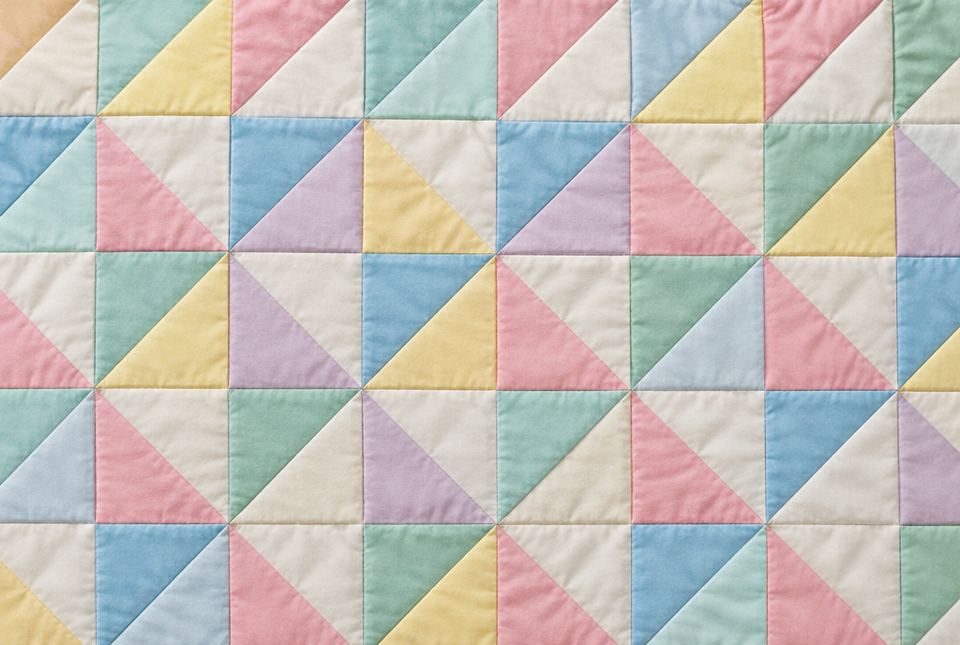 Every triangle in this quilt is the same size and shape. They are congruent, so they fit together perfectly. AI-generated imageLeft: two right triangles, one turned and flipped, with legs of 4 and 3 squares. Congruent. Middle: a rectangle 4 squares by 2 squares and one 2 by 4. Congruent (just turned). Right: two parallelograms with the same side lengths, but one leans more. Not congruent.
How to check for congruence
Way 1: Trace and place. Trace one shape, cut out the tracing, and try to place it exactly on the other. You may slide it, turn it or flip it over. If it covers the other shape exactly, they are congruent.
Way 2: Measure. Measure the corresponding parts (the sides and angles that match up). In congruent shapes, every pair of corresponding sides is equal, and every pair of corresponding angles is equal.
On a drawing, matching tick marks show equal sides and matching arcs show equal angles.
Shortcuts for each shape
- Triangles: if all three sides match, the triangles are congruent. (Remember from the last lesson: three sides make only one triangle shape.) Two sides and the angle between them is also enough.
- Rectangles: all angles are 90°, so you only need to check the length and the width.
- Parallelograms: be careful! The side lengths are not enough. A parallelogram can lean more or less, like a gate that sags. You must check the sides and an angle.
Worked exampleExample 1: Rectangles
Rectangle A is 8 cm by 3 cm. Rectangle B is 3 cm by 8 cm. Are they congruent?
- Both rectangles have all four angles equal to 90°.
- Compare the sides: both have two 8 cm sides and two 3 cm sides. B is just turned a quarter turn.
Worked exampleExample 2: Triangles
Triangle P has sides 5 cm, 6 cm and 7 cm. Triangle Q has sides 7 cm, 5 cm and 6 cm. Are they congruent?
- List the sides of each from shortest to longest. P: 5, 6, 7. Q: 5, 6, 7.
- All three pairs of sides match. Three sides decide a triangle.
Yes, they are congruent. The order in which the sides were listed doesn't matter.
Worked exampleExample 3: Parallelograms
Two parallelograms both have sides of 5 cm and 3 cm. One has angles of 60° and 120°. The other has angles of 70° and 110°. Are they congruent?
- The sides match.
- But the angles don't: 60° is not equal to 70°. One parallelogram leans more than the other.
- If you put one on top of the other, the slanted sides would not line up.
No, they are not congruent. For parallelograms, the sides and the angles must match.
Constructing a congruent shape
On grid paper, count the squares. Copy each move from one vertex to the next: "5 squares right, 2 right and 3 up, 5 left, 2 left and 3 down."
On plain paper, use a ruler and protractor. Copy each side length and each angle exactly.
Worked exampleExample 4: Copy on a grid
Make a congruent copy of the parallelogram in the picture above.
- Pick a starting vertex for the copy anywhere on the grid.
- Move 5 squares right. Mark a vertex.
- Move 2 right and 3 up. Mark a vertex.
- Move 5 squares left. Mark a vertex.
- Join the vertices. Check: you should end with a move of 2 left and 3 down back to the start.
The copy has the same sides and the same angles, so it is congruent to the original.
Show your evidence
When you say two shapes are congruent, be ready to give your evidence: "I measured all three sides, and they match." Mathematicians don't just say "they look the same", because looks can fool you!
Just for funRiddle: What did one congruent triangle say to the other?
"Wow, you look just like me, from every angle!"
Hands-on activityCongruent cookie cutters (paper version)
You need: paper or thin cardboard (like a cereal box), a ruler, a protractor, a pencil and scissors (with a grown-up).
- Draw a triangle with sides 6 cm, 8 cm and 10 cm. Cut it out. This is your pattern piece.
- Use your pattern to trace and cut 3 more congruent triangles. Check each new one by placing it on the pattern.
- Fit two triangles together along their longest sides. What shape do you make? Try fitting them together different ways.
- Now draw a parallelogram with sides 6 cm and 4 cm and angles of 60° and 120°. Cut it out. Ask your grown-up to draw one with sides 6 cm and 4 cm and angles of 80° and 100°. Place one on the other. Are they congruent?
(What to notice: in step 3, two of these right triangles joined along their longest sides make a rectangle 6 cm by 8 cm or a kite shape. Joined along other sides, they can make parallelograms or a bigger triangle. In step 4, the parallelograms are not congruent, because their angles differ.)
Math talk: "Why isn't it enough to check only the sides of a parallelogram?"
Your turn
1Two squares each have sides of 4 cm. Are they congruent?
Yes. All squares have 90° angles, and all their sides are 4 cm.
2Rectangle A is 6 cm by 2 cm. Rectangle B is 4 cm by 3 cm. They both have an area of 12 cm². Are they congruent?
No. Same area doesn't mean same shape. Their side lengths don't match.
3Triangle X has sides 3 cm, 4 cm, 5 cm. Triangle Y has sides 5 cm, 3 cm, 4 cm. Congruent?
Yes. All three sides match.
4Two triangles both have angles of 50°, 60° and 70°. One has a longest side of 4 cm and the other has a longest side of 8 cm. Congruent?
No. They are the same shape, but not the same size.
5Two parallelograms both have sides 6 cm and 4 cm and angles of 50° and 130°. Congruent?
Yes. The sides and the angles all match.
6A rectangle and a parallelogram both have sides of 6 cm and 4 cm. The parallelogram's angles are 70° and 110°. Congruent?
No. The rectangle's angles are all 90°, but the parallelogram's are not.
More practice: warm-up
1What does congruent mean?
Same size and same shape.
2If you flip a shape over, is it still congruent to the original?
Yes. Flipping, turning or sliding doesn't change size or shape.
3Is a 5 cm by 2 cm rectangle congruent to a 2 cm by 5 cm rectangle?
4Is a square with 3 cm sides congruent to a square with 4 cm sides?
No. They are different sizes.
5Name one way to check if two paper shapes are congruent.
Trace one and place it on the other, or measure all the sides and angles.
More practice: on your own
1A parallelogram on a grid has vertices at (0, 0), (5, 0), (7, 3) and (2, 3). You start a congruent copy at (10, 0). Where are the other three vertices?
(15, 0), (17, 3) and (12, 3). Every vertex moves 10 to the right, so add 10 to each first number.
2How many measurements do you need to check that two rectangles are congruent?
Two: the length and the width. All rectangles already have four 90° angles.
3Triangle A has sides of 5 cm and 7 cm with a 40° angle between them. Triangle B is drawn the same way. Are they congruent? Explain.
Yes. Two sides and the angle between them decide a triangle, so both triangles must be the same.
4Are all equilateral triangles congruent? Explain.
No. All equilateral triangles have 60° angles, so they are the same shape. But they can have different side lengths, like 2 cm or 10 cm, so they are not all the same size.
5Two rectangles both have a perimeter of 20 cm. Must they be congruent? Give an example.
No. A 6 cm by 4 cm rectangle and a 7 cm by 3 cm rectangle both have a perimeter of 20 cm, but they have different sides.
Challenge
1Cut a 6 cm by 4 cm rectangle along a diagonal (corner to opposite corner). Are the two triangles congruent? Explain.
Yes. Each triangle has a 6 cm side, a 4 cm side and the diagonal (which they share). All three sides match, so they are congruent.
2Draw two parallelograms with sides of 5 cm and 3 cm that are not congruent. Describe them.
Model answer: one is a rectangle 5 cm by 3 cm (all angles 90°). The other leans, with angles of 60° and 120°. Same sides, different angles, so not congruent.
3Nia says, "If two triangles have the same three angles, they must be congruent." Is she right? Explain.
No. Matching angles give the same shape, but one triangle could be an enlarged copy of the other. To be congruent, the sides must match too.
Quiz
2. Which pair of rectangles is congruent?
3. Two triangles have sides 6, 8, 10 cm and 10, 6, 8 cm. They are:
4. Two parallelograms both have sides 7 cm and 4 cm. What else must you check?
5. A shape is flipped over. Its image is:
6. Which is good evidence that two triangles are congruent?
Big idea: The Ontario curriculum (E1.2) asks Grade 5 students to identify and construct congruent triangles, rectangles and parallelograms. The key idea is that congruent shapes have all corresponding sides and angles equal, and orientation doesn't matter.
Common difficulties:
- Thinking a turned shape isn't congruent. Use cut-outs so your child can physically turn and flip.
- Confusing same area with congruent. A 6 by 2 rectangle and a 4 by 3 rectangle have the same area but are not congruent.
- Checking only the sides of parallelograms. A cardboard parallelogram with paper-fastener corners shows how one with fixed sides can lean.
How to help: Help with scissors. Look for congruent shapes at home: tiles, windows, cupboard doors, the two halves of a sandwich cut corner to corner. Ask "How could we prove they are congruent?"